Expressions CS2: Data Structures and Algorithms Colorado State - - PDF document

expressions
SMART_READER_LITE
LIVE PREVIEW

Expressions CS2: Data Structures and Algorithms Colorado State - - PDF document

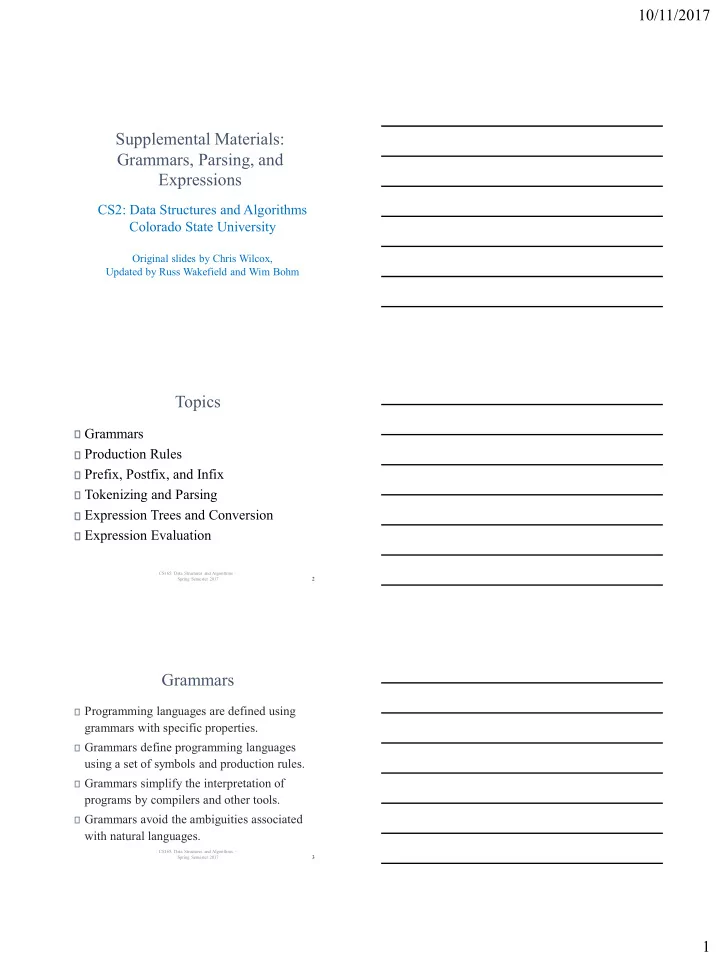
10/11/2017 Supplemental Materials: Grammars, Parsing, and Expressions CS2: Data Structures and Algorithms Colorado State University Original slides by Chris Wilcox, Updated by Russ Wakefield and Wim Bohm Topics Grammars Production Rules


slide-1
SLIDE 1

10/11/2017 1

Supplemental Materials: Grammars, Parsing, and Expressions

CS2: Data Structures and Algorithms Colorado State University

Original slides by Chris Wilcox, Updated by Russ Wakefield and Wim Bohm

Topics

Grammars Production Rules Prefix, Postfix, and Infix Tokenizing and Parsing Expression Trees and Conversion Expression Evaluation

CS165: Data Structures and Algorithms – Spring Semester 2017

2

Grammars

Programming languages are defined using grammars with specific properties. Grammars define programming languages using a set of symbols and production rules. Grammars simplify the interpretation of programs by compilers and other tools. Grammars avoid the ambiguities associated with natural languages.

CS165: Data Structures and Algorithms – Spring Semester 2017

3

slide-2
SLIDE 2

10/11/2017 2

Definitions

Grammar: the system and structure of a language. Syntax: A set of rules for arranging and combining language elements (form):

– For example, the syntax of an assignment statement is variable = expression;

Semantics: The meaning of the language elements and constructs (function):

– The semantics of an assignment statement is evaluate the expression and store the result in the variable.

CS165: Data Structures and Algorithms – Spring Semester 2017

4

Ambiguity

Natural Language: “British left waffles on Falklands.”

Did the British leave waffles behind, or is there waffling by the British political left wing?

“Brave men run in my family.”

Do the brave men in his family run, or are there many brave men in his ancestry?

CS165: Data Structures and Algorithms – Spring Semester 2017

5

Language and Grammar

A language is a set of sentences: strings of terminals -the words while, (, x < …. Grammar defines these, using productions

LHS ::= RHS Read this as the LHS is defined by RHS

6

CS165: Data Structures and Algorithms – Spring Semester 2017

slide-3
SLIDE 3

10/11/2017 3

Language and Grammar

LHS ::= RHS

RHS is a string of terminals and non- terminals

  • Terminals are the words of the language

– Non-terminals are concepts in the language – Non-terminals include java statements

A sequence of productions creates a sentence when no non-terminal is left

7

CS165: Data Structures and Algorithms – Spring Semester 2017

Production Rules (Example)

Non-terminals produce strings of terminals. For example, non-terminal S produces certain valid strings of a’s and b’s.

– S ::= aSb – S::= ba

Valid:

ba, abab, aababb, aaababbb, ... or anbabn | n ≥ 0)

Invalid:

a, b, ab, abb, aba, bab, ... and everything else!

CS165: Data Structures and Algorithms – Spring Semester 2017

8

Example productions

S ::= aSb or S ::= ba S  ba S  aSb  abab S  aSb  aaSbb  aababb S  anbabn | n ≥ 0

9

CS165: Data Structures and Algorithms – Spring Semester 2017

slide-4
SLIDE 4

10/11/2017 4

Production Rules and Symbols

::= means equivalence, is defined by <symbol> means needs further expansion Concatenation – x y denotes x followed by y Choice – x | y | z means one of x or y or z Repitition – * means 0 or more occurences – + means 1 or more occurences Block Structure: recursive definition – A statement can have statements inside it

CS165: Data Structures and Algorithms – Spring Semester 2017

10

Production Rules (Java Identifiers)

CS165: Data Structures and Algorithms – Spring Semester 2017

11

<identifier> ::= <initial> (<initial> | <digits>)* <initial> ::= <letter> | _ | $ <letter> ::= a | b | c | ... z | A | B | C | ... Z <digit> ::= 0 | 1 | 2 | ... 9

Valid:

myInt0, _myChar1, $myFloat2, _$_, _12345, ...

Invalid:

123456, 123myIdent, %Hello, my-Integer, ...

<Statement> ::= <Assignment> | <ForStatement> | … <ForStatement> ::= for (<ForInit> ; <Expression> ; <ForUpdate>) <Statement> <Assignment> ::= <LeftHand> <AssignmentOp> <Expression> <AssignmentOp> ::= = | *= | /= | %= | += …….

Production Rules (Other Java)

CS165: Data Structures and Algorithms – Spring Semester 2017

12

slide-5
SLIDE 5

10/11/2017 5

An alternative definition mechanism

– Simpler because non-recursive

Syntax used to define strings, for example by the Linux ‘grep’ command. Many other usages, for example Java String split and many other methods accept them. Two ways to interpret, 1) as a pattern matcher, or 2) as a specification of a syntax.

Regular Expressions

CS165: Data Structures and Algorithms – Spring Semester 2017

13

Regex Cheatsheet (1)

CS165: Data Structures and Algorithms – Spring Semester 2017

14

Symbol Meaning Example * Match zero, one or more of previous Ah* matches "A", "Ah", "Ahhhhh" ? Match zero or one of previous Ah? matches "A" or "Ah" + Match one or more of previous Ah+ matches "Ah", "Ahh" not "A" \ Used to escape a special character Hungry\? matches "Hungry?" . Wildcard, matches any character do.* matches "dog", "door", "dot" [ ] Matches a range of characters [a-zA-Z] matches ASCII a-z or A-Z [^0-9] matches any except 0-9.

Regex Cheatsheet (2)

CS165: Data Structures and Algorithms – Spring Semester 2017

15

Symbol Meaning Example | Matches previous or next character or group (Mon)|(Tues)day matches "Monday" or "Tuesday" { } Matches a specified number

  • f occurrences of previous

[0-9]{3} matches "315" but not "31" [0-9]{2,4} matches "12", "123", and "1234" ^ Matches beginning of a string. ^http matches strings that begin with http, such as a url. $ Matches the end of a string. ing$ matches "exciting" but not "ingenious"

slide-6
SLIDE 6

10/11/2017 6

[0-9a-f]+ matches hexadecimal, e.g. ab, 1234, cdef, a0f6, 66cd, ffff, 456affff. [0-9a-zA-Z] matches alphanumeric strings with a mixture of digits and letters [0-9]{3}-[0-9]{2}-[0-9]{4} matches social security numbers, e.g. 166-11-4433 [a-z]+@([a-z]+\.)+(edu|com) matches emails, e.g. whoever@gmail.com

Regex Examples (1)

CS165: Data Structures and Algorithms – Spring Semester 2017

16

b[aeiou]+t matches bat, bet, but, and also boot, beet, beat,etc. [$_A-Za-z][$_A-Za-z0-9]* matches Java identifiers, e.g. x, myInteger0, _ident, a01 [A-Z][a-z]* matches any capitalized word, i.e. a capital followed by lowercase letters .u.u.u. uses the wildcard to match any letter, e.g. cumulus

Regex Examples (2)

CS165: Data Structures and Algorithms – Spring Semester 2017

17

Infix Expressions

Infix notation places each operator between two operands for binary operators: This is the customary way we write math formulas in programming languages. However, we need to specify an order of evaluation in order to get the correct answer.

CS165: Data Structures and Algorithms – Spring Semester 2017

18

A * x * x + B * x + C; // quadratic equation

slide-7
SLIDE 7

10/11/2017 7

The evaluation order you may have learned in math class is named PEMDAS: Also need to account for unary, logical and relational operators, pre/post increment, etc. Java has a similar but not identical order of evaluation, as shown on the next slide.

parentheses → exponents → multiplication → division → addition → subtraction

Evaluation Order

19

CS165: Data Structures and Algorithms – Spring Semester 2017

Reminder: Java Precedence

parentheses ( ) unary ++ -- + - ~ ! multiplicative * / % additive + - shift << >> relational < > <= >= instanceof equality == != bitwise AND & bitwise exclusive OR ^ bitwise inclusive OR | logical AND && logical OR || ternary ? : assignment = += -= *= /= %= &= ^= |= <<= >>= >>>=

20

CS165: Data Structures and Algorithms – Spring Semester 2017

Associativity

Operators with same precedence:

* /

and

+ -

are evaluated left to right: 2-3-4 = (2-3)-4

21

CS165: Data Structures and Algorithms – Spring Semester 2017

slide-8
SLIDE 8

10/11/2017 8

Infix Example

How a Java infix expression is evaluated, parentheses added to show association.

z = (y * (6 / x) + (w * 4 / v)) – 2; z = (y * (6 / x) + (w * 4 / v)) – 2; // parentheses z = (y * (6 / x)) + (w * 4 / v) – 2; // multiplication (L-R) z = (y * (6 / x)) + ((w * 4) / v) – 2; // multiplication (L-R) z = (y * (6 / x)) + ((w * 4) / v) – 2; // division (L-R) z = ((y * (6 / x)) + ((w * 4) / v))) – 2; // addition (L-R) z = ((y * (6 / x)) + ((w * 4) / v))) – 2; // subtraction (L-R) z = ((y * (6 / x)) + ((w * 4) / v))) – 2; // assignment

CS165: Data Structures and Algorithms – Spring Semester 2017

22

Postfix Expressions

Postfix notation places the operator after two

  • perands for binary operators:

Also called reverse polish notation, just like a vintage Hewlett-Packard calculator! No need for parentheses, because the evaluation order is unambiguous.

CS165: Data Structures and Algorithms – Spring Semester 2017

23

A * x * x + B * x + C // infix version A x * x * B x * + C + // postfix version

Postfix Example

Evaluating the same expression as postfix, must search left to right for operators:

(y * (6 / x) + (w * 4 / v)) – 2 // original infix y 6 x / * w 4 * v / + 2 - // postfix translation (y (6 x /) *) w 4 * v / + 2 - ((y (6 x /) *) w 4 * v / + 2 - (y (6 x /) *) (w 4 *) v / + 2 - (y (6 x /) *) ((w 4 *) v /) + 2 – ((y (6 x /) *) ((w 4 *) v /) +) 2 - (((y (6 x /) *) ((w 4 *) v /) +) 2 -)

CS165: Data Structures and Algorithms – Spring Semester 2017

24

slide-9
SLIDE 9

10/11/2017 9

Calculator

Buttons you would push on a normal calculator: 12, *, 10, =, +, (, 6, *, 6, ) // = 156 Buttons you would push on my vintage calculator: 12↵, 10, *, 6 ↵, 6, *, + // = 156 Note the implicit use of a stack (↵), and the fact that no parentheses are needed.

CS165: Data Structures and Algorithms – Spring Semester 2017

25

(12 * 10) + (6 * 6)

Calculator

CS165: Data Structures and Algorithms – Spring Semester 2017

26

Prefix Expressions

Prefix notation places the operator before two operands for binary operators: Also called polish notation, because first documented by polish mathematician. No need for parentheses, because the evaluation order is unambiguous.

CS165: Data Structures and Algorithms – Spring Semester 2017

27

A * x * x + B * x + C // infix version + + * * A x x * B x C // prefix version

slide-10
SLIDE 10

10/11/2017 10

Formatting

Free-format language: program is a sequence of tokens, position of tokens unimportant (C, Java) Fixed-format language: indentation and position

  • f tokens on page is significant (Python)

Case-sensitive languages (C, C++, Java):

– myInteger differs from MyInteger and MYINTEGER

Case-insensitive languages (Fortran, Pascal):

– identifiers and reserved words!

CS165: Data Structures and Algorithms – Spring Semester 2017

28

Tokens

Tokens are the building blocks of a programming language:

– keywords, identifiers, numbers, punctuation

The initial phase of the compiler splits up the character stream into a sequence of tokens. Tokens themselves are defined by regular expressions

CS165: Data Structures and Algorithms – Spring Semester 2017

29

Expression Trees

Parsing decomposes source code and builds a representation that represents its structure. Parsing generally results in a data structure such as a tree:

CS165: Data Structures and Algorithms – Spring Semester 2017

30

(A * x * x) + (B * x) + C A x * x * B x * + C + // postfix version

+ C + * * * x B x x A

slide-11
SLIDE 11

10/11/2017 11

Tokenizing

Think about some of the difficulties with respect to tokenizing:

– How do identify reserved word and identifiers? – How do you extract special characters? – For example, take the following expression: – Straightforward parsing with Scanner yields:

CS165: Data Structures and Algorithms – Spring Semester 2017

31

int y = (A * x * x) + (B * x) + C; [int, y, =, (,A, *, x, *, x,), +, (,B, *, x), +, C,;]

Infix, Postfix, Prefix Conversion

CS165: Data Structures and Algorithms – Spring Semester 2017

32

Infix Postfix Prefix Notes A * B + C / D A B * C D / + + * A B / C D multiply A and B, divide C by D, add the results A * (B + C) / D A B C + * D / / * A + B C D add B and C, multiply by A, divide by D A * (B + C / D) A B C D / + * * A + B / C D divide C by D, add B, multiply by A

Expression Trees

CS165: Data Structures and Algorithms – Spring Semester 2017

33

Infix Postfix Prefix

( (A * B) + (C / D) ) ( (A B *) (C D /) +) (+ (* A B) (/ C D) ) ((A * (B + C) ) / D) ( (A (B C +) *) D /) (/ (* A (+ B C) ) D) (A * (B + (C / D) ) ) (A (B (C D /) +) *) (* A (+ B (/ C D) ) )

slide-12
SLIDE 12

10/11/2017 12

What’s Next?

However, we will need stacks, which we have studied, and trees, which we have not: Question: Does the Java Collection framework have support for binary trees? If not, why not? Answer: No, you have to build your own trees using the same techniques as with your linked list.

CS165: Data Structures and Algorithms – Spring Semester 2017

34