Exploring the ACS Guidelines and Expectations for the First Two - - PDF document

exploring the acs guidelines and expectations for the
SMART_READER_LITE
LIVE PREVIEW

Exploring the ACS Guidelines and Expectations for the First Two - - PDF document

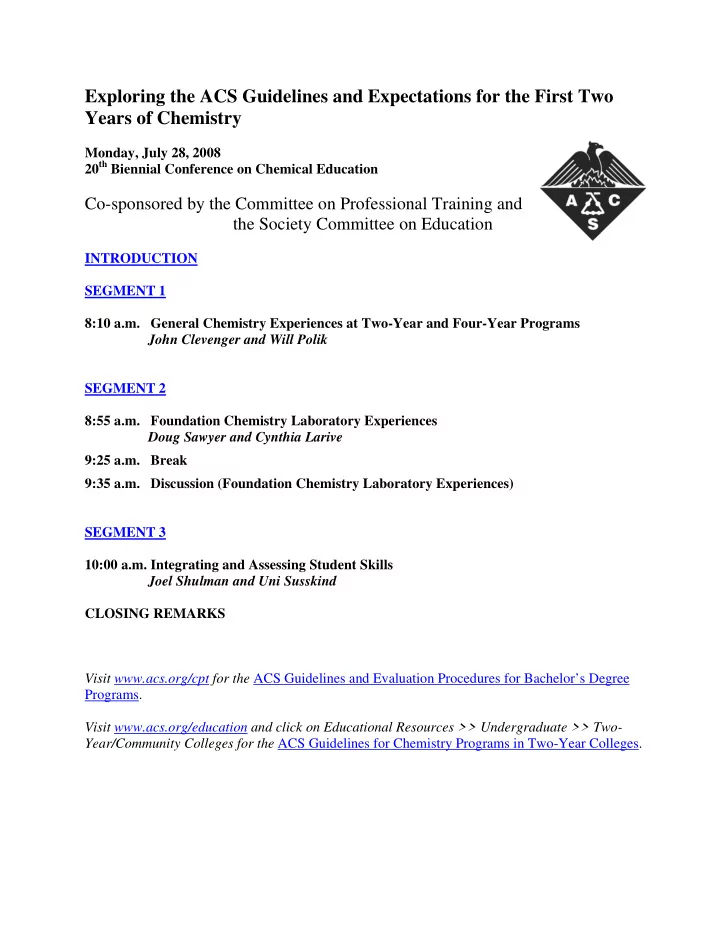
Exploring the ACS Guidelines and Expectations for the First Two Years of Chemistry Monday, July 28, 2008 20 th Biennial Conference on Chemical Education Co-sponsored by the Committee on Professional Training and the Society Committee on


slide-1
SLIDE 1

Exploring the ACS Guidelines and Expectations for the First Two Years of Chemistry

Monday, July 28, 2008 20th Biennial Conference on Chemical Education

Co-sponsored by the Committee on Professional Training and the Society Committee on Education

INTRODUCTION SEGMENT 1 8:10 a.m. General Chemistry Experiences at Two-Year and Four-Year Programs John Clevenger and Will Polik SEGMENT 2 8:55 a.m. Foundation Chemistry Laboratory Experiences Doug Sawyer and Cynthia Larive 9:25 a.m. Break 9:35 a.m. Discussion (Foundation Chemistry Laboratory Experiences) SEGMENT 3 10:00 a.m. Integrating and Assessing Student Skills Joel Shulman and Uni Susskind CLOSING REMARKS Visit www.acs.org/cpt for the ACS Guidelines and Evaluation Procedures for Bachelor’s Degree Programs. Visit www.acs.org/education and click on Educational Resources >> Undergraduate >> Two- Year/Community Colleges for the ACS Guidelines for Chemistry Programs in Two-Year Colleges.

slide-2
SLIDE 2

American Chemical Society American Chemical Society

Exploring the ACS Guidelines and Expectations for the First Two Years of Chemistry

Committee on Professional Training (CPT) Society Committee on Education (SOCED)

slide-3
SLIDE 3

American Chemical Society Biennial Conference on Chemical Education July 28, 2008 2 American Chemical Society 2

Objectives

  • Sharing revisions

– in place for four-year programs – under development for two-year programs

  • Exploring opportunities

– improving the first two-years of chemistry – facilitating student transfer

  • Obtaining input

– two-year guidelines revisions – guidelines supplements – future programming

slide-4
SLIDE 4

American Chemical Society Biennial Conference on Chemical Education July 28, 2008 3 American Chemical Society 3

Participants

  • Are you on the faculty in a…

– Bachelor’s degree program? – two-year program?

  • Do you teach…

– general chemistry? – organic chemistry? – analytical chemistry? – physical chemistry? – inorganic chemistry? – biochemistry?

slide-5
SLIDE 5

American Chemical Society Biennial Conference on Chemical Education July 28, 2008 4 American Chemical Society 4

Committee on Professional Training

  • Planned for major revision of ACS Guidelines and Evaluation

Procedures for Bachelor’s Degree Programs in 2004

  • Sought broad input from chemistry community during 2005
  • Proposed revisions and sought feedback in 2006
  • Developed draft guidelines and sought feedback in 2007
  • Released new ACS Guidelines in March 2008
slide-6
SLIDE 6

American Chemical Society Biennial Conference on Chemical Education July 28, 2008 5 American Chemical Society 5

Goals of the Revision

The revision of the ACS Guidelines and Evaluation Procedures for Bachelor’s Degree Programs sought to…

  • Simplify the ACS guidelines and procedures for approval of

chemistry programs

  • Provide greater flexibility to approved departments for designing

certified degrees

  • Encourage innovation and improvement in curriculum and

pedagogy by approved departments

  • Define faculty and infrastructure attributes that support excellent

undergraduate chemistry programs

slide-7
SLIDE 7

American Chemical Society Biennial Conference on Chemical Education July 28, 2008 6 American Chemical Society 6

Revisions to Guidelines for Four- Year Programs

New features and language:

  • Foundation courses (equivalent to 5 one-semester courses)
  • In-depth courses (equivalent to 4 one-semester courses)
  • Laboratory requirement (400 hours beyond general chemistry)
  • Student skills
  • Program self-evaluation
slide-8
SLIDE 8

American Chemical Society Biennial Conference on Chemical Education July 28, 2008 7 American Chemical Society 7

Society Committee on Education

  • Formed task force to consider revisions to the ACS Guidelines for

Chemistry Programs in Two-year Colleges in Spring 2005

  • Conducted an informal study in Fall 2005
  • Solicited input on how best to align guidelines
  • Solicited feedback on goals of revision in Winter 2007/08
  • Solicited feedback on proposed changes in Spring 2008
  • Will begin soliciting feedback on draft revisions in Fall 2008
  • Will release new guidelines in Spring 2009
slide-9
SLIDE 9

American Chemical Society Biennial Conference on Chemical Education July 28, 2008 8 American Chemical Society 8

Goals of the Revision

The revision of the ACS Guidelines for Chemistry Programs in Two- Year Colleges seeks to…

  • Reflect changes in pedagogy, technology, and accountability
  • Facilitate student transfer

– by aligning with the new ACS Guidelines and Evaluation Procedures for Bachelor’s Degree Programs (2008) – by calling for communicating with receiving institutions

  • Provide a more useful resource for strengthening programs

– by offering guidance for ongoing curricular change – by offering guidance for improving the working environment

slide-10
SLIDE 10

American Chemical Society Biennial Conference on Chemical Education July 28, 2008 9 American Chemical Society 9

Proposed Revisions to Guidelines for Two-Year Programs

  • Alignment of sections with guidelines for Bachelor’s programs

(order and content, as appropriate)

  • Inclusion of sections on

– transfer students – undergraduate research – student skills – student mentoring and advising – program self-evaluation – partnerships

  • Emphasis on professional development
  • Vision of excellence
slide-11
SLIDE 11

American Chemical Society Biennial Conference on Chemical Education July 28, 2008 10 American Chemical Society 10

Symposium Schedule

8:00 a.m. Opening remarks 8:10 a.m. General Chemistry Experiences at Two-Year and Four- Year Programs John Clevenger and Will Polik 8:55 a.m. Foundation Chemistry Laboratory Experiences Doug Sawyer and Cynthia Larive 9:25 a.m. Break 9:35 a.m. Discussion (Foundation Chemistry Laboratory Experiences) 10:00 a.m. Integrating and Assessing Student Skills Joel Shulman and Uni Susskind 10:45 a.m. Closing remarks

slide-12
SLIDE 12

American Chemical Society Biennial Conference on Chemical Education July 28, 2008 11 American Chemical Society 11

Related Symposia

Monday, July 28 2:00 p.m. S29: New ACS Guidelines for Bachelor's Degree Programs: Changes in Requirements and Procedures Persimmon Room 2:00 p.m. S32: Using the ACS Guidelines for Chemistry Programs in Two-Year Colleges to Enhance Chemistry Programs and to Facilitate Student Transitions Hoosier Room

slide-13
SLIDE 13

American Chemical Society American Chemical Society

General Chemistry Experiences at Two-Year and Four-Year Programs

Will Polik

Professor, Hope College Chair, Committee on Professional Training

John Clevenger

Emeritus Professor, Truckee Meadows Community College Chair, Society Committee on Education (SOCED) Task Force on the ACS Guidelines for Chemistry Programs in Two-Year Colleges

slide-14
SLIDE 14

American Chemical Society Biennial Conference on Chemical Education July 28, 2008 13 American Chemical Society 13

Objectives

  • Sharing revisions related to general chemistry

– in place for four-year programs – under development for two-year programs

  • Exploring opportunities

– improving general chemistry – facilitating student transfer

  • Obtaining input

– Key concepts and laboratory skills for general chemistry – Strategies for articulation and transfer of general chemistry

slide-15
SLIDE 15

American Chemical Society Biennial Conference on Chemical Education July 28, 2008 14 American Chemical Society 14

Definition

  • General chemistry is the chemistry course for

science and engineering majors

slide-16
SLIDE 16

American Chemical Society Biennial Conference on Chemical Education July 28, 2008 15 American Chemical Society 15

General Chemistry…

according to the ACS Guidelines and Evaluation Procedures for Bachelor’s Degree Programs

  • Serves the needs of a varied audience – general public, science

majors, and professional chemists – Provides common background – Allows for maturation of students in chemical topics, mathematical skills and laboratory skills

slide-17
SLIDE 17

American Chemical Society Biennial Conference on Chemical Education July 28, 2008 16 American Chemical Society 16

General Chemistry…

according to the ACS Guidelines and Evaluation Procedures for Bachelor’s Degree Programs

  • Serves the needs of professional chemists

– Ensures knowledge of basic chemical concepts and competency in basic laboratory skills – Prepares for foundation course work

  • Analytical chemistry
  • Biochemistry
  • Inorganic chemistry
  • Organic chemistry
  • Physical chemistry
slide-18
SLIDE 18

American Chemical Society Biennial Conference on Chemical Education July 28, 2008 17 American Chemical Society 17

General Chemistry…

according to the ACS Guidelines and Evaluation Procedures for Bachelor’s Degree Programs, ensures that students know and have

  • Basic chemical concepts

– Stoichiometry, states of matter, atomic structure, molecular structure and bonding, thermodynamics, equilibria, and kinetics

  • Basic laboratory skills

– Safe practices, keeping a notebook, use of electronic balances and volumetric glassware, preparation of solutions, chemical measurements using pH electrodes and spectrophotometers, data analysis, and report writing

slide-19
SLIDE 19

American Chemical Society Biennial Conference on Chemical Education July 28, 2008 18 American Chemical Society 18

General Chemistry Courses…

according to the ACS Guidelines and Evaluation Procedures for Bachelor’s Degree Programs

  • Reflect the diversity of institutions and students
  • Could range from a full-year course, to a one-semester course, to

waiving the course requirement for very well-prepared students

slide-20
SLIDE 20

American Chemical Society Biennial Conference on Chemical Education July 28, 2008 19 American Chemical Society 19

Requirements and Characteristics

  • Are not described by the ACS Guidelines and Evaluation

Procedures for Bachelor’s Degree Programs

  • Should be defined by institutions
  • Should be coordinated with chemistry programs that are a

significant source of transfer students via regular communication

slide-21
SLIDE 21

American Chemical Society Biennial Conference on Chemical Education July 28, 2008 20 American Chemical Society 20

Two-year College Curricula…

according to the draft revisions of the ACS Guidelines for Chemistry Programs at Two-Year Colleges

  • Are driven by the needs of students and the mission of the

institution

  • Reflect two specific areas of need:

– Students who require general education in scientific method, but do not require science for their ultimate academic and career goals – Students for whom chemistry is part of their career path

slide-22
SLIDE 22

American Chemical Society Biennial Conference on Chemical Education July 28, 2008 21 American Chemical Society 21

General Chemistry…

according to the draft revisions of the ACS Guidelines for Chemistry Programs at Two-Year Colleges

  • Provides a common background in basic chemical concepts
  • Develops competency in basic laboratory skills
  • Leads to common outcomes
slide-23
SLIDE 23

American Chemical Society Biennial Conference on Chemical Education July 28, 2008 22 American Chemical Society 22

Basic Chemical Concepts…

according to the draft revisions of the ACS Guidelines for Chemistry Programs at Two-Year Colleges, include

  • Stoichiometry
  • States of matter
  • Atomic structure
  • Molecular structure and bonding
  • Thermochemistry
  • Equilibria
  • Kinetics

Note: these are the same concepts included in the ACS Guidelines and Evaluation Procedures for Bachelor’s Degree Programs

slide-24
SLIDE 24

American Chemical Society Biennial Conference on Chemical Education July 28, 2008 23 American Chemical Society 23

Basic Laboratory Skills…

according to the draft revisions of the ACS Guidelines for Chemistry Programs at Two-Year Colleges, include

  • Laboratory safety
  • Keeping a notebook
  • Use of electronic balances and volumetric glassware
  • Preparation of solutions
  • Chemical measurements using pH electrodes and

spectrophotometers

  • Data analysis
  • Report writing

Note: these are the same skills included in the ACS Guidelines and Evaluation Procedures for Bachelor’s Degree Programs

slide-25
SLIDE 25

American Chemical Society Biennial Conference on Chemical Education July 28, 2008 24 American Chemical Society 24

Common Outcomes…

according to the draft revisions of the ACS Guidelines for Chemistry Programs at Two-Year Colleges, include

  • Basic chemical concepts
  • Strength in quantitative problem solving
  • Competency in basic laboratory skills
  • Preparation for higher-level course work
  • Maturation of students knowledge of chemistry
  • Data analysis
  • Report writing
slide-26
SLIDE 26

American Chemical Society Biennial Conference on Chemical Education July 28, 2008 25 American Chemical Society 25

Communications with receiving institutions…

according to the draft revisions of the ACS Guidelines for Chemistry Programs at Two-Year Colleges

  • Ensure that curricula of both institutions are coordinated
  • Convey educational background and academic goals of students
  • Focus efforts on assisting students with successful transitions

– Students are better served by program articulation than course articulation – Students need to be counseled to take courses in patterns comparable to those at receiving institutions

  • Chemistry
  • Math and physics
  • General education
slide-27
SLIDE 27

American Chemical Society Biennial Conference on Chemical Education July 28, 2008 26 American Chemical Society 26

Breakout Session

1. Assemble into groups of 4-6 people and introduce yourselves 2. Select a Time-Keeper and a Secretary for your group Time-Keeper: Keep group on-task to produce an answer in 15 minutes Secretary: Record group conclusions and report out one key point 3. Based on the symposium talks and your collective experience, answer the selected question 4. For the first 15 minutes, the Secretary will record key points 5. During the final 15 minutes, the Secretary will proceed to a microphone and report out ONE key point (that has not already been reported out by another group) 6. Turn in the sheet at the end of reporting out

slide-28
SLIDE 28

American Chemical Society Biennial Conference on Chemical Education July 28, 2008 27 American Chemical Society 27

Breakout Questions

Given the variety of students in and approaches to general chemistry, how do faculty… a) Ensure that students are prepared for foundation course work? b) Facilitate the articulation and transfer of general chemistry courses?

slide-29
SLIDE 29

American Chemical Society American Chemical Society

The Foundation Laboratory Experience

Doug Sawyer

Professor and Math / Science Division Chair, Scottsdale Community College Society Committee on Education (SOCED) Task Force on the ACS Guidelines for Chemistry Programs in Two-Year Colleges

Cindy Larive

Professor, University of California – Riverside Vice Chair, Committee on Professional Training

slide-30
SLIDE 30

American Chemical Society Biennial Conference on Chemical Education July 28, 2008 29

Foundation Chemistry Courses

  • Provide a common background for certified chemistry graduates

across the 5 areas of chemistry: Analytical, Biochemistry, Inorganic, Organic and Physical Chemistry

  • Students should have coverage equivalent to a 3-credit semester

course in each area (or 8 quarters total)

  • Guidelines provide flexibility in the mechanism for foundation

content coverage – The first course in a “standard” two-semester course sequence; students take the second semester as an in-depth course – A one-semester foundation course covering the breadth of topics in an area, whether or not it is followed by an in-depth course in that area

slide-31
SLIDE 31

American Chemical Society Biennial Conference on Chemical Education July 28, 2008 30

Why have a laboratory?

  • Students acquire essential chemistry skills
  • Important concepts reinforced
  • Students become familiar with common laboratory equipment and

instrumentation

  • Vehicle for enhancing other skills such as team work
slide-32
SLIDE 32

American Chemical Society Biennial Conference on Chemical Education July 28, 2008 31

Laboratory Experience

  • ACS Guidelines require 400 hours beyond introductory chemistry
  • Undergraduate research can count for 180 hours, if a comprehensive

written report is prepared

  • Lab course work should cover 4 of the 5 foundation areas
  • Can be distributed between the foundation and in-depth levels

Should include: – Synthesis of molecules – Measurement of chemical properties, structures, and phenomena – Hands-on experience with modern instrumentation – Computational data analysis and modeling

slide-33
SLIDE 33

American Chemical Society Biennial Conference on Chemical Education July 28, 2008 32

Small Group Activity

  • Pick a laboratory experience

– Organic, Analytical, Physical, Inorganic, Biochemistry

  • List the minimum skills students should acquire
  • List the concepts that must be reinforced with the lab experience
  • List the associated activities
  • List the minimum required equipment
slide-34
SLIDE 34

American Chemical Society Biennial Conference on Chemical Education July 28, 2008 33

Foundation Laboratory

Minimum Skills Minimum Concepts Laboratory Activities Minimum Equipment

slide-35
SLIDE 35

American Chemical Society Biennial Conference on Chemical Education July 28, 2008 34

Large Group Activity

For each spreadsheet:

  • Are any essential skills or concepts missing?
  • Could any of the activities be accomplished using computer

simulations?

  • Is the equipment list complete? Could anything be omitted?
slide-36
SLIDE 36

American Chemical Society American Chemical Society

Integrating and Assessing Student Skills

Joel Shulman

Adjunct Professor, University of Cincinnati Committee on Professional Training

Uni Susskind

Emerita Professor, Oakland Community College Society Committee on Education (SOCED) Task Force on the ACS Guidelines for Chemistry Programs in Two-Year Colleges

slide-37
SLIDE 37

American Chemical Society Biennial Conference on Chemical Education July 28, 2008 36 American Chemical Society

What do we mean by “student skills?”

Can be termed:

  • Process skills
  • Soft skills
  • Employability skills
  • Non technical professional competencies

Characteristics:

  • Generic and transferable
  • Marketable and lifelong
  • Wide applications that go beyond course content alone
slide-38
SLIDE 38

American Chemical Society Biennial Conference on Chemical Education July 28, 2008 37 American Chemical Society

Examples of Student Skills and Abilities

  • Laboratory safety
  • Chemical literature skills
  • Communication, both oral and written
  • Team skills
  • Professional ethics and social responsibility
slide-39
SLIDE 39

American Chemical Society Biennial Conference on Chemical Education July 28, 2008 38 American Chemical Society

What is new in the ACS Guidelines for Bachelor’s Degree Programs?

The Committee on Professional Training will now look at

  • Whether chemistry programs are developing these skills in their

graduates

  • How they are doing this
  • How they assess success in doing it

These skills will also be included in the proposed revisions to the Guidelines for Chemistry Programs in Two-Year Colleges

slide-40
SLIDE 40

American Chemical Society Biennial Conference on Chemical Education July 28, 2008 39 American Chemical Society

Laboratory Safety Skills: A Lifelong Impact

HAZARDS occur daily!

Lab safety teaches students about:

  • Minimizing hazard risks and

what to do when they occur

  • How to use prudent practices and

protective equipment

Ultimately, lab safety skills teach students to:

  • Create a safer/healthier environment for all
  • Live safer, healthier, longer lives
slide-41
SLIDE 41

American Chemical Society Biennial Conference on Chemical Education July 28, 2008 40 American Chemical Society

What do students need to demonstrate in a 4-yr program? In a 2-year program?

LABORATORY SAFETY

“Students [should] understand the concepts of safe laboratory practices and how to apply them.”

  • Begin safety awareness in the first lab course
  • Understand responsible handling, storing and disposal

techniques

  • Comply with safety regulations
  • Understand and use MSDSs
  • Recognize and minimize potential chemical

and physical hazards in the laboratory

slide-42
SLIDE 42

American Chemical Society Biennial Conference on Chemical Education July 28, 2008 41 American Chemical Society

Library and Information Literacy

“Set of abilities requiring individuals to recognize when information is needed, and have the ability to locate, evaluate, and use effectively the needed information.”

American Library Association (ALA)

slide-43
SLIDE 43

American Chemical Society Biennial Conference on Chemical Education July 28, 2008 42 American Chemical Society

What do students need to demonstrate in a 4-year program?

CHEMICAL LITERATURE SKILLS

“Students should learn how to retrieve specific chemical information from the chemical literature.”

  • Determine and access needed information
  • Retrieve specific information

– Journal articles, reviews, handbooks, etc. – Use of Chemical Abstracts (when appropriate)

  • Use both library and electronic sources
  • Evaluate technical articles critically
slide-44
SLIDE 44

American Chemical Society Biennial Conference on Chemical Education July 28, 2008 43 American Chemical Society

What do science-major students need to demonstrate in a 2-year program?

CHEMICAL LITERATURE SKILLS

  • A familiarity of the organization of chemistry books in the library

and how to use library tools and library services

  • An understanding of the content of standard reference works,

e.g., Handbook of Chemistry and Physics, Lange’s Handbook

  • f Chemistry, Merck Index
  • A knowledge of current periodicals and journals
  • Techniques of manual and on-line literature searching

Students usually partner with librarian or faculty member to learn the elements of information literacy.

slide-45
SLIDE 45

American Chemical Society Biennial Conference on Chemical Education July 28, 2008 44 American Chemical Society

Written and Oral Communication

  • “Effective communication is vital to a scientist.”
  • Industry, where 46% of new bachelor’s graduates go,* has

identified “outages,” especially – Communication skills – Team skills

* C&EN, June 2, 2008, p. 52

slide-46
SLIDE 46

American Chemical Society Biennial Conference on Chemical Education July 28, 2008 45 American Chemical Society

What do students need to demonstrate in a 4-year program?

COMMUNICATION

  • Present information in a clear and organized manner
  • Use appropriate technology (e.g., poster preparation,

PowerPoint, word processing, chemical drawing programs)

  • Write well-organized and concise reports in a scientifically

appropriate style

  • Respond effectively to questions in an
  • ral presentation
slide-47
SLIDE 47

American Chemical Society Biennial Conference on Chemical Education July 28, 2008 46 American Chemical Society

What do students need to demonstrate in a 2-year program?

COMMUNICATION

Show competency in writing and oral presentations by:

  • Being concise; using simple words and short sentences
  • Following rules of grammar and spelling correctly
  • Using your own words; or quoting verbatim using quotation

marks and acknowledging your source.

  • Using words correctly; avoiding jargon
slide-48
SLIDE 48

American Chemical Society Biennial Conference on Chemical Education July 28, 2008 47 American Chemical Society

“The ability to work in multidisciplinary teams is essential for a well-educated scientist.”

  • Enhances student learning
  • Is social, less competitive—not a solo race
  • Allows for sharing of ideas; increases listening, learning, and

communication skills

  • Develops cooperation and reciprocity
  • Uses active/interactive learning techniques
  • Stimulates interpersonal collaboration
  • Develops people skills

Industry uses the team approach to solve problems

Team Building

slide-49
SLIDE 49

American Chemical Society Biennial Conference on Chemical Education July 28, 2008 48 American Chemical Society

What do students need to demonstrate in a 4-year program?

TEAM SKILLS

In a four-year program students need to:

  • Work effectively in a group to solve scientific problems
  • Be able to lead portions of an activity and be effective

followers

  • Interact productively with a diverse group of peers
slide-50
SLIDE 50

American Chemical Society Biennial Conference on Chemical Education July 28, 2008 49 American Chemical Society

What do students need to demonstrate in a 2-year program?

TEAM SKILLS

In a two-year program students should be able to:

  • Work together to complete a specific task: e.g., perform a lab

experiment, write a report, prepare a position paper. Student’s performance can be assessed individually or as a group.

  • Be a productive member of a study team to promote one

another’s learning and success.

slide-51
SLIDE 51

American Chemical Society Biennial Conference on Chemical Education July 28, 2008 50 American Chemical Society

Ethics

  • Chemistry, like any discipline, has a social structure with a code of

practices that govern acceptable/unacceptable behaviors.

  • Progress in chemistry, as in all sciences, relies on complete

honesty, openness, trustworthiness, and reproducibility of experimental results.

  • ACS has recognized the importance of ethics in chemistry by

– Adopting an ACS Code of Conduct – Constituting a new Council Committee on Ethics

slide-52
SLIDE 52

American Chemical Society Biennial Conference on Chemical Education July 28, 2008 51 American Chemical Society

What do students need to demonstrate?

PROFESSIONAL ETHICS & SOCIAL RESPONSIBILITY

“Ethics should be an intentional part of the instruction in a chemistry program.”

  • Display high personal standards and integrity
  • Demonstrate an awareness of contemporary issues related to

chemistry

  • Recognize applications of chemistry in industrial,

governmental, and/or societal settings

slide-53
SLIDE 53

American Chemical Society Biennial Conference on Chemical Education July 28, 2008 52 American Chemical Society

How can chemistry programs impart and assess these skills and abilities?

Incorporate them into existing courses throughout the curriculum

  • Design a culture of safety into all lab courses
  • Consciously design team projects
  • Require some use of literature search in early chemistry

courses

  • Include writing and speaking opportunities throughout the

curriculum

  • Emphasize the absolute importance of ethics. As role models,

faculty should exemplify ethical conduct in all their professional activities.

slide-54
SLIDE 54

American Chemical Society Biennial Conference on Chemical Education July 28, 2008 53 American Chemical Society

  • Develop separate “mini” courses

– Safety – Writing and/or use of the literature – Ethics – Capstone seminars

  • Use advanced courses to assess skills

– A senior lab course – Poster session based on project, with literature component – Undergraduate research: a unique opportunity to develop and assess many of the student skills

  • Team skills
  • Written and oral reports
  • Critical use of literature

How can chemistry programs impart and assess these skills and abilities?

slide-55
SLIDE 55

American Chemical Society Biennial Conference on Chemical Education July 28, 2008 54 American Chemical Society 54

Breakout Session

1. Assemble into groups of 4-6 people and introduce yourselves 2. Select a Time-Keeper and a Secretary for your group Time-Keeper: Keep group on-task to produce an answer in 15 minutes Secretary: Record group conclusions and report out one key point 3. Based on the symposium talks and your collective experience, answer the selected question 4. For the first 15 minutes, the Secretary will record key points 5. During the final 15 minutes, the Secretary will report out ONE key point (that has not already been reported out by another group) 6. Turn in the sheet at the end of reporting out

slide-56
SLIDE 56

American Chemical Society Biennial Conference on Chemical Education July 28, 2008 55 American Chemical Society

Breakout Questions

What challenges do you face in imparting and assessing student skills in

  • A four-year curriculum?
  • A two-year college transfer curriculum?
slide-57
SLIDE 57

American Chemical Society American Chemical Society

Exploring the ACS Guidelines and Expectations for the First Two Years of Chemistry

Thank you for attending!

(Please return your worksheets before leaving) Comments and questions can be sent to: CPT@acs.org

  • r

CommCollChem@acs.org

slide-58
SLIDE 58

American Chemical Society Biennial Conference on Chemical Education July 28, 2008 57 American Chemical Society 57

Related Symposia

Monday, July 28 2:00 p.m. S29: New ACS Guidelines for Bachelor's Degree Programs: Changes in Requirements and Procedures Persimmon Room 2:00 p.m. S32: Using the ACS Guidelines for Chemistry Programs in Two-Year Colleges to Enhance Chemistry Programs and to Facilitate Student Transitions Hoosier Room