Exploring interaction processes between cyclists and car drivers a - - PDF document

exploring interaction processes between cyclists and car
SMART_READER_LITE
LIVE PREVIEW

Exploring interaction processes between cyclists and car drivers a - - PDF document

Exploring interaction processes between cyclists and car drivers a Grounded Theory approach Elisabeth Fssl 27 th ICTCT Workshop in Karlsruhe, 16/17 October 2014 Cyclist safety in Vienna 6% of all trips in Vienna Project background 12 %


slide-1
SLIDE 1

Elisabeth Füssl Exploring interaction processes between cyclists and car drivers – a Grounded Theory approach

27th ICTCT Workshop in Karlsruhe, 16/17 October 2014

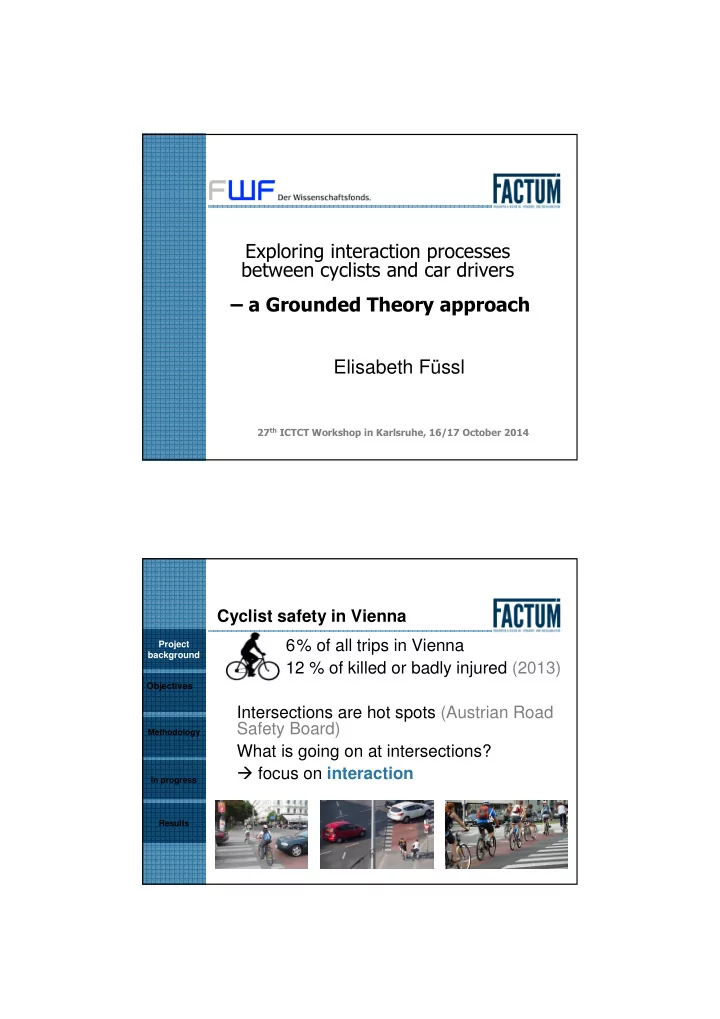
Cyclist safety in Vienna 6% of all trips in Vienna 12 % of killed or badly injured (2013) Intersections are hot spots (Austrian Road Safety Board) What is going on at intersections? focus on interaction

Project background Objectives

Methodology In progress Results

slide-2
SLIDE 2

Objectives Grounded theory about interaction processes: Strategies: Identify & collect different forms

  • f interactions and their intention

Interrelations: Identify key factors that influence interaction processes Image & status of cyclists & car drivers as road users: Power relations in road traffic

Project background Objectives

Methodology In progress Results

Methodology

Project background Objectives

Methodology

Grounded Theory (Glaser/ Strauss 1967) Theory-Triangulation Actor-Network-Theory (Callon/Latour 1992) Symbolic Interactionism (Mead/Blumer 1969) Diamond model (Risser 2000) GADGET matrix (Hatakka et al. 1999) Data triangulation (mixed methods approach) (Creswell & PlanoClark 2008)

In progress Results

slide-3
SLIDE 3

Overview Methodology

in-depth interviews FGI

  • bservation

questionnaire demonstration of value Actor-Network Theory Symbolic Interactionism Diamond model GADGET Matrix key factors mutual process symbols structuring traffic system different levels status validation & hypotheses further collection & validation → Grounded Theory: Emerge theory about interaction processes

Project aims Data triangulation

→ Value of road users

Theory triangulation

→ Identify Strategies → Explore Interrelations intentions & forms of interactions key factors

Data Collection: Interview

Project background

Methodology In progress

In-depth interviews with car drivers and bicyclists Theoretical sampling: Gender / Age / driving experience (Renge 2000) Work in progress: 6 interviews (3 bicyclists/ 3 car drivers)

Results

Objectives

slide-4
SLIDE 4

Data Collection: Observation

Project background

Methodology In preparation stage

Video observation on different intersections 3 cameras, 4 intersections – 100 test drivers, 100 control group drivers Analysis: category scheme INTERACT

Results

Objectives

DC: Questionnaire & Focus groups

Project background

Methodology Next steps

Standarized questionnaire with bicyclists after test run Focus Group discussions with bicyclists / (car drivers?): further data collection

Results

Objectives

slide-5
SLIDE 5

Preliminary results

Project background

Methodology Next steps

Strategies: Intention of interactions vs. Interpretation of Interactions

Results

Objectives

Interaction cyclists' view car drivers view saftey margin arrogance of cyclists more comfort, smooth flow disrespect of rules

  • vertaking

cyclists recklessness

  • f car drivers

tailgating ignore red lights intention

Preliminary results

Project background

Methodology Next steps

Interrelations: Self-perception correlates with rule compliance „The traffic rules are made for cars. I understand why cyclists do not resepect those rules.“ (Male cyclist, 20-30)

Results

Objectives

slide-6
SLIDE 6

Preliminary results

Project background

Methodology Next steps

Image & status of road users: Cycling car drivers seem to have more willigness to „accept“ cyclists on the road „Before I started to use the bike myself I used to overtake cyclists with narrow margin and thought they do not have any right to be on the road.“ (Female car driver, 30-40)

Results

Objectives Project background

Methodology Next steps

Thank you for your attention!

elisabeth.fuessl@factum.at

Results END

Objectives