Exploration of the Synchronization Constraint in Quantum-dot - - PowerPoint PPT Presentation

exploration of the synchronization constraint in quantum
SMART_READER_LITE
LIVE PREVIEW

Exploration of the Synchronization Constraint in Quantum-dot - - PowerPoint PPT Presentation

Exploration of the Synchronization Constraint in Quantum-dot Cellular Automata (QCA) Frank Sill Torres 1,2 , Pedro A. Silva 3 , Geraldo Fontes 3 , Jos A. M. Nacif 3 , Ricardo S. Ferreira 3 , Omar P. V. Neto 4 , Jeferson F. Chaves 4,5 , Rolf


slide-1
SLIDE 1

Sill Torres – QCA

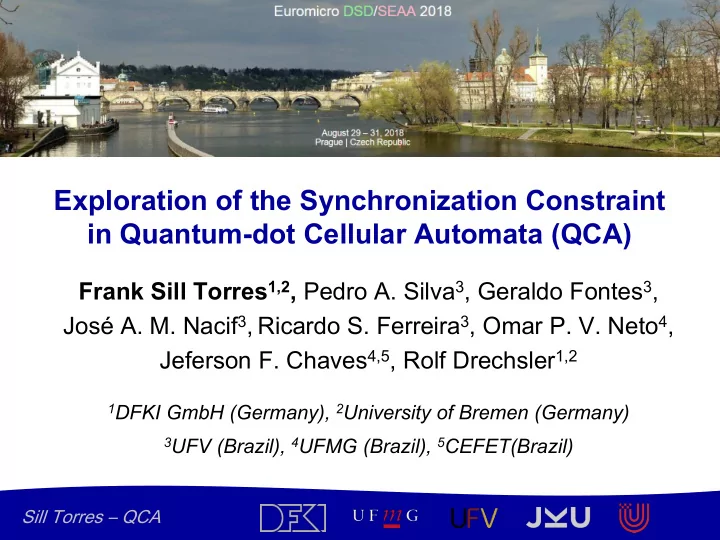
Exploration of the Synchronization Constraint in Quantum-dot Cellular Automata (QCA)

Frank Sill Torres1,2, Pedro A. Silva3, Geraldo Fontes3, José A. M. Nacif3, Ricardo S. Ferreira3, Omar P. V. Neto4, Jeferson F. Chaves4,5, Rolf Drechsler1,2

1DFKI GmbH (Germany), 2University of Bremen (Germany) 3UFV (Brazil), 4UFMG (Brazil), 5CEFET(Brazil)

slide-2
SLIDE 2

2 Sill Torres – QCA

Outline

  • Trends
  • Quantum-dot Cellular Automata Basics
  • Clocking in QCA
  • Synchronicity
  • Impact Analysis
  • Conclusions
slide-3
SLIDE 3

3 Sill Torres – QCA

Trends

CMOS Scaling limits

0.01 0.1 1 10 100 0.001 0.01 0.1 1

LGATE (µm) Gate Delay (ps)

0.0001 0.00001 0.000001 0.1 0.01 0.001 100 10 1

0.001 1 0.01 0.1

LGATE (µm) Switching Energy (fJ)

Source: Nikonov (Intel), 2013

  • Current CMOS device scaling close to the ideal limits
  • Intel/ITRS: Scaling might end between 2021 and 2030 (at 3.5 nm)
slide-4
SLIDE 4

4 Sill Torres – QCA

  • Simple example:

– Array of novel devices with 1nm x 1nm footprint → Density: 1014 devices per cm² (0.1 Peta) – Frequency: 100 GHz – Each device in each clock cycle: single electron has to drop down potential of 0.1V (=energy loss of 0.1eV) Total Power: 160 kW cm-2

Trends

Power

slide-5
SLIDE 5

5 Sill Torres – QCA

Trends

Quantum-dot Cellular Automata

Source: Lent, 2002

Power [W] 10-3 10-7 10-11 10-15 Propagation Delay [s] 10-14 10-11 10-7 1 fJ 1 aJ 20 nm CMOS

Ek – kink energy (energetic costs of two neighboring cells having opposite polarizations)

1 yJ 1 zJ Costs per device

slide-6
SLIDE 6

6 Sill Torres – QCA

  • Nanometer sized structure (1nm –

10nm)

  • Capable of trapping (confine)

electrons in 3 dimensions (due to the high potential required to escape)

  • Like in Atom: Quantized energy

levels due to confinement of electrons (also known as: artificial atom)

  • Electrical and optical characteristics

can be adapted

Quantum-dot Cellular Automata

What is a Quantum dot?

slide-7
SLIDE 7

7 Sill Torres – QCA

  • Basic elements:

– 4 Quantum dots (shown as circles) – 2 Electrons located within quantum dots → can tunnel between dots

  • Principle:

– Quantum dots confine electrons – Coulomb forces repel of electrons – Only two possible states => enables binary logic – Balance between Coulomb forces, dot distance and confinement

Quantum-dot Cellular Automata

QCA Cell

  • Polarization -1

Polarization +1 Binary 0 Binary 1

slide-8
SLIDE 8

8 Sill Torres – QCA

  • Two cells placed close to each other with adequate distance d such

that: – Electrons cannot tunnel between cells (tunneling probabilities decay exponentially with distance) – Electrons of one cell influence electrons other cell (Coulombic forces decay quadratically) → No current!

Quantum-dot Cellular Automata

QCA cell-to-cell Coupling

d

Coulombic Interactions

slide-9
SLIDE 9

9 Sill Torres – QCA

  • Wire
  • Majority

Quantum-dot Cellular Automata

Basic Blocks

‘1’ ‘1’

Coulombic Interactions

B = 1 C = 1 A = 0 F = MAJ(A,B,C) = 1

slide-10
SLIDE 10

10 Sill Torres – QCA

Quantum-dot Cellular Automata

  • AND:

– FAND=MAJ(A,B,C=0)=AB

  • OR

– FAND=MAJ(A,B,C=1)=A+B

Boolean Cells

B C = 0 (fix) A F = AB B C = 1 (fix) A F = A+B

slide-11
SLIDE 11

11 Sill Torres – QCA

  • Problem: How to deal with metastability and how to control data

transfer?

  • Solution: External electric fields (clocks) that control potential

barriers of Quantum dots

Clocking in QCA

Potential barrier manipulation Potential V(x,y) Potential barriers increased Potential barriers decreased

Source: Goser, 1998

slide-12
SLIDE 12

12 Sill Torres – QCA

Clocking in QCA

Clocking States

Switch

  • Barriers raised, cells become polarized

→ processing and information stored in cell Hold

  • Barriers are held high

→ stored information remains stable, can act as inputs to next stage Release

  • Barriers are lowered

→ Information gets lost Relax

  • Cell barriers remain lowered

→ Cell in neutral state

slide-13
SLIDE 13

13 Sill Torres – QCA

  • Four external clocks (1-4), phase-shifted by 90 degrees
  • QCA cells organized in tiles (can contain wires or logic)
  • All cells within tile controlled by same clock
  • Information transfer only between

consecutively numbered clocks (1 → 2, 2 → 3, …, 4 → 1)

Clocking in QCA

Tile-based Design

1

2 3 4 1

Possible cell locations Clock number controlling all cells

1 2 3 2 3 4

Tile

slide-14
SLIDE 14

14 Sill Torres – QCA

1 2 3 2 3 4 s a f b

Clocking in QCA

Information Transfer

1 2 3 2 3 4 f s=1 a=0 b=0

1

Clock State

1 Switch 2 Relax 3 Release 4 Hold

↔ ↔ ↓ ↓ X

Clock State

1 Hold 2 Switch 3 Relax 4 Release

1 ↔ ↔ ↓

  • Pipeline-like information transfer

Clock State

1 Release 2 Hold 3 Switch 4 Relax

↓ ↔

slide-15
SLIDE 15

15 Sill Torres – QCA

  • Common assumption: All data paths in QCA must be of equal length
  • Complicated Design

Synchronicity

Constraint

2 3 4 1 2 3 4 1 2 1 2 3

  • 1
  • 2

In2 In1

  • 3

1

A B

2 3 4 1 2 3 4 1 2 1 2 3

  • 1
  • 2

In2 In1

  • 3

1

A B

Source: Campos, 2015

Random

  • perations
slide-16
SLIDE 16

16 Sill Torres – QCA

4 3 2 1 4 2 3 4

  • 4
  • 5

1

  • 6
  • 7

1

  • 1

4 3 4 1 2

  • 8
  • 2

In1 In2

3

  • 3

2 3

  • 9

f

1 4 2

A B

  • Inputs can be hold stable for X clock cycles
  • Drawback: Reduced throughput

Synchronicity

Solution

Clock 1 In1 In2 B A In1-1 In1-2 In2-1 In2-2 undef In1-1 In2-1 In2-2 In1-2

slide-17
SLIDE 17

17 Sill Torres – QCA

  • Question: Impact of allowing to break synchronicity constraint?
  • Modification of bi-directional algorithm for QCA Place-and-Route (P&R)

Impact Analysis

Environment

Gates Inputs

Output

Inputs

Output

slide-18
SLIDE 18

18 Sill Torres – QCA

Impact Analysis

Environment cont’d

  • 1
  • 3
  • 4
  • 5
  • 6
  • 2

6 2 2 6 2 4

  • 1
  • 3
  • 4
  • 5
  • 6
  • 2

5 2 2 4 2 2

4 3 2 1 4 2 3 4 1 1

  • 1

3 4 1 2 3

  • 3
  • 2
  • 4
  • 5
  • 6

Synchronicity achieved Failed synchronicity Logic levels

Distances

1 4 2 4 3 2 1 4 2 3 4 1 1 3 4 1 2 3

  • 3
  • 2
  • 6
  • 5
  • 4
  • 1
slide-19
SLIDE 19

19 Sill Torres – QCA

0% 20% 40% 60% 80% c17 t newtag CLPL FA-AOIG FA-MAJ B1_r2 XOR5_r XOR5_r1

Reduction

  • Occ. clock zones

Latency Throughput

Results

Area (33%) (Area) Latency (13%) Throughput (50%)

slide-20
SLIDE 20

20 Sill Torres – QCA

  • Quantum-dot Cellular Automata (QCA) is promising nanotechnology

for ultra-low power applications

  • Information transfer controlled by external electric clocking fields →

circuits may have pipeline-like behavior

  • Contrast to what is common believe → not a mandatory constraint

for QCA circuits

  • Simulation results for relaxed synchronicity constraint:

– Area reductions of up to 70%, Latency improved by up to 25% – Throughput decreases by up to 70%

  • New degree of freedom for designers

Conclusions

slide-21
SLIDE 21

21 Sill Torres – QCA

Thank you!

frasillt@uni-bremen.de

slide-22
SLIDE 22

Sill Torres – QCA

Exploration of the Synchronization Constraint in Quantum-dot Cellular Automata (QCA)

Frank Sill Torres1,2, Pedro A. Silva3, Geraldo Fontes3, José A. M. Nacif3, Ricardo S. Ferreira3, Omar P. V. Neto4, Jeferson F. Chaves4,5, Rolf Drechsler1,2

1DFKI GmbH (Germany), University of Bremen (Germany) 3UFV (Brazil), 4UFMG (Brazil), 5CEFET(Brazil)