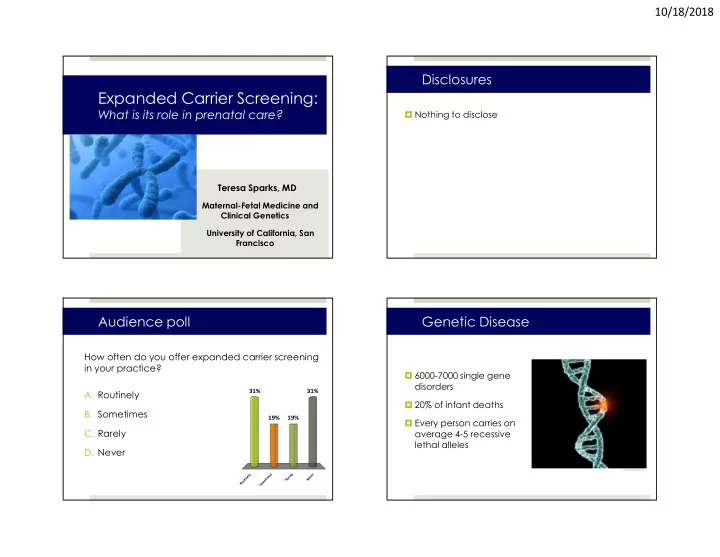
Expanded Carrier Screening: What is its role in prenatal care? - - PowerPoint PPT Presentation

expanded carrier screening
SMART_READER_LITE
LIVE PREVIEW

Expanded Carrier Screening: What is its role in prenatal care? - - PowerPoint PPT Presentation

10/18/2018 Disclosures Expanded Carrier Screening: What is its role in prenatal care? Nothing to disclose Teresa Sparks, MD Maternal-Fetal Medicine and Clinical Genetics University of California, San Francisco Audience poll Genetic


slide-1
SLIDE 1

10/18/2018 1

Expanded Carrier Screening:

What is its role in prenatal care?

Teresa Sparks, MD

Maternal-Fetal Medicine and Clinical Genetics University of California, San Francisco

Disclosures

 Nothing to disclose

Audience poll

  • A. Routinely
  • B. Sometimes
  • C. Rarely
  • D. Never

How often do you offer expanded carrier screening in your practice?

R

  • u

t i n e l y S

  • m

e t i m e s R a r e l y N e v e r

31% 31% 19% 19%

Genetic Disease

 6000-7000 single gene disorders  20% of infant deaths  Every person carries on average 4-5 recessive lethal alleles

wiringthebrain.com

slide-2
SLIDE 2

10/18/2018 2

Carrier Screening: What is the point?

 Recessive disorders pass quietly through generations  Usually there is no known family history of disease

Unaffected carriers Affected

Carrier Screening: What is the point?

 Identify those at risk of transmitting a genetic condition

Neonatal Before or during pregnancy

Newborn screening Screening for affected Expanded carrier screening Screening for carriers During pregnancy Pre- conception Birth

Carrier Screening: What is the point?

Carrier Screening

Counseling Preconception Prenatal diagnosis Assess personal beliefs, values Individualize management when fetus affected Anticipate postnatal needs

Carrier Screening: What is the point?

slide-3
SLIDE 3

10/18/2018 3

 Good test is

available

 Disorder is:

  • common
  • important problem
  • severe

 Intervention  Natural history

understood

 Voluntary  Informed consent Hemoglobinopathies 1970’s Tay Sachs disease 1971 Canavan disease 1998 Cystic fibrosis 2001 Familial dysautonomia 2004 Spinal muscular atrophy 2008 (ACMG) Spinal muscular atrophy 2017 (ACOG) Expanded Jewish panel 2008 (ACMG) Expanded Jewish panel 2017 (ACOG) Expanded carrier screening 2017 (ACOG)

History of Carrier Screening Traditional Carrier Screening

 Traditional carrier screening

 Ancestry and family history  Small number of genetic diseases  Well-defined phenotype  ↑ prevalence in certain populations  Significantly impact quality of life

→ Cognitive or physical disabilities → Fetal, neonatal, early childhood onset

slide-4
SLIDE 4

10/18/2018 4

Disease Example: Tay Sachs

Tay Sachs disease

 Lysosomal storage disease → Hexosaminidase A deficiency  GM2 gangliosides  neurodegeneration  Offered to French Canadian, Cajun, Ashkenazi Jewish → 1:30 of Ashkenazi Jewish descent are carriers  Several subtypes

 Death in early childhood to later onset  No treatment

  • r cure

Traditional Career Screening:

Professional Society Recommendations

 Screening should be offered to ALL women for:

 Cystic fibrosis  Spinal muscular atrophy  Thalassemias and hemoglobinopathies  Screen with MCV for all  For those with low MCV or at risk: hemoglobin electropheresis

 African, Mediterranean, Middle Eastern, Southeast Asian, West Indian

2017

 Screening for Fragile X should be offered when:

 Family history of Fragile X-related disorders  Family history of intellectual disability  Unexplained ovarian insufficiency or failure

Traditional Career Screening:

Professional Society Recommendations

 Ashkenazi Jewish carrier screening:

 French Canadian, Cajun, Ashkenazi Jewish

 Canavan disease, cystic fibrosis, familial dysautonomia, Tay Sachs disease  The 4 recommended by ACOG plus: Fanconi anemia (group C), Niemann Pick (type A,) Bloom syndrome, mucolipidosis IV, Gaucher disease

Traditional Career Screening:

Professional Society Recommendations

Consider additional diseases

slide-5
SLIDE 5

10/18/2018 5 Traditional Career Screening:

Professional Society Recommendations

It is reasonable to do:  Ethnicity based screening  Pan-ethnic screening  Expanded carrier screening

2017

Traditional Screening: Limitations

Multiethnic populations Genetic conditions not isolated to populations Not a comprehensive risk assessment

www.quest.com

May not optimize knowledge

Expanded Carrier Screening

Advancing genetic technology Hundreds of genetic diseases simultaneously Who should this be

  • ffered to?

Audience poll

  • A. True
  • B. False
  • C. Undecided

TRUE OR FALSE: Every patient considering a pregnancy or currently pregnant should be offered expanded carrier screening.

T r u e F a l s e U n d e c i d e d

36% 24% 40%

slide-6
SLIDE 6

10/18/2018 6

Expanded Carrier Screening

 Next generation sequencing for hundreds of conditions simultaneously  Most are full-exon sequencing  Cost ~$100-350, some insurance in-network

www.counsyl.com

Expanded Carrier Screening

Advantages

Audience poll

  • A. 10%
  • B. 22%
  • C. 36%
  • D. 45%

What percentage of individuals will be identified as a carrier of a genetic disease?

1 % 2 2 % 3 6 % 4 5 %

18% 22% 27% 33%

slide-7
SLIDE 7

10/18/2018 7

Expanded Carrier Screening

What are the down sides?

Expanded Carrier Screening

Challenges  Uncertainties

 Variable phenotype

 Within one disease, and among all

→ Degree of impairment, etc.

 For rare diseases, less clarity about:

 Prognosis  Performance of the test  Carrier frequency in the population → residual risk

Expanded Carrier Screening Expanded Carrier Screening

 Disease variation in panels

 Very rare prevalence  Limited prognostic information  Later age of onset  Minimal disease symptoms  Incomplete penetrance  Variable expression  Screening for general population NOT recommended

→ Genetic variants subject to interpretation

slide-8
SLIDE 8

10/18/2018 8

Disease Example: Achromatopsia

 Achromatopsia

 Reduced visual acuity, nystagmus, photophobia, scotoma, partially or completely color blind  CNGB3, CNGA3, GNAT2, PDE6C, ATF6, or PDE6H  Non-progressive  No other organ systems affected Should this really be on ECS panels?

Expanded Career Screening:

Professional Society Recommendations

Screening in the Age of Genomic Medicine

 Carrier frequency of at least 1/100  Well-defined phenotype  Detrimental effect on quality of life

 Cognitive or physical impairment, surgical or medical intervention

 Early onset in life  Able to diagnose disease prenatally

 Antenatal intervention, perinatal management, etc.

 Most at-risk patients would consider prenatal diagnosis  Transparency about:  Incomplete penetrance, variable expressivity, mild phenotype, adult-onset  Causative genes, variants, and variant frequencies known  Validated association between variants and disease  Quality control for labs

Position on Expanded Carrier Screening

Expanded Career Screening:

Professional Society Recommendations

6 ECS panels Inclusion: autosomal recessive, carrier prevalence ≤1/100, carrier detection rate ≥70% Exclusion: adult-onset, poorly studied population, unknown prevalence, incomplete penetrance, mild phenotype

slide-9
SLIDE 9

10/18/2018 9

Audience poll

  • A. 5%
  • B. 27%
  • C. 45%
  • D. 62%

What proportion of diseases on these panels met inclusion criteria?

5 % 2 7 % 4 5 % 6 2 %

55% 1% 4% 39%

Expanded Carrier Screening Expanded Carrier Screening

Challenges:

More carriers Counseling Further testing Uncertainties Variety of phenotypes Time and cost Anxiety

Advantages:

Panethnic Equitable Many diseases Increased information Decision-making Earlier diagnosis More targeted care

 Patient preferences and beliefs  First do no harm

Expanded Carrier Screening

PRE-test counseling

slide-10
SLIDE 10

10/18/2018 10

Expanded Carrier Screening

Counseling is more broad:

“Do you want screening to assess the risk of genetic diseases?” “Outcomes vary widely but many are serious.” “Not everything is detected by these tests.”

PRE-test counseling

Expanded Carrier Screening

  • Kraft. Genetics in Medicine. 2018.

Expanded Carrier Screening

POST-test counseling

Expanded Carrier Screening

“…..the foremost purpose of prenatal screening is not to reduce the incidence of genetic disease but to fulfill a couple’s reproductive goals.”

Rowley, Loader and Kaplan; Am. J. Hum. Genet. 63:1160–1174, 1998

  • r an individual’s
slide-11
SLIDE 11

10/18/2018 11

Thank you!

teresa.sparks@ucsf.edu