EXPANDED CARRIER SCREENING Research funding from Natera Consultant - - PowerPoint PPT Presentation

expanded carrier screening
SMART_READER_LITE
LIVE PREVIEW

EXPANDED CARRIER SCREENING Research funding from Natera Consultant - - PowerPoint PPT Presentation

Disclosures EXPANDED CARRIER SCREENING Research funding from Natera Consultant to Invitae Mary E Norton MD University of California, San Francisco OBGYN Update UCSF, San Francisco CA 2019 1 2 Availability of Genetic Tests Spectrum


slide-1
SLIDE 1

EXPANDED CARRIER SCREENING

Mary E Norton MD University of California, San Francisco

OBGYN Update UCSF, San Francisco CA 2019

Disclosures

  • Research funding from Natera
  • Consultant to Invitae

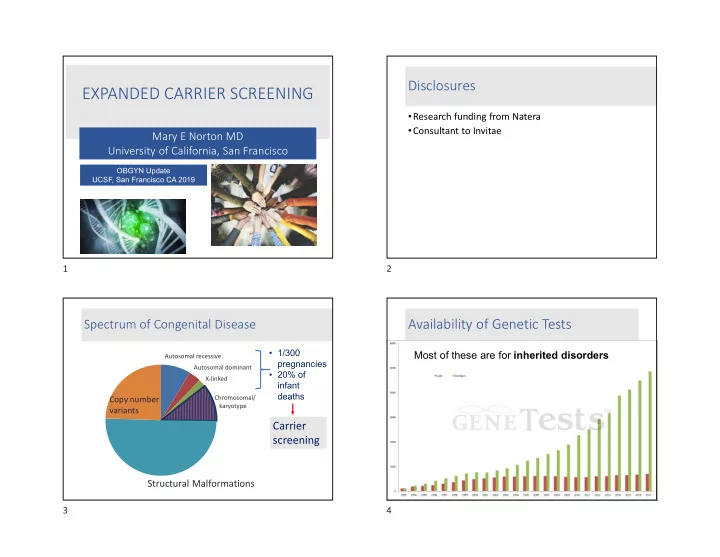
Spectrum of Congenital Disease

Structural Malformations

Autosomal recessive Autosomal dominant X-linked Chromosomal/ karyotype

Copy number variants

  • 1/300

pregnancies

  • 20% of

infant deaths

Spectrum of Congenital Disease

Carrier screening

Availability of Genetic Tests

Most of these are for inherited disorders 1 2 3 4

slide-2
SLIDE 2

Recessive inheritance

Unaffected carriers Affected

Recessive inheritance

Unaffected carriers Affected

What is the purpose of prenatal carrier screening? What is the purpose of newborn screening?

5 6 7 8

slide-3
SLIDE 3

Newborn screening Carrier screening NEWBORN

Screening for Affected

PRENATAL

Screening for Carriers

Wilson and Junger: Criteria for screening for disease

  • A good test is available
  • The disorder is common
  • The disorder is severe
  • There is an intervention
  • Testing is voluntary and patients give

informed consent

History of Prenatal Carrier Screening

1. Hemoglobinopathies 1970’s 2. Tay Sachs disease 1971 3. Canavan disease 1998 4. Cystic fibrosis 2001 5. Familial dysautonomia 2004 6. Spinal muscular atrophy 2008 (ACMG) 7. Spinal muscular atrophy 2017 (ACOG) 8. Expanded Jewish panel 2008 (ACMG) 9. Expanded Jewish panel 2017 (ACOG)

  • 10. Expanded carrier screening

2017 (ACOG) 9 10 11 12

slide-4
SLIDE 4

Traditional Carrier Screening

  • Focus on ancestry and family history
  • Small number of diseases
  • High frequency in a certain population
  • Severe morbidity or mortality
  • Fetal, neonatal or early childhood onset
  • Well-defined phenotype

Sickle cell disease Tay-Sachs disease

Ethnicity Based Screening

Ashkenazi Jews Tay Sachs disease, Canavan disease, cystic fibrosis, familial dysautonomia Louisiana Cajun, Tay Sachs disease Fr Canadian Caucasians Cystic fibrosis Africans, African Sickle cell anemia, beta Americans thalassemia Southeast Asians Alpha thalassemia Mediterraneans Beta thalassemia

ACOG 2017 Updated Screening Recommendations

  • Screening should be offered to all women before or

during pregnancy for:

  • Cystic fibrosis
  • Spinal muscular atrophy
  • MCV should be offered to all women who are

currently pregnant

  • To those at risk for hemoglobinopathies, Hb

electrophoresis should be offered (African, Mediterranean, Middle Eastern, SE Asian, West Indian) or if MCV is low

ACOG 2017 Updated Screening Recommendations

  • Fragile X screening should be offered to

all women with:

  • a family history of FraX related disorders
  • unexplained ovarian insufficiency or failure
  • Tay Sachs screening should be offered

to those who are:

  • French Canadian
  • Cajun
  • Ashkenazi Jewish

13 14 15 16

slide-5
SLIDE 5

ACOG 2017 Updated Screening Recommendations

It is reasonable to do:

  • Ethnicity based screening
  • Pan-ethnic screening
  • Same tests are offered to everyone
  • Expanded carrier screening

Expanded (Universal) Carrier Screening Expanded Carrier Screening

Utilization of new technologies to identify carriers of multiple genetic conditions simultaneously Multiplex Panel Screening: Expanded Carrier Screening

  • Multiplex screening now allows testing for

many (>100) disorders at once

  • This is relatively inexpensive (~$350)
  • Should it be offered to everyone?

17 18 19 20

slide-6
SLIDE 6

Is More Better?

  • What are these additional conditions?
  • What is the process for adding new

conditions?

  • Is the test accurate?
  • How often does the test find

something?

  • What happens then?

Newborn vs prenatal screening

Disorder is important  test is developed and introduced Technology is developed  test is introduced

Newborn Screening

  • Disorders chosen by Health Resources and

Services Administration (HRSA)

  • Recommended Uniform Screening Panel
  • Cause serious health problems if treatment is

not started shortly after birth

  • Identification and management of these

conditions may prevent life-threatening complications

What is on expanded panels and how are disorders chosen?

Disorders should be:

  • Severe
  • Common
  • Have a well-described natural history

and phenotype

  • Have a high detection rate

21 22 23 24

slide-7
SLIDE 7

What criteria are required by laboratories before adding gene variants to panels?

Achromatopsia

  • Decreased visual acuity, nystagmus
  • Increased light sensitivity
  • Decreased color discrimination
  • Non-progressive
  • Does not lead to blindness
  • No other organ system

affected

  • Should this be on panels?

Alpha 1 antitrypsin deficiency

Chronic Obstructive Pulmonary Disease

  • Smoking influences the onset of COPD
  • Non-smokers often have a normal life span
  • Extremely rare in children

Liver disease – increased risk with age

  • Adults – Cirrhosis 15-20% by age 50
  • Children -- obstructive jaundice
  • 2% liver failure
  • Hepatocellular carcinoma - rare

Clinical disease is infrequent in heterozygote state

  • Smoking increases risk

 Would most consider prenatal diagnosis? 25 26 27 28

slide-8
SLIDE 8

Other mild/minimal/non-disorders

Hemochromatosis

  • Inappropriate absorption of

iron

  • Clinical – end organ failure
  • Onset: >40 years
  • 75-90% - asymptomatic

MTHFR

  • Elevated homocysteine
  • Risk for thrombosis,

cerebrovascular and cardiovascular disease, stroke

  • Treatment: vitamins

 Because we “can” should we be offering carrier screening?

  • Which may lead to partner carrier screening…. Anxiety
  • Prenatal diagnosis….

“First, do no harm” Condition 1/ α1AT deficiency 13 Cystic fibrosis 28 DFNB1 43 SMA 57

Fam Mediterranean Fever

64 SLO 68 SS/ β-thal 70 Gaucher disease 77 Factor XI deficiency 92 Achromatopsia 98

  • 23,453 patients screened

for 96 conditions

  • Mild conditions excluded:

hemochromatosis (HFE) MTHFR others

Lazarin GA, et.al.. Genetics in Med 2012.

Expanded Carrier Screening: The Wild West

Gene variants

What criteria are required by laboratories before adding variants to panels? Test is available

29 30 31 32

slide-9
SLIDE 9

Optimal criteria for carrier screening: ACMG and ACOG

  • Good test is available
  • Detection rate ≥ 70%
  • Carrier frequency is high
  • At least 1 in 100
  • Exclusions:
  • Adult onset
  • Poorly studied
  • Prevalence unknown
  • Incomplete penetrance
  • Mild phenotype
  • Evaluated commercially available panels
  • 27% of included disorders meet criteria

per ACMG and ACOG

Which conditions should be included?

  • Includes conditions for which carrier screening of the

general population is NOT recommended

  • Factor V Leiden, Fragile X, hemochromatosis
  • Include conditions with significant variation in their

presentation

  • Age at onset
  • Severity
  • Includes rare conditions with unknown detection rates

and carrier frequencies and uncertain natural history

  • Counseling about likely phenotype difficult
  • Calculation of residual risk may not be possible

33 34 35 36

slide-10
SLIDE 10

How accurate is the test?

Molecular DNA testing is not the recommended screening approach for certain conditions

  • Tay-Sachs disease
  • Hexosaminidase A enzyme analysis is best test for

non-Jewish individuals

  • Hemoglobinopathies
  • Gold standard is MCV and hemoglobin

electrophoresis

  • Carrier screening platforms do not include all

mutations for alpha and beta thalassemia

Other Limitations and Challenges

Individuals with a positive family history

  • Family-specific mutations may not be on

commercially available panels

  • Genetic counseling should be considered

before offering ECS

How Often Do Tests Find Something? What Then?

24-45% will have something

  • Explain to the patient
  • Test the partner (he might not have

insurance)

  • He will often have something else
  • If low detection rate on original panel, do gene

sequencing

  • Explain all this to the patient

37 38 39 40

slide-11
SLIDE 11

A real patient story

  • Patient reports that she carries SMA
  • Partner has expanded carrier screening through

panel covered by his insurance

  • Carries Fanconi Anemia, group A
  • Patient undergoes expanded carrier screening with

panel covered by her insurance

  • She carries Pompe disease but was not tested for

Fanconi group A, just group C (updated panel)

  • They are frustrated and seek a second opinion
  • He undergoes gene sequencing for Pompe and she

has sequencing for Fanconi group A

  • All he really needed was testing for SMA

Another patient story

  • Patient and partner had expanded

carrier screening during first pregnancy (in NY)

  • Both carried a variant for Zellweger

disease

  • Life-threatening metabolic disorder
  • Usually neonatal death
  • Had prenatal diagnosis: fetus carrier

41 42 43 44

slide-12
SLIDE 12

Delayed pregnancy for THREE years

  • Saw GC for pre-conception counseling
  • Planning for preimplantation genetic testing
  • GC was having a slow day….

Results Results (Page 2 of report, fine print)

Researched this variant

  • ClinVar (public database)
  • 2 labs: pathogenic or likely pathogenic
  • 1 benign
  • 1 VUS (variant of uncertain significance)
  • Gnomad (another genome database)
  • 8 individuals who were homozygous and

presumably normal

  • PubMed
  • Called a researcher, who said that variant

should be reclassified as benign

45 46 47 48

slide-13
SLIDE 13

What about cost?

  • Tests for hundreds of disorders at once
  • Relatively inexpensive ($100-350)
  • Less expensive than gene-by-gene testing
  • But is it really?

The PROCESS is more expensive:

  • Patients need pre-test counseling
  • Many conditions are rare
  • Rare conditions often not well characterized
  • No test can rule out all genetic diseases
  • Screening for hemoglobinopathies and Tay

Sachs disease may not be as accurate

  • MCV, enzyme testing may be better
  • High chance of finding something, needing to

test partner

Expanded Carrier Screening: Pros and Cons

  • Efficient
  • All patients offered

same tests

  • Detects more conditions
  • Does not require

ethnicity

  • Reduces disparities in

screening by racial/ethnic categories

  • Conditions may be:
  • mild and variable
  • rare, esoteric, hard to

explain

  • treatable (PKU)
  • adult onset
  • Some gene variants have

uncertain significance

  • Overall process is MORE

expensive

  • Efficient
  • All patients offered

same tests

  • Detects more conditions
  • Does not require

ethnicity

  • Reduces disparities in

screening by racial/ethnic categories

Expanded Carrier Screening: Pros and Cons

49 50 51 52

slide-14
SLIDE 14

Expanded carrier screening

  • Need informed consent:
  • Detection of disorders that are variable or mild
  • Some are adult onset
  • Many are rare with low detection rate
  • Uncertain residual risk

 In a 15 minute office visit, how can one obtain informed consent for all of these disorders?

Expanded Carrier Screening

  • Paradigm for testing will change from single disorder

approach to broader screening

  • Counseling will be more generic:
  • “Do you want testing for birth defects?”
  • “Outcomes vary widely but generally most result in

significant disease.”

  • “Not everything is detected by these tests.”

The Real Question: Answer: Not always!!

53 54 55 56

slide-15
SLIDE 15

Conclusions Thank You!

57 58