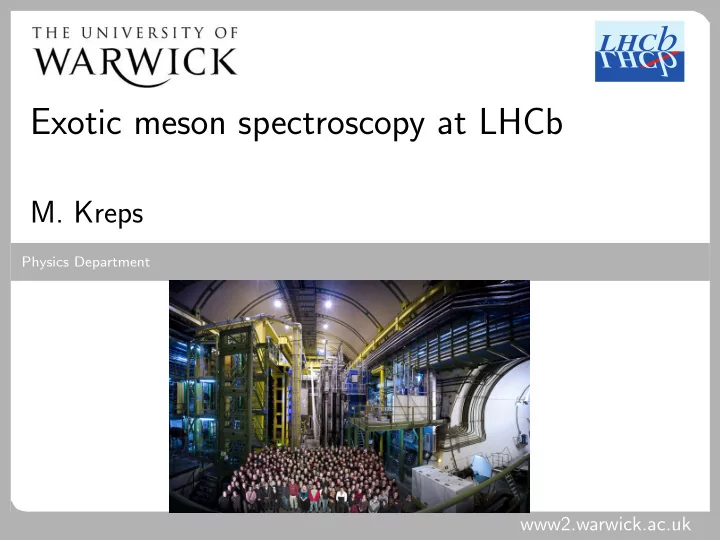
Exotic meson spectroscopy at LHCb M. Kreps Physics Department - - PowerPoint PPT Presentation

exotic meson spectroscopy at lhcb
SMART_READER_LITE
LIVE PREVIEW

Exotic meson spectroscopy at LHCb M. Kreps Physics Department - - PowerPoint PPT Presentation

Exotic meson spectroscopy at LHCb M. Kreps Physics Department www2.warwick.ac.uk Introduction In the quark model we think of hadrons as qq or qqq


slide-1
SLIDE 1

Physics Department

www2.warwick.ac.uk

Exotic meson spectroscopy at LHCb

  • M. Kreps
slide-2
SLIDE 2

Introduction

2 28 October 2014 Michal Kreps – Exotic meson spectroscopy at LHCb

  • In the quark model we think of hadrons as qq or qqq
  • But there is nothing preventing other combinations

→ Where are all those combinations with more than 3 quarks or anti-quarks?

slide-3
SLIDE 3

Introduction - molecules

3 28 October 2014 Michal Kreps – Exotic meson spectroscopy at LHCb

  • There are lot of objects composed of baryons
slide-4
SLIDE 4

Introduction - molecules

3 28 October 2014 Michal Kreps – Exotic meson spectroscopy at LHCb

  • There are lot of objects composed of baryons
  • Where are similar objects from mesons?
slide-5
SLIDE 5

Scalar mesons

4 28 October 2014 Michal Kreps – Exotic meson spectroscopy at LHCb

NOTE ON SCALAR MESONS BELOW 2 GEV Revised September 2013 by C. Amsler (Univ of Bern), S. Ei- delman (Budker Institute of Nuclear Physics, Novosibirsk), T. Gutsche (University of T¨ ubingen), C. Hanhart (Forschungszen- trum J¨ ulich), S. Spanier (University of Tennessee), and N.A. T¨

  • rnqvist (University of Helsinki).
  • V. Interpretation of the scalars below 1 GeV: In the

literature, many suggestions are discussed, such as conventional q¯ q mesons, q¯ qq¯ q or meson-meson bound states. In addition one expects a scalar glueball in this mass range. In reality, there can be superpositions of these components, and one often depends

  • n models to determine the dominant one. Although we have

seen progress in recent years, this question remains open. Here, we mention some of the present conclusions. The f0(980) and a0(980) are often interpreted as multiquark states [140–144] or K ¯ K bound states [145]. The insight into

From RPP by PDG

  • Candidates beyond qq mesons exist, but real trouble is how to

decide whether they are qq or something else

slide-6
SLIDE 6

Charmonium

5 28 October 2014 Michal Kreps – Exotic meson spectroscopy at LHCb

  • Back in 2003, many expected

states still missing

  • Belle started to search for them

and quickly found one

  • Did not fit into expected spectra
  • Mass close to m(D0) + m(D∗0)

arXiv:1403.1254

0.40 0.80 1.20 M(π+π-l+l-) - M(l+l-) (GeV) 100 200 300 Events/0.010 GeV

PRL 91, 262001

slide-7
SLIDE 7

X(3872) properties

6 28 October 2014 Michal Kreps – Exotic meson spectroscopy at LHCb

]

2

) [ GeV/c

  • π

+

π ψ m(J/

3.65 3.7 3.75 3.8 3.85 3.9 3.95 4

2

entries / 2.5 MeV/c

1000 2000 3000 4000 5000 6000 (2S) ψ 228 ± 20285 113 X(3872) ± 2292

CDF Run II

  • 1

780pb ≈ L

) [MeV] ψ ) - M(J/ ψ J/

  • π

+

π M( 600 800 1000 1200 1400 Number of candidates / (2.5 MeV) 200 400 600 800 1000 1200

LHCb

550 600 200 400 600 800 1000 1200

(2S) ψ

750 800 10 20 30 40 50 60 70

X(3872) /2| π | - π

  • Φ

∆ || X(3872) yield / unit volume 100 200 300 400 500

0.63 1.15 /2 π 0.63 1.15 /2 π 0.63 1.15 /2 π 0.63 1.15 /2 π

)| < 0.6

ψ J/

θ |cos( )| > 0.6

ψ J/

θ |cos(

)| < 0.5

π π

θ |cos( )| > 0.5

π π

θ |cos( )| < 0.5

π π

θ |cos( )| > 0.5

π π

θ |cos(

CDF Run II Preliminary

  • 1

780pb ≈ L

X(3872) data points

  • acc. corrected

prediction for ++ p

  • s

1

++ p

1

  • +

p

2

) ]

++

(1 L )/

  • +

(2 L = -2 ln[ t

  • 200
  • 100

100 200 Number of experiments / bin

2

10

3

10

4

10

5

10

6

10

7

10

data

t

  • +

=2

PC

Simulated J

++

=1

PC

Simulated J

LHCb

PRL 98, 132002 PRL 110, 222001

  • Quantum numbers JPC = 1++
slide-8
SLIDE 8

What is X(3872)?

7 28 October 2014 Michal Kreps – Exotic meson spectroscopy at LHCb

  • Lot has been done for X(3872)
  • Despite all effort during 10 years, our understanding of what

X(3872) is still about same

  • To find convincing case of non-conventional meson is hard
slide-9
SLIDE 9

Z(4430)+ history

8 28 October 2014 Michal Kreps – Exotic meson spectroscopy at LHCb

3.8 4.05 4.3 4.55 4.8 M(π+ψι) (GeV) 10 20 30 Events/0.01 GeV

200 400

K

θ Flat cos K moments

  • π

(2S) ψ K moments

  • π

ψ J/

(b)

)

2

(GeV/c

  • π

(2S) ψ

m

3.8 4 4.2 4.4 4.6 4.8

  • 200

200

0,+

K

  • π

(2S) ψ →

  • ,0

B (d)

Candidates Residuals Belle PRL 100, 142001 PRD 79, 112001

  • Seen by Belle, but not

Babar

  • Data consistent
  • Charged state

→ Cannot be cc

  • Latest Belle result uses 4D

analysis

  • Is it real and if yes, is it resonance?
slide-10
SLIDE 10

Z(4430)+ history

8 28 October 2014 Michal Kreps – Exotic meson spectroscopy at LHCb

3.8 4.05 4.3 4.55 4.8 M(π+ψι) (GeV) 10 20 30 Events/0.01 GeV

10 20 30

(a) Belle

10 20 30

(b) BABAR (*1.18) )

2

(GeV/c

  • π

(2S) ψ

m

3.8 4 4.2 4.4 4.6 4.8

2

Diff./10 MeV/c

  • 20
  • 10

10 (c) /NDF = 54.7/58

2

χ

2

Events/10 MeV/c

Belle PRL 100, 142001 PRD 79, 112001

  • Seen by Belle, but not

Babar

  • Data consistent
  • Charged state

→ Cannot be cc

  • Latest Belle result uses 4D

analysis

  • Is it real and if yes, is it resonance?
slide-11
SLIDE 11

Issue of reflections

9 28 October 2014 Michal Kreps – Exotic meson spectroscopy at LHCb

]

4

/c

2

[GeV

2

  • π

+

π

M 0.5 1 1.5 2 2.5 3

4

/c

2

Candidates per 0.01 GeV 1000 2000 3000 4000 5000 6000 7000

Data Fit Function Background

  • 1

CDF Run II preliminary, L = 6.0 fb

PRD 86, 032007 (2012)

  • Look to bit simpler system of D0 → KSπ+π− (only 2D rather

than 4D system)

  • Inspecting π+π− invariant mass, is there state around 1.8 GeV?
slide-12
SLIDE 12

Issue of reflections

10 28 October 2014 Michal Kreps – Exotic meson spectroscopy at LHCb

]

4

/c

2

[GeV

2 (RS)

±

π

s

K

M 0.5 1 1.5 2 2.5 3 ]

4

/c

2

[GeV

2

  • π

+

π

M 0.2 0.4 0.6 0.8 1 1.2 1.4 1.6 1.8 2

  • 1

CDF Run II preliminary, L = 6.0 fb

]

4

/c

2

[GeV

2

  • π

+

π

M 0.5 1 1.5 2 2.5 3

4

/c

2

Candidates per 0.01 GeV 1000 2000 3000 4000 5000 6000 7000

Data Fit Function Background

  • 1

CDF Run II preliminary, L = 6.0 fb

]

4

/c

2

[GeV

2 (RS)

±

π

s

K

M 0.5 1 1.5 2 2.5 3

4

/c

2

Candidates per 0.01 GeV 2000 4000 6000 8000 10000 12000 14000 16000 18000

  • 1

CDF Run II preliminary, L = 6.0 fb Data Fit Function Background

PRD 86, 032007 (2012)

  • No new π+π− resonance
  • What is seen in π+π− is result
  • f reflection from KSπ and its

angular structure

  • Need

to be careful when making claims in this type of systems

slide-13
SLIDE 13

LHCb detector

11 28 October 2014 Michal Kreps – Exotic meson spectroscopy at LHCb

  • Good mass resolution
  • Good time resolution
  • High trigger rate on c

and b

  • Uniform running

conditions

slide-14
SLIDE 14

LHCb detector

11 28 October 2014 Michal Kreps – Exotic meson spectroscopy at LHCb

  • Good mass resolution
  • Good time resolution
  • High trigger rate on c

and b

  • Uniform running

conditions

slide-15
SLIDE 15

Data sample

12 28 October 2014 Michal Kreps – Exotic meson spectroscopy at LHCb

[MeV]

  • π

+

'K ψ

m 5250 5300 Candidates / 1 MeV 200 400 600 800 1000 1200 1400 1600 1800

LHCb

sideband sideband signal range

]

2

[GeV

2

  • π

+

K

m

0.5 1 1.5 2 2.5

]

2

[GeV

2

  • π

' ψ

m

15 16 17 18 19 20 21 22 1 10

2

10

LHCb

  • Use B0 → ψ(2S)Kπ decays
  • Large statistics (> 25k), about 10 times what B-factories had
  • Very clean signal, background 4 % of events (about 8% at

B-factories)

  • Perform both model-independent analysis (BABAR) and amplitude

fit (Belle)

K∗(892) K∗

J(1430)

Only 2 out of 4 dimensions PRL 112 (2014) 222002

slide-16
SLIDE 16

Amplitude analysis

13 28 October 2014 Michal Kreps – Exotic meson spectroscopy at LHCb

  • Full 4D amplitude analysis
  • Amplitude

|M|2 =

  • ∆λµ
  • λψ
  • k

Ak,λψ(Ω|m0k, Γ0k) +

  • λZ

ψ

AZ,λZ

ψ(ΩZ|m0Z, Γ0Z)ei∆µα

  • 2
  • Mass described by relativistic Breit-Wigner
  • Angular part using helicity formalism
  • Imposes model how invariant mass distribution should look like

Rotation between helicity frames

slide-17
SLIDE 17

Amplitude analysis

14 28 October 2014 Michal Kreps – Exotic meson spectroscopy at LHCb

|M|2 =

  • ∆λµ
  • λψ
  • k

Ak,λψ(Ω|m0k, Γ0k) +

  • λZ

ψ

AZ,λZ

ψ(ΩZ|m0Z, Γ0Z)ei∆µα

  • 2

Ak,λψ(Ω|mR, ΓR) = F LB

B

pB mB LB R(m|mR, ΓR)F LR

R

pR mR LR Z(Ω) Blatt-Weisskopf form factor Orbital momentum part Angular distribution (Helicity) R(m|mR, ΓR) = 1 m2

R − m2 − imRΓ(m, ΓR)

Γ(m, ΓR) =ΓR pR pR0 2LR+1 mR m F 2

R

slide-18
SLIDE 18

Model independent method

15 28 October 2014 Michal Kreps – Exotic meson spectroscopy at LHCb

]

2

[GeV

2

  • π

+

K

m

0.5 1 1.5 2 2.5

]

2

[GeV

2

  • π

' ψ

m

15 16 17 18 19 20 21 22 1 10

2

10

LHCb

PRL 112 (2014) 222002

  • Try to build up model

which has proper behaviour for Kπ resonances

  • But

avoid imposing assumptions

  • n

the shape

  • f

m(Kπ) for resonances

  • Construct Dalitz plot for

pure Kπ activity and project on ψ(2S)π axis

  • See whether model and

data agree

  • Test whether contributions in Kπ

system can describe data

  • Do not impose specific model for

resonances → Model independent test

slide-19
SLIDE 19

Model independent method

16 28 October 2014 Michal Kreps – Exotic meson spectroscopy at LHCb

  • Look to cos(θK) in bins
  • f Kπ mass
  • Allows to find out which

spins contribute

  • i

1 ǫi Pl(cos θKi)

  • Take
  • nly

moments corresponding to J ≤ 2

  • Construct

Dalitz plot and project on ψ(2S)π axis

2

>/10 MeV/c

U 1

<P

  • 1000
  • 500

500

0,+

K

  • π

ψ J/ →

  • ,0

B >

U 1

(a) <P

  • 400
  • 200

200

0,+

K

  • π

(2S) ψ →

  • ,0

B >

U 1

(c) <P )

2

(GeV/c

  • π

K

m

1 1.5 2

2

>/10 MeV/c

U 2

<P

1000 2000

>

U 2

(b) <P )

2

(GeV/c

  • π

K

m

0.8 1 1.2 1.4 1.6 500

>

U 2

(d) <P

PRD 79, 112001

slide-20
SLIDE 20

Why Legendre moments?

17 28 October 2014 Michal Kreps – Exotic meson spectroscopy at LHCb

P U

1

= S0P0 cos(δS0 − δP0) + 2

  • 2

5P0D0 cos(δP0 − δD0) +

  • 6

5[P+1D+1 cos(δP+1 − δD+1) + P−1D−1 cos(δP−1 − δD−1)] P U

2

=

  • 2

5P 2

0 +

√ 10 7 D2

0 +

√ 2S0D0 cos(δS0 − δD0) −

  • 1

√ 10

  • P 2

+1 + P 2 −1

  • + 5

√ 10 28

  • D2

+1 + D2 −1

  • P U

3

= 3

  • 6

35P0D0 cos(δP0 − δD0) − 3

  • 2

35(P+1D+1 cos(δP+1 − δD+1) + P−1D−1 cos(δP−1 − δD−1))

slide-21
SLIDE 21

Why Legendre moments?

17 28 October 2014 Michal Kreps – Exotic meson spectroscopy at LHCb

P U

1

= S0P0 cos(δS0 − δP0) + 2

  • 2

5P0D0 cos(δP0 − δD0) +

  • 6

5[P+1D+1 cos(δP+1 − δD+1) + P−1D−1 cos(δP−1 − δD−1)] P U

2

=

  • 2

5P 2

0 +

√ 10 7 D2

0 +

√ 2S0D0 cos(δS0 − δD0) −

  • 1

√ 10

  • P 2

+1 + P 2 −1

  • + 5

√ 10 28

  • D2

+1 + D2 −1

  • Allows to cut expansion in physically meaningful way
  • If we cut expansion, we select maximal spin which can contribute
  • You might wonder why this is important
slide-22
SLIDE 22

ψ′π reflection

18 28 October 2014 Michal Kreps – Exotic meson spectroscopy at LHCb

) [GeV] π ψ M(J/

4 4.5

Events

10 20 30 40 50 60

) [GeV] π M(K

1 1.5

Events

2 4 6 8 10 12 14 16 18 20 22 24

)

K

θ cos(

  • 1
  • 0.5

0.5 1

Events

5 10 15 20 25 30

  • Example of B0 → Z+(→ ψ′π+)K−
  • Such contribution reflect to whole

Kπ mass range

  • Helicity angle distribution peaking

→ Moments will receive contributions from reflection

slide-23
SLIDE 23

ψπ reflection

19 28 October 2014 Michal Kreps – Exotic meson spectroscopy at LHCb

) [GeV] π M(K

1 1.5

>

1

<P

  • 10
  • 8
  • 6
  • 4
  • 2

2 4 6 8 10

) [GeV] π M(K

1 1.5

>

2

<P

  • 10
  • 8
  • 6
  • 4
  • 2

2 4 6 8 10

) [GeV] π M(K

1 1.5

>

3

<P

  • 10
  • 8
  • 6
  • 4
  • 2

2 4 6 8 10

) [GeV] π M(K

1 1.5

>

8

<P

  • 10
  • 8
  • 6
  • 4
  • 2

2 4 6 8 10

  • Reflections make model independent method hard for measurement
slide-24
SLIDE 24

Model independent result

20 28 October 2014 Michal Kreps – Exotic meson spectroscopy at LHCb

[GeV]

π ’ ψ

m 3.8 4 4.2 4.4 4.6 4.8 Efficiency corrected yield / ( 25 MeV ) 0.01 0.02 0.03 0.04

LHCb

PRL 112 (2014) 222002

  • Clearly, pure kaon resonances cannot explain M(ψ(2S)π) spectrum
  • Understanding details difficult
  • Resonances in ψ(2S)π will contribute to Kπ and its moments
  • Any fit to ψ(2S)π on top of reflections neglects interference

between two axes

slide-25
SLIDE 25

Only K∗ resonances

21 28 October 2014 Michal Kreps – Exotic meson spectroscopy at LHCb

]

2

[GeV

2

π ' ψ

m 16 18 20 22 )

2

Candidates / ( 0.2 GeV 500 1000

LHCb

]

2

[GeV

2

π ' ψ

m 16 18 20 22 )

2

Candidates / ( 0.2 GeV 100 200

LHCb

2

< 1.8 GeV

2

π

+

K

1.0 < m

PRL 112 (2014) 222002

slide-26
SLIDE 26

Only K∗ resonances

21 28 October 2014 Michal Kreps – Exotic meson spectroscopy at LHCb

]

2

[GeV

2

π ' ψ

m 16 18 20 22 )

2

Candidates / ( 0.2 GeV 500 1000

LHCb

]

2

[GeV

2

π ' ψ

m 16 18 20 22 )

2

Candidates / ( 0.2 GeV 100 200

LHCb

2

< 1.8 GeV

2

π

+

K

1.0 < m

PRL 112 (2014) 222002

D a t a c a n n

  • t

b e d e s c r i b e d b y K

  • n

l y

slide-27
SLIDE 27

Adding Z+

22 28 October 2014 Michal Kreps – Exotic meson spectroscopy at LHCb

]

2

[GeV

2

π ’ ψ

m 16 18 20 22 )

2

Candidates / ( 0.2 GeV 500 1000

LHCb

]

2

[GeV

2

π

+

K

m 0.5 1 1.5 2 2.5 )

2

Candidates / ( 0.02 GeV 1 10

2

10

3

10

LHCb

data total fit excluded

  • Z(4430)

(892)

*

K S-wave

*

K

(1430)

2 *

K

  • Z(4430)

background (1680)

*

K (1410)

*

K

  • total fit with no Z(4430)

’ ψ

θ cos

  • 1
  • 0.5

0.5 1 Candidates / 0.05 200 400 600

LHCb

[degrees] φ

  • 100

100

  • Candidates / 20

500 1000

LHCb

PRL 112 (2014) 222002

slide-28
SLIDE 28

Dalitz plot slices

23 28 October 2014 Michal Kreps – Exotic meson spectroscopy at LHCb

]

2

[GeV

2

  • π
+

K

m

0.5 1 1.5 2 2.5

]

2

[GeV

2

  • π

' ψ

m

15 16 17 18 19 20 21 22 1 10

2

10

LHCb

]

2

[GeV

2

π ' ψ

m 16 18 20 22 )

2

Candidates / ( 0.2 GeV 20 40 60 80

LHCb

2

< 0.7 GeV

2

π

+

K

m

data total fit excluded

  • Z(4430)

(892)

*

K S-wave

*

K

  • Z(4430)

background (1410)

*

K (1680)

*

K (1430)

2 *

K

]

2

[GeV

2

π ' ψ

m 16 18 20 22 )

2

Candidates / ( 0.2 GeV 200 400

LHCb

2

< 1.0 GeV

2

π

+

K

0.7 < m

]

2

[GeV

2

π ' ψ

m 16 18 20 22 )

2

Candidates / ( 0.2 GeV 100 200

LHCb

2

< 1.8 GeV

2

π

+

K

1.0 < m

]

2

[GeV

2

π ' ψ

m 16 18 20 22 )

2

Candidates / ( 0.2 GeV 50 100 150 200

LHCb

2

> 1.8 GeV

2

π

+

K

m

PRL 112 (2014) 222002

slide-29
SLIDE 29

Results

24 28 October 2014 Michal Kreps – Exotic meson spectroscopy at LHCb

]

2

[GeV

2

π ’ ψ

m 16 18 20 22 )

2

Candidates / ( 0.2 GeV 500 1000

LHCb

PRL 112 (2014) 222002

M(Z) 4475 ± 7+15

−25 MeV

Γ(Z) 172 ± 13+37

−34 MeV

fZ 5.9 ± 0.9+1.5

−3.3 %

f I

Z

16.7 ± 1.6+2.6

−5.2 %

Significance > 13.9σ

  • Data are described well with 1+ Z(4430)+ contribution

(χ2 p-value 12%)

  • Parameters extracted consistent with Belle
  • Large interference effects seen
  • Adding additional K∗ resonances to model does not alter

conclusion

fZ =

  • AZ(Ω)dΩ
  • A(Ω)dΩ

f I

Z = 1 −

  • AnoZ(Ω)dΩ
  • A(Ω)dΩ
slide-30
SLIDE 30

Z(4430)+ spin

25 28 October 2014 Michal Kreps – Exotic meson spectroscopy at LHCb

) L ln 2 (- ∆

  • 200

200 400 Pseudo-experiments / 10.0 50 100 150 200 250 300

Data

Simulated experiments

= 0

Z P

J Simulated experiments

+

= 1

Z P

J

LHCb

PRL 112 (2014) 222002

  • As we use full kinematic information, we have sensitivity to quantum

numbers

  • Test spins 0,1 and 2 with both parities
  • Based on likelihood ratio
  • Quote exclusion based on asymptotic formula (lower bound)
  • Verified by simulation
  • All rejections relative to 1+
  • Z(4430)+ is 1+ state without any doubts

Hypothesis Rejection 0− 9.7 σ 1− 15.8 σ 2+ 16.1 σ 2− 14.6 σ

slide-31
SLIDE 31

Is Z(4430)+ resonance?

26 28 October 2014 Michal Kreps – Exotic meson spectroscopy at LHCb

1 m2

R − m2 − imRΓ(m, ΓR)

  • Data are consistent with BW for

Z(4430)+

  • But will they follow if BW is not

imposed?

  • Change

BW in Z(4430)+ amplitude to 6 complex numbers in 6 M(ψ(2S)π) bins

  • Plot

resulting amplitude

  • n

Argand plot

slide-32
SLIDE 32

Is Z(4430)+ resonance?

26 28 October 2014 Michal Kreps – Exotic meson spectroscopy at LHCb

1 m2

R − m2 − imRΓ(m, ΓR)

  • Data are consistent with BW for

Z(4430)+

  • But will they follow if BW is not

imposed?

  • Change

BW in Z(4430)+ amplitude to 6 complex numbers in 6 M(ψ(2S)π) bins

  • Plot

resulting amplitude

  • n

Argand plot ⇒ It shows resonance behaviour without imposing it

Z

Re A

  • 0.6
  • 0.4
  • 0.2

0.2

Z

Im A

  • 0.6
  • 0.4
  • 0.2

0.2

LHCb PRL 112 (2014) 222002

slide-33
SLIDE 33

Second Z+ state

27 28 October 2014 Michal Kreps – Exotic meson spectroscopy at LHCb

]

2

[GeV

2

π ' ψ

m 16 18 20 22 )

2

Candidates / ( 0.2 GeV 100 200

LHCb

2

< 1.8 GeV

2

π

+

K

1.0 < m

PRL 112 (2014) 222002

M(Z0) 4239 ± 18+45

−10 MeV

Γ(Z0) 220 ± 47+108

−74 MeV

fZ0 1.6 ± 0.5+1.9

−0.4 %

f I

Z0

2.4 ± 1.1+1.7

−0.2 %

Significance 6σ

  • Data can be described even better by adding second ψ(2S)π state
  • On its own, it is significant
  • Preferred 0− (but 660 ± 150 MeV wide 1+ option cannot be ruled out)
  • Argand diagram is inconclusive
  • No evidence in model-independent approach
  • Will need more data to clarify situation
slide-34
SLIDE 34

Second Z+ state

27 28 October 2014 Michal Kreps – Exotic meson spectroscopy at LHCb

]

2

[GeV

2

π ’ ψ

m 16 18 20 22 )

2

Candidates / ( 0.2 GeV 100 200

LHCb

2

< 1.8 GeV

2

π

+

K

1.0 < m

PRL 112 (2014) 222002

M(Z0) 4239 ± 18+45

−10 MeV

Γ(Z0) 220 ± 47+108

−74 MeV

fZ0 1.6 ± 0.5+1.9

−0.4 %

f I

Z0

2.4 ± 1.1+1.7

−0.2 %

Significance 6σ

  • Data can be described even better by adding second ψ(2S)π state
  • On its own, it is significant
  • Preferred 0− (but 660 ± 150 MeV wide 1+ option cannot be ruled out)
  • Argand diagram is inconclusive
  • No evidence in model-independent approach
  • Will need more data to clarify situation
slide-35
SLIDE 35

Excitement?

28 28 October 2014 Michal Kreps – Exotic meson spectroscopy at LHCb

Z(4430) is the first confirmed unambiguous four-quark candidate

slide-36
SLIDE 36

Interpretation

29 28 October 2014 Michal Kreps – Exotic meson spectroscopy at LHCb

  • What Z(4430)+ really is?
  • Large decay width ⇒ strong decay
  • cc state in final state ⇒ cc has to be also in initial state
  • Charged, so cannot be conventional charmonia with cc only
  • From Argand plot it behaves as resonance
  • Often there are threshold effects (cusps) when new channels opens
  • In case of Z(4430)+ we are close to D

∗–D1 threshold

  • Cusp would be S-wave effect, so would have JP = 0−, 1− or 2−
  • We find JP = 1+ thus excluding threshold effect
  • From all this all conventional explanations fail
  • We have something “exotic” like tetraquark, molecule, ...
  • If there is one “exotic” state, then there should be whole spectrum of

them, so lot of work ahead of us

  • First natural choice to look for is neutral partner of Z(4430)+
slide-37
SLIDE 37

Conclusions

30 28 October 2014 Michal Kreps – Exotic meson spectroscopy at LHCb

  • At LHCb we collected large samples of B decays
  • Started to check various claims for new states
  • Often those analyses are difficult as we want to do careful job
  • We confirmed existence of Z(4430)+
  • Belle and Babar had different conclusion due to lower statistics and

lower sensitivity of method at Babar

  • We improved measurement of Z(4430)+ properties
  • Our date show proper resonance behaviour of Z(4430)+
  • We exclude non-exotic interpretation of Z(4430)+
  • Exotic spectroscopy is now fully open for new states