Exercises for SMS Lectures 1+2 June 29, 2020 Here is a collection - - PDF document

exercises for sms lectures 1 2
SMART_READER_LITE
LIVE PREVIEW

Exercises for SMS Lectures 1+2 June 29, 2020 Here is a collection - - PDF document

Exercises for SMS Lectures 1+2 June 29, 2020 Here is a collection of problems to go with the first days lectures. As youll see the problems largely use tools and techniques not covered in the lecture. Instead you should think of this problem


slide-1
SLIDE 1

Exercises for SMS Lectures 1+2

June 29, 2020

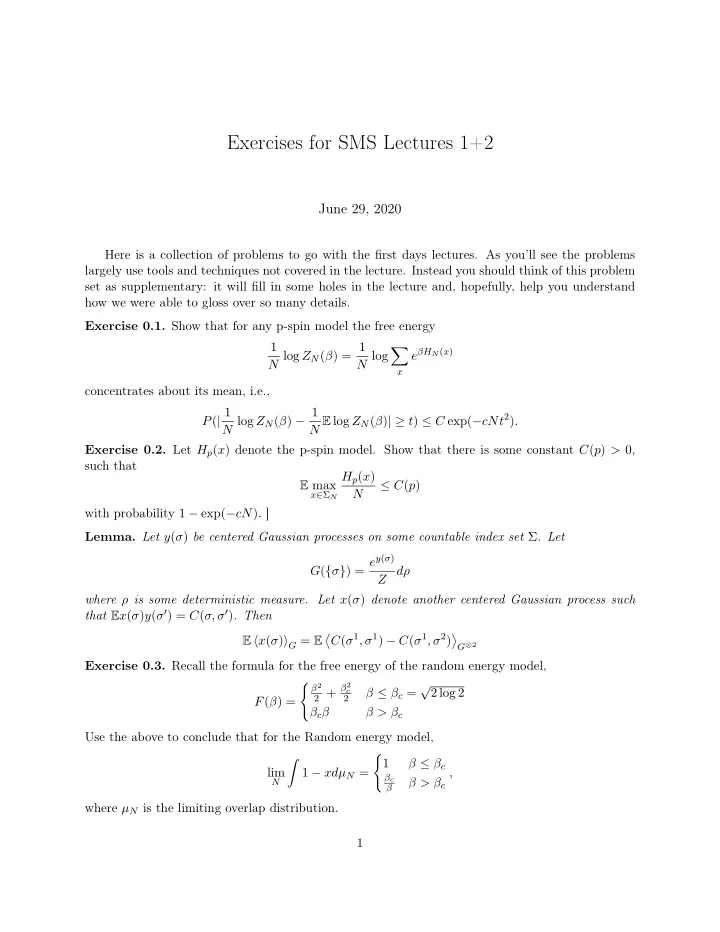
Here is a collection of problems to go with the first days lectures. As you’ll see the problems largely use tools and techniques not covered in the lecture. Instead you should think of this problem set as supplementary: it will fill in some holes in the lecture and, hopefully, help you understand how we were able to gloss over so many details. Exercise 0.1. Show that for any p-spin model the free energy 1 N log ZN(β) = 1 N log

  • x

eβHN(x) concentrates about its mean, i.e., P(| 1 N log ZN(β) − 1 N E log ZN(β)| ≥ t) ≤ C exp(−cNt2). Exercise 0.2. Let Hp(x) denote the p-spin model. Show that there is some constant C(p) > 0, such that E max

x∈ΣN

Hp(x) N ≤ C(p) with probability 1 − exp(−cN). ]

  • Lemma. Let y(σ) be centered Gaussian processes on some countable index set Σ. Let

G({σ}) = ey(σ) Z dρ where ρ is some deterministic measure. Let x(σ) denote another centered Gaussian process such that Ex(σ)y(σ′) = C(σ, σ′). Then E x(σ)G = E

  • C(σ1, σ1) − C(σ1, σ2)
  • G⊗2

Exercise 0.3. Recall the formula for the free energy of the random energy model, F(β) =

  • β2

2 + β2

c

2

β ≤ βc = √2 log 2 βcβ β > βc Use the above to conclude that for the Random energy model, lim

N

  • 1 − xdµN =
  • 1

β ≤ βc

βc β

β > βc , where µN is the limiting overlap distribution. 1

slide-2
SLIDE 2

Exercise 0.4. [Guerra-Toninelli]

  • 1. Let HN denote the Sherrington-Kirkpatrick Hamiltonian. [For the sake of this problem we will

assume that the sequence of random functions, (HN)N, are jointly independent]. Consider the Hamiltonian Ht : ΣN+M → R given by Ht((ρ, ǫ)) = √ 1 − tHN+M((ρ, ǫ)) + √ t (HN(ρ) + HM(ǫ)) Show that the function φ(t) = E log

  • (ρ,ǫ)∈ΣN+M

eβHt is decreasing. Use this to conclude that the sequence aN = N · FN(β) where FN(β) =

1 N E log ZN is super-additive, that is, aN+M ≥ aN + aM. Conclude that FN has a limit.

  • 2. Use the preceeding and the inequality

1 N max HN ≤ 1 βN log

  • eβH ≤ 1

N max HN + O( 1 β ) to conclude that

1 N E max HN also has a limit.

Exercise 0.5. Let (σℓ) be drawn iid from GN,β,p, the Gibbs measure for the p-spin model. Consider the sequence of arrays RN =

  • RN

ℓℓ′

  • ℓ,ℓ′≥1

where Rℓℓ′ = σℓ·σℓ′

N

. Show that RN is tight and weakly exchangable. Exercise 0.6. Let (xn) be the ranked points of a PPP(θt−θ−1dt).

  • 1. Show that if θ > 1, then

E

  • xn✶xn≥ǫ < ∞

E

  • xn✶xn≤ǫ = ∞
  • 2. On the other hand, show that if θ < 1 , show that

E

  • xn✶x<1 < ∞

E#{xn ≥ 1} = ∞ Use this to conclude that the Poisson-Dirichlet process PD(θ), vn = xn ∞

k=1 xk

, is well-defined.

  • 3. Compare this Poisson-Dirichlet process to the two parameter Poisson-Dirichlet processes.

2

slide-3
SLIDE 3

Exercise 0.7. (Ultrametric spaces)

  • 1. Prove the four properties of an ultrametric space from lecture.

(a) All triangles are acute isoceles (b) The intersection of two balls is either empty or one ball contains the other (c) The collection of balls of a fixed radius forms a partition (d) For any finite collection of radii, r1 < r2 < . . . < rn the collections of balls of those radii can be labelled by the vertices of a rooted tree in such away that the parent-child relationship matches the inclusion relationship, i.e., if α is a parent of β then Bα ⊃ Bβ.

  • 2. Let T be a rooted tree and let L denote the leaves of T, i.e., those verticies of degree 1. Show

that if v ∧ w denotes the least common ancestor of v, w ∈ L then d(v, w) = min{|v → v ∧ w|, |w → v ∧ w| is an ultrametric, where |v → x| denotes the length of the shortest (by graph distance on tree) path from v → x 3