Exercise Comparison of different rate control methods in Internet. - - PowerPoint PPT Presentation

exercise
SMART_READER_LITE
LIVE PREVIEW

Exercise Comparison of different rate control methods in Internet. - - PowerPoint PPT Presentation

Lic.(Tech.) Marko Luoma (1/16) Lic.(Tech.) Marko Luoma (2/16) Exercise Comparison of different rate control methods in Internet. Methods which are used are: S38.180 Palvelunlaatu Internetiss Token bucket Time sliding


slide-1
SLIDE 1

Lic.(Tech.) Marko Luoma (1/16)

S−38.180 Palvelunlaatu Internetissä S−38.180 Quality of Service in Internet Harjoitus 1: Rate Control Exercise 1: Rate Control

Lic.(Tech.) Marko Luoma (2/16)

Exercise

  • Comparison of different rate control methods in Internet.
  • Methods which are used are:

Token bucket Time sliding window Single rate two color marker.

Lic.(Tech.) Marko Luoma (3/16)

Reporting

Due date: 31.10.2001 at 1200 hours. Reports: delivered to course locker in G−wing 2nd floor.

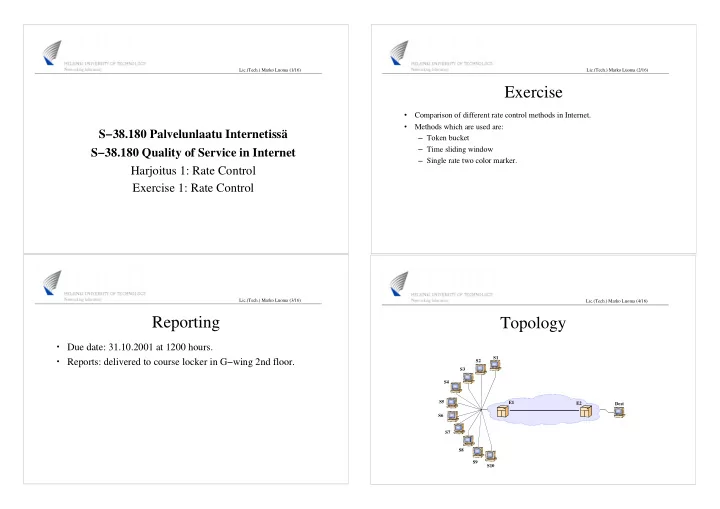
Lic.(Tech.) Marko Luoma (4/16) E2 E1 S1 S2 S3 S4 S5 S6 S7 S8 S9 S10 Dest

Topology

slide-2
SLIDE 2

Lic.(Tech.) Marko Luoma (5/16)

Task

  • Investigate the operation of different

metering and marking algorithms

  • Source population (traffic mix):

Pure TCP (greedy FTP) Pure UDP (CBR) Mixed (2−4 UDP clients and 6−8 TCP clients)

  • Contracts:

All clients equal contract Some clients substantially higher contract Some clients zero contract

  • Sending rates

Controllable sources (UDP) Below At Over the contracted capacity

  • See what is the outcome of the

service expressed as recovered capacities.

Lic.(Tech.) Marko Luoma (6/16)

Rate control

  • Implemented as policies:

$qE2E1 addPolicyEntry [$dest id] [$s1 id] TSW2CM 20 $cir1

Queue to manipulate Controlled connection Policer to be used Initial codepoint Contracted rate or size

Lic.(Tech.) Marko Luoma (7/16)

Policers

  • TSW2CM:

Time Sliding Window Meter with Two Color Marker Queue addPolicyEntry [Destination id] [Source id] TSW2CM Initial Codepoint CIR Packets are marked to lower precedence probabilistically when CIR is exceeded

  • TSW3CM:

Time Sliding Window Meter with Three Color Marker Queue addPolicyEntry [Destination id] [Source id] TSW3CM Initial Codepoint CIR PIR Packets are marked to medium precedence probabilistically when CIR is exceeded Packets are marked to low precedence probabilistically when PIR is exceeded

Lic.(Tech.) Marko Luoma (8/16)

Policers

  • Token Bucket:

Queue addPolicyEntry [Destination id] [Source id] tokenBucket Initial Codepoint CIR CBS Packets are marked to lower precedence when bucket is empty CIR = Token rate * Token size CBS = Size of the token bucket
slide-3
SLIDE 3

Lic.(Tech.) Marko Luoma (9/16)

Policers

  • srTCM:

Single Rate Meter with Three Color Marker Queue addPolicyEntry [Destination id] [Source id] srTCM Initial Codepoint CIR CBS EBS Two token buckets in cascade Packets are marked to medium precedence when first bucket is empty but second is not Packets are marked to low precedence when both buckets are empty

Lic.(Tech.) Marko Luoma (10/16)

Policers

  • trTCM:

Two Rate Meter with Three Color Marker

  • Queue addPolicyEntry [Destination id] [Source id] trTCM Initial Codepoint CIR CBS PIR PBS

Two token buckets in cascade Packets are marked to medium precedence when first bucket is empty but second is not Packets are marked to low precedence when both buckets are empty

Lic.(Tech.) Marko Luoma (11/16)

Policers

  • Action of policers is defined
  • $qE1E2 addPolicerEntry TSW2CM 10 11

Queue to manipulate Policer type Initial codepoint Degraded codepoint

Lic.(Tech.) Marko Luoma (12/16)

Forwarding

  • Each packet with assigned codepoint need some forwarding action to be

associated

  • This is done by selecting queue and precedence based on the codepoint

$qE1E2 addPHBEntry 10 0 1

Codepoint Queue Precedence (virtual queue)

slide-4
SLIDE 4

Lic.(Tech.) Marko Luoma (13/16)

Forwarding

  • Each virtual queue (precedence) is associated a RED algorithm with own

parameters: $qE1E2 configQ 0 1 10 40 0.10

Queue Precedence Min_TH Max_TH P_Max

Lic.(Tech.) Marko Luoma (14/16)

Sources

  • UDP source is defined by

Protocol source Packet size Protocol destination Null Application Packet size Sending rate

set udp1 [new Agent/UDP] $ns attach−agent $s1 $udp1 set cbr1 [new Application/Traffic/CBR] $cbr1 attach−agent $udp1 $cbr1 set packet_size_ $packetSize $udp1 set packetSize_ $packetSize $cbr1 set rate_ $rate1 set null1 [new Agent/Null] $ns attach−agent $dest $null1 $ns connect $udp1 $null1

Lic.(Tech.) Marko Luoma (15/16)

Sources

  • TCP source is defined by

Protocol source Packet size Protocol destination Sink Application

set tcp10 [new Agent/TCP] $ns attach−agent $s10 $tcp10 set ftp10 [new Application/FTP] $ftp10 attach−agent $tcp10 $tcp10 set packetSize_ $packetSize set sink10 [new Agent/TCPSink] $ns attach−agent $dest $sink10 $ns connect $tcp10 $sink10

Lic.(Tech.) Marko Luoma (16/16)

Simulator output

  • Event file where all

Enqueue (+) Dequeue (−) Drop (d) Receive (r) are presented in tabulated fashion

r 6.6938 4 5 tcp 1000 −−−−−−− 1 0.0 2.0 657 1301 + 6.6938 5 2 tcp 1000 −−−−−−− 1 0.0 2.0 657 1301 − 6.6938 5 2 tcp 1000 −−−−−−− 1 0.0 2.0 657 1301 r 6.694155 1 4 tcp 1000 −−−−−−− 2 1.0 3.0 10 1356 + 6.694155 4 5 tcp 1000 −−−−−−− 2 1.0 3.0 10 1356 d 6.694155 4 5 tcp 1000 −−−−−−− 2 1.0 3.0 10 1356 r 6.6946 0 4 tcp 1000 −−−−−−− 1 0.0 2.0 684 1357