
SLIDE 1
2
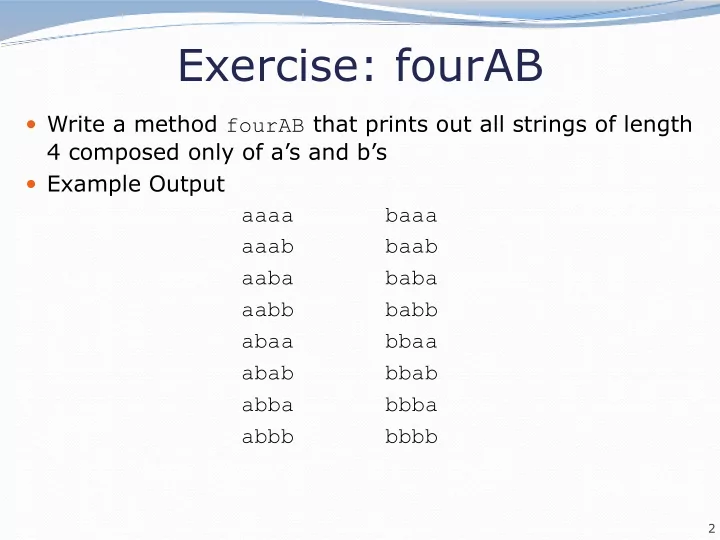
Exercise: fourAB
Write a method fourAB that prints out all strings of length
4 composed only of a’s and b’s
Example Output
aaaa baaa aaab baab aaba baba aabb babb abaa bbaa abab bbab abba bbba abbb bbbb
Exercise: fourAB Write a method fourAB that prints out all strings - - PowerPoint PPT Presentation
Exercise: fourAB Write a method fourAB that prints out all strings of length 4 composed only of as and bs Example Output aaaa baaa aaab baab aaba baba aabb babb abaa bbaa abab bbab abba bbba abbb bbbb 2 Decision Tree
2
Write a method fourAB that prints out all strings of length
4 composed only of a’s and b’s
Example Output
aaaa baaa aaab baab aaba baba aabb babb abaa bbaa abab bbab abba bbba abbb bbbb
3
a aa aaa aaab aab aaba aabb aaaa ab … b …
4
Write a method diceRoll that accepts an integer
parameter representing a number of 6-sided dice to roll, and output all possible arrangements of values that could appear on the dice.
diceRoll(2); diceRoll(3);
[1, 1] [1, 2] [1, 3] [1, 4] [1, 5] [1, 6] [2, 1] [2, 2] [2, 3] [2, 4] [2, 5] [2, 6] [3, 1] [3, 2] [3, 3] [3, 4] [3, 5] [3, 6] [4, 1] [4, 2] [4, 3] [4, 4] [4, 5] [4, 6] [5, 1] [5, 2] [5, 3] [5, 4] [5, 5] [5, 6] [6, 1] [6, 2] [6, 3] [6, 4] [6, 5] [6, 6] [1, 1, 1] [1, 1, 2] [1, 1, 3] [1, 1, 4] [1, 1, 5] [1, 1, 6] [1, 2, 1] [1, 2, 2] ... [6, 6, 4] [6, 6, 5] [6, 6, 6]
6
chosen available
1 3 dice 1, 1 2 dice 1, 1, 1 1 die 1, 1, 1, 1 1, 2 2 dice 1, 3 2 dice 1, 4 2 dice 2 3 dice 1, 1, 2 1 die 1, 1, 3 1 die 1, 1, 1, 2 1, 1, 3, 1 1, 1, 3, 2 1, 4, 1 1 die ... ... ... ... ... ... ... ...
10
backtracking: Finding solution(s) by trying partial
solutions and then abandoning them if they are not suitable.
a "brute force" algorithmic technique (tries all paths) often implemented recursively
Applications:
producing all permutations of a set of values parsing languages games: anagrams, crosswords, word jumbles, 8 queens combinatorics and logic programming
12
When solving a backtracking problem, ask these questions:
What are the "choices" in this problem?
What is the "base case"? (How do I know when I'm out of
choices?)
How do I "make" a choice?
Do I need to create additional variables to remember my choices? Do I need to modify the values of existing variables?
How do I explore the rest of the choices?
Do I need to remove the made choice from the list of choices?
Once I'm done exploring, what should I do? How do I "un-make" a choice?
13
Write a method diceSum similar to diceRoll, but it also
accepts a desired sum and prints only arrangements that add up to exactly that sum.
diceSum(2, 7); diceSum(3, 7);
[1, 1, 5] [1, 2, 4] [1, 3, 3] [1, 4, 2] [1, 5, 1] [2, 1, 4] [2, 2, 3] [2, 3, 2] [2, 4, 1] [3, 1, 3] [3, 2, 2] [3, 3, 1] [4, 1, 2] [4, 2, 1] [5, 1, 1] [1, 6] [2, 5] [3, 4] [4, 3] [5, 2] [6, 1]
14
chosen available desired sum
5 1 2 dice 1, 1 1 die 1, 1, 1 1, 2 1 die 1, 3 1 die 1, 4 1 die 6 2 dice ... 2 2 dice 3 2 dice 4 2 dice 5 2 dice 1, 5 1 die 1, 6 1 die 1, 1, 2 1, 1, 3 1, 1, 4 1, 1, 5 1, 1, 6 1, 6, 1 1, 6, 2
15
We need not visit every branch of the decision tree.
Some branches are clearly not going to lead to success. We can preemptively stop, or prune, these branches.
Inefficiencies in our dice sum algorithm:
Sometimes the current sum is already too high.
(Even rolling 1 for all remaining dice would exceed the sum.)
Sometimes the current sum is already too low.
(Even rolling 6 for all remaining dice would not reach the sum.)
When finished, the code must compute the sum every time.
(1+1+1 = ..., 1+1+2 = ..., 1+1+3 = ..., 1+1+4 = ..., ...)
16
chosen available desired sum
5 1 2 dice 1, 1 1 die 1, 1, 1 1, 2 1 die 1, 3 1 die 1, 4 1 die 6 2 dice ... 2 2 dice 3 2 dice 4 2 dice 5 2 dice 1, 5 1 die 1, 6 1 die 1, 1, 2 1, 1, 3 1, 1, 4 1, 1, 5 1, 1, 6 1, 6, 1 1, 6, 2