Exercise 1 public class AlcoholRegulations { public class Student { - - PowerPoint PPT Presentation

exercise 1
SMART_READER_LITE
LIVE PREVIEW

Exercise 1 public class AlcoholRegulations { public class Student { - - PowerPoint PPT Presentation

Exercise 1 public class AlcoholRegulations { public class Student { public boolean canLegallyDrinkAlcohol(Student st){ private String id; switch (st.getUniversity().getCountry()) { private University university; case "Afghanistan": private


slide-1
SLIDE 1

1

Exercise 1

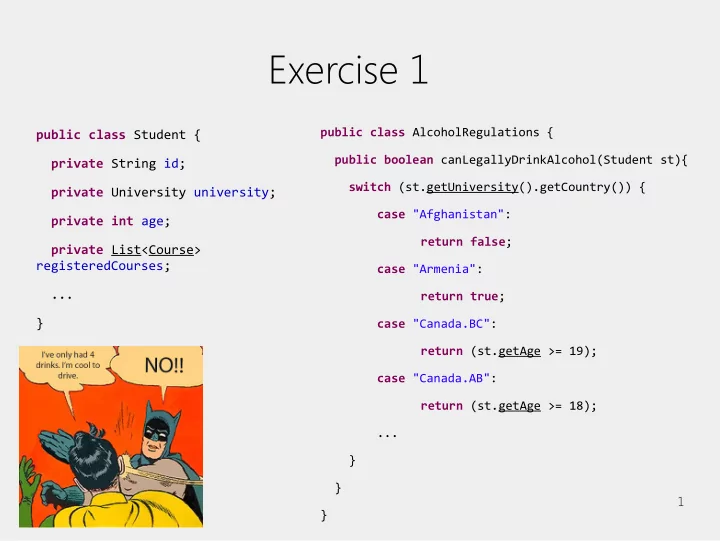
public class Student { private String id; private University university; private int age; private List<Course> registeredCourses; ... }

public class AlcoholRegulations { public boolean canLegallyDrinkAlcohol(Student st){ switch (st.getUniversity().getCountry()) { case "Afghanistan": return false; case "Armenia": return true; case "Canada.BC": return (st.getAge >= 19); case "Canada.AB": return (st.getAge >= 18); ... } } }

slide-2
SLIDE 2

2

TODO

Refactor these classes to reduce their coupling.

slide-3
SLIDE 3

3

Exercise 1

public class AlcoholRegulations { public boolean canLegallyDrinkAlcohol(Student st){ switch (st.getUniversity().getCountry()) { case "Afghanistan": return false; case "Armenia": return true; case "Canada.BC": return (st.getAge >= 19); case "Canada.AB":

P1 P2

slide-4
SLIDE 4

4

public class Student { private String id; private University university; private int age; private List<Course> registeredcourses; private Country country; //added } public class AlcoholRegulations { public boolean canLegallyDrinkAlochol(Student st) { //here we removed the call to getUniversity() switch(st.getCountry()) { case "Afghanistan": return false; } } }

ALTERNATIVE 1

Unnecessa sary duplication of da data Still tied to the Student class

slide-5
SLIDE 5

5

public class Student { private int age; private String id; private University university; private List<Course> registeredCourses; public boolean canLegallyDrinkAlcohol() { switch (this.getCountry()) { case "Afghanistan": return false; case "Armenia": return true; case "Canada.BC": return (this.getAge() >= 19); case "Canada.AB": return (this.getAge() >= 18); } public String getCountry() { return university.getCountry(); } public int getAge() { return age; } }

ALTERNATIVE 2

No mor

  • re coupling right now (o

(only one class) ) :) :) Bad cohesion :( ( Still tied to the Student class

slide-6
SLIDE 6

6

public interface Person { public int getAge(); public University getUniversity(); } public class Student implements Person { private String id; private University university; private int age; private List<Course> registeredCourses; public int getAge() {...} public University getUnivesity() {...} } public class AlcoholRegulation { public boolean canLegallyDrinkAlcohol (Person p) { switch (p.getUniversity().getCountry()) { case "Afghanistan": return false; case "Armenia": return true; case "Canada.BC": return (p.getAge()>=19); case "Canada.AB": return (p.getAge()>=18); ... } } }

ALTERNATIVE 3

Demeter's principle still violated Still so some coupling (A (AlcoholRegulation depends on Perso son) ) More complex design :( ( Limited to peopl ple that have a a link with a universi sity

slide-7
SLIDE 7

7

public class Person{ private String id; private int age; private String country; } public class Student extends Person{ private String sid; private University university; private List<Course> registeredCourse; ... } public class AlcoholRegulation { public boolean canLegallyDrinkAlcohol(Person p){ switch (p.getCountry()){ case ... case "Canada.BC": return (p.getAge >= 19); case "Canada.AB": return (p.getAge >= 18); ... } } }

ALTERNATIVE 4

Still some me coupling (A (Alcoh

  • holRegulation depends on Perso

son) ) More complex design :( (

slide-8
SLIDE 8

8

public class AlcoholRegulations { public boolean canLegallyDrink(String country, int age){ switch (country) { case "Afghanistan": return false; case "Armenia": return true; case "Canada.BC": return (age >= 19); case "Canada.AB": return (age >= 18); } } }

POSSIBLE SOLUTION

Demeter's principle respected No more dependencies, , rely on the use

  • f basic data types.
slide-9
SLIDE 9

9

Exercise 2 – What's wrong here ?

public class GameLauncher { protected RiskController controller; protected RiskGame game; private PrintWriter outChat = null; private BufferedReader inChat = null; private ChatArea chatter = null; private Socket chatSocket = null; private ChatDisplayThread myReader = null; private int applicationPort; protected String myIPAddress; protected boolean unlimitedLocalMode; private boolean autoplaceallMode; private boolean battleMode; private boolean replayMode; ... }

slide-10
SLIDE 10

10

TODO

Design a UML class diagram of this system where you would aim for more cohesion

slide-11
SLIDE 11

11

Exercise 2 – What's wrong here ?

public class GameLauncher { protected RiskController controller; protected RiskGame game; private PrintWriter outChat = null; private BufferedReader inChat = null; private ChatArea chatter = null; private Socket chatSocket = null; private ChatDisplayThread myReader = null; private int applicationPort; protected String myIPAddress; protected boolean unlimitedLocalMode; private boolean autoplaceallMode; private boolean battleMode; private boolean replayMode; ... }

Game Prope perties Game Prope perties Game Properties Game Properties NETWORK NETWORK CHAT NETWORK CHAT CHAT CHAT CHAT User INTEFACE User INTEFACE User INTEFACE User INTEFACE

slide-12
SLIDE 12

12

Do not duplicate class sses, you can create se several associations s between classes if needed

slide-13
SLIDE 13

13

Use se inheritance when you want to extend a behavior

  • r
slide-14
SLIDE 14

14 AGAIN here attributes and associations are expressing pretty much the same thing. T ake a look back at the exercises we did in class on association if you still don't understand why

slide-15
SLIDE 15

15 Design pretty okay, still some cohesion problems with chat/network aspects

slide-16
SLIDE 16

16

One of the best design gn from the class