SLIDE 1
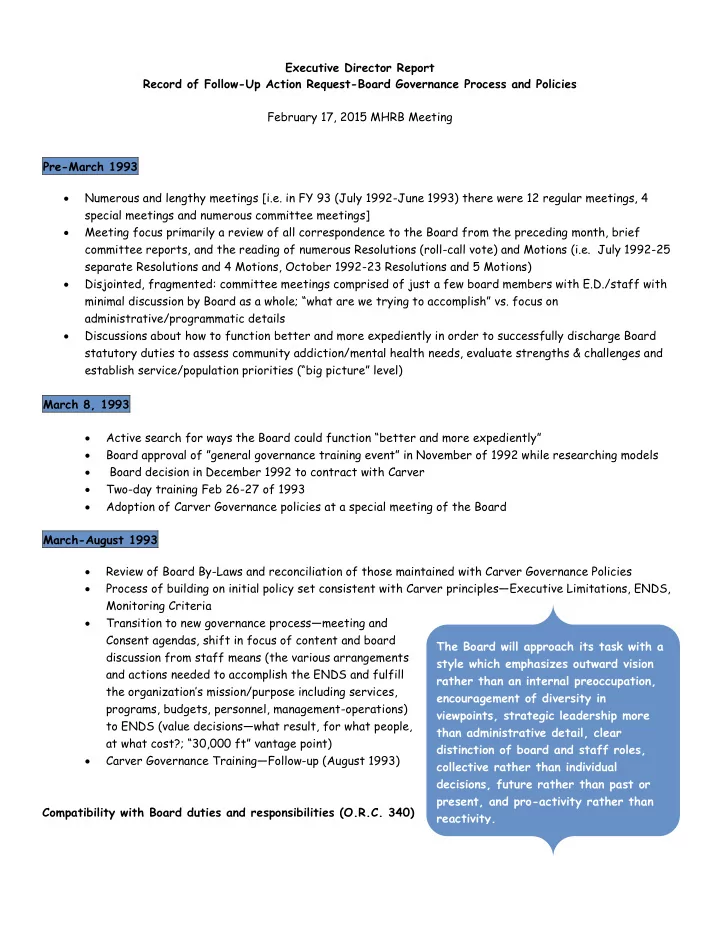
Executive Director Report Record of Follow-Up Action Request-Board Governance Process and Policies February 17, 2015 MHRB Meeting Pre-March 1993 Numerous and lengthy meetings [i.e. in FY 93 (July 1992-June 1993) there were 12 regular meetings, 4 special meetings and numerous committee meetings] Meeting focus primarily a review of all correspondence to the Board from the preceding month, brief committee reports, and the reading of numerous Resolutions (roll-call vote) and Motions (i.e. July 1992-25 separate Resolutions and 4 Motions, October 1992-23 Resolutions and 5 Motions) Disjointed, fragmented: committee meetings comprised of just a few board members with E.D./staff with minimal discussion by Board as a whole; “what are we trying to accomplish” vs. focus on administrative/programmatic details Discussions about how to function better and more expediently in order to successfully discharge Board statutory duties to assess community addiction/mental health needs, evaluate strengths & challenges and establish service/population priorities (“big picture” level) March 8, 1993 Active search for ways the Board could function “better and more expediently” Board approval of ”general governance training event” in November of 1992 while researching models Board decision in December 1992 to contract with Carver Two-day training Feb 26-27 of 1993 Adoption of Carver Governance policies at a special meeting of the Board March-August 1993 Review of Board By-Laws and reconciliation of those maintained with Carver Governance Policies Process of building on initial policy set consistent with Carver principles—Executive Limitations, ENDS, Monitoring Criteria Transition to new governance process—meeting and Consent agendas, shift in focus of content and board discussion from staff means (the various arrangements and actions needed to accomplish the ENDS and fulfill the organization’s mission/purpose including services, programs, budgets, personnel, management-operations) to ENDS (value decisions—what result, for what people, at what cost?; “30,000 ft” vantage point) Carver Governance Training—Follow-up (August 1993) Compatibility with Board duties and responsibilities (O.R.C. 340) The Board will approach its task with a style which emphasizes outward vision rather than an internal preoccupation, encouragement of diversity in viewpoints, strategic leadership more than administrative detail, clear distinction of board and staff roles, collective rather than individual decisions, future rather than past or present, and pro-activity rather than reactivity.
SLIDE 2 1994-Present Refinement and enhancement of board governance practice and policies Ongoing review and amendment of individual policies; comprehensive reviews of sections II (Governance Process) and IV (Ends) in 2007, 2014 Periodic Training on Policy Governance Model—formal, dedicated training sessions (noted below) plus various education or refresher segments on model and/or Board policies as part of regular meeting agenda under CQI Planning Carolyn Bailey-Carver Policy Governance & “New Board Leadership”: 1998, 2000, 2004, 2006, 2013 Staff and/or Board Solicitor-Carver Policy Governance (principles, ENDS, board member role & responsibilities, ethics) and Continuous Quality Improvement Planning: 2005, 2007, 2008, 2010, 2013, 2014 Board organization & membership (O.R.C. 340.02) and role of trustees November 2003-June 2004 Planning based primarily on historical service utilization and relatively “hold harmless” agency budgets Incremental/“Status Quo” approaches to planning and fund transfer policy resulted in a “get what we pay for, not what we plan for” scenario Lack of clarity of local system priorities—paramount in times of limited funds—and need for flexibility, adaptation and innovation in service mix and delivery Need for improved and more structured means of communication with stakeholders Precluded statutorily required central planning (assess community needs, set priorities, establish a plan based on set priorities for meeting the needs) at the MHRB level as the primary driving force for allocation
- f funds or changes to the system of care
Realization that the two approaches were incompatible…with a finite budget, cannot fund a system of care based on changing priorities and or results AND based on historical service utilization and static agency budgets at the same time Board charge to staff to investigate the best approach to develop a system of care that most effectively serves the mental health, alcohol and drug needs of Erie and Ottawa County residents July 2004-June 2005 Staff recommendation for Outcomes-based or Continuous Quality Improvement (CQI) planning approach was made and accepted at a special meeting of the Board on July 8, 2004
“Values” issues/priorities for consideration presented to Board in July; Board deliberation of system priorities in a series of regular and special meetings; Values translated into formal Resolutions outlining priorities for the local behavioral health care system-Nov. ’04 Directive for Request for Information (RFI) incorporating Board values, services and funding levels and distribution of such to all eligible and interested providers in December; Final RFI approved and distributed-Feb. 2005 ODADAS and ODMH community plans consistent with RFI and priorities
Board training on CQI planning approach (Sandy Starr, ODADAS & John Aller, Stark County ADM Board) Staff allocation recommendations based upon the evaluation of the bids and the values adopted by the board previous to the letting of the RFI were approved in June FY 2006 POS Contracts = watershed
SLIDE 3 July 2006-Present
- Ongoing development and integration of various components of
CQI Planning Process: Needs Assessment & Prioritization, Coordination & Collaboration, Budget & Contracting, and Monitoring, Oversight & Evaluation Includes tools, processes and other mechanisms to: Ensure the “continuous” part of CQI planning Preserve the accountability and transparency of the Board process Balance programming and funding across the system of care and the various service and population priorities with finite resources Ensure the integration of Board values/priorities and state & federal priorities within the context of policy and budget realities Ensure the alignment of resources with planned service and population priorities
- In recognition that the Board’s continuous monitoring and
development of its own process and functioning is an integral component of CQI planning, a comprehensive examination of governance policies was undertaken in accordance with the following perspectives and principles: The feedback and integration of information at each point in the planning cycle helps to ensure that continuous quality improvement occurs. To ensure compliance with O.R.C. Chapter 340 and other relevant laws and administrative rules To integrate policy governance principles and language, thus ensuring uniformity between our policies and practice To ensure compliance with Peer Certification Standards where relevant From a Continuous Quality Improvement approach
SLIDE 4 Present GOVERNANCE POLICY REVIEW & NEXT STEPS Section II: Governance Process: comprehensive reviews in 2007, 2014; monitoring criteria updated to reflect continuous quality improvement philosophy (i.e. monthly meeting evaluation) Section IV: ENDS: translation of Board priorities (November 2004 Resolutions) into values and incorporation into ENDS policy; review and additional values added in March, 2008; comprehensive review resulting in additional priorities/values, clarification, and further integration with Carver “language” in October, 2010; amendments to reflect statute changes and clarification of “recovery” value consistent with ROSC Section III: Board-Executive Director Relationship:
- Comprehensive initial review and vetting completed by staff
per review process, consistent with perspectives and principles
- Everything in current policy set included in proposed revisions;
previous Board policy decisions incorporated (from Personnel Manual, Motion re: Ad Hoc Personnel Committee recommendations)
- Reorganization of information and addition of two policies
- Will be presented to Board at March meeting
Process for Review, Revision & Amendment of Policies PRINCIPLES
▪As individual policies within each section and/or between sections are inter-related, any revision or review involves looking at them as a set. This approach to address the policies collectively helps ensure:
- that changes are not contradictory
with existing policies
- that missing or incomplete policies
are addressed in a logical manner, rather than by cross-reference or duplication
- that policies are contained in the
correct domain or section ▪Recognition that various/individual polices are integral pieces of a whole as well as discrete, separate standards or rules underlying a given action
Review of content of existing policy/section:
- Does it address issues relevant to
the policy area?
- Does it say too much or too little?
- Does it address all relevant laws,
rules and regulations?
- Does it address required elements in
conformance with relevant COQ Standards?
- Do policies need to be developed or
amended in other sections in order to accurately reflect the desired rule/standard/perspective?
- Is it consistent with the principles
and language of policy governance?
- Does it include proposed changes or
additions to policy based on Board discussion (prospective, based on Board concerns or interest, or retrospective, based on feedback after the drafted or amended policy is presented for discussion)?