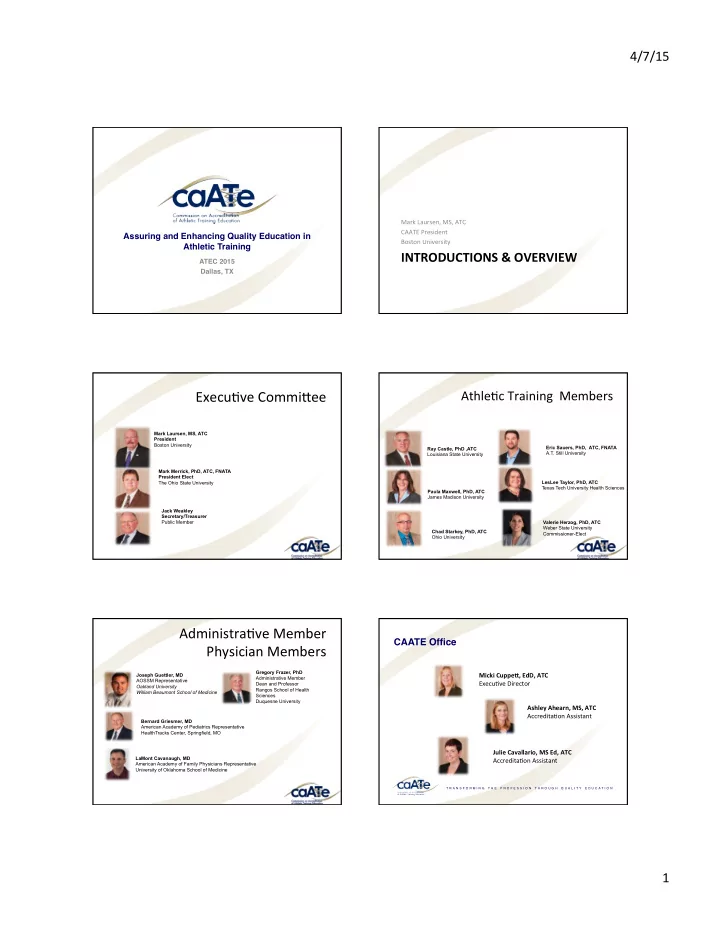
ExecuAve CommiCee AthleAc Training Members Mark Laursen, - - PDF document

execuave commicee
SMART_READER_LITE
LIVE PREVIEW

ExecuAve CommiCee AthleAc Training Members Mark Laursen, - - PDF document

4/7/15 Mark Laursen, MS, ATC CAATE President Assuring and Enhancing Quality Education in Boston University Athletic Training INTRODUCTIONS & OVERVIEW ATEC 2015 Dallas, TX ExecuAve


slide-1
SLIDE 1

4/7/15 ¡ 1 ¡

Assuring and Enhancing Quality Education in Athletic Training

ATEC 2015 Dallas, TX

INTRODUCTIONS ¡& ¡OVERVIEW ¡

Mark ¡Laursen, ¡MS, ¡ATC ¡ CAATE ¡President ¡ Boston ¡University ¡

ExecuAve ¡CommiCee ¡

Mark Laursen, MS, ATC President Boston University Mark Merrick, PhD, ATC, FNATA President Elect The Ohio State University Jack Weakley Secretary/Treasurer Public Member Ray Castle, PhD ,ATC Louisiana State University Chad Starkey, PhD, ATC Ohio University

AthleAc ¡Training ¡ ¡Members ¡

Paula Maxwell, PhD, ATC James Madison University LesLee Taylor, PhD, ATC Texas Tech University Health Sciences Eric Sauers, PhD, ATC, FNATA A.T. Still University Valerie Herzog, PhD, ATC Weber State University Commissioner-Elect

AdministraAve ¡Member ¡ ¡ Physician ¡Members ¡

LaMont Cavanaugh, MD American Academy of Family Physicians Representative University of Oklahoma School of Medicine Gregory Frazer, PhD Administrative Member Dean and Professor Rangos School of Health Sciences Duquesne University Joseph Guettler, MD AOSSM Representative Oakland University William Beaumont School of Medicine Bernard Griesmer, MD American Academy of Pediatrics Representative HealthTracks Center, Springfield, MO

T R A N S F O R M I N G T H E P R O F E S S I O N T H R O U G H Q U A L I T Y E D U C A T I O N

CAATE Office

Ashley ¡Ahearn, ¡MS, ¡ATC ¡ AccreditaAon ¡Assistant ¡

¡

Micki ¡Cuppe?, ¡EdD, ¡ATC ¡ ExecuAve ¡Director ¡ Julie ¡Cavallario, ¡MS ¡Ed, ¡ATC ¡ AccreditaAon ¡Assistant ¡

¡

slide-2
SLIDE 2

4/7/15 ¡ 2 ¡

T R A N S F O R M I N G T H E P R O F E S S I O N T H R O U G H Q U A L I T Y E D U C A T I O N

Overview

  • Analytics
  • Public Accountability & Transparency
  • Quality Improvement Current
  • Quality Improvement Future
  • Questions
  • Examining the Professional Degree
  • Public Comments

ANALYTICS ¡

Mark ¡Merrick, ¡PhD, ¡ATC, ¡FNATA ¡ CAATE ¡President-­‑Elect ¡ The ¡Ohio ¡State ¡University ¡

Current ¡ Number ¡

  • f ¡

Programs ¡ Average ¡ Total ¡ Annual ¡ Graduates ¡ Percentage ¡

  • f ¡

Graduates ¡ who ¡took ¡ BOC ¡Exam ¡ Average ¡ Graduates ¡ per ¡program ¡ (Exam ¡ Candidates) ¡ ¡ Program ¡ Average ¡1st ¡ A?empt ¡ BOC ¡Exam ¡ Pass ¡Rate ¡ Program ¡ Average ¡ Any-­‑ A?empt ¡ BOC ¡Exam ¡ Pass ¡Rate ¡ Programs ¡ Non-­‑ Compliant ¡ with ¡ Standard ¡ 11 ¡ Percentage ¡

  • f ¡all ¡

Programs ¡ Non-­‑ Compliant ¡ with ¡ Standard ¡11 ¡

365 ¡ 3629.7 ¡ 94% ¡ 10.1 ¡ ¡ (9.5) ¡ 79% ¡ 90% ¡ 96 ¡ 26% ¡

Current ¡Three ¡Year ¡GraduaAon ¡ ¡ and ¡BOC ¡Exam ¡Totals ¡(2012-­‑14) ¡

* ¡Data ¡exclude ¡new ¡programs ¡with ¡< ¡3 ¡yrs ¡data ¡(N=4) ¡ 0 ¡ 20 ¡ 40 ¡ 60 ¡ 80 ¡ 100 ¡ 120 ¡ 140 ¡

  • ­‑

9 % ¡ 1

  • ­‑

1 9 % ¡ 2

  • ­‑

2 9 % ¡ 3

  • ­‑

3 9 % ¡ 4

  • ­‑

4 9 % ¡ 5

  • ­‑

5 9 % ¡ 6

  • ­‑

6 9 % ¡ 7

  • ­‑

7 9 % ¡ 8

  • ­‑

8 9 % ¡ 9

  • ­‑

1 % ¡ 1 ¡ 1 ¡ 8 ¡ 5 ¡ 9 ¡ 27 ¡ 45 ¡ 58 ¡ 82 ¡ 125 ¡

Number ¡of ¡programs ¡per ¡range ¡ 1st ¡A?empt ¡Pass ¡Rate ¡Range ¡(3yr ¡avg) ¡

1st ¡A?empt ¡BOC ¡Exam ¡Pass ¡Rate ¡ ¡ ALL ¡PROGRAMS: ¡ ¡ 2012-­‑2014 ¡exams ¡(current) ¡

Majority ¡of ¡students ¡in ¡these ¡ ¡ programs ¡fail ¡1st ¡aCempt ¡ ¡ at ¡board ¡exam, ¡N=24 ¡

30 ¡of ¡45 ¡are ¡at ¡ 65% ¡pass ¡rate ¡

  • r ¡beCer ¡

0 ¡ 50 ¡ 100 ¡ 150 ¡

0-­‑9% ¡ 10-­‑19% ¡ 20-­‑29% ¡ 30-­‑39% ¡ 40-­‑49% ¡ 50-­‑59% ¡ 60-­‑69% ¡ 70-­‑79% ¡ 80-­‑89% ¡ 90-­‑100% ¡

1 ¡ 1 ¡ 8 ¡ 5 ¡ 9 ¡ 27 ¡ 45 ¡ 58 ¡ 82 ¡ 125 ¡

Number ¡of ¡programs ¡per ¡range ¡

1st ¡A?empt ¡Pass ¡Rate ¡Range ¡(3yr ¡avg) ¡

1st ¡A?empt ¡BOC ¡Exam ¡Pass ¡Rate ¡ ¡ ALL ¡PROGRAMS: ¡ ¡ 2012-­‑2014 ¡exams ¡(current) ¡

0 ¡ 50 ¡ 100 ¡ 150 ¡

0-­‑9% ¡ 10-­‑19% ¡ 20-­‑29% ¡ 30-­‑39% ¡ 40-­‑49% ¡ 50-­‑59% ¡ 60-­‑69% ¡ 70-­‑79% ¡ 80-­‑89% ¡ 90-­‑100% ¡

3 ¡ 2 ¡ 5 ¡ 9 ¡ 10 ¡ 26 ¡ 42 ¡ 55 ¡ 90 ¡ 123 ¡

Number ¡of ¡programs ¡per ¡range ¡

1st ¡A?empt ¡Pass ¡Rate ¡Range ¡(3yr ¡avg) ¡

1st ¡A?empt ¡BOC ¡Exam ¡Pass ¡Rate ¡ ¡ ALL ¡PROGRAMS: ¡ ¡ 2011-­‑2013 ¡exams ¡(1 ¡year ¡ago) ¡

New ¡Programs ¡ 4 ¡ Non-­‑compliant ¡ 96 ¡ Compliant ¡ 265 ¡

Standard ¡11 ¡Compliance ¡2012-­‑14: ¡ ¡ All ¡Programs ¡(count) ¡

slide-3
SLIDE 3

4/7/15 ¡ 3 ¡

New ¡ Programs ¡ 3 ¡

Standard ¡11 ¡Compliance ¡ 2012-­‑14: ¡ ¡ Bachelor's ¡Programs ¡ (count) ¡

Compliant ¡ 237 ¡ Non-­‑compliant ¡ 96 ¡ New ¡ Programs ¡ 1 ¡ Non-­‑ compliant ¡ 1 ¡

Standard ¡11 ¡Compliance ¡ 2012-­‑14: ¡ ¡ Master's ¡Programs ¡(count) ¡

Compliant ¡ 28 ¡ For ¡2012-­‑14, ¡Bachelors ¡programs ¡are ¡13.2 ¡Ames ¡more ¡likely ¡to ¡be ¡non-­‑compliant ¡on ¡ Standard ¡11 ¡than ¡Masters ¡programs ¡ ¡ ¡ 0 ¡ 50 ¡ 100 ¡ 150 ¡

0-­‑9% ¡ 10-­‑19% ¡ 20-­‑29% ¡ 30-­‑39% ¡ 40-­‑49% ¡ 50-­‑59% ¡ 60-­‑69% ¡ 70-­‑79% ¡ 80-­‑89% ¡ 90-­‑100% ¡

1 ¡ 1 ¡ 8 ¡ 5 ¡ 9 ¡ 27 ¡ 44 ¡ 56 ¡ 81 ¡ 100 ¡ Number ¡of ¡programs ¡per ¡ range ¡ 1st ¡A?empt ¡Pass ¡Rate ¡Range ¡(3yr ¡avg) ¡

1st ¡A?empt ¡BOC ¡Exam ¡Pass ¡Rate ¡ ¡ BACHELOR ¡PROGRAMS: ¡ ¡ 2012-­‑2014 ¡exams ¡(current) ¡

0 ¡ 50 ¡ 100 ¡ 150 ¡

0-­‑9% ¡ 10-­‑19% ¡ 20-­‑29% ¡ 30-­‑39% ¡ 40-­‑49% ¡ 50-­‑59% ¡ 60-­‑69% ¡ 70-­‑79% ¡ 80-­‑89% ¡ 90-­‑100% ¡

0 ¡ 0 ¡ 0 ¡ 0 ¡ 0 ¡ 0 ¡ 1 ¡ 2 ¡ 1 ¡ 25 ¡ Number ¡of ¡programs ¡per ¡ range ¡ 1st ¡A?empt ¡Pass ¡Rate ¡Range ¡(3yr ¡avg) ¡

1st ¡A?empt ¡BOC ¡Exam ¡Pass ¡Rate ¡ ¡ MASTER'S ¡PROGRAMS: ¡ ¡ 2012-­‑2014 ¡exams ¡(current) ¡

*30% ¡of ¡bachelor’s ¡and ¡86% ¡of ¡master’s ¡programs ¡had ¡1st ¡aCempt ¡pass ¡rates ¡>90% ¡

Number ¡of ¡ Programs ¡ Average ¡ Total ¡ Annual ¡ Graduates ¡ Average ¡ Percentage ¡

  • f ¡

Graduates ¡ who ¡took ¡ BOC ¡Exam ¡ Average ¡ Exam ¡ Candidates ¡ per ¡ Program ¡ 1st ¡A?empt ¡ BOC ¡Exam ¡ Pass ¡Rate ¡ Any ¡ A?empt ¡ BOC ¡Exam ¡ Pass ¡Rate ¡ Number ¡of ¡ ¡ Non-­‑ Compliant ¡ with ¡ Standard ¡ 11 ¡ Percentage ¡

  • f ¡Non-­‑

Compliant ¡ with ¡ Standard ¡ 11 ¡ Bachelors ¡

335 ¡ 3336.0 ¡ 94% ¡ 9.4 ¡ 78% ¡ 89% ¡ 95 ¡ 28% ¡

Masters ¡ ¡

30 ¡ 293.7 ¡ 98% ¡ 9.9 ¡ 93% ¡ 98% ¡ 1 ¡ 3% ¡

Total ¡

365 ¡ 3629.7 ¡ 94% ¡ 9.5 ¡ 79% ¡ 90% ¡ 96 ¡ 26% ¡

BOC ¡Exam ¡Performance ¡By ¡Program ¡Type ¡

*Professional ¡programs ¡average ¡10.1 ¡graduates ¡per ¡year. ¡17% ¡of ¡programs ¡graduate ¡5 ¡or ¡fewer ¡per ¡ year ¡and ¡57% ¡of ¡programs ¡graduate ¡10 ¡or ¡fewer ¡per ¡year. ¡

0% ¡ 10% ¡ 20% ¡ 30% ¡ 40% ¡ 50% ¡ 60% ¡ 70% ¡ 80% ¡ 90% ¡ 100% ¡ 0.0 ¡ 5.0 ¡ 10.0 ¡ 15.0 ¡ 20.0 ¡ 25.0 ¡ 30.0 ¡ 35.0 ¡ 40.0 ¡

1st ¡A?empt ¡Pass ¡Rate ¡(3yr ¡avg) ¡

  • Avg. ¡Annual ¡Program ¡Graduates ¡

2012-­‑14 ¡1st ¡ACempt ¡BOC ¡Exam ¡Pass ¡Rate ¡v. ¡Annual ¡ ¡ Graduates ¡

PUBLIC ¡ACCOUNTABILITY ¡& ¡ TRANSPARENCY ¡

Eric ¡Sauers, ¡PhD, ¡ATC, ¡FNATA ¡ CAATE ¡Commissioner ¡ A.T. ¡SAll ¡University ¡

T R A N S F O R M I N G T H E P R O F E S S I O N T H R O U G H Q U A L I T Y E D U C A T I O N

CHEA Recognition

  • CHEA Board action September 30, 2014
  • Have interim report due July 1, 2017
slide-4
SLIDE 4

4/7/15 ¡ 4 ¡

T R A N S F O R M I N G T H E P R O F E S S I O N T H R O U G H Q U A L I T Y E D U C A T I O N

Key Issues in Higher Education Accreditation

  • Quality Assurance AND Quality Improvement
  • Reducing costs and regulatory burden of

accreditation

  • Consumer protection via increased transparency

and accountability

T R A N S F O R M I N G T H E P R O F E S S I O N T H R O U G H Q U A L I T Y E D U C A T I O N

Important Policies Impacting Higher Education Accreditation

  • Reauthorization of the Higher Education Act
  • National Advisory Committee on Institutional Quality

and Integrity

  • College Rating System
  • Gainful Employment Rule
  • The Supporting Academic Freedom through

Regulatory Relief Act

T R A N S F O R M I N G T H E P R O F E S S I O N T H R O U G H Q U A L I T Y E D U C A T I O N

Implication for the CAATE and AT Education

  • Focus on outcomes to reduce the regulatory

burden

  • Greater emphasis on quality improvement
  • Increased consumer protection through greater

transparency and accountability

  • Consider key metrics of rating: access, cost, and
  • utcomes
  • Mindful of gainful employment mindset

QUALITY ¡IMPROVEMENT ¡-­‑ ¡ CURRENT ¡

Micki ¡CuppeC, ¡EdD, ¡ATC ¡ ExecuAve ¡Director ¡

T R A N S F O R M I N G T H E P R O F E S S I O N T H R O U G H Q U A L I T Y E D U C A T I O N

Quality Improvement eAccreditation

  • All Substantive Changes now done electronically

– Request for degree change – Program director change – Change in college/school

  • Benchmarking now available
  • CAATE Analytics Report
slide-5
SLIDE 5

4/7/15 ¡ 5 ¡

Benefits ¡of ¡A ¡CAS ¡

Programs ¡ ¡

  • Free ¡parAcipaAon ¡
  • Exposure ¡to ¡wider ¡

applicant ¡pool ¡

  • Benchmarking ¡vs. ¡

naAonal ¡or ¡idenAfied ¡ cohorts ¡

  • Maintain ¡individual ¡

workflow ¡and ¡ admissions ¡standards ¡ ¡

Applicants ¡ ¡

  • Single ¡online ¡

applicaAon ¡

  • Easy, ¡intuiAve ¡interface ¡
  • 24x7 ¡mobile ¡access ¡
  • Real-­‑Ame ¡updates ¡
  • One ¡point ¡of ¡contact ¡

for ¡support ¡

¡ ¡ AssociaAon ¡ ¡

  • Real-­‑Ame ¡data ¡& ¡

common ¡standards ¡

  • Accurate ¡staAsAcs ¡on ¡

professions ¡

  • Assists ¡with ¡workforce ¡

projecAons, ¡future ¡ trends, ¡and ¡recruitment ¡ strategies ¡

¡ ¡

T R A N S F O R M I N G T H E P R O F E S S I O N T H R O U G H Q U A L I T Y E D U C A T I O N

Workshops

  • 2014 Conference a success

– Over capacity – 125 participants

  • 6 Deans
  • 15 Department

Chairs

  • 61 Program Directors
  • Site Visitor Workshops
  • District workshops

T R A N S F O R M I N G T H E P R O F E S S I O N T H R O U G H Q U A L I T Y E D U C A T I O N

Accreditation Conference 2015

  • October 16-18, 2015
  • Hilton Tampa Downtown
  • Larger space with room for more attendees
  • 2 ½ days of programming geared toward program personnel and

administration

QUALITY ¡ASSURANCE ¡IN ¡THE ¡SITE ¡ VISIT ¡PROCESS ¡

Leslee ¡Taylor, ¡PhD, ¡LAT, ¡ATC ¡ CAATE ¡Commissioner ¡ Texas ¡Tech ¡University ¡Health ¡Sciences ¡Center ¡

T R A N S F O R M I N G T H E P R O F E S S I O N T H R O U G H Q U A L I T Y E D U C A T I O N

Site Visitor Training

Focus of the site visit teams, CAATE Committees, & Commission is to look for compliance NOT noncompliance

Training

  • Site Visitor Training & Administrator’s Session

– ATEC – ~35 site visitors & 26 Administrators – St. Louis– June 22-23, 2015

  • Site Visitor Chair Training

– CAATE Accreditation Conference October 2015

T R A N S F O R M I N G T H E P R O F E S S I O N T H R O U G H Q U A L I T Y E D U C A T I O N

Site Visit Purpose

  • Validate the self-study report and compliance

with the appropriate CAATE Standards

  • To aid CAATE in reaching an accreditation

decision that is defined, consistent, free of personal biases, free of conflicts of interest, free

  • f non-sanctioned interpretations, and upholds

respect for institutional autonomy.

slide-6
SLIDE 6

4/7/15 ¡ 6 ¡

T R A N S F O R M I N G T H E P R O F E S S I O N T H R O U G H Q U A L I T Y E D U C A T I O N

Site Visit Process

Once Program Submits Documents via eAccreditation Site Visitor Selection & Notification

  • Site Visit Committee makes SV team assignments

– Size of Institution/Carnegie Classification, – Conflict of Interest (Site Visitor & Institution), etc.

  • Three person team:

– SV Chair – SV Team Member – SV Reader

  • Within one week of receiving the SV assignment, the SV chair must

make contact with the program and team members

– Please let the CAATE office know if you do not hear from your SV chair.

T R A N S F O R M I N G T H E P R O F E S S I O N T H R O U G H Q U A L I T Y E D U C A T I O N

Site Visit Process

Review of Self Study

  • Pre-Site Visit Module in eAccreditation

– Each site visitor independently indicates a preliminary degree of compliance for each standard

  • If needed, the SV chair will contact the program to request any

additional materials or to clarify areas of question

– Via eAccreditation by reopening specific standards

Site Visit Agenda

  • All site visits will use the 3 day agenda

– Agenda lengthened to allow adequate time meet with everyone and visit clinical sites unrushed. Change made based on feedback from programs & site visitors – On-going evaluation based on feedback

T R A N S F O R M I N G T H E P R O F E S S I O N T H R O U G H Q U A L I T Y E D U C A T I O N

Site Visit Process

On-Site Visit

  • Preliminary Conference
  • Standards are the minimum requirements that a program

must meet

  • Meet with the program director daily to keep him/her

apprised of concerns, areas of non-compliance, etc.

  • Exit Conference

T R A N S F O R M I N G T H E P R O F E S S I O N T H R O U G H Q U A L I T Y E D U C A T I O N

Site Visit Process

Site Visit Report

  • Introduction – Brief History of the Program
  • Strengths – Positive Aspects of the Program
  • Standards – Report areas of non-compliance with a rationale

– If non-compliance cited, indication that the SV team cannot find compliance; the rejoinder allows the institution to demonstrate compliance

  • Recommendations – Suggestions that might strengthen the

program

  • Individuals interviewed – List name, credentials, and role in

program

T R A N S F O R M I N G T H E P R O F E S S I O N T H R O U G H Q U A L I T Y E D U C A T I O N

Quality Assurance

The CAATE is striving to improve the SV process and increase the quality of its site visits. An integral part of our quality assurance process is obtaining valid feedback from all individuals (peer, program, and review team) involved in the site visit process.

  • Cumulative data will be collected and sent to all site visitors.

– Allows the site visitor to see his/her status compared to others – Aids Site Visit Committee in recommending retention and training

  • Evaluation includes professionalism, knowledge of Standards, and

preparedness for visit (i.e. fair and objective, maintained confidentiality, unbiased, and appropriately dressed).

  • Only as good at the feedback we receive about the process and site

visitors.

T R A N S F O R M I N G T H E P R O F E S S I O N T H R O U G H Q U A L I T Y E D U C A T I O N

Site Visit Numbers*

* ¡All ¡numbers ¡beginning ¡with ¡2015-­‑2016 ¡subject ¡to ¡change ¡un;l ¡documents ¡submi=ed. ¡

2014-­‑20 15 ¡ 2015-­‑20 16 ¡ 2016-­‑20 17 ¡ 2017-­‑20 18 ¡ 2018-­‑20 19 ¡ ConAnuing ¡AccreditaAon ¡ Professional ¡(Bac ¡ ¡& ¡Post ¡Bac) ¡ 22 ¡ 29 ¡ 27 ¡ 52 ¡ 83 ¡ Post-­‑Professional ¡Degree ¡ 0 ¡ 5 ¡ 5 ¡ 4 ¡

  • ­‑-­‑ ¡

Residency ¡ 0 ¡ 0 ¡ 0 ¡ 2 ¡

  • ­‑-­‑ ¡

SubstanAve ¡Change ¡– ¡Level ¡of ¡Degree ¡ Professional ¡ 6 ¡ 8 ¡ 5 ¡ 3 ¡

  • ­‑-­‑ ¡

Post-­‑Professional ¡Degree ¡ 0 ¡ 1 ¡ 1 ¡

  • ­‑-­‑ ¡
  • ­‑-­‑ ¡

IniAal ¡AccreditaAon ¡ Professional ¡(Bac ¡ ¡& ¡Post ¡Bac) ¡ 4 ¡ 12 ¡

  • ­‑-­‑ ¡
  • ­‑-­‑ ¡
  • ­‑-­‑ ¡

Post-­‑Professional ¡Degree ¡ 0 ¡

  • ­‑-­‑ ¡
  • ­‑-­‑ ¡
  • ­‑-­‑ ¡
  • ­‑-­‑ ¡

Residency ¡ 3 ¡

  • ­‑-­‑ ¡
  • ­‑-­‑ ¡
  • ­‑-­‑ ¡
  • ­‑-­‑ ¡

Total ¡Number ¡of ¡Visits ¡ 35 ¡ 55 ¡ 38 ¡ 61 ¡ 83 ¡
slide-7
SLIDE 7

4/7/15 ¡ 7 ¡

T R A N S F O R M I N G T H E P R O F E S S I O N T H R O U G H Q U A L I T Y E D U C A T I O N

Substantive Change – Level of Degree

  • Purpose

– The Substantive Change Process is designed for Programs that are mid‐accreditation cycle and wish to voluntarily change the level of the without completing an entire self-study. (Professional & Post-Professional Degree)

  • Eligibility

– This process is available annually to programs that are mid- accreditation cycle and are in good standing (i.e., not on probation).

  • Timeline

– MAY 1st – Notification of Intent & review fee are due – AUGUST 1st - Substantive Change Application & Documents are due

QUALITY ¡ASSURANCE ¡IN ¡THE ¡ REVIEW ¡PROCESS ¡

Paula ¡Maxwell, ¡PhD, ¡ATC ¡ CAATE ¡Commissioner ¡ ¡ James ¡Madison ¡University ¡

Review ¡CommiCee ¡

  • Made ¡up ¡of ¡non-­‑CAATE ¡Commissioners ¡

– Review ¡CommiCee ¡Chair ¡ – Review ¡Team ¡Coordinators ¡ – Review ¡Team ¡Members ¡(3-­‑4 ¡per ¡team) ¡ – Three ¡teams ¡for ¡Professional ¡Programs; ¡Two ¡teams ¡for ¡Post ¡Professional ¡ Programs ¡

  • Liaison ¡from ¡the ¡Commission ¡to ¡the ¡Review ¡CommiCee ¡

¡

Review ¡ Commi?ee ¡Chair ¡

Review ¡ Team ¡#1 ¡ Review ¡ Team ¡#2 ¡ Review ¡ Team ¡#3 ¡ Review ¡ Team ¡#4 ¡ Review ¡ Team ¡#5 ¡

Commissioner ¡ Liaison ¡to ¡the ¡RC ¡ CAATE ¡ Commission ¡

Roles ¡of ¡Review ¡Commi?ee ¡Members ¡

  • Commissioner ¡Liaison: ¡ ¡

– Resource ¡person ¡

¡

  • Review ¡Commi?ee ¡Chair: ¡ ¡

– Organizes ¡and ¡tracks ¡reports ¡ – Assigns ¡reports ¡to ¡teams ¡according ¡to ¡Conflicts ¡of ¡ Interest ¡ – Resource ¡person ¡for ¡the ¡Review ¡Teams ¡ – Reviews ¡all ¡reports ¡for ¡consistency ¡and ¡accuracy ¡once ¡ RT ¡finish ¡ – Communicates ¡with ¡the ¡CAATE ¡and ¡the ¡Standards ¡ CommiCee ¡ – Completes ¡annual ¡assessment ¡of ¡NCs ¡to ¡suggest ¡areas ¡ for ¡change ¡or ¡clarity ¡

¡ ¡ T R A N S F O R M I N G T H E P R O F E S S I O N T H R O U G H Q U A L I T Y E D U C A T I O N

Roles of Review Committee Members


  • Review Team Coordinator:

– Organizes team and reports within the individual team – Tracks reports and maintains timelines – Communicates with the Review Committee Chair and

  • ther team Coordinators

– Helps review reports with team members

  • Review Team Members:

– Review site visit reports, rejoinders and progress reports – Communicate with the site visitors

Review ¡Process ¡

Site ¡visit ¡report/rejoinder/progress ¡report ¡submiCed ¡via ¡ eAccreditaAon ¡ Report ¡checked ¡for ¡typos, ¡grammaAcal ¡errors, ¡proper ¡ format, ¡completeness ¡ Review ¡CommiCee ¡Chair ¡and ¡Review ¡Team(s) ¡noAfied ¡ that ¡report ¡is ¡ready ¡ Review ¡Team ¡Reviews ¡the ¡report ¡ Call ¡SV ¡Team ¡ if ¡SV ¡Report ¡ Review ¡CommiCee ¡Team ¡#2 ¡reviews ¡report ¡if ¡ complicated, ¡has ¡potenAal ¡negaAve ¡outcomes ¡or ¡if ¡team ¡ members ¡are ¡not ¡in ¡agreement; ¡Release ¡back ¡to ¡RC ¡Chair ¡ for ¡final ¡review ¡ ¡ Review ¡CommiCee ¡Chair ¡reviews ¡for ¡accuracy, ¡ consistency, ¡and ¡appropriateness ¡of ¡NCs ¡– ¡Returns ¡report ¡ to ¡CAATE ¡Office ¡via ¡eAccred ¡ Report ¡forwarded ¡to ¡Commission ¡for ¡acAon ¡

slide-8
SLIDE 8

4/7/15 ¡ 8 ¡

  • The Review Team analyzes each Standard to determine its level of
  • compliance. If a Standard is deemed “non-compliant,” the Review

Team will ensure there is adequate evidence and sufficient description detailing why the Standard is non-compliant and what must be submitted to demonstrate compliance.

  • Review process takes 6-8 weeks to complete
  • Multi-step process with several evaluators to gain accuracy and

consistency

  • No official NCs until the review process is complete

– Unless health and safety, discrimination or fair practices are involved, the Commission does not see or act on the Site Visit report until after the program has an opportunity to address the NCs (i.e. submit the Rejoinder).

Review ¡Process ¡

T R A N S F O R M I N G T H E P R O F E S S I O N T H R O U G H Q U A L I T Y E D U C A T I O N

How to Get Involved

  • Call for new members this spring
  • Training in October

– In conjunction with Accreditation Conference

  • You are encouraged to apply

QUALITY ¡IMPROVEMENT ¡-­‑ ¡FUTURE ¡

Mark ¡Laursen, ¡MS, ¡ATC ¡ CAATE ¡President ¡ Boston ¡University ¡ ¡

T R A N S F O R M I N G T H E P R O F E S S I O N T H R O U G H Q U A L I T Y E D U C A T I O N

CAATE Vision

Improving Health by assuring and recognizing excellence in AT education.

T R A N S F O R M I N G T H E P R O F E S S I O N T H R O U G H Q U A L I T Y E D U C A T I O N

eAccreditation Enhancements in the Future

  • Focus Group from all Users

– Program Administrators, Site Visitors, Review Team, Annual Report

  • Examine the platform to make the process more

robust and user friendly

T R A N S F O R M I N G T H E P R O F E S S I O N T H R O U G H Q U A L I T Y E D U C A T I O N

Encouraging and Recognizing Excellence


  • Creating standards and a process that

encourages creativity and excellence.

  • Create an environment that encourages

innovative and new curricula that prepare athletic trainers for our future place in health care.

  • Provide a purposeful continuum of education.
slide-9
SLIDE 9

4/7/15 ¡ 9 ¡

T R A N S F O R M I N G T H E P R O F E S S I O N T H R O U G H Q U A L I T Y E D U C A T I O N

Creating an educational format which produces graduates that……

  • Have a strong scientific foundational knowledge.
  • Are clinically competent.
  • Want athletic training as a career.
  • Have a place in healthcare as a Level II

Provider.

  • Possess The Institute of Medicine Core

Competencies for Health Professionals

T R A N S F O R M I N G T H E P R O F E S S I O N T H R O U G H Q U A L I T Y E D U C A T I O N

Currently, the Commission believes:

  • Standards should be continually examined
  • Required professional knowledge needs to change as

medical practice and needs change.

  • There should be periods of full-time clinical engagement
  • Programs should have faculty with specific areas of

expertise

  • AT programs should be housed within schools of health

professions

Questions EXAMINING ¡THE ¡PROFESSIONAL ¡ DEGREE ¡

Mark ¡Laursen, ¡MS, ¡ATC ¡ CAATE ¡President ¡ Boston ¡University ¡ ¡

T R A N S F O R M I N G T H E P R O F E S S I O N T H R O U G H Q U A L I T Y E D U C A T I O N

Examining the Professional Degree

  • Currently, the Commission believes:

– Compelling evidence indicates that better outcomes are being achieved at the masters level – The elements of quality improvement we have identified will be easier to implement at the masters level – It is important to facilitate programs who want to transition their program to the post-baccalaureate level

T R A N S F O R M I N G T H E P R O F E S S I O N T H R O U G H Q U A L I T Y E D U C A T I O N

The Commission also believes…..

  • To accomplish our mission, changes need to

continue to be made in professional education regardless of the level of the degree.

slide-10
SLIDE 10

4/7/15 ¡ 10 ¡

T R A N S F O R M I N G T H E P R O F E S S I O N T H R O U G H Q U A L I T Y E D U C A T I O N

Examining the Professional Degree

  • Commitment to an objective evaluation and

transparent process are warranted prior to making any decision.

  • Online solicitation of stakeholder feedback

– Current open comment

  • Evaluation of information as it becomes available
  • Collaboration with our strategic partners

T R A N S F O R M I N G T H E P R O F E S S I O N T H R O U G H Q U A L I T Y E D U C A T I O N

Examining the Professional Degree

  • Electronic open comment

– Began February – Ends March 20 – # Comments to date =

  • Discussing at meeting next week
  • Continue conversations with strategic partners

Comments

ATEC 2015 Dallas, TX

T R A N S F O R M I N G T H E P R O F E S S I O N T H R O U G H Q U A L I T Y E D U C A T I O N

Accreditation Conference 2015

  • October 16-18, 2015
  • Hilton Tampa Downtown
  • Larger space with room for more attendees
  • 2 ½ days of programming geared toward program personnel and

administration