Exchange Treatment THURSDAY, FEBRUARY 15, 2018 1pm Eastern | - - PowerPoint PPT Presentation

exchange treatment
SMART_READER_LITE
LIVE PREVIEW

Exchange Treatment THURSDAY, FEBRUARY 15, 2018 1pm Eastern | - - PowerPoint PPT Presentation

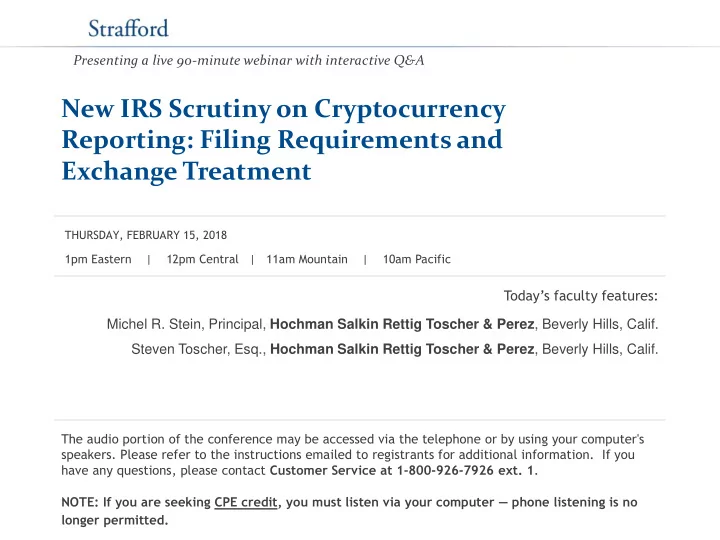
Presenting a live 90-minute webinar with interactive Q&A New IRS Scrutiny on Cryptocurrency Reporting: Filing Requirements and Exchange Treatment THURSDAY, FEBRUARY 15, 2018 1pm Eastern | 12pm Central | 11am Mountain | 10am


slide-1
SLIDE 1

The audio portion of the conference may be accessed via the telephone or by using your computer's

  • speakers. Please refer to the instructions emailed to registrants for additional information. If you

have any questions, please contact Customer Service at 1-800-926-7926 ext. 1. NOTE: If you are seeking CPE credit, you must listen via your computer — phone listening is no longer permitted.

New IRS Scrutiny on Cryptocurrency Reporting: Filing Requirements and Exchange Treatment

Today’s faculty features:

1pm Eastern | 12pm Central | 11am Mountain | 10am Pacific THURSDAY, FEBRUARY 15, 2018

Presenting a live 90-minute webinar with interactive Q&A Michel R. Stein, Principal, Hochman Salkin Rettig Toscher & Perez, Beverly Hills, Calif. Steven Toscher, Esq., Hochman Salkin Rettig Toscher & Perez, Beverly Hills, Calif.

slide-2
SLIDE 2

Tips for Optimal Quality

Sound Quality If you are listening via your computer speakers, please note that the quality

  • f your sound will vary depending on the speed and quality of your internet connection.

If the sound quality is not satisfactory, you may listen via the phone: dial

1-866-328-9525and enter your PIN when prompted. Otherwise, please

send us a chat or e-mail sound@straffordpub.com immediately so we can address the problem. If you dialed in and have any difficulties during the call, press *0 for assistance. NOTE: If you are seeking CPE credit, you must listen via your computer — phone listening is no longer permitted. Viewing Quality To maximize your screen, press the F11 key on your keyboard. To exit full screen, press the F11 key again.

FOR LIVE EVENT ONLY

slide-3
SLIDE 3

Continuing Education Credits

In order for us to process your continuing education credit, you must confirm your participation in this webinar by completing and submitting the Attendance Affirmation/Evaluation after the webinar. A link to the Attendance Affirmation/Evaluation will be in the thank you email that you will receive immediately following the program. For CPE credits, attendees must participate until the end of the Q&A session and respond to five prompts during the program plus a single verification code. In addition, you must confirm your participation by completing and submitting an Attendance Affirmation/Evaluation after the webinar. For additional information about continuing education, call us at 1-800-926-7926 ext. 2.

FOR LIVE EVENT ONLY

slide-4
SLIDE 4

February 15, 2018

Cryptocurrency Reporting

Steven Toscher, Principal Hochman Salkin Rettig Toscher & Perez, P .C. toscher@taxlitigator.com Michel R. Stein, Principal Hochman Salkin Rettig Toscher & Perez, P .C. stein@taxlitigator.com

slide-5
SLIDE 5

Notice

ANY TAX ADVICE IN THIS COMMUNICATION IS NOT INTENDED OR WRITTEN BY THE SPEAKERS’ FIRMS TO BE USED, AND CANNOT BE USED, BY A CLIENT OR ANY OTHER PERSON OR ENTITY FOR THE PURPOSE OF (i) AVOIDING PENALTIES THAT MAY BE IMPOSED ON ANY TAXPAYER OR (ii) PROMOTING, MARKETING OR RECOMMENDING TO ANOTHER PARTY ANY MATTERS ADDRESSED HEREIN.

The information contained herein is of a general nature and based on authorities that are subject to change. Applicability of the information to specific situations should be determined through consultation with your tax adviser.

Nothing in this presentation should be construed to constitute investment advice, tax advice or securities advice in any way or manner.

slide-6
SLIDE 6

www.taxlitigator.com

Program Outline

  • Introduction
  • Means of Obtaining Cryptocurrency
  • Cryptocurrency Guidance
  • IRS Notice 2014-21 - Tax Reporting Rules for Cryptocurrency
  • Special Tax Issues for Cryptocurrency
  • Potential Foreign Disclosure Requirements
  • IRS Civil Examination Considerations
  • IRS Criminal Investigation Considerations
  • Use of Voluntary Disclosure to Get into Compliance
  • Future of Cryptocurrency Enforcement
  • Glossary of Key Terms

6

slide-7
SLIDE 7

www.taxlitigator.com

Introduction

  • Cryptocurrency is drawing increased attention from government

regulators.

  • Coinbase, Inc. (largest virtual currency exchange) has been ordered

to release information for an estimated 14,000 customers.

  • Huge cryptocurrency market valuations and fluctuations.

― $300 to $500 Billion Market Cap

  • Some have made huge profits on cryptocurrency.
  • Some are now experiencing large losses.
  • There is now mainstream media attention.
  • Increased acceptance by 100,000’s of retail establishments.

7

slide-8
SLIDE 8

www.taxlitigator.com

Introduction (cont.)

  • At one point, there were 100,000’s of new users each week.
  • In 2014, the IRS set forth rules treating Cryptocurrency as property,

wherein treating it more so like currency may prove more easy to administer.

  • The explosion of cryptocurrency has created challenging tax

reporting issues with no further guidance from the IRS.

8

slide-9
SLIDE 9

www.taxlitigator.com

Types of Cryptocurrency (aka Virtual Currency)

Virtual Currencies Exchanges

Bitcoin Coinbase, Inc. Bitcoin Cash Gemini Ethereum Bitfinex Litecoin Kraken 900+ 50+

9

slide-10
SLIDE 10

www.taxlitigator.com

Means of Obtaining Cryptocurrency (aka Virtual Currency)

  • Mining
  • Exchanging Virtual Currency (“VC”) for Sovereign

(fiat) currency

  • Exchanging VC for property (i.e. Barter)
  • Exchanging VC for VC
  • Hardfork/Air Drops
  • Initial Coin Offerings (ICOs)

10

slide-11
SLIDE 11

www.taxlitigator.com

Cryptocurrency (aka Virtual Currency) Guidance

1. FinCEN’s Regulations to Persons Administering, Exchanging or Using Virtual Currencies FIN-2013-G001 (Mach 18, 2013) 2. Virtual Economies and Currencies, GAO 13-516 (May 2013) 3. IRS Notice 2014-21 (2014) 4. AICPA Comments on Notice 2014-21 dated June 10, 2016 5. As the Use of Virtual Currencies in Taxation Become More Common, Additional Actions are Needed, TIGTA Report, Sept 21, 2016 6. US v. Coinbase, Inc. Case No 17-cv-01431, Order to Enforce IRS Summons (November 28, 2017)

11

slide-12
SLIDE 12

www.taxlitigator.com

Tax Reporting Requirements of Virtual Currency (IRS Notice 2014-21)

  • Notice 2014 -21 describes how existing tax principles apply to

transactions using virtual currency (“VC”)

  • Notice 2014-21 is the only IRS position on Tax Reporting

Requirements to date

  • Sale or exchange or use of VC to pay for goods or service has

tax consequences that may result in a tax liability.

  • Gain or loss on sale of VC is gain or loss from sale of exchanges
  • f profits, treated in a manner similar to sale or exchange of

securities.

12

slide-13
SLIDE 13

www.taxlitigator.com

IRS Notice 2014-21 – Key Provisions

  • VC is Property (Not Currency).
  • Sales or exchange can produce gains or losses.
  • Income from exchanging VC for goods or services is FMV of VC
  • n date property was received (in USD).
  • Basis = FMV on date currency was received (in USD).
  • If FMV of property received exceeds TP’s basis in VC, then TP

has taxable gain (or vice versa a loss).

  • Character of gain or loss depends on whether VC is a capital

asset in the hands of TP . If held as investment property, the gain or loss on sale would be capital in nature.

13

slide-14
SLIDE 14

www.taxlitigator.com

IRS Notice 2014-21 – Key Provisions

  • Employers paying VC as remuneration for services constitute wages for

employment tax purposes and is subject to Federal tax withholding.

  • VC Payments are subject to the same information reporting as other payments

(i.e. Forms W-2, 1099, 1042 – Misc., etc.)

  • Payments made by VC are subject to back-up withholding rules to the same

extend as other payments. ― Payors must solicit TIN from payees ― Issue re: Anonymity

  • Property Settlement Entities are required to report payments made to

merchants to settle payments between merchants and their customers on Form 1099-K if the number of transaction exceeds 200 and the gross amount

  • f payments made to merchant exceeds $20,000.

14

slide-15
SLIDE 15

www.taxlitigator.com

Tax Reporting Requirements for Cryptocurrency Exchanges – Unresolved Issues

  • Mining Activity

― Does the mining of VC produce taxable income? Yes ― Subject self-employment tax? Yes ― Expenses associated with mining activity deductible? Should be

  • Section §1031 – Like Kind Exchanges

― Is exchanging VC for VC a Like-Kind Exchange (Pre-2018 Exchanges)? ― Eliminated for Post-January 1, 2018 Exchanges (Tax Cuts and Jobs Act of 2017)

  • Treatment of Hard Forks (split into two or more VC with shared history)

― Is this a taxable event? Perhaps ― Analogous to Stock Split? Not Exactly ― New Asset with Zero Basis – Perhaps

  • Gains Subject to 3.8% Net Income Tax

― Probably Yes

15

slide-16
SLIDE 16

www.taxlitigator.com

Tax Reporting Requirements for Cryptocurrency Exchanges - Unresolved

  • Initial Coin Offerings (ICO)

― Is the raising of funds recognizable in income? ― Stock offerings v. Sale of goods and services ― What about offsetting liability?

  • AICPA Proposals for Further Guidance

― De minis Exception for small transactions (i.e., $200 – similar to Currency Rule IRC §988 (e)(2)) ― Charity contribution above $5,000 and need for Qualified Appraisal ― VC’s held by Retirement accounts ― FBAR and Form 8938 Guidance ― Expensing guidance for mining activity

  • ABA Comments

16

slide-17
SLIDE 17
slide-18
SLIDE 18

www.taxlitigator.com

Unresolved Issues

  • Accounting for Gains and Losses

― FIFO ― LIFO ― Specific Identification

  • Wash Sales Rule

― IRC § 1091

  • Recordkeeping Rules

― IRC § 6001

  • Economic Substance Doctrine
  • Lost or Stolen Coins

― Casualty loss ― Pre-Tax Cuts and Jobs Act of 2017 ― Post-Tax Cuts and Jobs Act of 2017

18

slide-19
SLIDE 19

www.taxlitigator.com

Unresolved Issues (cont.)

  • Timing of Gains and Losses

― Annual accounting concept

  • Valuation Rules

― How do they apply

  • Fees and Costs

― Schedule A

  • Pre-Tax Cuts and Jobs Act of 2017
  • Post-Tax Cuts and Jobs Act of 2017

― Mining

  • Application of Currency Rules IRC § 988
  • Tax Planning

― Expatriation IRC §877 ― Moving to Puerto Rico (Bonafide Resident)

19

slide-20
SLIDE 20

www.taxlitigator.com

Tips for Virtual Currency Investors

  • Create a record-keeping system.
  • Keep track of acquisition dates, sell dates and cost basis information
  • Report dispositions on Schedule D and Form 8949.
  • Identify your exchange rate.
  • Use regular capital gains strategies: offset gains with losses, time dispositions

to qualify for long-term treatment.

  • Watch tax rates: short-term v. long-term capital rates; gains subject to the

3.8% net investment income tax.

  • Be aware of tax treatment for virtual currency received by "mining" them –

may be business income subject to the income tax and self-employment tax.

  • Deduct any investment-related expenses (Schedule A) (Pre-Tax Cuts and Jobs

Act of 2017).

20

slide-21
SLIDE 21

www.taxlitigator.com

Potential Foreign Disclosure Requirements – FBAR

  • Who Must File an FBAR

― A United States person that has a financial interest in or signature authority over foreign financial accounts must file an FBAR if the aggregate value of the foreign financial accounts exceeds $10,000 at any time during the calendar year.

  • Financial Account Definition

― A financial account includes, but is not limited to, a securities, brokerage, savings, demand, checking, deposit, time deposit, or other account maintained with a financial institution (or other person performing the services of a financial institution). A financial account also includes a commodity futures or options account, an insurance policy with a cash value (such as a whole life insurance policy), an annuity policy with a cash value, and shares in a mutual fund or similar pooled fund.

21

slide-22
SLIDE 22

www.taxlitigator.com

Potential Foreign Disclosure Requirements – FBAR

  • Does holding VC as an Off Exchange Digital Wallet implicate the FBAR rules?

― Probably not ― Analogous to holding gold in a safe deposit box ― Based on Informal Statements of IRS Personnel in 2014

  • Does holding VC in an Digital Currency Exchange Account implicate the FBAR rules?

― Perhaps ― Location of Exchange ― Domestic v. Foreign Servers ― Analogous to Financial Institutions ― FinCen would have interest in knowing

  • When in doubt, disclose on FBAR.
  • 22
slide-23
SLIDE 23

www.taxlitigator.com

Potential Foreign Disclosure Requirements – Form 8938

  • Specified foreign financial assets include the following assets
  • 1. Financial accounts maintained by a foreign financial institution.
  • 2. Stock or securities issued by someone that is not a U.S. person
  • 3. Any interest in a foreign entity, and
  • 4. Any financial instrument or contract that has an issuer or counterparty

that is not a U.S. person

  • Does VC need to be disclosed on Form 8938?

― Not clear ― Unless considered held by a foreign Financial Institution

  • When in doubt, disclose on Form 8938

23

slide-24
SLIDE 24

www.taxlitigator.com

Civil Exam Considerations

  • Lack of Information reporting – Form 1099K
  • IRS Enforcement Staffing Dedicated to address VC
  • Compliance has been Low – 800 to 900 Per Year
  • Standard Audit Question Now Asking About Virtual Currency
  • IRS Coinbase “John Doe” Summons
  • Tax and Compliance Issues Make Reporting Difficult
  • Recordkeeping by Exchanges and Holders of VC

24

slide-25
SLIDE 25

www.taxlitigator.com

Criminal Investigations and Prosecutions for Failing to Property Report Cryptcurrency Transactions

  • CI Contract with Chainanalysis, Inc. (2017)
  • Leads and Development from Examination
  • Results of Coinbase John Doe Summons

Enforcement

25

slide-26
SLIDE 26

www.taxlitigator.com

The Use of the IRS Voluntary Disclosure Policy to Get into Compliance and the Availability of “Qualified Amended Returns” to Avoid Penalties

  • History of Voluntary Disclosures (“VDs”)
  • Domestic VDs
  • Foreign VDs
  • Effectiveness of VDs
  • Qualified Amended Returns and Penalty Relief
  • Applicable Penalties
  • Still time to correct
  • IRS Cryptocurrency is Coming!!!

26

slide-27
SLIDE 27
slide-28
SLIDE 28

www.taxlitigator.com

Cryptocurrency and Key Term?*

  • Cryptocurrency (or Virtual Currency)

― A cryptocurrency (or crypto currency) is a digital asset designed to work as a medium of exchange that uses cryptography to secure its transactions, to control the creation of additional units, and to verify the transfer of assets. Cryptocurrencies are a form of digital currencies, alternative currencies and virtual currencies. Cryptocurrencies use decentralized control as opposed to centralized electronic money and central banking systems.

  • Blockchain

― A blockchain, originally block chain, is a continuously growing list of records, called blocks, which are linked and secured using cryptography. Each block typically contains a cryptographic hash of the previous block, a timestamp and transaction data. By design, a blockchain is inherently resistant to modifications of the data.

28

slide-29
SLIDE 29

www.taxlitigator.com

Cryptocurrency and Key Term? (cont.)*

  • Digital Wallet

― A digital wallet refers to an electronic device that allows an individual to make electronic transactions. This can include purchasing items on-line with a computer or using a smartphone to purchase something at a store. A cryptocurrency wallet is a digital wallet where private keys are stored for cryptocurrencies like bitcoin.

  • Cryptocurrency Address

― A Bitcoin address, or simply address, is an identifier of 26-35 alphanumeric characters, beginning with the number 1 or 3 , that represents a possible destination for a bitcoin payment. Addresses can be generated at no cost by any user of Bitcoin.

29

slide-30
SLIDE 30

www.taxlitigator.com

Cryptocurrency and Key Term? (cont.)*

  • Mining Virtual Currency

― In cryptocurrency networks, mining is a validation of transactions. For this effort, successful miners obtain new cryptocurrency as a reward. The reward decreased transaction fees by creating a complementary incentive to contribute to the processing power of the network

  • Digital Currency Exchanges

― Cryptocurrency exchanges or digital currency exchanges (DCE) are businesses that allow customers to trade cryptocurrencies or digital currencies for other assets, such as conventional fiat money, or different digital currencies. They can be market makers that typically take the bid/ask spreads as transaction commissions for their services or simply charge fees as a matching platform.

  • Hard Fork

― A hard fork occurs when a blockchain splits into two incompatible separate

  • chains. This is a consequence of the use of two incompatible sets of rules

trying to govern the system

30

slide-31
SLIDE 31

www.taxlitigator.com

Cryptocurrency and Key Term? (cont.)*

  • Airdrop

― An airdrop for a cryptocurrency is a procedure of distributing tokens by awarding them to existing holders of a particular blockchain currency, such as Bitcoin or Ethereum. In the United States, the practice has raised questions about tax liabilities and whether they amount to income or capital gains.

  • Initial Coin Offering

― An initial coin offering (ICO) is a means of crowdfunding centered around cryptocurrency, which can be a source of capital for startup companies. In an ICO, a quantity of the crowdfunded cryptocurrency is preallocated to investors in the form of "tokens," in exchange for legal tender or other cryptocurrencies such as bitcoin or ethereum. These tokens supposedly become functional units of currency if or when the ICO's funding goal is met and the project launches.

*Definitions obtained from https://www.wikipedia.org/

31

slide-32
SLIDE 32

Be Prepared. . .

IRS cryptocurrency enforcement is coming!!!!

Steven Toscher, Principal Michel Stein, Principal Hochman Salkin Rettig Toscher & Perez, P.C.

9150 Wilshire Blvd., Suite 300 Beverly Hills, CA 90212 Office: (310) 281-3200 Fax: (310) 859-1430 toscher@taxlitigator.com stein@taxligiator.com