
SLIDE 1
social contribution
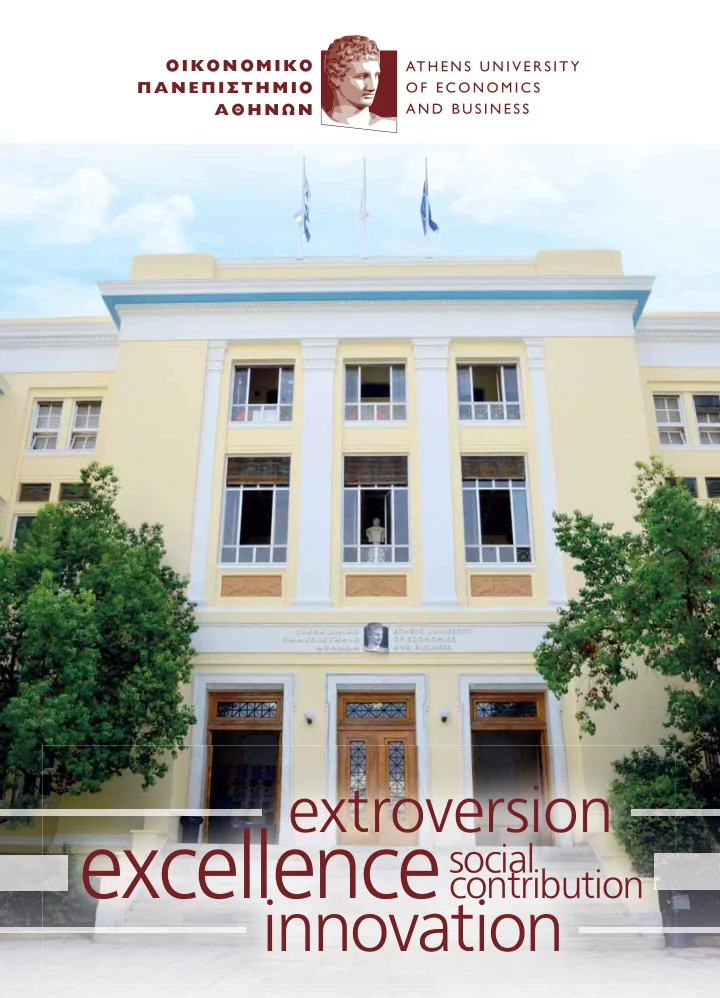
excellence social contribution innovation Hermes bearing the - - PDF document
extroversion excellence social contribution innovation Hermes bearing the infant Dionysus, Praxiteles, 4 th century B.C. AUEBs emblem, which adorns the Universitys Aula. (Fair copy of the original, which is exhibited at the
social contribution
Hermes bearing the infant Dionysus, Praxiteles, 4th century B.C. AUEB’s emblem, which adorns the University’s Aula. (Fair copy of the original, which is exhibited at the Archaeological Museum of Olympia)
Welcome Message from the Rector
. .. .. .. .. .. .. .. .. .. .. .. .. .. .. .. .. .. .. .. .. .. .. .. .. .. .. .. .. .. .. .. .. .. .. .. .. .. .. .. .. .. .. .. .. .. .. .. .................51.1. AUEB at a glance . .. .. .. .. .. .. .. .. .. .. .. .. .. .. .. .. .. .. .. .. .. .. .. .. .. .. .. .. .. .. .. .. .. .. .. .. .. .. .. .. .. .. .. .. .. .. .. .. .. .. .. .. .. .. .. .. .. ................. 6 1.2. Vision and Values .. .. .. .. .. .. .. .. .. .. .. .. .. .. .. .. .. .. .. .. .. .. .. .. .. .. .. .. .. .. .. .. .. .. .. .. .. .. .. .. .. .. .. .. .. .. .. .. .. .. .. .. .. .. .. .. .. .. ................ 7 1.3. Organizational Structure .. .. .. .. .. .. .. .. .. .. .. .. .. .. .. .. .. .. .. .. .. .. .. .. .. .. .. .. .. .. .. .. .. .. .. .. .. .. .. .. .. .. .. .. .. .. .. .. .. .. ................. 8 1.4. Historical Milestones
. .. .. .. .. .. .. .. .. .. .. .. .. .. .. .. .. .. .. .. .. .. .. .. .. .. .. .. .. .. .. .. .. .. .. .. .. .. .. .. .. .. .. .. .. .. .. .. .. .. .. .. .. .. .. ................ 92.1. Degree Programs . .. .. .. .. .. .. .. .. .. .. .. .. .. .. .. .. .. .. .. .. .. .. .. .. .. .. .. .. .. .. .. .. .. .. .. .. .. .. .. .. .. .. .. .. .. .. .. .. .. .. .. .. .. .. .. .. .. ............. 10
2.2. Executive Training Center . .. .. .. .. .. .. .. .. .. .. .. .. .. .. .. .. .. .. .. .. .. .. .. .. .. .. .. .. .. .. .. .. .. .. .. .. .. .. .. .. .. .. .. .. .. .. .. .. .. ............. 18
3.1. Laboratories ..... .. .. .. .. .. .. .. .. .. .. .. .. .. .. .. .. .. .. .. .. .. .. .. .. .. .. .. .. .. .. .. .. .. .. .. .. .. .. .. .. .. .. .. .. .. .. .. .. .. .. .. .. .. .. .. .. .. .. .. .............. 20 3.2. Research Center
. .. .. .. .. .. .. .. .. .. .. .. .. .. .. .. .. .. .. .. .. .. .. .. .. .. .. .. .. .. .. .. .. .. .. .. .. .. .. .. .. .. .. .. .. .. .. .. .. .. .. .. .. .. .. .. .. .. .. .............. 214.1. Job Market and Entrepreneurship . .. .. .. .. .. .. .. .. .. .. .. .. .. .. .. .. .. .. .. .. .. .. .. .. .. .. .. .. .. .. .. .. .. .. .. .. .. .. .. .. .............. 22
ce .. .. .. .. .. .. .. .. .. .. .. .. .. .. .. .. .. .. .. .. .. .. .. .. .. .. .. .. .. .. .. .. .. .. .. .. .. .. .. .. .. .. .. .. .. .. .. .. .. .. .. .. .. .. .. .. .. .. .. ............. 23
ce.. .. .. .. .. .. .. .. .. .. .. .. .. .. .. .. .. .. .. .. .. .. .. .. .. .. .. .. .. .. .. .. .. .. .. .. .. .. .. .. .. .. .. .. .. .. .. .............. 24
4.2. Social Responsibility .. .. .. .. .. .. .. .. .. .. .. .. .. .. .. .. .. .. .. .. .. .. .. .. .. .. .. .. .. .. .. .. .. .. .. .. .. .. .. .. .. .. .. .. .. .. .. .. .. .. .. .. .. .. .............. 27
5.1. Master's Programs taught in English .. .. .. .. .. .. .. .. .. .. .. .. .. .. .. .. .. .. .. .. .. .. .. .. .. .. .. .. .. .. .. .. .. .. .. .. .. .. .. ............. 28 5.2. Erasmus+ Program . .. .. .. .. .. .. .. .. .. .. .. .. .. .. .. .. .. .. .. .. .. .. .. .. .. .. .. .. .. .. .. .. .. .. .. .. .. .. .. .. .. .. .. .. .. .. .. .. .. .. .. .. .. .. .. .............. 30 5.3. The Business Confucius Institute of Athens .. .. .. .. .. .. .. .. .. .. .. .. .. .. .. .. .. .. .. .. .. .. .. .. .. .. .. .. .. .. .. ............. 32 5.4. Participation in International Organizations and Networks
.. .. .. .. .. .. .. .. .. .. .. .. .. .. .. .. .. ............. 326.1. Location and Facilities . .. .. .. .. .. .. .. .. .. .. .. .. .. .. .. .. .. .. .. .. .. .. .. .. .. .. .. .. .. .. .. .. .. .. .. .. .. .. .. .. .. .. .. .. .. .. .. .. .. .. .. .. .............. 34
6.2. Student Services
.. .. .. .. .. .. .. .. .. .. .. .. .. .. .. .. .. .. .. .. .. .. .. .. .. .. .. .. .. .. .. .. .. .. .. .. .. .. .. .. .. .. .. .. .. .. .. .. .. .. .. .. .. .. .. .. .. .. .............. 37Contact Information ...... .. .. .. .. .. .. .. .. .. .. .. .. .. .. .. .. .. .. .. .. .. .. .. .. .. .. .. .. .. .. .. .. .. .. .. .. .. .. .. .. .. .. .. .. .. .. .. .. .. .. .. .. .. .. .. .. .. .. .. .............. 42
Contents
The Athens University of Economics and Business (AUEB) will soon be completing one full century of operation. Through the efg
community over this period of time, it has attained recognition as a center of educational and scientifj c excellence and as a source of intellectual wealth in our country. The scientifj c identity of AUEB is defj ned by its three Schools: the School of Economic Sciences, the School of Business and the School of Information Sciences and Technology. These are the scientifj c disciplines in which AUEB holds a leading position and for which it receives international recognition. AUEB’s eight Departments, which occupy top positions in the preferences of prospective students, its popular full-time and part-time Master's programs, as well as its high quality Doctoral programs, contribute to its ranking among the top Universities internationally. Everyone working at AUEB, through their individual skills and efg
ll our dual objectives of educating students who are distinguished by their scientifj c knowledge and moral character, and of awarding degrees which have earned recognition in the international job market. We consider it essential to provide an academic environment that is of high aesthetics and that ensures respect for freedom of thought and speech. We aim to serve as a source of excellence and to contribute through our collaborations to the growth
knowledge and high quality scientifj c education to our students, we help to pave the way for continual progress in our country. Our ultimate goal is for the greek society to be proud of the accomplishments of our University. This is the University, which I invite you to get to know better. The Rector Professor Emmanouil Giakoumakis
5
Welcome Message from the Rector
Athens University of Economics and Business (AUEB) is the third oldest Higher Education Institution in Greece and the fj rst in the fj elds of Economic Science and Business Administration. Over time the scientifj c fj elds of Informatics and Statistics have also been
present time, the University has been characterized by a rich history of noteworthy scientifj c accomplishments, which shape its exceptional
AUEB, as a center of excellence in academic research and in teaching, is evaluated as one of the top Universities in the country and as one of the best internationally in the academic fj elds in which it
ection not only of the high caliber of its scientifj c stafg , the quality of its research and teaching output, its contemporary programs of study, but also of the scientifj c expertise
professionally established in Greece and abroad. AUEB implements quality assurance processes for its academic activities and its services. More specifj cally, the University’s Quality Assurance Unit (QAU) is responsible for: a) ensuring and constantly improving the quality of teaching and research, of programs
the coordination and support of the evaluation procedures at the Department, School, and University level and at its other services and c) supporting the external evaluation and accreditation for its study programs as well as of its internal quality assurance system, according to the framework of principles and guidelines of the Hellenic Quality Assurance and Accreditation Agency (HQAA). The Quality Assurance Unit has contributed signifj cantly to the development and establishment of a culture of quality within the University. The vision of AUEB is to be internationally recognized as a center of excellence in the sciences of Economics, Business and Information and, through its activities, to contribute to successfully meeting the challenges facing science, society and the economy of today and tomorrow. AUEB’s mission is to produce and disseminate knowledge in areas that serve the national and international economy and society, as well as to contribute to the development of responsible citizens who are capable of creating, contributing, participating and leading in the broader international environment. The values of the University Excellence, Innovation, Extroversion and Social Contribution constitute the pillars for its development and its reference points.
About the University
1.1 AUEB at a glance 1.2 Vision and Values
6
1
AUEB’s focus on excellence is demonstrated by the following distinctions:
(2016).
among Universities ofg ering MBA programs (2014-2015). Moreover, on a world-wide level, it ranks AUEB in the scientifj c fj elds below in the following places: Scientifj c Field/Year 2015 2016 Economics 151-200 151-200 Business Administration 151-200 151-200 Computer Science 301-400 301-350 Accounting and Finance 101-150 101-150
task by the HQAA, identifj ed the University as “the premier educational institution” in Greece in its scientifj c fj elds and equal in standing to other high quality foreign institutions (2015).
Key Figures Distinctions
Schools 3 Undergraduate Study Programs 8 Master's Study Programs 36 Undergraduate Students 9,500 Postgraduate Students 1,800 Doctoral Students 330 International Students 220 through Erasmus+ Program, approximately 500 in Master's Programs Executive Training Center Students 350 Teaching Stafg 265 Administrative Stafg 150 Collaborations with Foreign Universities 250 Programs taught in English 15 Master's Programs Number of Publications 2013-2016 (Scopus) 930 Facilities 40,000 square meters
7
1.3 Organizational Structure
AUEB, as an Institution of Higher Education, is a fully self-governed public legal entity, which is subsidized and
Senate
The Senate is the highest collective decision-making body of the University. It is comprised of the Rector, the Deans of the Schools, the Chairmen of the Departments (up to two Department Chairmen from each School), an undergraduate student representative, a representative from the Master's students, a representative from the PhD students and a representative from each of the categories of stafg .
Schools and Departments
The University is composed of three Schools: School of Economic Sciences, which supervises and coordinates the operation of the Department of International and European Economic Studies and the Department of Economics. School of Business, which supervises and coordinates the operation of the Department of Management Science and Technology, the Department of Business Administration, the Department of Accounting and Finance and the Department of Marketing and Communication. School of Information Sciences and Technology, which supervises and coordinates the operation of the Department of Informatics and the Department of Statistics. Each School is governed by the Dean of the School, The Dean’s Council and the School’s General Assembly, while each Department is governed by the Department Chairman and the Departmental General Assembly.
Rectorate
The Rectorate of the University consists of the Rector and the Deputy Rectors. Rector Professor Emmanouil Giakoumakis Deputy Rector for Academic Afg airs Professor Dimitrios Bourantonis Deputy Rector for Economic Afg airs Professor Dimitrios Gkritzalis
8
Institution’s Council
AUEB’s Council is comprised of fj fteen (15) members: nine (9) internal and six (6) external. The internal elected members are eight (8) Professors or Associate Professors of the University and a representative from AUEB’s
gures in science and culture.
1903: Grigorios Maraslis donates funds in order to create the Athens Maraslios School of Commerce. 1914: The School is renamed the Athens School of Commercial Studies. 1920: Prime Minister Eleftherios Venizelos invites George Pailliard, Professor at the University
Commercial Studies, originally housed in a building at Kaningos Square and later at a building near to its current location. A library, which includes a study area, is added to the School’s facilities. AUEB’s library is the oldest Economics library in Greece. 1926: The Athens School of Commercial Studies is renamed the Athens School of Economics and Business. 1928: The Alumni Association is founded, making it the
1935: The School moves to its new facilities located at 76 Patission Str. 1939: The Athens School of Economics and Business is recognized as equivalent to the University
University of Athens (NTUA). 1956: The number of students climbs to nearly 4,000. As a result, the School purchases additional property adjacent to its existing facilities. At the same time, an annex is added to the main building. 1961: The growing need for highly trained business executives leads to the founding of the “Institute for Training in Business Administration,” to which graduates of the Athens School of Economics and Business and other Universities in Greece and abroad are admitted. 1970: The Department of Commerce is renamed the Department of Business Administration. 1978: The fj rst postgraduate studies in Greece leading to a Master’s degree (2 year program) or a PhD degree (also, 2 year program) are organized by the Department of Economics. 1983: The University’s Research Center is created, through which the Centre for Economic Studies is founded with the goal of conducting research and disseminating scientifj c knowledge. 1984: The University is divided into three independent Departments: the Department of Economics, the Department of Business Administration and the Department of Statistics and Informatics. 1985: The Master’s program in Business Administration (MBA) is founded by the Department of Business Administration. 1987: The University facilities are expanded to include a new building located at 3-5 Derigni Str. 1989: The Athens School of Economics and Business is renamed the Athens University of Economics and Business (AUEB) and expands to include a total of six Departments: the Department of Economics, the Department of Business Administration, the Department of Applied Informatics, the Department of Statistics, the Department of International and European Economic Studies and the Department of Business Management and Marketing. 1992: The Student Employment and Alumni Career Offj ce comes into operation for the fj rst time. This Offj ce is later renamed the Career Offj ce. The Department of Business Management and Marketing is renamed the Department of Operations Research and Marketing. 1995: The University facilities are expanded to include a new wing on Antoniadou Str. 1999: The Department of Accounting and Finance commences operating. 2000: The Department of Management Science and Technology begins operating. The Executive Training Center is founded according to the Senate’s decision. New facilities are completed at the junction of Evelpidon and Lefkados Str, which are used to house the Center of Master's Studies. 2002: The Department of Operations Research and Marketing is renamed Department of Marketing and Communication. 2009: The Business Confucius Institute of Athens, an institute unique to Greece, commences
the University of International Business and Economics (UIBE) in Beijing and the Offj ce of Chinese Language Council International. 2013: AUEB’s Departments are organized into three Schools: the School of Economic Sciences, the School of Business and the School of Information Sciences and Technology.
1.4 Historical Milestones
9
The most signifj cant milestones in the University’s course of development over time are captured by the events below:
10
AUEB consists of three (3) Schools, which are comprised of a total of eight (8) Departments, and ofg ers degree programs at three (3) cycles of study: (a) Undergraduate, (b) Master's and (c) Doctoral. The University’s experienced teaching stafg , its facilities, together with the high quality of the students who choose to study at AUEB; all contribute to a continuous improvement in the studies ofg
(2015), recognized the studies at AUEB at the undergraduate as well as at the master's level, the learning processes and the overall support ofg ered to students as excellent. AUEB ofg ers eight (8) Programs of Undergraduate Study at its eight (8) Departments. Undergraduate studies have a duration of eight (8) semesters (four years) which correspond to, at a minimum, 240 ECTS (European Credit Transfer and Accumulation System). Each academic year is divided into two (2) semesters, the fall and the spring one. Depending on their choices of elective courses, students acquire a specialization in specifj c scientifj c fj elds according to their academic interests.
Studies
2
2.1 Degree Programs Undergraduate Studies
The Department of Economics is the oldest Department in Greece in the fj eld of Economic
economic thinking and educating high caliber
spectrum of subjects in economic analysis, quantitative methods and social sciences. The Department ofg ers three (3) areas of specialization:
The graduates of the Department have excellent prospects for employment in fj nancial institutions, research organizations, regulatory authorities, and enterprises of the private and the public sector. Furthermore, the Department’s graduates have acquired solid knowledge in economics, which qualifj es them to continue their studies at the postgraduate level in economic analysis, applied economics and other related areas, such as fj nance and business administration, thereby laying the foundation for a successful career in
abroad. The scientifj c areas covered by the Department include economics related to the market, businesses, economic behavior, decisions of individuals and governments, relationships between countries, quantitative methods, the social, political and institutional dimensions of economic reality, the international economy, and the institutions and policies of the European Union. The Department ofg ers two (2) specializations:
The Department uses a variety of efg ective teaching methods such as tutorials, group discussions, written assignments and the preparation of a senior thesis. It also maintains a fully equipped computer laboratory (EUROLAB). Graduates of the Department, as economists with multi-disciplinary knowledge, can work in banks, in businesses in the private sector, in international organizations, in the European Union, and in the public sector. They can also continue their studies in master's or doctoral level in one of the Department’s well established programs.
Department of Economics Department of International and European Economic Studies
11
Globalization and the Digital Economy are framing new challenges for University
foundations and up-to-date competences in three academic areas. Upon solid foundations in management, organizational behavior and strategy, future professionals should also demonstrate competence in Mathematics for Management – Management Science, and in Software Technologies and Information Systems in order to act and lead efg ectively in the contexts of socio-economic development and innovative entrepreneurship, particularly in the digital realm. The Degree in Management Science and Technology (4 years of study) unfolds in three parts: the fj rst fj ve (5) semesters cover core management, information technology/ software engineering, organizational behavior, and quantitative methods topics. In semesters six (6) and seven (7), students select a specialization out of:
Science
In the fj nal (8th) semester students are in an internship placement. The Department’s graduates, due to their strong technological and management background are extremely well positioned as executives and consultants in all the traditional roles of Business Administration and in the new environment of E-Business and Digital Innovation such as: marketing, production management, fj nance, human resources etc. The Department of Business Administration is the oldest of its kind in Greece. Its purpose is to educate students in the science of Business Administration and to create tomorrow’s business leaders. Its curriculum is one of the most comprehensive in Europe. During the fj rst two years, students are taught a wide range
accounting, fj nance, microeconomics and macroeconomics and statistics. In the third year, students have the choice of specializing in the area that intrigues them the most. The four (4) ofg ered specializations are:
The ofg ering of general as well as specialized knowledge provides the Department’s graduates with fm exibility in the competitive labor market. Graduates are qualifj ed for careers in positions such as business consultants and strategic planning analysts, advertising executives, product managers, sales managers
ed accountants, investment analysts and portfolio managers, stock brokers and information systems
new businesses and become entrepreneurs.
Department οf Management Science and Technology Department of Business Administration
12
13
The Department’s Studies Program provides students with all the necessary preparation in subjects related to the fj nancial operations of businesses, the organization and operation of accounting and auditing services of businesses, as well as with the operation of credit institutions and of money and capital markets. Graduates are especially well suited to stafg the fj nance and accounting units of businesses in the private and the public sectors. They can also work in accounting-auditing companies and in large fj nancial organizations. Their up-to-date scientifj c training gives them the ability to efg ectively deal with the rapidly changing conditions in the modern, globalized capital markets; to conduct high quality fj nancial analyses; to efg ectively manage large portfolios and to respond to the needs of large companies for complex auditing procedures. Furthermore, the Department’s graduates have the necessary foundation to pursue postgraduate studies or scientifj c research in Greece or abroad.
Department of Accounting and Finance
The Department of Marketing and Communication is a highly acclaimed, dynamic and forward-looking Department. Its commitment to staying at the forefront of developments in research and education and to operating as a center of academic excellence is manifested in the signifj cant research output
students with high quality scientifj c training and multifaceted skills. Students acquire advanced knowledge in the fj elds of marketing and business communication along with solid foundations in business administration and
specialize in one of four (4) areas:
Management
The close ties of the Department with the business community, the opportunities for internships and international mobility, and the focus of the program on cultivating skills such as complexity management, critical thinking and creativity, enhance graduates’ competitive advantage in the job market.
Department of Marketing and Communication
14
The Department of Informatics ofg ers a very well organized four-year program of studies that thoroughly covers the entire spectrum
Economics, Business Administration and
multifaceted approach to Informatics; students develop a strong theoretical background and receive extensive practice by means of laboratory exercises. The Department provides specialization in the following six (6) focus areas:
Information Technology
c Computing After receiving their degree from the Department, graduates can build successful careers in the Greek and the international informatics industry, in IT departments of companies and organizations, in business consulting fj rms, in the areas of management and fj nance, as well as in education. Moreover, graduates of the Department usually complete master's and/or doctoral studies and pursue academic or research careers in Greece and abroad. The Department of Statistics advances and disseminates knowledge in Statistical Science and related subjects - theoretical and applied - through research and education, and by training graduates to be able to apply appropriate methods of statistical analysis in various sectors of activity (e.g., economic, social, business, industrial, research and educational activities). The Department is competitive, providing education of high caliber through its undergraduate and postgraduate curricula
prospects for its graduates. Professional sectors in which graduates are employed include scientifj c research centers, the Hellenic Statistical Authority, statistical departments
research companies, advertising companies, insurance companies, banks, petroleum- product companies, industries and others. The length of studies in the undergraduate program is four (4) years, during the fj rst two (2) of which most ofg ered courses are mandatory, aiming to provide students with a solid theoretical foundation. In the remaining two (2) years the majority of ofg ered courses are electives, enabling students to shape their own direction of specialization according to their particular interests.
Department of Informatics Department of Statistics
15
In 2011, AUEB initiated the fj rst recognized teacher education program in a Greek
the University’s students who complete the program a Certifj cate of Pedagogical and Teaching Profj ciency, which is recognized by the Ministry of Education, Research and Religious Afg
cate qualifj es students to teach certain subjects in the greek primary and secondary schools. The program, which is open to students in all of the Departments of the University who have reached their fourth year of studies, has a two-semester duration. It focuses on educating students with regard to teaching methods in the fj elds of Economics, Information Technology and Business Administration. Emphasizing in extroversion, in 2015, the Program signed two important international agreements. One was with the Department of Teacher Education and School Research of the University of Oslo in Norway and the
Department of Art of Helsinki in Finland.
Teacher Education Program
AUEB was the fj rst University in Greece to organize and successfully operate master's studies, starting in 1978. Today, AUEB ofg ers 36 master's programs, some of which are full-time and some of which are part-time, while three
joint collaboration with other
the Bologna Process for the European Higher Education Area, these programs belong to the second cycle of studies. The goal of AUEB’s master's programs is to create leaders who will possess the knowledge and skills necessary to be competitive internationally in today’s society of knowledge and information, and who will be fully capable of successfully dealing with the challenges
environment of the 21st century. According to the University’s recent external evaluation by the Hellenic Quality Assurance and Accreditation Agency (HQAA), AUEB’s master's programs are
programs of well-respected foreign Universities.
Master's Studies
16 MASTER'S PROGRAMS Important Distinctions1 & Accreditations
International & European Economic Studies Eduniversal Master's Ranking Top 200 Regional Ranking (Western Europe): 30th place (Economics) Master in Business Administration International - MBA International)
Management) Master of Science in Services Management (full-time) Eduniversal Master's Ranking Top 200 Regional Ranking (Western Europe): 14th place (General Manage- ment) MBA (Master in Business Administration) (full-time) Eduniversal Master's Ranking Top 200 Regional Ranking (Western Europe): 19th place Accounting & Finance
ed Accountants (ACCA)
Marketing & Communication
(full time program)
Marketing & Communication, Specialization in International Marketing
Human Resources Management
Management)
Computer Science Eduniversal Master's Ranking Top 200 Regional Ranking (Western Europe): 16th place (Information Systems Management) Executive MBA
part-time) MA in Heritage Management Eduniversal Master's Ranking Top 50 Global Ranking: 8th place (Art & Cultural Management) Applied Economics and Finance Eduniversal Master's Ranking Top 100 Global Ranking: 60th place (Financial Markets) Public Policy and Management Eduniversal Master's Ranking Top 200 Regional Ranking (Western Europe): 16th place (Public Administration/ Management)
1 Eduniversal Master's Rankings 2016 17
Full-Time Master's Programs Part-Time Master's Programs
* Master's Programs are taught solely in English. ** Master's Programs are taught in Greek and English.
Doctoral Studies
In today’s globalized business world, generating new knowledge and turning it into new products and services is crucial to maintaining and enhancing competitiveness. The rapid advances that have taken place in recent years, due in large part to dramatic changes in technology, as well as to new procedures that have been adopted by corporations, make it necessary for business executives to acquire up-to-date information and know-how which supplements their University studies. For this reason, AUEB encourages the development of specialized training programs. As part of this efg
was created in 2000, following the Senate’s decision, to support a series of specialized training programs. During the course of its operation, over 5,000 business executives have completed training at the Center. This number clearly demonstrates that the market supports and trusts the Executive Training Center’s programs. The programs ofg ered by the Executive Training Center, which has now been operating for over 15 years, were augmented by the recent addition of a state-of-the-art electronic platform (eLearning). Through this platform AUEB is able to make even more effj cient use of the wide- ranging scientifj c, teaching and professional experience
education.
2.2 Executive Training Center
18
AUEB places particular emphasis on the organization of doctoral programs of the highest caliber, since they are an indicator of the level of scientifj c development not just of the University but of the country as a whole. The programs of studies in the doctoral programs specialize in the University Departments’ primary areas of expertise, as well as in closely-related fj
Process for the European Higher Education Area, these programs belong to the third cycle of studies. During the period from 2010 to 2015 AUEB participated in the Heraclitus II Program (co-funded by the European Social Funds and greek national funds through the Operational Program “Education and Life Long Learning” of the National Strategic Reference Framework-NSRF) with 33 doctoral candidates in the fj elds of Economics, Informatics, Statistics and Management and with a total budget of 1.3 million euros. The program produced signifj cant research fj ndings, which were presented at international conferences and published in prestigious scientifj c journals.
19
AUEB has an especially strong research orientation. Its faculty members, active in both theoretical as well as applied research, participate in national and international research projects and publish their fj ndings in international journals and proceedings
c conferences. AUEB’s overriding goal is to promote scientifj c and technological knowledge and to foster a culture of research among the University’s
excellence in this area is the recent external evaluation
Unit (HQAA), which states that the extent of funding that the University has secured in recent years, as well as the indicators measuring the effj cacy of its research, are outstanding and serve as proof of the Institution’s global standing. In order to produce high quality scientifj c research, the University has invested extensive efg
mutually reinforcing types of activities. On the
laboratories that are properly equipped and stafg ed by scientifj c stafg
University has developed supporting services such as the University’s Research Center, and has established research support programs, which are funded with 1 million euros annually. Furthermore, AUEB provides the opportunity for scientists who have recently obtained their PhD degree to carry out postdoctoral research in areas that fall within the research areas of the University’s Departments, or in closely related fj
is to produce high quality scientifj c research and also to enhance the research capabilities of promising young scientists who have the potential to contribute to the progress of science, research and their
Departments enhance their academic standing and international recognition. Since 2011 the Senate has been providing support for postdoctoral researchers through the program, “Research support at AUEB aiming at extroversion and excellence”, which is funded at the level of approximately 150,000 euros annually.
Research at AUEB
3
3.1 Laboratories
20
The University’s laboratories are one of the foundations of the research that is conducted at AUEB. Today there are a total of 17 laboratories at the University which have been formally approved, and which are designed to promote research and to disseminate their results so that they can be used in Greece and
cooperative efg
stafg
researchers, doctoral and master's students. Depending on its specifj c function, each laboratory has been equipped with the infrastructure necessary to support its operations. The laboratories ofg er comprehensive services, undertake international and national projects, establish domestic and international partnerships and disseminate fj ndings to the scientifj c community through publications in refereed journals and conference proceedings. The formally approved research laboratories1 at AUEB are listed below by School: School of Economic Sciences
School of Business Administration
School of Information Sciences and Technology
and Technology Systems
to decision published at the Government’s Gazette (GG)
3.2 Research Center
The Athens University of Economics and Business Research Center was established in 1983. It aims to promote theoretical and applied research in the fj elds of science that the University covers and to allocate and manage funds that come from various sources and are intended to cover a range
education, training and development, as well as continuing education projects and projects providing scientifj c and technological services. Moreover, funds administered by the AUEB Research Center cover expenditures that are deemed necessary in order to prepare special studies, to provide specialized consulting, to draft specifj cations for third parties, and other relevant services or activities that contribute to the link between education, research and production.
21
22
The development of AUEB is guided by the University’s fundamental institutional values of Excellence, Innovation, Extroversion and Social Contribution. To this end, the University forges and strengthens collaborations with private and public organizations in Greece and abroad. The connection with the job market, the bolstering of entrepreneurship and, fj nally, AUEB’s continuous social contribution constitute priorities of the University that are aimed not only at developing outstanding students and alumni, but also at contributing directly to the needs of the society. As a testament of AUEB’s commitment and ongoing efg
European Commission, in its “Modernization of Higher Education in Europe: Access, Retention and Employability 2014” report, as a model University for promoting entrepreneurship and supporting employability. In 2013, the University was declared the national champion in the area of bolstering entrepreneurship. Finally, the recent external evaluation performed by the HQAA praises the University for its focus and its results with regards to its connections to the market and its social involvement, and recognizes it as a leading university in setting environmental issues as a strategic priority.
Connections with Society
4
1 The AUEB Employment and Career Unit, as well as the Career Offjce, the Central Internship Offj ce and the Innovation and Entrepreneurship Unit, are co-fj nanced by the European Social Fund and by national funds through the “Education and Lifelong Learning” program.
Employment and Career Unit 4.1 Job Market and Entrepreneurship
The AUEB Employment and Career Unit coordinates the University’s actions and services that promote job
recent graduates. With support and coordination from the Employment and Career Unit, three separate units are currently in operation: the Career Offj ce, the Central Internship Offj ce and the Innovation and Entrepreneurship Unit1. AUEB’s focus on employment and entrepreneurship is approached in multiple ways. On the one hand, AUEB provides high quality career services for its undergraduate, postgraduate students and alumni and on the other hand, it nurtures entrepreneurial culture through its teaching and research.
22
23
AUEB’s Career Offj ce was founded in 1992 and was the fj rst such Offj ce to operate within a greek University. Its basic aim is to guide and assist AUEB students and recent graduates (from all undergraduate and postgraduate programs) in making informed decisions that pertain to their future employment and career path. Within the framework of services provided, the Career Offj ce has developed and is constantly expanding a broad network of dynamic partnerships with large organizations both within Greece and abroad such as the British Council, DAAD (German Academic Exchange Service), and the Embassy of the Netherlands in Athens, as well as with corporations. More than 2,500 students and graduates utilize the Career Offj ce’s services every year and more than 700 CVs are sent to employers in response to posted job announcements. Moreover, every year since 1993, the Career Offj ce has hosted the “Career Days” event, at which large numbers of AUEB undergraduate and postgraduate students and graduates have the chance to meet and interact with potential employers from a variety of difg erent business sectors.
Career Offj ce
students and graduates on the Offj ce’s website as well as on social networking pages, and forwarding of CVs
current needs of students and graduates, the most notable of which is the annual hosting of “Career Days”.
the topics indicated by the students/graduates themselves (e.g., career planning, job market update, CV preparation, interview coaching) with the use of specialized tools (Personality Test, Numerical/Verbal Reasoning Test).
students and graduates.
at the postgraduate level and search for scholarships and bequests from Greece or from abroad.
paths followed by AUEB graduates in the labor market. The Career Offj ce provides the following services:
24
The Internship Program is an indispensable part of the experience provided at AUEB. All the Departments of the University have recognized the Internship Program and integrated it into their respective programs of studies. The mission of the Central Internship Offj ce is to provide undergraduate students with the opportunity to apply the theoretical knowledge they have acquired during their studies in a real world situation, so as to smooth their transition from student status to professional life. The main functions and activities of the Central Internship Offj ce focus on: The Central Internship Offj ce provides internship positions to AUEB students through a robust and specifj cally designed IT system, which is directly linked with the Centralized Internship Support system of the Ministry of Education, Research and Religious Afg airs. In the six-year period 2009-2015, more than 3,600 students participated in the Internship Program with placements in more than 2,500 organizations from the public and the private sector. The Central Offj ce has managed to earn an enviable reputation, since it has created very strong links with the labor market. As a result of this, placements through the Internship Program at AUEB are highly sought by many organizations.
AUEB Departments, in order to facilitate the effj cient and efg ective provision of services.
student throughout its duration.
preparing students to undertake internships.
regarding cooperating companies and organizations that provide internship positions, and matching students with related internship positions.
Central Internship Offj ce
25
AUEB’s Innovation and Entrepreneurship Unit aims to instill entrepreneurial spirit and skills in students and to support ventures in their early stages. To this end, the Unit links theory and practice by inviting business people to share their experiences and to advise students on the development of their business plans. The Unit also supports the instruction of courses on entrepreneurship by organizing – in collaboration with instructors – presentations in new fj elds of business, as well as by ofg ering contemporary materials and tools. Moreover, through its website and social networking pages, the Unit shares entrepreneurship-related updates and educational resources. One of the Unit’s primary functions is to assist the AUEB Employment and Career Unit in the hosting
which students have the opportunity to attend a series of specialized seminars, as well as to develop business plans with their teams and mentors that could lead to implementation. Following the competition, the Unit continues to support the teams in further developing their business plans in
Since its establishment, AUEB's Innovation and Entrepreneurship Unit has invited more than 20 speakers for in-class presentations and more than 40 speakers, from Greece and abroad, for workshops and seminars. The Unit has also brought together student teams with more than 60 mentors. It has developed, in conjunction with researchers and teaching stafg , a series of case studies, entrepreneurial issues and business plan models.
Innovation and Entrepreneurship Unit
26
Athens Center for Entrepreneurship and Innovation (ACEin)
The Athens Center for Entrepreneurship and Innovation (ACEin) is the incubation center of AUEB,
ering support to researchers and potential young entrepreneurs in order to help them develop innovative business ideas and bring them to the market. ACEin puts signifj cant efg
are pursuing undergraduate studies, master's or doctoral degrees, and researchers who wish to turn their innovative entrepreneurial ideas or scientifj c research results into a sustainable business model and subsequent start-up a company. The Center ofg ers more than just physical resources. The key strategy includes trainings on how to establish and run a start-up, services from experts, mentoring and networking. Parallel to this, the Center organizes innovative actions in the context of its wider synergies with the market in certain sectors, in
c market
Education: A carefully designed mixture of lectures, team assignments/workshops, case studies and action
specialized industry experts. Networking: Organization of various networking activities at a national and international level, team development activities, access to the european network
dissemination activities, participation in international exhibitions and events. Consulting services: Teams benefj t from professional services (provided by experts), which vary depending
c needs and the capabilities of the Center. The consulting services are provided in various fj elds, such as business planning, marketing, branding and design, IT, accounting and legal issues, and all of them are ofg ered through personalized meetings with experts. Motivation and Mentoring: Access to mentors with proven corporate, startup and venture capital experience and a successful track record. Motivation through a series
Exploitation of research output: An important part
research laboratories. This is tackled through a concrete Technology/Knowledge Transfer methodology and a number of activities, such as providing continuous information/motivation to the research teams, adequate assessment of the prospects of scientifj c achievements, collaborative identifj cation of the most appropriate exploitation plan per research result (e.g. setting up a business, selling research and development services, concession permits) and providing specialized consulting services, depending on the business readiness, maturity and needs of each research team. The Unit of Social Entrepreneurship (USE) at AUEB aims at the advancement of sustainable social entrepreneurship initiatives nationally and worldwide. To this end, it creates and supports educational programs for the development of skills for social enterprising, based on world-class standards. More specifj cally, it supports the Diploma in Social Entrepreneurship (DoSE) that is ofg ered by the University’s Executive Training Center. This is a yearlong 220-hour professional training program, which is aimed at developing sustainable initiatives that have a social purpose, and also supporting them on an
impact on society. In addition, USE conducts cutting edge research that focuses on the conceptual clarifj cation of various aspects of social entrepreneurship, and on mapping the particular characteristics (i.e., legal status) of the national institutional framework for this sector in
the research knowledge of its members through the development of rich and innovative teaching material, the organization of seminars and symposia, the presentation of research work at various research fora and its continuing interaction with dynamic social entrepreneurs. To achieve its objectives, USE has created and is continually expanding a collaborative hub of academics, for-profj t and social entrepreneurs. Such a collaborative hub bridges the gap between theory and practice, enabling the difg usion and efg ective use of research knowledge at the individual and/or group level for the development of sustainable social purpose initiatives. Finally, under the auspices of USE, student teams ofg er pro bono customized consulting services to social enterprises in order to strengthen their sustainability.
Unit of Social Entrepreneurship (USE)
Incorporation of the concepts of Corporate Social Responsibility into core and elective courses, at both the undergraduate and the postgraduate levels. Improvement of the University’s “ecological footprint”, through targeted actions to reduce energy consumption (such as energy saving light bulbs, natural gas for heating), better insulation of its buildings, and the organization of an extensive recycling program for paper, batteries and printer toners, aimed at reducing garbage production. Development of green and social entrepreneurship. Creation of AUEB’s Unit of Social Entrepreneurship, the fj rst research and educational laboratory in Greece for issues related to the promotion of social entrepreneurship in national and international level. Active support of non-profj t organizations and volunteer organizations, and the joint hosting of events to promote their mission as well as to inform all members of the AUEB community about crucial issues such as breast cancer and providing fj rst aid. Regular organization of blood donations two times a year in cooperation with the stafg
Hospital “Panagiotis & Aglaia Kyriakou”, in which all members of the AUEB community – professors, students and administrative stafg – are encouraged to take part. Creation of the “Young Entrepreneurship Summer School”, a summer school for high school students that aims to cultivate their entrepreneurial thinking as well as to provide them with basic knowledge about management and business. The University also organizes a series of free seminars
Confederation of Greek Workers and the Athens Chamber of Commerce and Industry, for businesses and professionals who face serious problems due to the economic crisis. Creation of the student volunteer group “Get Involved” in the Department of Marketing and Communication, which focuses on activities with a social context. Signifj cant initiatives are led by AUEB students, such as social advocacy in relation to addiction to online gambling, creation of the Energy and Sustainability Club, as well as award-winning entrepreneurial ideas with respect to environmental issues.
Some of AUEB’s other noteworthy activities in the area of social responsibility are:
4.2 Social Responsibility
AUEB is an Institution with a tradition of strong social sensitivity and responsiveness to the needs of the society within which it operates. In this context, AUEB has systematically developed a series of activities with cultural, environmental and social content. The aim of these activities is to promote and reinforce important concepts such as sustainable development, but also to actively recognize the responsibility that organizations have towards the society and the environment. AUEB is a member of the United Nations Global Compact and the Principles for Responsible Management Education initiatives, as well as of the CSR Hellas Network. Furthermore, in 2013, AUEB founded the “AUEB Social Contribution Network”, involving two (2) teams of the University’s teaching and research stafg who undertake actions in two (2) separate areas: education and
in cooperation with the educational program, “Social Tutoring,” provided by the Library of the Archdiocese
support to vulnerable social groups, such as primary and secondary education pupils from low-income families, and unemployed young people. AUEB’s consulting activities are aimed at providing support and consulting services to small businesses.
27
28
AUEB, an institution open to the global market and society, collaborates with more than 250 foreign Universities and institutions within the context of its educational programs, its research and of the services ofg
AUEB actively participates in international organizations, fora and networks that aim to improve Higher Education as well as in initiatives that aim at strengthening international collaborations. As a result, AUEB is consistently placed highly in international rankings such as the QS, Times Higher Education, Eduniversal and others, and thus is able to develop international collaborations with prestigious organizations. During the recent external evaluation performed by HQAA, AUEB was recognized as “worthy of merit“ for its exceptionally well-developed internationalization strategy. Indicative examples of AUEB’s international focus are its master’s programs taught in English, its long participation in the Erasmus+ program, the foundation of Confucius Institute for the development
nally, its participation in international networks and organizations.
Going International
5
Since the creation of the fj rst master's programs at a greek University in 1978, AUEB has continued to develop them in response to new scientifj c advances and the needs of a highly competitive market. Open and internationally
broader geographical areas of the Balkans, the Middle East, the United States, Latin America, Africa and China. The fj rst Master program to be taught in English at AUEB was the MBA International program, which is accredited by the international Association of MBAs. Every year its students come from EU countries (mostly France, Germany, Spain, Italy and Denmark), the Balkan Peninsula (mostly Serbia, Romania and Bulgaria), Africa (mostly Algeria, Nigeria, Egypt) as well as the Middle East (Syria,
5.1 Master's Programs taught in English
29
Oman, Lebanon). It is worth noting that each year the MBA International is also attended by students coming from China, the USA and Latin America (mostly Brazil, Colombia and Mexico). The MBA International’s excellent reputation is refm ected in international rankings such as Eduniversal, in which it is ranked in 13th place in the category Top 200 Regional Ranking (Western Europe). The next Master program to be ofg ered in English at AUEB was the MSc in Marketing & Communication, Specialization in International Marketing. This particular program, which aims to maintain small class sizes, attracts many students every year from Spain and Germany, with program alumni also originating from China and the United States. It is worth noting that the program holds the 21st place in the Eduniversal ranking in the category Top 200 Regional Ranking (Western Europe). AUEB, with the aim of forging international collaborations to capitalize on its strong assets, recently developed a partnership with the University of Kent in the UK to
MA in Heritage Management with a very high ranking. It received the 8th place in 2015 in the “Art & Cultural Management” category (up 6 places from its 14th position in 2014). The program’s impressive trajectory has resulted in approximately 70% of incoming students every year being international, and originating from countries spread across all of the world’s continents. In addition, AUEB ofg ers the following Master’s programs in Greek and English: MSc in Management Science and Technology, MSc in Accounting and Finance and MSc in Computer Science. Finally, the following three (3) master's programs also
from the Balkans,
Management, which in addition to the Balkans also attracts students from Cyprus and the United States,
30
During the fj ve-year period from 2010 to 2015, the countries in which the more than 1,400 AUEB students who participated in the Erasmus+ program studied, in descending order of frequency, were: France, Belgium, the Netherlands, Germany, Spain, Austria, Portugal, Sweden, the United Kingdom and Poland. During the same period, AUEB welcomed approximately 1,000 international students, most of who came from Universities in France, Germany, Poland, the Netherlands, Belgium, Spain, Lithuania, Finland, Italy and the Czech Republic. AUEB, a pioneer in interuniversity cooperation, has been participating actively in the Erasmus+ Program since 1987. Within this framework, AUEB fosters collaboration with Universities, research centers, enterprises, and international
students, faculty and administrative stafg . AUEB has signed about 220 Erasmus+ agreements with other universities, through which about 360 AUEB students every year attend courses or participate in internships abroad, and approximately the same number
the Erasmus+ program at AUEB has been operating, more than 8,800 students have participated in the program, with a fairly balanced mobility between outgoing and incoming students. AUEB ofg ers to all incoming Erasmus+ students an interdepartmental study program consisting of over 80 courses annually, which are taught in English by the teaching stafg from its three Schools. AUEB’s program has received positive feedback from its Erasmus+ partners, and operates with quality assurance and successful results. Along with the program of studies in English, incoming Erasmus+ students are ofg ered free courses in Greek, which are funded by the program. In addition to student exchanges for studies and internships, Erasmus+ ofg ers scholarships to teaching and administrative stafg
at Universities, organizations or enterprises in European
ers Erasmus scholarships to teaching stafg enabling them to teach for a short period of time at
Because of the successful operations of its Erasmus+ program, AUEB received two signifj cant distinctions in 2014: the fj rst is the Erasmus+ 2014-2020 charter, which certifj es the successful course of operations of the University’s Erasmus program and the second is the "Outstanding International Student Satisfaction Award" from StudyPortals platform, which is based on thousands
European Union who study at a foreign country.
5.2 Erasmus+ Program Mobility of Erasmus+ students for studies
31
Comments from outgoing Erasmus+ students Comments from incoming Erasmus+ students
We are both named Anna and we both participated in the Erasmus+ program in the academic year 2013-2014. In the beginning we signed up for one semester, but after that it was impossible to leave, so we stayed for another semester. There are no words capable
gained went far beyond academic learning. The contact with
environment and everyday life will forever change the way that you view the world and yourself. It is an experience of a
Anna Petsi and Anna Hatzinikolaou Erasmus+ in Groupe ESC Troyes, France Amazing time with amazing people, at a great University with great teachers.” Christin University of Potsdam, Germany Four months, eight countries, 2,123 photographs, countless experiences. I would never have imagined how much life could be changed by a decision that began with the thought: “Erasmus, hmm, why not?” I was enchanted by the French language and culture from an early age, and thus chose Strasbourg, one of the most beautiful European
friends, my social circle and the people with whom I shared so many unforgettable moments. We swam on the Côte d'Azur, we drank hot Viennese chocolate at the cafe that Freud frequented, we strolled down the cobblestone streets of Prague and much, much more. Who would have imagined when I learned my f rst “Bonjour” that it would enable me, ten years later, to celebrate my twentieth birthday in my home in Strasburg with my Italian, Spanish, American, German, Japanese and Australian friends! With regard to the University, among the courses I attended, some were at the postgraduate level, and I was very pleased to discover that AUEB had given me an excellent level of education and that as a University we have nothing to be jealous of Universities abroad.” Aikaterini Taka Erasmus+ in the School of Management, Strasbourg, France My Erasmus experience in Athens was amazing, probably one of the best moments in my life. Greece and its inhabitants have given me pleasure, fun, joy, warmth and kindness. The beauty of Greece cannot be described. I would like to mention that ESN, the exchange student network, together with our Erasmus coordinator, did a magnif cent job guiding all the Erasmus students and they tried to give us everything they had to ofg
them it would have never been this great. I made friends for life in this city. They will take part in my life, my crazy mind and my heart. I can go on and on talking about Erasmus, but the most important thing is and always will be that I feel as if my heart has been divided into two
are amazing! Thank you for everything that you have given me.” Thibault Van Peel Katholieke Universiteit Leuven, Belgium
32
5.3 The Business Confucius Institute of Athens 5.4 Participation in International Organizations and Networks
The Business Confucius Institute of Athens was established at AUEB in 2009, in collaboration with the University of International Business and Economics (UIBE) in Beijing and the Offj ce of Chinese Language Council International (HANBAN). It is the sole Confucius Institute in Greece and the third in Europe with a focus on economics and business administration. Its predominant aim is to function as a bridge in communication and cooperation between Greece and China, to contribute to the building of cultural ties between the two nations and to foster academic, research and business partnerships. The Institute, which ofg ers a wide variety of multifaceted activities, runs a multitude of educational programs and hosts a range of cultural events, which are designed for all those interested in the Chinese language and culture. Within this framework, the Institute recently organized a conference on “The Dialogue between the Two Cultures”, which drew the interest of the academic and the business community. In addition, the Institute supports student exchange to/from China and Greece for summer language courses and educational trips, and participates in
ceremonies. AUEB is a participating member of many well-known
(EUA), the Association for Collegiate Schools of Business (AACSB), the Association of MBAs (AMBA), UN Global Compact, Principles for Responsible Management Education (PRME), the European Marketing Academy, the European Consortium for Political Research (ESPR), the Association of Economic Universities of South and Eastern Europe and the Black Sea Region (ASECU) and HERMES (Higher Education and Research in Management
awarded eight (8) teaching Chairs through the Jean Monnet Program and it was the fj rst university in Greece selected to operate a center of excellence in European Studies. In addition, AUEB students exhibit a continuous and active participation in international competitions, which
er them the opportunity to get acquainted with fellow students from Universities in other countries and to hone their skills in challenging academic
the Global Management Challenge Business Game, the Brandstorm Business Game sponsored by L’Oreal, the Global Algorithmic Trading Competition hosted by University College London, the Data Mining Cup, as well as the International MBA Case Competition organized by the Aspen Institute. Moreover, the AUEB branches of the international student organizations AIESEC, AEGEE and Erasmus Student Network further enhance the international character of students’ everyday lives through their programs and activities.
AUEB is located in the heart of Athens, the densely populated greek capital, near the intersection of two large streets: Patission Street (also called 28th of October) and Alexandras Avenue. It is right next to Pedion Areos Park and the Panellinios Athletics Club. Situated in the center of a constantly changing city and a country in motion, the University strives to improve its infrastructure in order to provide an environment that is conducive to learning and the advancement of science.
Life at AUEB
6
33
6.1 Location and Facilities
The University’s main building is located at 76 Patission Street since
Derigni, Antoniadou and Mavrommataion Streets, with an entrance to the building on each of the four (4) streets. The main entrance to the University is on Patission Street. Buildings on nearby streets (Kodringtonos, Derigni, Ydras, and others) provide additional space for professors’ offj ces, classrooms, and support services. In addition, the AUEB Center of Postgraduate Studies is located in a modern building at the junction of Evelpidon and Lefkados Streets, while the AUEB Research Center is housed at 46 Kefallinias Str. Responding to ever increasing educational and research needs, AUEB recently acquired an additional building, fully renovated and close to the main building, at the junction of Troias and Spetson Str, which provides a total area of over 5,000 square meters.
34
35
Library
The Library and Information Center of AUEB was founded in 1920 and is located on the fj rst and second fm
LINK), the Europe Direct Network and the Hellenic Economic Library Network. There are also three (3) Documentation Centers housed within the Library:
(EDC), operating since 1992,
Organization for Economic Co-operation and Development (OECD), operating since 1997,
Tourism Organization (WTO), operating since 2004. The Library provides a loan service to its members for all its printed collections, apart from the journals and statistical series, according to the Library’s internal rules of operation. The Library and Information Center of AUEB has a study room, PC work stations for its visitors, as well as photocopy machines and printers. An interlibrary loan service is also available for books and articles from other Hellenic Academic Libraries that are members of the networks in which the Library participates. The holdings of the Library include:
c journals
c journals
University’s students
Hellenic Statistical Service
cial governmental publications from the European Union, the OECD and the WTO
The Library contributes signifj cantly to meeting the needs of the academic community for scientifj c information as well as supporting its scholarly and research work. These aims are realized through the organization of its collections and the co-ordination of services.
36
Network Operation Center (NOC) is responsible for the design and operation of data and voice networks, the installation and management of its telecommunications equipment and maintenance of the cable infrastructure and active network
for synchronous and asynchronous distance learning and teleconferences, as well as the University’s electronic mail, website, and Wi-Fi. AUEB operates a large, modern Computer Center that continuously upgrades its infrastructure and services. The Computer Center administers systems that have a large processing power and three (3) main laboratories for teaching and additional uses, with a total capacity of 160 workstations. These laboratories are equipped with state-of-the-art projectors and wireless microphone facilities. To accommodate the students’ printing needs, AUEB’s Computer Center also has two central high-speed laser printers, as well as one laser printer in each of the three (3) laboratories.
Network Operation Center and Computer Center
37
The University’s information system E-registry provides students with easy, fast and safe access to a variety of procedures ofg ered by the Department Secretariats. The design of the system ensures that only authorized users have access to relevant information. It supports the Department Secretariats in managing data for the University’s undergraduate students, such as registration, renewal of registration, suspension of studies, issuing certifj cates, or verifj cation of successful completion of degree
by students in order to register for courses, select textbooks, view grades, complete forms
through the platform, the teaching faculty can see which students have registered for each class and can enter student grades for each of their courses.
E-registry
6.2 Student Services
AUEB provides a series of services to its students, which have two objectives: to broaden students’ intellectual horizons and to ensure high quality standards within the University premises. Within this context, the University provides or supports a wide range of services and activities such as the E-registry and athletics, culture, and social involvement opportunities.
38
Cultural Activities
AUEB, in an efg
ers numerous cultural activities.
guitar, piano and drums. There is also a choir.
the art of dancing, an activity that builds teamwork, cooperation, rhythm and musicality. Expression via movement is the ultimate goal.
and other Universities. It ofg ers workshops and organizes performances. To date the Drama club has staged more than 40 performances, and has also participated in a number of PanHellenic Drama festivals.
cinematography and production of short fj lms and hosts discussions around selected movies.
seminars in which students are trained in how to address an audience and how to prepare and present convincing arguments. At the same time, students are involved in debate contests at which they represent AUEB in both national and international championships.
are exposed to the work of some of the most famous photographers in the world. Members also practice creating their own work.
Foreign Languages Program
Knowledge of foreign languages is a necessary qualifj cation for productive involvement and interaction in a complex and diverse contemporary society. The University recognizing the importance of language learning ofg ers foreign language courses to students attending a greek University or Technological Educational Institute, as well as to anyone else interested. The languages
ered are English, French, German, Spanish, Italian and Russian, while there is a possibility of forming seminars in additional languages, if there is suffj cient demand.
Foreign Languages, Culture and Sports
39
Physical Education Center
AUEB’s Physical Education Center provides students with the opportunity to become acquainted with difg erent sports and participate in various athletic
students’ physical, mental and intellectual abilities. Moreover, these activities aim to instill in students an awareness of the benefj ts of exercise and sports, so that they adopt a healthier and more active lifestyle and make good use
Training sessions are held daily at the facilities of the Panellinios Athletics Club, which are rented by the University on an annual basis. The facilities include indoor gymnasiums and an indoor-outdoor swimming pool. Students have the opportunity to take part in the following sports: basketball, volleyball, swimming, athletics (track and fj eld), and table tennis, for which championships are organized during the course of the year. In addition, students can participate in shooting, water polo, chess and tennis. AUEB students show outstanding moral character and sportsmanship and have repeatedly honored the University.
40
“Sotiris Petroulas” Students’ Association The AUEB Students’ Association is named for Sotiris Petroulas, in memory of the heroic AUEB student leader who was killed during a demonstration on July 21, 1965. The Executive Board of the Students’ Association consists of 11 members, who are elected during student elections held each spring. Members of the Association represent it in the University Senate and the departmental General Assemblies. AUEB Erasmus Student Network (ESN) ESN was founded in 1992 and its main
participating in the Erasmus+ program,
and housing of students who visit AUEB under the auspices of Erasmus+,
and professional interest and to
associations in other Universities within the framework of the ESN International. AIESEC AUEB has hosted a branch of AIESEC, since the founding of the organization in Greece in 1956. AIESEC is a non-political and not for profj t organization, entirely ran by students. AIESEC’s goal is to develop leadership skills and to empower the younger generation. With a presence in 125 countries and 2,400 Universities, AIESEC ofg ers students the opportunity to live in another country within its network, through participating in an international internship program in corporations and non-governmental
AEGEE (Association des Etats Generaux des Etudiants de l' Europe) AEGEE is an independent, european, non- governmental student and young scientists’
european conscience and collaboration. This goal is achieved by organizing conferences and events of european scientifj c interest and through intensive promotion of exchanges and visits of a large number of students throughout Europe. AUEB Students' Investment & Finance Club The AUEB Students’ Investment & Finance Club was founded in early 2013 by 22 students and alumni of the University, for students who are interested in acquiring practical knowledge about fj nance, investment and consulting. It is a non-political, non-governmental association with a social character and its mission is purely
students as well as recent alumni of AUEB. Students’ Entrepreneurship Club ThinkBiz ThinkBiz was founded in 2012 to further develop an entrepreneurial culture amongst the students. It is a venture by students and for students, which organizes regular activities, nurtures the exchange of ideas and realizes selected projects. Its activities are always rooted in collaboration, innovation, networking, research and creative thinking.
Student Associations
41
AUEB is extremely proud of the thousands of students who have graduated from the University and have gone
ll top leadership roles in the economic, business, social and political life. AUEB alumni hold positions in Universities in Greece and abroad, in international research institutes and in organizations in both the public and the private sector. As the University realizes the importance in developing and enhancing its ties with its alumni, it puts signifj cant efg
In addition, after the initiative of several alumni of the University, the AUEB Alumni Association was founded. The purpose of the AUEB Alumni Association is to cultivate a sense of belonging within a dynamic community, to promote the participation of alumni in activities, and fj nally to provide ongoing professional know how to its members. The Association is open to all AUEB alumni, while current students can register as provisional members.
AUEB alumni
7
Contact Information
42
DIRECTORY SERVICES TELEPHONE E–MAIL / WEBSITE Rectorate +30 210 82 03 292 rector@aueb.gr Department of International and European Economic Studies +30 210 82 03 106, 107 deossecr@aueb.gr www.deos.aueb.gr Department of Economics +30 210 82 03 303, 304, 305 econ@aueb.gr • www.econ.aueb.gr Department of Management Science and Technology +30 210 82 03 110, 129, 139 dmst@aueb.gr • www.dmst.aueb.gr Department of Business Administration +30 210 82 03 308, 309, 310 ode@aueb.gr • www.ode.aueb.gr Department of Accounting and Finance +30 210 82 03 300, 302, 322 accfj n@aueb.gr • www.loxri.aueb.gr Department of Marketing and Communication +30 210 82 03 101, 102, 103 secretary.marketing@aueb.gr www.mbc.aueb.gr Department of Informatics +30 210 82 03 314, 315, 316 infotech@aueb.gr • www.cs.aueb.gr Department of Statistics +30 210 82 03 111, 112, 113 stat@aueb.gr • www.stat-athens.aueb.gr Executive Training Center +30 210 82 03 912 kek-opa@aueb.gr • www.kek.aueb.gr Research Center +30 210 82 03 830 info@rc.aueb.gr • www.rc.aueb.gr Employment and Career Unit +30 210 82 03 806 dasta@aueb.gr • www.dasta.aueb.gr Career Offj ce +30 210 82 03 819, 825 career@aueb.gr • www.career.aueb.gr Central Internship Offj ce +30 210 82 03 813 internship@aueb.gr • www.internship.aueb.gr Innovation and Entrepreneurship Unit +30 210 82 03 803 mke@aueb.gr • www.mke.aueb.gr Athens Center for Entrepreneurship and Innovation (ACEin) +30 210 82 03 827, 829 acein@aueb.gr • www.acein.aueb.gr Unit of Social Entrepreneurship +30 210 82 03 384, 553 use@aueb.gr • www.use.aueb.gr Public Relations Offj ce +30 210 82 03 216, 218, 220 pr-offj ce@aueb.gr International Relations Offj ce +30 210 82 03 250, 270 erasmusplusaueb@aueb.gr Quality Assurance Unit +30 210 82 03 116, 117, 118 modip-opa@aueb.gr • www.modip.aueb.gr The Business Confucius Institute of Athens +30 210 82 26 735 confucius@aueb.gr • www.confucius.aueb.gr Library +30 210 82 03 261 library@aueb.gr • www.lib.aueb.gr Network Operation Center +30 210 82 03 900 noc@aueb.gr Foreign Languages, Culture and Sports +30 210 82 03 223, 201 lesxi@aueb.gr Alumni Relations
Erasmus+ Student Network +30 210 82 26 207 aueb@esnathens.gr • www.aueb.esnathens.gr AIESEC +30 210 82 03 739 aiesec.athens@aiesec.net • www.aiesec.gr AEGEE +30 210 82 03 711 info@aegee-athina.gr • www.aegee-athina.gr Students’ Entrepreneurship Club ThinkBiz
AUEB Students' Investment & Finance Club
AUEB Alumni Association
Information and assistance kiosk – Main Building +30 210 82 03 200
76, Patission Str. 80, Patission Str. 95, Patission Str. 12, Derigni Str. 12, Kodrigktonos Str. 13, Elpidos Str. 46, Kefallinias Str. 28, Ydras Str. Kimolou, Spetson and Troias Str. 29, Evelpidon Str. 47Α, Evelpidon and 33, Lefkados Str.
AUEB's buildings
VIKTORIAS VIKTORIAS SQUARE SQUARE VIKTORIAS SQUARE PEDION TOU AREOSM
Agiou Meletiou Ithakis T i n 44
www.aueb.gr
Athens University
76, Patission Str., GR 104 34, Athens, Greece Τel.: +30 210 82 03 911 Fax: +30 210 82 26 204 E-mail: webmaster@aueb.gr
MAVROGENIS S.A. +30 2310 700770 • www.mavrogenis.com.gr