Example Challenge bits select weights, stage index determines signs - - PowerPoint PPT Presentation

example
SMART_READER_LITE
LIVE PREVIEW

Example Challenge bits select weights, stage index determines signs - - PowerPoint PPT Presentation

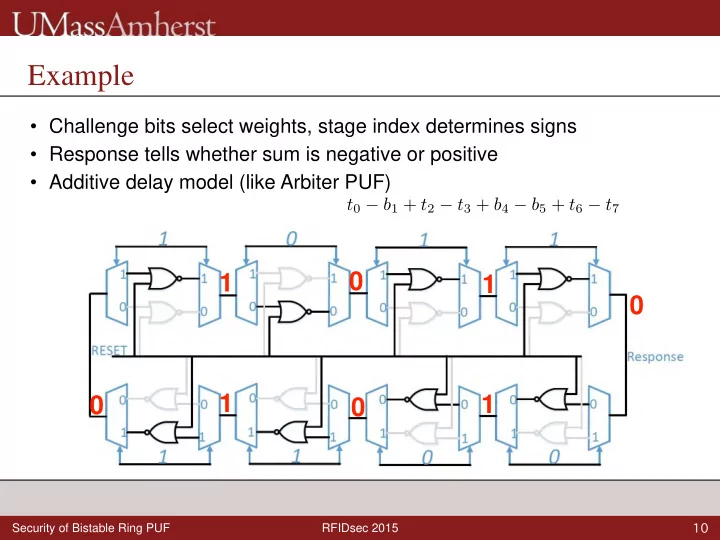
Example Challenge bits select weights, stage index determines signs Response tells whether sum is negative or positive Additive delay model (like Arbiter PUF) t 0 b 1 + t 2 t 3 + b 4 b 5 + t 6 t 7 0 1 1 0 1 1 0


slide-1
SLIDE 1

RFIDsec 2015 Security of Bistable Ring PUF

Example

10

  • Challenge bits select weights, stage index determines signs
  • Response tells whether sum is negative or positive
  • Additive delay model (like Arbiter PUF)

t0 − b1 + t2 − t3 + b4 − b5 + t6 − t7

1 1 1 1

slide-2
SLIDE 2

RFIDsec 2015 Security of Bistable Ring PUF

Example

10

  • Challenge bits select weights, stage index determines signs
  • Response tells whether sum is negative or positive
  • Additive delay model (like Arbiter PUF)

t0 − b1 + t2 − t3 + b4 − b5 + t6 − t7

slide-3
SLIDE 3

RFIDsec 2015 Security of Bistable Ring PUF

Example

10

  • Challenge bits select weights, stage index determines signs
  • Response tells whether sum is negative or positive
  • Additive delay model (like Arbiter PUF)

t0 − b1 + t2 − t3 + b4 − b5 + t6 − t7

Additive Model of BR PUF:

see also Schuster et al. Trust 2014

αi = −1i ✓ti − bi 2 ◆ βi = −1i ✓ti + bi 2 ◆ R(C) = sgn( X

i=0..n−1

αi + ciβi)

slide-4
SLIDE 4

RFIDsec 2015 Security of Bistable Ring PUF

Implementation of SVM Modeling Attacks

11

  • Modeling with Support Vector Machines classification
  • CRPs from FPGA implementation, SVM attacks use Matlab
  • CRPs divided into training and validation datasets:
  • Train the PUF model:

PUF_model=svmtrain(training_input, training_output, 'options', 'kernel_function', 'polynomial', 'polyorder', number_of_XOR); %% polynomial kernel is used, while the polyorder is the XOR complexity, i.e., for a single BR PUF, number_of_XOR=1

  • Validate the PUF model:

model_output= svmclassify(PUF_model,validation_input); prediction_rate=(model_output==validation_output); %% predication rate is the percentage of model_output equals with that of validation output

slide-5
SLIDE 5

RFIDsec 2015 Security of Bistable Ring PUF

BR PUF is Not Secure

12

slide-6
SLIDE 6

RFIDsec 2015 Security of Bistable Ring PUF

Twisted BR PUF

13

  • TBR-PUF(6) has a more compact design
  • All 2n inverting elements used in each ring
  • Challenge bit determines whether ring position of each inverting element

is even or odd

  • Additive model still applies and is simpler than regular BR PUF

(6) D. Schuster, et al. Trust and Trustworthy Computing 2014

slide-7
SLIDE 7

RFIDsec 2015 Security of Bistable Ring PUF

Twisted BR PUF

13

  • TBR-PUF(6) has a more compact design
  • All 2n inverting elements used in each ring
  • Challenge bit determines whether ring position of each inverting element

is even or odd

  • Additive model still applies and is simpler than regular BR PUF

(6) D. Schuster, et al. Trust and Trustworthy Computing 2014

63th and 66th ring positions

slide-8
SLIDE 8

RFIDsec 2015 Security of Bistable Ring PUF

Twisted BR PUF

13

  • TBR-PUF(6) has a more compact design
  • All 2n inverting elements used in each ring
  • Challenge bit determines whether ring position of each inverting element

is even or odd

  • Additive model still applies and is simpler than regular BR PUF

(6) D. Schuster, et al. Trust and Trustworthy Computing 2014

63th and 66th ring positions 66th and 63rd ring positions

1

slide-9
SLIDE 9

RFIDsec 2015 Security of Bistable Ring PUF

Twisted BR PUF

13

  • TBR-PUF(6) has a more compact design
  • All 2n inverting elements used in each ring
  • Challenge bit determines whether ring position of each inverting element

is even or odd

  • Additive model still applies and is simpler than regular BR PUF

(6) D. Schuster, et al. Trust and Trustworthy Computing 2014

63th and 66th ring positions 66th and 63rd ring positions

1

Model of TBR PUF:

R(C) = sgn( X

i=0..n−1

ciβi) βi = −1i (ti − bi)

slide-10
SLIDE 10

RFIDsec 2015 Security of Bistable Ring PUF

TBR PUF is Not Secure

14

slide-11
SLIDE 11

RFIDsec 2015 Security of Bistable Ring PUF

TBR PUF is Not Secure

14

  • Trivial to model with SVM
  • Fewer CRPs than BR PUF (same settings)
slide-12
SLIDE 12

RFIDsec 2015 Security of Bistable Ring PUF

Outline

15

  • Background
  • PUFs
  • Modeling attacks on PUFs
  • Bistable Ring PUF
  • Security Evaluation of BR PUFs
  • Modeling the BR PUF
  • Results against BR PUF and variants
  • Security Enhancement of BR PUFs
  • XORing BR PUFs to enhance the security
  • Impact on other PUF parameters
  • Conclusion and future work
slide-13
SLIDE 13

RFIDsec 2015 Security of Bistable Ring PUF

XOR BR PUFs to Enhance Security

16

  • XOR responses to harden against SVM modeling attacks
  • Prevent direct observation of CRP relation of single PUFs
  • Standard technique in many PUF protocols
slide-14
SLIDE 14

RFIDsec 2015 Security of Bistable Ring PUF

Security of XOR BR PUFs

17

  • Resists SVM modeling

attacks when >4 XORs used

  • Similar to findings with

Arbiter PUFs(1)

  • Polynomial kernel;

polynomial order set equal the number of XORs

  • Stronger machine

learning attacks may succeed

(1) U. Rühmair, et al, CCS, 2010.

slide-15
SLIDE 15

RFIDsec 2015 Security of Bistable Ring PUF

Impact of XOR on Uniqueness and Uniformity

18

  • XOR increases within-

class Hamming Distance

  • Within-class and

between-class HD remain separable

  • Single PUFs have poor

uniformity

  • Uniformity improves with

XOR

slide-16
SLIDE 16

RFIDsec 2015 Security of Bistable Ring PUF

Impact of XOR on Reliability

19

  • XOR degrades reliability
  • Any single PUF response flip will change response parity

Sun Electronics EC12 Environmental Chamber

slide-17
SLIDE 17

RFIDsec 2015 Security of Bistable Ring PUF

Conclusion and Future Work

20

  • BR PUF and TBR PUF are vulnerable to machine learning

modeling attacks

  • 95% accurate prediction surpasses capabilities of ANN-

based attacks(1)

  • Reasonable runtime and fewer than 10k CRPs
  • XORing four or more BR PUFs produces a behavior that is

beyond the modeling capability of the applied SVM attacks

  • XOR function improves uniformity but degrades reliability
  • Future work will explore the effectiveness of other modeling

attacks including evolutionary strategies and logistic regression

Thank you for your attention

(1) Schuster et al. TRUST 2014