Example: Linux Process-Independent Interrupt Service Avoid undue - - PDF document

example linux process independent interrupt service avoid
SMART_READER_LITE
LIVE PREVIEW

Example: Linux Process-Independent Interrupt Service Avoid undue - - PDF document

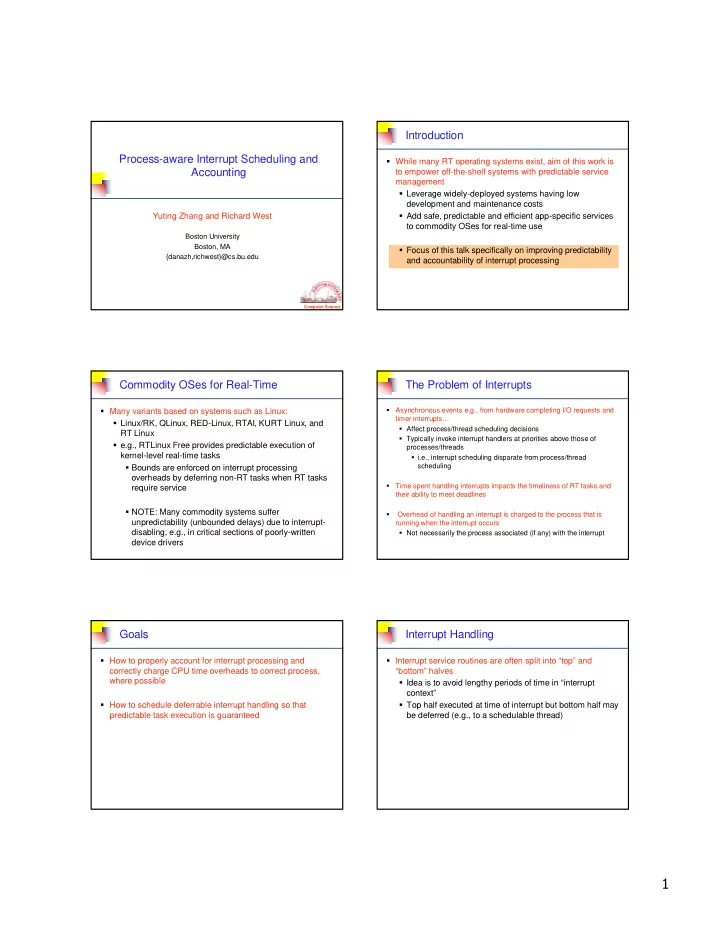
Introduction Process-aware Interrupt Scheduling and While many RT operating systems exist, aim of this work is Accounting to empower off-the-shelf systems with predictable service management Leverage widely-deployed systems having low


slide-1
SLIDE 1
  • Computer Science

Process-aware Interrupt Scheduling and Accounting

Yuting Zhang and Richard West

Boston University Boston, MA {danazh,richwest}@cs.bu.edu

Introduction

While many RT operating systems exist, aim of this work is to empower off-the-shelf systems with predictable service management Leverage widely-deployed systems having low development and maintenance costs Add safe, predictable and efficient app-specific services to commodity OSes for real-time use Focus of this talk specifically on improving predictability and accountability of interrupt processing

Commodity OSes for Real-Time

Many variants based on systems such as Linux: Linux/RK, QLinux, RED-Linux, RTAI, KURT Linux, and RT Linux e.g., RTLinux Free provides predictable execution of kernel-level real-time tasks Bounds are enforced on interrupt processing

  • verheads by deferring non-RT tasks when RT tasks

require service NOTE: Many commodity systems suffer unpredictability (unbounded delays) due to interrupt- disabling, e.g., in critical sections of poorly-written device drivers

The Problem of Interrupts

  • Asynchronous events e.g., from hardware completing I/O requests and

timer interrupts… Affect process/thread scheduling decisions Typically invoke interrupt handlers at priorities above those of processes/threads i.e., interrupt scheduling disparate from process/thread scheduling

  • Time spent handling interrupts impacts the timeliness of RT tasks and

their ability to meet deadlines

  • Overhead of handling an interrupt is charged to the process that is

running when the interrupt occurs Not necessarily the process associated (if any) with the interrupt

Goals

How to properly account for interrupt processing and correctly charge CPU time overheads to correct process, where possible How to schedule deferrable interrupt handling so that predictable task execution is guaranteed

Interrupt Handling

Interrupt service routines are often split into “top” and “bottom” halves Idea is to avoid lengthy periods of time in “interrupt context” Top half executed at time of interrupt but bottom half may be deferred (e.g., to a schedulable thread)

slide-2
SLIDE 2
  • Process-Independent Interrupt Service
  • Traditional approach:

I/O service request via kernel OS sends request to device via driver code; Hardware device responds w/ an interrupt, handled by a “top half” Deferrable “bottom half” completes service for prior interrupt and wakes waiting process(es) – Usually runs w/ interrupts enabled A woken process can then be scheduled to resume after blocking I/O request Processes OS Interrupt handler Top Halves Bottom Halves P1 P2 P3 P4 Hardware

interrupts 1 2 3 4 1 2 3 4

Example: Linux

Avoid undue impact of interrupt handling on CPU time for a running process Execute a finite # of pending deferrable fns after top half execution (in “interrupt context”) Linux deferrable fns: softirqs and tasklets (bottom halves now deprecated) Iterate through softirq handling a fixed number of times to avoid undue delay to processes but good responsiveness for interrupts (e.g., via network) Defer subsequent bottom halves to threads Awaken “ksoftirqd_CPUn” kernel thread

Linux Problems

A real-time or high-priority blocked process waiting on I/O may be unduly delayed by a deferred bottom half Mismatch between bottom half priority and process Interrupt handling takes place in context of an arbitrary process May lead to incorrect CPU time accounting Why not schedule bottom halves in accordance with priorities of processes affected by their execution? For fairness and predictability: charge CPU time of interrupt handling to affected process(es), where possible

Process-Aware Interrupt Handling

Not all interrupts associated with specific processes e.g., timer interrupt to update system clock tick, IPIs… Not necessarily a problem if we can account for such costs in execution time of tasks e.g., during scheduling I/O requests via syscalls (e.g., read/write) associate a process with a device that may generate an interrupt For this class of interrupts we assign process priorities to bottom half (deferrable) interrupt handling Allow top halves to run with immediate effect but consider dependency between bottom halves and processes

Bottom Half Scheduling / Accounting

  • Modify Linux kernel to include interrupt

accounting TSC measurements on bottom halves Determine target process for interrupt processing and update system time accordingly

  • BH/interrupt scheduler immediately

between do_irq() and do_softirq() Predict target process associated with interrupt and set BH priority accordingly BH scheduler OS Interrupt handler Top Halves Bottom Halves BH accounter

Interrupt Accounting Algorithm

Measure the average execution time of a bottom half (BH) across multiple BH executions On x86 use rdtsc since time granularity typically < 1 clock tick Measure total interrupts processed and # processed for each process in 1 clock tick Adjust system CPU time for processes due to mischarged interrupt costs For simplicity, focus on interrupts for one device type (e.g., NIC) but idea applies to all I/O devices

slide-3
SLIDE 3
  • System CPU Time Compensation (1/2)

N(t) - integer # interrupts whose total BH execution time = 1 clock tick (or jiffy) Actually use an Exponentially-Weighted Moving Avg for N(t), N’(t) N’(t) = (1-γ)N’(t-1) + γ N(t) | 0 < γ < 1 m(t) - # interrupts processed in last clock tick xk(t) - # unaccounted interrupts for process Pk Let Pi(t) be active at time t m(t) – xi(t) (if +ve) is # interrupts overcharged to Pi

System CPU Time Compensation (2/2)

At each clock tick (do_timer) update accounting info as follows: xi(t) = xi(t) – m(t); // current # under-charged if +ve sign = sign of (xi(t)); while (abs(xi(t)) >= N(t)) // update integer # of jiffies system_time(Pi) += 1*sign; timeslice(Pi) -= 1*sign; xi(t) = xi(t) – N(t); m(t) = 0;

Example: System CPU Time Compensation

t 1 2 3 4 5 6 7 8 P1 P1 P3 P4 P1 P2 P1 P3 I1 I2 I1 I3 I2 I3 I1 I1 I4 I3 I2I1I1 I4 I3 I2 I1 I1 I3 I3 P2 x1(1): -3 + 2 = -1, x2(2): -1 + 1= 0, x3(3): -2 + 2 = 0, x4(4) : -3 + 1 =-2, x4(5): -2 + -4+ 0= -6, x2(6): 0 + -2 + 2 = 0, x1(7): -1 + -2+ 4= 1, x3(8): 0 + -3 + 4 = 1,

Interrupt Scheduling Algorithm

(1) Find candidates associated with interrupt on device, D In top half can determine D A blocked process waiting on D may be associated with the interrupt We require I/O requests to register process ID and priorities with corresponding device (2) Predicting process associated with interrupt on D At end of top half select highest priority (ρmax(D)) from processes waiting on D Use a heap structure for waiting processes (3) Compare priority of BH with running process If (ρmax(D) = ρBH) > ρcurrent run BH else process

Interrupt Scheduling Observations

No need for ksoftirqd_CPUn Run interrupt scheduler at time of process scheduling If pending BH highest prio run in context of current process, else do switch to highest prio process Setting prio of BH (ρBH) to highest process prio (ρmax(D) ) for device D Rationale: no worse than current approach of always preferring BH (at least for finite occurrences) over process Simple priority scheme can provide better predictability for more important processes

Example: Interrupt Scheduling (1/3)

t1: P1 issues I/O request and blocks, allowing P2 to run t2: top half interrupt processing for P1 in P2’s context t3: top half completes t4-t5: bottom half runs t6: P1 wakes up and runs

t1 t6 Interrupt Handler Process Hardware P1 P2 It1 IB1 P1 t2 t3 t4 t5

slide-4
SLIDE 4
  • Example: Interrupt Scheduling (2/3)

Previous case: top and bottom half processing charged to P2 Our approach: correctly charge bottom half processing to P1

Interrupt Handler Process Hardware P1 P2 It1 IB1 P1 t2 t3 t4 t1 t6 t5

Example: Interrupt Scheduling (3/3)

If P2 is higher priority than P1, let P2 finish and defer the BH for P1

Interrupt Handler Process Hardware P1 It1 IB1 P1 t1 t2 t3 t4 t5 P2

System Implementation

Implemented scheduling & accounting framework on top of existing Linux bottom half (specifically, softirq) mechanism Focus on network packet reception (NET_RX_SOFTIRQ) Read TSC for each net_rx_action call as part of softirq Determine # pkts received in one clock tick udp_rcv() identifies proper socket/process for arriving pkt(s) Modify account_system_time() to compensate processes Interrupt scheduling code implemented in do_softirq() Before call to softirq handler (e.g., net_rx_action())

Linux Control Path for UDP Packet Reception

bind() connect() sys_ bind() sys_ connect() read() recv() recvfrom() sock_recvmsg() sock_common_recvmsg() udp_recvmsg() skb_recv_datagram() wait_for_packet() (block) (device specific irq handler) netif_rx_schedule(dev) __raise_softirq_irqoff net_rx_action() (device specific poll fn) netif_receive_skb() do_softirq() udp_rcv() udp_queue_rcv_skb() sock_def_readable() wakeup_interruptible() wait_for_packet() (wake up) skb_copy_datagram_iovec() read() recv() recvfrom() User Kernel Hardware skb_recv_datagram()

Experiments

UDP server receives pkts on designated port CPU-bound process also active on server to observe effect of interrupt handling due to pkt processing UDP client sends pkts to server at adjustable rates Machines have 2.4GHz Pentium IV uniprocessors and 1.2GB RAM each Gigabit Ethernet connectivity Linux 2.6.14 with 100Hz timer resolution Compare base 2.6.14 kernel w/ our patched kernel running accounting (Linux-IA) and scheduling (Linux-ISA) code

Accounting Accuracy

CPU-bound process set to real-time priority 50 in SCHED_FIFO class Repeatedly runs for 100 secs & then sleeps 10 secs UDP server process non-real-time UDP client sends 512 byte pkts to server at constant rate Read /proc/pid/stat to measure user/system time

slide-5
SLIDE 5
  • Accounting Accuracy Results

4.2 8.6 16.6 31.1 54.1 87.3 124.9 218 2000 4000 6000 8000 10000 12000 14000 Packet Sending Rate (103 pkt/s)) # Jiffies Accounted for CPU-bound Process Linux Linux-IA Opt

  • Optimal case (Opt) is total user/system-level CPU time that should be charged to

CPU-bound process discounting unrelated interrupt processing

  • Linux-IA close to optimal but original Linux miss-charges all interrupt processing

Ratio of Accounting Error to Optimal

  • Error as high as 60% in Linux
  • Less than 20% and more often less than 5% using Linux-IA

4.2 8.6 16.6 31.1 54.1 87.3 124.9 218 10 20 30 40 50 60 Packet Sending Rate (103 pkt/s)) Accounting Error (%) Linux Linux-IA

Absolute Compensated Time

4.2 8.6 16.6 31.1 54.1 87.3 124.9 218 1000 2000 3000 4000 Packet Sending Rate (103 pkt/s)) Abs(Compensated Time) (jiffies) CPU-bound UDP-Server(a) UDP-Server(b)

  • UDP-Server(a) – charged time for interrupts over 100s of each 110s period of

CPU bound process

  • UDP-Server(b) – charged time over full 110s period
  • CPU-bound – system service time deducted from CPU-bound process

Bottom Half Scheduling Effects

4.2 8.6 16.6 31.1 54.1 87.3 124.9 218 2000 4000 6000 8000 10000 12000 Packet Sending Rate (103 pkt/s)) # Jiffies Consumed by CPU-bound Process Linux Linux-ISA

  • Linux – CPU-bound process affected by interrupts
  • Linux-ISA – defer bottom-half interrupt processing until (higher priority)

real-time CPU-bound process sleeps

Time Consumed by Interrupts (every 110s)

4.2 8.6 16.6 31.1 54.1 87.3 124.9 218 1000 2000 3000 4000 5000 Packet Sending Rate (103 pkt/s)) # Jiffies Consumed by Interrupts Linux Linux-ISA

  • Time consumed by CPU-server every 110s handling interrupts
  • Linux-ISA – bottom half handling deferred to interval [100-110s]
  • Linux – bottom half processing not deferred

UDP-Server Packet Reception Rate

4.2 8.6 16.6 31.1 54.1 87.3 124.9 218 2 4 6 8 10 12 Packet Sending Rate (103 pkt/s)) % Pkts Received by UDP-server Linux Linux-ISA

slide-6
SLIDE 6
  • Bursty Packet Transmission Experiments

UDP-client sends bursts of pkts w/ avg geometric sizes of 5000 pkts Different avg exponential burst inter-arrival times CPU-bound process is periodic w/ C=0.95s and T=1.0s Runs for 100s as before Deadline at end of each 1s period

Deadline Miss Rate

  • Linux-ISA – no missed deadlines for CPU-bound process
  • Bottom half interrupt handling deferred until CPU-bound process

completes each period

4.2 8.6 16.6 31.1 54.1 87.3 124.9 218 20 40 60 80 100 Packet Sending Rate (103 pkt/s)) Deadline Miss Rate (%) Linux Linux-ISA

Interrupt Overheads (100s interval)

4.2 8.6 16.6 31.1 54.1 87.3 124.9 218 500 1000 1500 2000 2500 Packet Sending Rate (103 pkt/s)) # Jiffies Consumed by Interrupts Linux Linux-ISA

Performance of UDP-server

4.2 8.6 16.6 31.1 54.1 87.3 124.9 218 2 4 6 8 10 12 Packet Sending Rate (103 pkt/s)) % Pkts Received by UDP-server Linux Linux-ISA

  • CPU-bound process cannot finish executing in 1s period when interrupt
  • verheads are high

Always competes for CPU cycles, starving lower priority UDP-server

  • Linux-ISA guarantees “slack” time usage for UDP-server

Conclusions and Future Work

Explore dependency between processes and interrupts Focus on bottom half scheduling and accounting Compensate processes for time spent in bottom halves Charge correct processes benefiting from interrupts Unify the scheduling of bottom half interrupt handlers w/ processes Improve predictability of real-time tasks while avoiding undue interrupt-handling overheads Consequently, benefit non-real-time tasks also! Future? Better predictors of process(es) associated w/ interrupts for scheduling purposes Interrupt management on multi-processors/cores