SLIDE 1
Ancient Egyptians Week 2 Pyramids Slides.notebook 1 May 13, 2020 LO - To examine sources of evidence and consider how they were discovered
Steps To Success I can research two versions of an event and compare I can ask a variety of questions I can begin to evaluate the usefulness of different sources
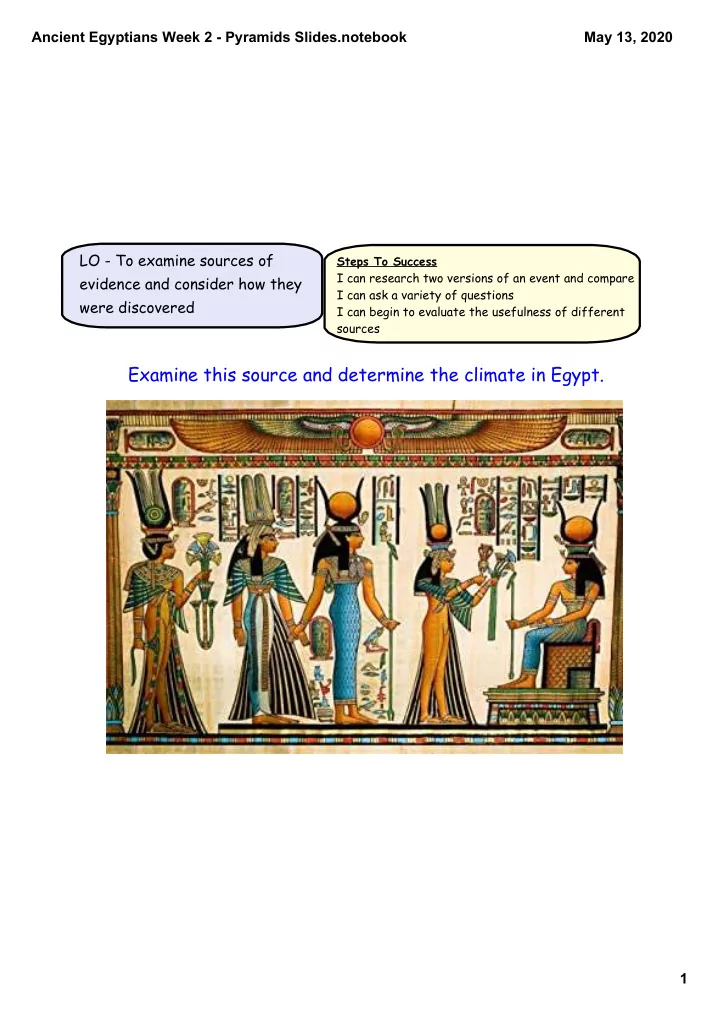
Examine this source and determine the climate in Egypt.
SLIDE 2
Ancient Egyptians Week 2 Pyramids Slides.notebook 2 May 13, 2020 LO - To examine sources of evidence and consider how they were discovered
Steps To Success I can research two versions of an event and compare I can ask a variety of questions I can begin to evaluate the usefulness of different sources
Today, we have been invited to join an archeological excavation. The information you gather will help us on our expedition to Ancient Egypt and may be useful in answering our big question: How has Ancient Egypt impacted the world today? Analyse the sources below and identify how historians have learned about the Ancient Egyptians. Discuss what can historians infer about Ancient Egyptian life from these sources.
SLIDE 3 Ancient Egyptians Week 2 Pyramids Slides.notebook 3 May 13, 2020 LO - To examine sources of evidence and consider how they were discovered
Steps To Success I can research two versions of an event and compare I can ask a variety of questions I can begin to evaluate the usefulness of different sources
We know about the ancient Egyptians from the discovery of buildings, monuments, objects and mummies.
The practice of studying these items is called Egyptology and the people who study them are called Egyptologists. An Egyptologist is an archaeologist who specialises in ancient Egypt. Historians were able to decipher ancient Egyptian texts through the discovery of the Rosetta Stone. The stone had a message carved into it in three different types of
- writing. It was an important clue that helped experts learn to read Egyptian
hieroglyphs (a writing system which used pictures as signs). This was a groundbreaking discovery, as it allowed modern historians to understand ancient Egyptian language and culture. Click on the picture of the Rosetta Stone hieroglyphs for a video about how historians have used the remains of ancient Egyptian life to form a picture about the past.
SLIDE 4 Ancient Egyptians Week 2 Pyramids Slides.notebook 4 May 13, 2020 LO - To examine sources of evidence and consider how they were discovered
Steps To Success I can research two versions of an event and compare I can ask a variety of questions I can begin to evaluate the usefulness of different sources
One of the most useful discoveries from ancient Egypt were the
- pyramids. Within these stone structures lay valuable evidence for how
the ancient Egyptians lived their lives. Sources of evidence give us clues about people of the past. Analyse the following pyramid sources. Discuss or record 3 things the source can tell you about ancient Egyptian life and any questions you may have.
SLIDE 5
Ancient Egyptians Week 2 Pyramids Slides.notebook 5 May 13, 2020 LO - To examine sources of evidence and consider how they were discovered
Steps To Success I can research two versions of an event and compare I can ask a variety of questions I can begin to evaluate the usefulness of different sources
Predict what this source could reveal about the purpose of pyramids.
Modern artist interpretation of items found inside a tomb.
SLIDE 6 Ancient Egyptians Week 2 Pyramids Slides.notebook 6 May 13, 2020 LO - To examine sources of evidence and consider how they were discovered
Steps To Success I can research two versions of an event and compare I can ask a variety of questions I can begin to evaluate the usefulness of different sources
The Egyptian pyramids are some of the most magnificent man-made structures in
- history. They were built to preserve the
reign of pharaohs (kings) after their
- death. Ancient Egyptians believed that
when the king died, a part of this spirit remained with his body. To properly care for this spirit, everything the king would need in the afterlife was buried with him - including furniture, treasure and jewelry. The walls of the Pharaoh's burial chamber were covered with carvings and
- paintings. Near the Pharaoh's chamber would be other rooms where family
members and servants were buried. Purpose of pyramids
SLIDE 7
Ancient Egyptians Week 2 Pyramids Slides.notebook 7 May 13, 2020 LO - To examine sources of evidence and consider how they were discovered
Steps To Success I can research two versions of an event and compare I can ask a variety of questions I can begin to evaluate the usefulness of different sources
Discuss what these sources might demonstrate about how pyramids have changed.
The Great Pyramids of Giza (construction began in 2550 BC) King Djoser's Step Pyramid (built in 2630 B.C.)
SLIDE 8 Ancient Egyptians Week 2 Pyramids Slides.notebook 8 May 13, 2020 LO - To examine sources of evidence and consider how they were discovered
Steps To Success I can research two versions of an event and compare I can ask a variety of questions I can begin to evaluate the usefulness of different sources
The oldest known pyramid in Egypt was build around 2630 BC for King Djoser. It was known as the step pyramid as it had large ledges built onto the sides that looked like giant steps. Archeologists believe that the steps were built as stairways for the pharaoh to climb to the sun god. Over 80 years later, pyramids began to be constructed with sloping and flat sides. According to ancient Egyptian creation stories, these pyramids represent a mound that emerged at the beginning of time. The sun god Ra stood on the mound and created the other gods and goddesses. Early pyramids The first step in building a pyramid was to choose a suitable site. This had to be on the west side of the River Nile because the west was where the sun set and where the dead were thought to enter the
- underworld. The pyramids also
needed to be situated on the high ground, away from the danger of flooding. This map shows where some of the famous pyramids and temples are located.
SLIDE 9
Ancient Egyptians Week 2 Pyramids Slides.notebook 9 May 13, 2020 LO - To examine sources of evidence and consider how they were discovered
Steps To Success I can research two versions of an event and compare I can ask a variety of questions I can begin to evaluate the usefulness of different sources
The Mayer Papyri (1108 BC) A fragment of papyrus (paper) on which 14 lines of hieroglyphs are written. This papyrus documents part of the trial of men accused of robbing the tomb of Ramesses VI during the 20th Dynasty.
Discuss what this source may illustrate about the pyramids.
SLIDE 10 Ancient Egyptians Week 2 Pyramids Slides.notebook 10 May 13, 2020 LO - To examine sources of evidence and consider how they were discovered
Steps To Success I can research two versions of an event and compare I can ask a variety of questions I can begin to evaluate the usefulness of different sources
Tomb robbers The tombs of pharaohs and nobles were built to protect the corpse and
- possessions. However, while many have endured for thousands of years, some
pyramids were robbed and their contents taken. The burial chamber was purposefully hidden within a maze of chambers and hallways, yet there was always some way around these obstacles. The vast treasures within a pyramid was too tempting for some and sometimes those who were supposed to protect the tombs used the same tools they had built them with to break in and rob them. Consider this confession from a man named Amenpanufer, who was a mason, dated 1110 BC: We went to rob the tombs as is our usual habit and we found the pyramid tomb of King Sobekemsaf, this tomb being unlike the pyramids and tombs of the nobles which we usually rob. We took our copper tools and forced a way into the pyramid
- f this king through its innermost part. We located the underground chambers
and, taking lighted candles in our hands, went down. We found the god lying at the back of his burial place. And we found the burial place of Queen Nubkhaas, his consort, beside him, it being protected and guarded by plaster and covered with rubble. We opened their sarcophagi and their coffins, and found the noble mummy of the king equipped with a sword. There were a large number of amulets and jewels of gold on his neck and he wore a headpiece of gold. The noble mummy of the king was completely covered in gold and his coffins were decorated with gold and with silver inside and out and inlaid with precious stones. We collected the gold that we found on the mummy of the god including the amulets and jewels which were
- n his neck. We set fire to their coffins.
SLIDE 11 Ancient Egyptians Week 2 Pyramids Slides.notebook 11 May 13, 2020 LO - To examine sources of evidence and consider how they were discovered
Steps To Success I can research two versions of an event and compare I can ask a variety of questions I can begin to evaluate the usefulness of different sources
Every image, object, building and landscape is a piece of evidence that can help us in understanding the past. Analysing this evidence is called 'interpreting'.
The Mask of ancient Egyptian Pharoah Tutankhamun (reigned 1332-1323 BC) A photograph from a television series based
- n the life of Tutankhamun (2015)
True or false? All historical sources can be trusted. Determine how events in history can be misunderstood by historians Explain why it can be difficult to interpret the past.
SLIDE 12 Ancient Egyptians Week 2 Pyramids Slides.notebook 12 May 13, 2020 LO - To examine sources of evidence and consider how they were discovered
Steps To Success I can research two versions of an event and compare I can ask a variety of questions I can begin to evaluate the usefulness of different sources
It is difficult to interpret the past because we don't always have a clear picture of what happened. Many sources are people's own interpretation and may not be accurate, as everyone sees the world from their own point
When interpreting evidence or studying sources, it is important to keep an open mind and attempt to look at the information in a fair and balanced way.
SLIDE 13
Ancient Egyptians Week 2 Pyramids Slides.notebook 13 May 13, 2020 LO - To examine sources of evidence and consider how they were discovered
Steps To Success I can research two versions of an event and compare I can ask a variety of questions I can begin to evaluate the usefulness of different sources
We are going to practice analysing different interpretations of the past and thinking about the reliability of these interpretations. Predict who you think built the pyramids.
SLIDE 14
Ancient Egyptians Week 2 Pyramids Slides.notebook 14 May 13, 2020 LO - To examine sources of evidence and consider how they were discovered
Steps To Success I can research two versions of an event and compare I can ask a variety of questions I can begin to evaluate the usefulness of different sources
Click the picture below to watch one interpretation of this question from the film Prince of Egypt (1998). After watching, identify the point of view of pyramid builders the video suggests. How does the type of source affect its reliability?
SLIDE 15 Ancient Egyptians Week 2 Pyramids Slides.notebook 15 May 13, 2020 LO - To examine sources of evidence and consider how they were discovered
Steps To Success I can research two versions of an event and compare I can ask a variety of questions I can begin to evaluate the usefulness of different sources
So, did slaves really build the pyramids? To help you answer the problem, consider these clues based discovered
- n excavations (archaeological digs) in Egypt:
Many graves were excavated showing that men had titles such as 'Inspector of building tombs'.
Many of the bodies found showed evidence of medical care; broken bones had been treated; one even survived having his leg cut off. Would this have been done for slaves?
In a book written by a famous man called Herodotus, it was the 100,000 slaves who built
- them. But he wrote his book a long time afterwards
and he only relied on what people told him.
Men might have done the work instead of paying the king
- taxes. They did the work for just a few months rather than
pay the money.
Thousands of men may have volunteered to build the pyramids because they thought it would please their gods.
SLIDE 16
Ancient Egyptians Week 2 Pyramids Slides.notebook 16 May 13, 2020 LO - To examine sources of evidence and consider how they were discovered
Steps To Success I can research two versions of an event and compare I can ask a variety of questions I can begin to evaluate the usefulness of different sources
Challenge Task Stretch Task Super Stretch Task
Analysing the 2 different interpretations, come up with your own answer to the question: Who built the pyramids? Using your own research and analysing the 2 different interpretations, come up with an answer to the question: Who built the pyramids? Using your own research and analysing the 2 different interpretations, come up with an answer to the question: Who built the pyramids? Discuss how trustworthy the sources are.
Extension - Prove or Disprove: All evidence is valuable when interpreting the past.
SLIDE 17
Ancient Egyptians Week 2 Pyramids Slides.notebook 17 May 13, 2020 LO - To examine sources of evidence and consider how they were discovered
Steps To Success I can research two versions of an event and compare I can ask a variety of questions I can begin to evaluate the usefulness of different sources
What does the evidence suggest? According to the British Museum, the Ancient Greek writer Herodotus claimed that the Great Pyramid was built by slaves, however, this is not true. Many of the workers were actually farmers. There were certain times of year when farmers had to wait for their crops to grow. They had nothing to do during this time, so they went to work for the king on building projects. There were some professional builders in ancient Egypt. When they died, they were buried in a special workmen's cemetery near the Giza pyramids. This proves that they were not slaves. Determine why sources like the Prince of Egypt movie depicted the pyramid builders as slaves.