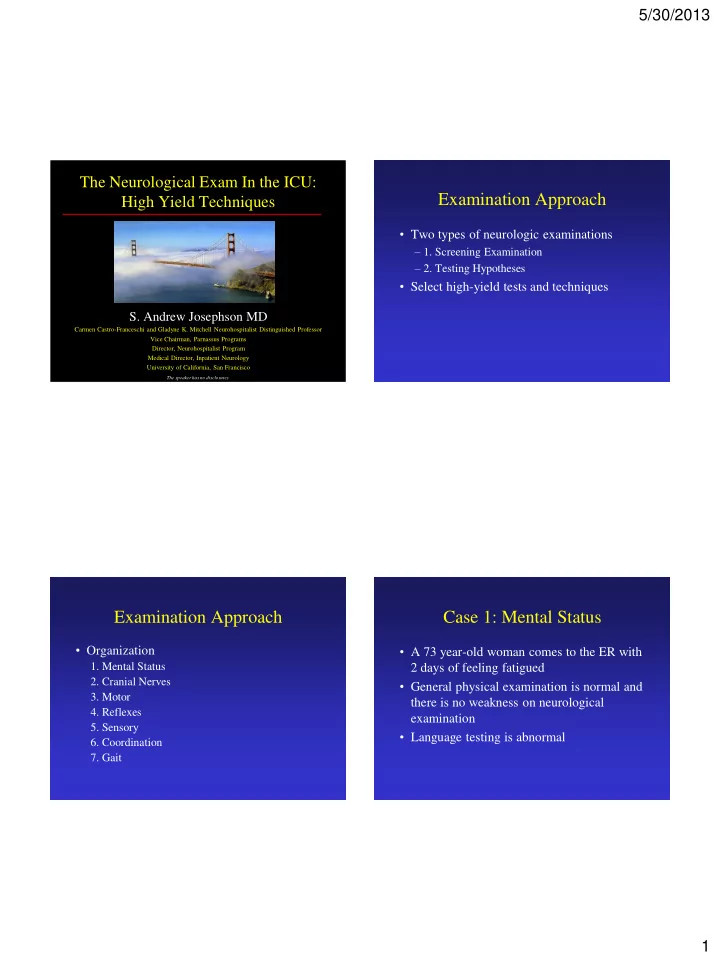
Examination Approach High Yield Techniques Two types of neurologic - - PDF document

examination approach
SMART_READER_LITE
LIVE PREVIEW

Examination Approach High Yield Techniques Two types of neurologic - - PDF document

5/30/2013 The Neurological Exam In the ICU: Examination Approach High Yield Techniques Two types of neurologic examinations 1. Screening Examination 2. Testing Hypotheses Select high-yield tests and techniques S. Andrew Josephson


slide-1
SLIDE 1

5/30/2013 1 The Neurological Exam In the ICU: High Yield Techniques

  • S. Andrew Josephson MD

Carmen Castro-Franceschi and Gladyne K. Mitchell Neurohospitalist Distinguished Professor Vice Chairman, Parnassus Programs Director, Neurohospitalist Program Medical Director, Inpatient Neurology University of California, San Francisco

The speaker has no disclosures

Examination Approach

  • Two types of neurologic examinations

– 1. Screening Examination – 2. Testing Hypotheses

  • Select high-yield tests and techniques

Examination Approach

  • Organization
  • 1. Mental Status
  • 2. Cranial Nerves
  • 3. Motor
  • 4. Reflexes
  • 5. Sensory
  • 6. Coordination
  • 7. Gait

Case 1: Mental Status

  • A 73 year-old woman comes to the ER with

2 days of feeling fatigued

  • General physical examination is normal and

there is no weakness on neurological examination

  • Language testing is abnormal
slide-2
SLIDE 2

5/30/2013 2

Aphasia Testing

  • Fluency: Use Naming and Conversation
  • Comprehension: More difficult commands
  • Repetition: “Today is a sunny day…”

Aphasia Anatomy

Blumenfeld H. Neuroanatomy Through Clinical Cases. 2002.

Aphasia Chart

Name Fluency Comp Rep Broca’s Bad Good Bad Wernicke’s Good Bad Bad Global Bad Bad Bad Conduction Good Good Bad Transcort Motor Bad Good Good Transcort Sens. Good Bad Good Transcort Mixed Bad Bad Good

Evaluating Patients for Delirium

  • Multiple screening tools have been

examined for delirium, each with its own caveats

– Compared with DSM-IV criteria: likely insensitive

  • Would like to design a tool that is short and

easy to use by nurses as well as physicians

  • ABCDE bundle
slide-3
SLIDE 3

5/30/2013 3 Confusion Assessment Method (CAM-ICU)

  • Sensitivity and specificity > 90%
  • Four elements (need 1 and 2 and 3 or 4)

used to define delirium at the bedside

  • 1. Acute Onset and Fluctuating Course
  • 2. Inattention
  • 3. Disorganized Thinking
  • 4. Altered Level of Consciousness (RASS)

icudelirium.org

Deficits of Attention

  • Neuropsychologic hallmark of delirium
  • Diffuse localization
  • Diagnose during the history

– Tangential speech, fragmented ideas

  • Test at bedside with digits forward task

– Four digits or less signifies lack of attention

  • MMSE often not helpful

Cranial Nerve Testing

II: Pupils, Acuity, Visual Fields III, IV, VI: Extraocular Movements V: Facial Sensation VII: Facial Strength VIII: Hearing IX, X: Palatal Elevation and Gag XI: SCM and Trapezius Power XII: Tongue Power

Coma

  • Definition:

– Not Awake – Not Arousable – Not Aware

  • Test with cerebral motor response to pain

centrally and in all four extremities (supraorbital and nail-bed pressure)

slide-4
SLIDE 4

5/30/2013 4

Structures involved in coma

Blumenfeld H. Neuroanatomy Through Clinical Cases. 2002.

Two Localizations of Coma

  • 1. Brainstem
  • 2. Bilateral Hemispheres
  • Use the CN exam to localize to brainstem or

hemispheres

Cranial Nerve Nuclei in the Brainstem Pupillary Reaction

  • Midbrain: CN III

– Parasympathetics mediate

  • Caveats

– Make sure light stimulus is adequate – Assure no drug effects

  • In many cases of brain death, the pupils are

not “blown” and are midposition

slide-5
SLIDE 5

5/30/2013 5

Corneal Reflex

  • Pons: CN V and VII
  • Test with a Q-tip or drops of saline
  • Caveat: Make sure you are touching the

cornea not the sclera

Oculocephalic Reflex

  • Pons: CN III, VI, and VIII
  • Vestibulo-ocular reflex (VOR) which we

use on a moment-by-moment basis to foveate

  • Testing procedure
  • Doll’s don’t do this anymore

Cold Calorics

  • Pons: CN III, VI, and VIII
  • Stronger stimulus than oculocephalic
  • 30cc of ice saline in each ear (1-3 min

between); wait 1 minute for the response

  • Correct response very misunderstood and

poorly taught

Cough and Gag

  • Medulla: CN IX and X
  • Best to do both by suctioning through ET

tube and touching each side of the palate with a tongue depressor

  • Asymmetry is more interesting for us…

– Remember 10-30 percent have no gag normally

slide-6
SLIDE 6

5/30/2013 6

Respiratory Drive

  • Lowest Part of the Medulla
  • Technique

– Are they overbreathing? – Consider apnea test in specific situations such as brain death determination

Case 2: Motor

  • A 75 yo male with HTN, DM and current

tobacco use comes from the ED with mild problems walking and a complaint of “my left arm is not working right.”

Case 2: Motor

  • The ED physician tells you that he knows

the patient has no weakness in his extremities as his own exam shows equal hand grasps, moving all fours, and “stepping on the gas” in the lower extremities.

Upper Motor Neurons of the Pyramidal Tract

Predictable Pattern of Weakness Distal Extensors of the UEs and Distal (Dorsi)Flexors of the LEs

slide-7
SLIDE 7

5/30/2013 7 Quick Screen for Upper Motor Neuron/Pyramidal Weakness

  • Pronator Drift
  • Fine Finger Movements/Toe Taps
  • One muscle in each of four extremities

– Upper Extremities: 1st DI or finger extensors – Lower Extremities: Extensor of big toe

  • Common ED screen VERY insensitive!

UMN LMN Pattern of Weakness Pyramidal Variable Function/Dexterity Slow alternate motion rate Impairment of function is mostly due to weakness Tone Increased Decreased Tendon Reflex Increased Decreased, absent or normal Other signs Babinski sign, other CNS signs (e.g. aphasia, visual field cut) Atrophy (except with problem

  • f neuromuscular junction)

Motor Neuron Disease Neuropathy NMJ Myopathy Weakness Pattern Variable Distal Diffuse Proximal DTR Increased, normal and/or decreased Decreased or absent Normal or decreased Normal or decreased Atrophy Yes Yes No No Fasciculations Yes Sometimes No No Sensory symptoms/ signs No Yes No No

Case 3: Sensory

  • A 45 yo man presents with 2 days of

progressive tingling and weakness of the lower extremities. He now is having trouble walking and rising from a chair.

slide-8
SLIDE 8

5/30/2013 8

Case 3: Sensory

  • Exam

– MS, CN normal – Motor: normal tone throughout, normal power in upper ext., 4/5 throughout in the lower extremities – Sensory: decreased PP/Vib/temp patchy in lower extremities

  • A sensory level is found at T10

Case 4: Coordination

  • A 54 year-old woman presents with vertigo

and gait difficulties

  • On finger-nose-finger, she exhibits

dysmetria with the right upper extremity, but not with the left

Key Cerebellar Exam Tips

  • Bilateral dysfunction is often benign and

drug/medication related

  • Unilateral dysfunction is a cerebellar lesion

until proven otherwise

– CT insensitive in this region

  • Cerebellar tracts run through the brainstem

– Cerebellar signs with cranial nerve deficits is a brainstem lesion until proven otherwise