Thyroid Examination: Purpose and Coverage Examination "We will - - PowerPoint PPT Presentation

thyroid examination purpose and coverage
SMART_READER_LITE
LIVE PREVIEW

Thyroid Examination: Purpose and Coverage Examination "We will - - PowerPoint PPT Presentation

Thyroid Thyroid Examination: Purpose and Coverage Examination "We will promote the health of the children in Fukushima for the long term." [Purpose] Health effects of radiation due to the accident at Tokyo Electric Power Company


slide-1
SLIDE 1

"We will promote the health of the children in Fukushima for the long term."

Prepared based on the website of the Radiation Medical Science Center for the Fukushima Health Management Survey, Fukushima Medical University, "Information on the Thyroid Examination"

Thyroid Examination

Thyroid Examination: Purpose and Coverage

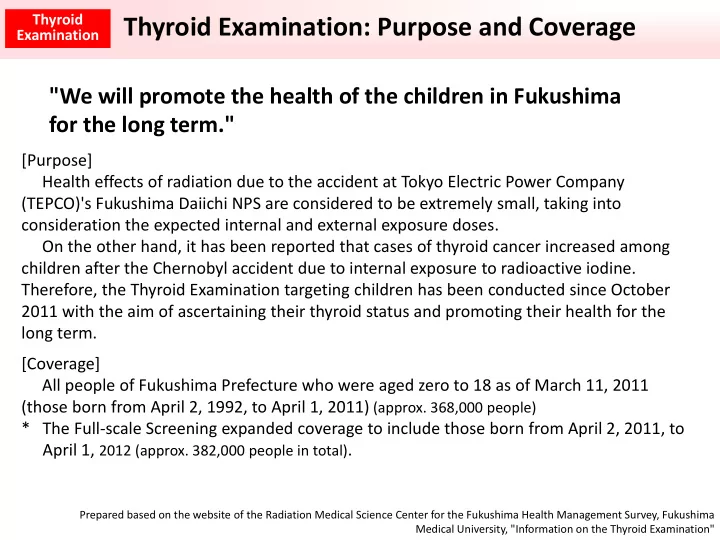
[Purpose] Health effects of radiation due to the accident at Tokyo Electric Power Company (TEPCO)'s Fukushima Daiichi NPS are considered to be extremely small, taking into consideration the expected internal and external exposure doses. On the other hand, it has been reported that cases of thyroid cancer increased among children after the Chernobyl accident due to internal exposure to radioactive iodine. Therefore, the Thyroid Examination targeting children has been conducted since October 2011 with the aim of ascertaining their thyroid status and promoting their health for the long term. [Coverage] All people of Fukushima Prefecture who were aged zero to 18 as of March 11, 2011 (those born from April 2, 1992, to April 1, 2011) (approx. 368,000 people) * The Full‐scale Screening expanded coverage to include those born from April 2, 2011, to April 1, 2012 (approx. 382,000 people in total).

slide-2
SLIDE 2
  • Coverage and examination plan

Prepared based on the website of the Radiation Medical Science Center for the Fukushima Health Management Survey, Fukushima Medical University, "Information on the Thyroid Examination“

Screening category Period Coverage

First examination Initial Screening

(In order to ascertain children's thyroid status)

  • Oct. 2011 ‐ March 2014

Residents who were residing in Fukushima Prefecture at the time of the earthquake and were approximately 18 years old or younger (those born from April 2, 1992, to April 1, 2011)

Second examination

Full‐scale Screening

(In order to make comparison with the results of the Initial Screening) April 2014 ‐ March 2016 In addition to those covered by the Initial Screening, those born from April 2, 2011, to April 1, 2012

Third examination

April 2016 ‐ March 2018 In principle, those born from April 2, 1992, to April 1, 2012

Fourth examination ‐

Once every two years until becoming 20 years old, then once every five years after becoming 25 years old, for example, at the ages of 30, 35 and so on

Thyroid Examination: Outline (1/3)

Thyroid Examination

slide-3
SLIDE 3

When there is no need for the Confirmatory Examination

(Grade A)

When the Confirmatory Examination is recommended

(Grade B)

When the Confirmatory Examination is required immediately

(Grade C)

When nodules and cysts are not found

(A1)

When small nodules or cysts are found

(A2)

When nodules of 5.0 mm

  • r smaller or cysts of 20.0

mm or smaller are found

Primary Examination

  • When nodules of 5.1 mm or larger
  • r cysts of 20.1 mm or larger are

found

  • When overall thyroid status

suggests the need for the Confirmatory Examination

The next examination onward (Full‐scale Screening) Once every two years until the targeted people become 20 years old and

  • nce every five years thereafter

Diagnosis Criteria Follow‐up Treatment (surgery, etc.)

Confirmatory Examination

Diagnosed as Grade A1 or Grade A2 through a detailed examination

Benign

Malignant or suspicious for malignancy

Fine‐needle aspiration cytology

Fukushima Health Management Survey Medical care covered by health insurance

  • Examination procedures and diagnosis criteria

Prepared based on the website of the Radiation Medical Science Center for the Fukushima Health Management Survey, Fukushima Medical University, "Information on the Thyroid Examination"

Thyroid Examination: Outline (2/3)

Thyroid Examination

  • When the Confirmatory

Examination is found to be urgently necessary based on

  • verall thyroid status
slide-4
SLIDE 4

Content of the examination

Prepared based on the website of the Radiation Medical Science Center for the Fukushima Health Management Survey, Fukushima Medical University, "Information on the Thyroid Examination"

Thyroid Examination: Outline (3/3)

Thyroid Examination

[Primary Examination] An ultrasound examination assesses whether there are any nodules or cysts. The examination

  • rdinarily finishes in three to five minutes with no

pain involved. The diagnosis panel, consisting of medical specialists, reviews the ultrasound images and makes diagnoses. The examination results are sent by post, but explanations are given at the examination venues or by phone upon examinees' requests. [Confirmatory Examination] When a more detailed examination is found to be necessary as a result of the Primary Examination, the Confirmatory Examination is conducted for the relevant person. In the Confirmatory Examination, another ultrasound examination, plus blood and urine tests are conducted. If a doctor considers it necessary as a result of these tests, fine‐needle aspiration cytology

  • f the thyroid may also be performed and interpreted.
slide-5
SLIDE 5

Prepared based on the website of the Radiation Medical Science Center for the Fukushima Health Management Survey, Fukushima Medical University, "Q&A on the Thyroid Examination"

Thyroid Examination: Nodules

Thyroid Examination

A nodule, which might also be called a lump, is an irregular growth of thyroid cells.

Size Grade A2 Grade B

  • Nodules may be malignant (cancerous), but most are benign.

< Thyroid cancer >

  • In many cases, latent thyroid cancer has no symptoms or health effects over

a lifetime.

  • Latent thyroid cancer is usually small. It may be disadvantageous to force

patients to receive treatment if such a cancer is found incidentally.

  • Therefore, a detailed examination is not generally conducted for small

nodules. < Thyroid Examination conducted in the Fukushima Health Management Survey>

  • The Confirmatory Examination is not conducted for nodules of 5 mm or

smaller and follow‐ups are to be made at the time of the next examination.

  • However, when a detailed examination is found to be necessary, a case with

nodules of 5 mm or smaller is diagnosed as Grade B and the Confirmatory Examination is recommended.

slide-6
SLIDE 6

Prepared based on the website of the Radiation Medical Science Center for the Fukushima Health Management Survey, Fukushima Medical University, "Q&A on the Thyroid Examination"

A cyst, which resembles a bag filled with fluid, is generally benign, and is often found even in healthy people.

Thyroid Examination: Cysts

Thyroid Examination

Size Grade A2 Grade B

Cysts are generally benign, but those of 20 mm or larger may cause a feeling of pressure in the throat and fluid in a cyst is sometimes withdrawn.

  • Cysts often change in size or number.
  • Many people have multiple cysts, and the estimated size of the

largest one is told to each examinee in this examination.

  • Cysts consisting only of fluid and containing no cells are not

cancerous.

  • Cysts found in the latest examination were all deemed to be benign.
  • Cysts are seldom found in babies and infants but are rather found in

primary and secondary school students.

slide-7
SLIDE 7

Cysts with solid components are all judged as nodules.

  • Cysts partially containing solid components (cells) are called cystic nodules or cysts with solid components.
  • They are treated as equivalents to ordinary cysts in general medical examinations. Even when the

Confirmatory Examination is conducted, they are deemed unlikely to cause problems and are placed under follow‐up observations.

When the maximum size of a cyst with solid components (the length of the

  • range arrow) is 5.1 mm or larger, the

examinee is diagnosed as Grade B.

Prepared based on the website of the Radiation Medical Science Center for the Fukushima Health Management Survey, Fukushima Medical University, "Q&A on the Thyroid Examination"

Thyroid Examination: Handling of Cysts with Solid Components

Solid components

Measure the entirety of a cyst Thyroid Examination

slide-8
SLIDE 8

Prepared based on Thyroid Report No. 3 of the Radiation Medical Science Center for the Fukushima Health Management Survey, Fukushima Medical University

Enter the name of the medical institution you chose in the consent form/inquiry sheet.

Start

Understand the examination system!

A notice of examination date(s) and venue(s) is sent to you by post.

The examination will be continued to promote your health for the long term.

A notice in and after FY2016 will be sent to you Once every two years Once every five years thereafter until you become 20 years old (Scheduled)

Examination results are sent to you.

The results of the Thyroid Examination are sent individually.

The results will be sent by post around two months after the examination. When you receive the examination at any medical institution in

  • r outside the prefecture, the results are to be sent to you a

little later – around two to three months after the examination – due to the need for data exchange between the relevant medical institution and Fukushima Medical University.

For details, see the website of the Radiation Medical Science Center for the Fukushima Health Management Survey. Date of the Thyroid Examination List of available medical institutions in Fukushima Prefecture List of available medical institutions outside Fukushima Prefecture

After receiving the examination

Designated venues Designated venues

Preschoolers

Public facilities or medical institutions within the prefecture are designated.

Primary and secondary school students

Their respective schools are designated.

University and vocational school students and business people, etc.

Public facilities or medical institutions within the prefecture are designated. When you are unable to receive the examination at the designated venue due to some errand or illness,

When you cannot receive the examination at the designated venue due to some errand or depending on the location of your residence, you may receive the examination at any venue you choose.

Examination venue of your choice

You may receive the examination at any venue you choose.

Public facilities Medical institutions within the prefecture

When intending to receive the examination outside the prefecture

Examination outside the prefecture

You may receive the examination at more than 90 medical institutions nationwide. With more available medical institutions, we do not have to worry even if we cannot receive the examination on the designated date due to some errand or illness.

If you intend to receive the examination at a medical institution in

  • r outside the prefecture, you need to make a reservation with the

Radiation Medical Science Center for the Fukushima Health Management Survey, Fukushima Medical University.

(You cannot make a reservation directly with the medical institution.)

http://fukushima‐minamori.jp/thyroid‐examinati

  • n/schedule‐fukushima/

http://fukushima‐minamori.jp/thyroid‐exa mination/kyoten/ http://fukushima‐minamori.jp/thyroid‐examinati

  • n/schedule‐outside/media/inspection‐list‐outsid

e‐the‐prefecture.pdf

Thyroid Examination: System for Examinations in and outside Fukushima

Thyroid Examination
slide-9
SLIDE 9

The examination has been conducted sequentially, starting in areas where ambient dose rates were highest after the disaster.

Municipalities where the FY2014 Primary Examination was conducted (25 municipalities) Municipalities where the FY2015 Primary Examination was conducted (34 municipalities) Municipalities where the FY2016 Primary Examination was conducted (25 municipalities) Municipalities where the FY2017 Primary Examination was conducted (34 municipalities)

Thyroid Examination: Order of Full‐scale Screening

Thyroid Examination

 The first Full‐scale Screening (the second one after the Initial Screening)  The second Full‐scale Screening (the third one after the Initial Screening)

Materials for the 22nd and 24th Prefectural Oversight Committee Meetings for Fukushima Health Management Survey

slide-10
SLIDE 10

Number of those with determined results (people) Number of those having nodules or cysts against number of those with determined results (%) Nodules Cysts 5.1 mm or larger 5.0 mm or smaller 20.1 mm or larger 20.0 mm or smaller Total

300,473 2,275 (0.8) 1,713 (0.6) 12 (0.0) 143,899 (47.9)

Coverage (people) Examinees (people) Diagnosis rate (%) Number of those diagnosed (people) Breakdown by grade (%) Percentage of examinees (%) Those who received the examination

  • utside the prefecture

Those requiring the Confirmatory Examination

A1 A2 B C

Total

367,649 300,473 (81.7) 9,511 300,473 (100.0) 154,605(51.5) 143,574 (47.8) 2,293(0.8) 1 (0.0)

Coverage (people) Examinees (people) Number of those with determined results (people) Determination rate (%) Next examination Regular healthcare program, etc. Percentage of examinees (%)

A1 A2

Those who received fine‐needle aspiration cytology Total

2,293 2,130 (92.9) 2,090 (98.1) 132 (6.3) 579 (27.7) 1,379 (66.0) 547 (39.7) Grade A: 99.2%

Grade B

Thyroid Examination: Results of the Initial Screening

Thyroid Examination

Latest Examination Results: http://www.pref.fukushima.lg.jp/site/portal/kenkocyosa‐kentoiinkai.html (in Japanese)

 Number and percentage of those having nodules or cysts

* Even when nodules were 5.0 mm or smaller or cysts were 20.0 mm or smaller, the relevant examinee may be diagnosed as Grade B depending on other factors.

  • Results of the Confirmatory Examination
  • Results of the Primary Examination

 Results of the fine‐needle aspiration cytology

Malignant or suspicious for malignancy: 116 people; 39 males and 77 females Average age: 17.3 ± 2.7 years old (8 to 22 years old); At the time of the earthquake: 14.9 ± 2.6 years old (6 to 18 years old) Average tumor size: 13.9 ± 7.8 mm (5.1 to 45.0 mm)

 Out of 116 people whose tumors were diagnosed as malignant or suspicious for malignancy, 102 people had surgery (benign nodule: 1; papillary cancer: 100; poorly differentiated cancer: 1).

Prepared based on the material for the 27th Prefectural Oversight Committee Meeting for Fukushima Health Management Survey

slide-11
SLIDE 11

Fukushima Prefecture

Grade B 0.8% Grade C 0.0%

3 prefectures (Nagasaki, Yamanashi, and Aomori)

Grade B 1.0% Grade C 0.0%

300,476 residents of Fukushima Prefecture who were aged 18 or younger at the time of the earthquake

Prepared based on the material for the 20th Prefectural Oversight Committee Meeting for Fukushima Health Management Survey

* One person

Grade A2 47.8% Grade A1 51.5% Grade A2 56.5% Grade A1 42.5%

Thyroid Examination: Comparison between the Initial Screening and the Examination in Other Prefectures

Thyroid Examination

4,365 children ranging from kindergarteners to high school students in Nagasaki, Yamanashi and Aomori Prefectures (young

children aged under 3 were not covered)

Prepared based on the "Survey Results on Detection Rates of Thyroid Abnormalities in the Examination in Three Prefectures Other than Fukushima Prefecture" (March 29, 2013) released by the Ministry of the Environment

slide-12
SLIDE 12

Coverage (people) Examinees (people) Number of those with determined results (people) Determination rate (%) Next examination Regular healthcare program, etc.

Percentage of examinees (%)

A1 A2 Those who received fine‐ needle aspiration cytology Total

2,227 1,844(82.8) 1,788(97.0) 63(3.5) 360(20.1) 1,365(76.3) 205(15.0)

Coverage (people) Examinees (people) Diagnosis rate (%) Number of those diagnosed (people) Breakdown by grade (%) Percentage of examinees (%) Those who received the examination

  • utside the prefecture

Those requiring the Confirmatory Examination A1 A2 B C Total 381,256 270,516(71.0)

15,647 270,515 (100.0) 108,710(40.2) 159,578(59.0) 2,227(0.8) 0 (0.0)

Number of those with determined results (people) Number of those having nodules or cysts against number of those with determined results (%) Nodules Cysts 5.1 mm or larger 5.0 mm or smaller 20.1 mm or larger 20.0 mm or smaller Total

270,515 2,219(0.8) 1,570(0.6) 6 (0.0) 160,357(59.3)

  • Results of the Primary Examination
  • Number and percentage of those having nodules or cysts

Grade A: 99.2% Grade B

  • Results of the Confirmatory Examination

Thyroid Examination: Results of the Full‐scale Screening (2nd Examination)

Thyroid Examination

Latest Examination Results: http://www.pref.fukushima.lg.jp/site/portal/kenkocyosa‐kentoiinkai.html (in Japanese)

* Even when nodules were 5.0 mm or smaller or cysts were 20.0 mm or smaller, the relevant examinee may be diagnosed as Grade B depending on other factors.

* The total of percentages with one decimal place may not be 100% due to rounding.

Results of the fine‐needle aspiration cytology

Malignant or suspicious for malignancy: 71people; 32 males and 39 females Average age: 16.9 ± 3.3 years old (9 to 23 years old); At the time of the earthquake: 12.6 ± 3.3 years old (5 to 18 years old) Average tumor size: 11.1 ± 5.7 mm (5.3 to 35.6 mm)

Out of 71 people whose tumors were diagnosed as malignant or suspicious for malignancy, 50 people had surgery (papillary cancer: 49; other types of thyroid cancer: 1).

Prepared based on the material for the 28th Prefectural Oversight Committee Meeting for Fukushima Health Management Survey

slide-13
SLIDE 13

 Age distribution of examinees whose tumors were diagnosed as malignant or suspicious for malignancy as a result of fine‐needle aspiration cytology

Thyroid Examination: Results of the Initial Screening and the Full‐scale Screening (Details of Fine‐needle Aspiration Cytology)

Thyroid Examination

Latest Examination Results: http://www.pref.fukushima.lg.jp/site/portal/kenkocyosa‐kentoiinkai.html (in Japanese)

Results of the Initial Screening (116 examinees)

Female Male

Age distribution as of March 11, 2011

Results of the Full‐scale Screening (2nd examination) (71 examinees)

Age distribution as of March 11, 2011

"‐1" refers to babies of Fukushima Prefecture born from April 2, 2011, to April 1, 2012

Age distribution as of the time of the Confirmatory Examination Age distribution as of the time of the Confirmatory Examination

Female Male (people) (age) (age) (people) (people) (people) (age) (age)

Materials for the 27th and 28th Prefectural Oversight Committee Meetings for Fukushima Health Management Survey

Female Male Female Male

slide-14
SLIDE 14

The Thyroid Examination, which had no precedent for childhood screening, revealed thyroid cancers that might have otherwise gone unnoticed.

Percentage of examinees whose tumors were diagnosed as malignant or suspicious for malignancy as a result of fine‐needle aspiration cytology (against the total examinees of the Primary Examination)

Evaluation of thyroid cancers found in the Initial Screening, the Interim Report by the Prefectural Oversight Committee Meeting for Fukushima Health Management Survey (March 2016)

"Comprehensively considering that: exposure doses due to the accident at the Fukushima Daiichi NPS were generally lower than those caused by the Chernobyl accident; the period of time from the exposure to the detection of cancers is short (mostly from one to four years); cancers have not been detected in those aged 5 or younger at the time of the accident; and there is no significant regional difference in detection rates, it can be concluded that thyroid cancers found so far through the Thyroid Examination cannot be attributed to radiation discharged due to the accident. However, the possibility of radiation effects may be small but cannot be completely denied at this point in time. Additionally, it is necessary to accumulate information in the long term for accurate evaluation of the effects. Therefore, the Thyroid Examination should be continued, while meticulously explaining the disadvantages of receiving the examination and obtaining the understanding

  • f examinees.“

○The United Nations Scientific Committee on the Effects of Atomic Radiation (UNSCEAR) reiterated in its 2015 White paper* that excessive thyroid cancer risks due to radiation exposure do not need to be taken into consideration.

*Developments since the 2013 UNSCEAR Report on the levels and effects of radiation exposure due to the nuclear accident following the great east‐Japan earthquake and tsunami (A 2015 White Paper to guide the Scientific Committee's future programme of work)

In order to ascertain radiation effects, it is necessary to monitor developments over a long term. Please receive the examination continuously from the viewpoint of managing your own health as well.

Thyroid Examination: Remarks on the Results of the Initial Screening

Thyroid Examination FY2011 FY2012 FY2013 0.03% 0.04% 0.04%

Material for the 20th Prefectural Oversight Committee Meeting for Fukushima Health Management Survey