The surgical management of medullary thyroid cancer Nothing to - - PowerPoint PPT Presentation

the surgical management of medullary thyroid cancer
SMART_READER_LITE
LIVE PREVIEW

The surgical management of medullary thyroid cancer Nothing to - - PowerPoint PPT Presentation

The surgical management of medullary thyroid cancer Nothing to disclose Updated guidelines Jessica E. Gosnell MD Associate Professor of Clinical Surgery 3/6/15 2 Surgical management of MTC 3/6/15 Medullary thyroid cancer Medullary thyroid


slide-1
SLIDE 1

[ADD PRESENTATION TITLE: INSERT TAB > HEADER & FOOTER > NOTES AND HANDOUTS] 3/7/2015 1

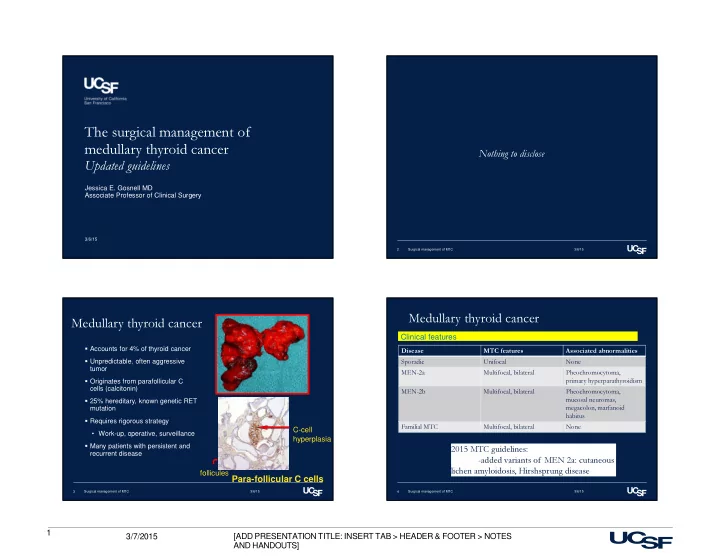
The surgical management of medullary thyroid cancer

Updated guidelines

3/6/15

Jessica E. Gosnell MD Associate Professor of Clinical Surgery

3/6/15 Surgical management of MTC 2

Nothing to disclose

Medullary thyroid cancer

Accounts for 4% of thyroid cancer Unpredictable, often aggressive tumor Originates from parafollicular C cells (calcitonin) 25% hereditary, known genetic RET mutation Requires rigorous strategy

  • Work-up, operative, surveillance

Many patients with persistent and recurrent disease

3/6/15 Surgical management of MTC 3

Para-follicular C cells

follicules C-cell hyperplasia

Medullary thyroid cancer

Disease MTC features Associated abnormalities Sporadic Unifocal None MEN-2a Multifocal, bilateral Pheochromocytoma, primary hyperparathyroidism MEN-2b Multifocal, bilateral Pheochromocytoma, mucosal neuromas, megacolon, marfanoid habitus Familial MTC Multifocal, bilateral None

Clinical features

3/6/15 Surgical management of MTC 4

2015 MTC guidelines:

  • added variants of MEN 2a: cutaneous

lichen amyloidosis, Hirshsprung disease

slide-2
SLIDE 2

[ADD PRESENTATION TITLE: INSERT TAB > HEADER & FOOTER > NOTES AND HANDOUTS] 3/7/2015 2

3/6/15 Surgical management of MTC 5

Clinical disease Recurrent disease Disease diagnosed by genetic test

Preoperative work-up: clinical disease

Extent of disease

  • Hx/ exam
  • Calcitonin/CEA level
  • Neck ultrasound
  • laryngoscopy

Hereditary disease

  • RET mutational analysis
  • Calcium, iPTH, fractionated

plasma metanephrines,24- hour urine metanephrines and normetanephrines

3/7/2015 6

2015 MTC guidelines:

  • Rule out pheochromocytoma. If present,

resect the pheo first after appropriate preoperative preparation, prior to surgery for MTC

Surgical management of MTC

Preoperative work-up: clinical disease

Calcitonin levels (2009 guidelines) ‒ <400 pg/ml -> high resolution neck ultrasound ‒ >400 pg/ml -> metastatic workup

3/7/2015 Surgical management of MTC 7

Revised 2015 MTC guidelines: >500pg/ml or N1 disease -> chest CT, neck CT and 3-phase contrast enhanced CT abdomen,

  • r contrast enhanced MRI

3/6/15 Surgical management of MTC 8

Calcitonin 308 (<2) CEA 19 (<5) 63yo man

slide-3
SLIDE 3

[ADD PRESENTATION TITLE: INSERT TAB > HEADER & FOOTER > NOTES AND HANDOUTS] 3/7/2015 3

“Overall, the rate of persistent

hypercalcitoninemia is nearly 50% for patients with nonpalpable macroscopic disease and greater then 80% for patients presenting with a palpable MTC.”

Van Heerden et al Annals of Surgery, 2000

3/6/15 Surgical management of MTC 9

Surgical management of MTC: clinical disease

Lack of effective adjuvant therapy Aggressive Difficult to cure biochemically Patient often live with disease for decades

3/7/2015 10

Completeness of resection Surgical risk

Surgical management of MTC

Surgical management of MTC: clinical disease

Total thyroidectomy & Lymph node dissection

3/7/2015 11

2009/2015 MTC guidelines: Total thyroidectomy

Surgical management of MTC

Sporatic MTC – 20% bilateral Hereditary MTC- 90%

Surgical management of MTC: clinical disease

Cervical lymph nodes Central neck

  • Hyoid to inominate,

between the carotid sheaths Left and right lateral neck

  • Lateral to the vessels,

divided into submandibular, parajugular and posterior triangle

3/7/2015 12 Surgical management of MTC

slide-4
SLIDE 4

[ADD PRESENTATION TITLE: INSERT TAB > HEADER & FOOTER > NOTES AND HANDOUTS] 3/7/2015 4

High incidence of lymph node metastases in patients with MTC

Over 50% involvement of cervical lymph nodes Moley et al: 81% of central lymph nodes involved in patients with unilateral tumors

3/7/2015 13

(Moley, Ann Surg 1999;240:1000)

Surgical management of MTC

Surgical management of MTC: clinical disease

Central lymph node dissection

3/7/2015 14

2009/2015 MTC guidelines: In patients with no evidence of advanced local disease, no evidence of cervical lymph metastasis on PE or US and no distant mets, patients should undergo Total tx and prophylactic VI neck dissection

Surgical management of MTC

Surgical management of MTC: clinical disease

3/7/2015 15

CENTRAL LYMPH NODE DISSECTION (VI, VII)

Surgical management of MTC

Surgical management of MTC: clinical disease

METASTASES COMMON! Machens et al, Cancer 2000 Unilateral lateral neck involvement

  • No cLNs

10%

  • 1-3 +cLNs

77%

  • >4 +cLNS

98% Contralateral lateral neck involvement

  • No cLNs

5%

  • 1-9 +cLNs

38%

  • >10 +cLNS 77%

3/7/2015 16

LATERAL LYMPH NODE DISSECTION (II, III, IV, V)

Surgical management of MTC

slide-5
SLIDE 5

[ADD PRESENTATION TITLE: INSERT TAB > HEADER & FOOTER > NOTES AND HANDOUTS] 3/7/2015 5

Surgical management of MTC: clinical disease

Lateral neck lymph node dissection

3/7/2015 17

2009 MTC guidelines: Selective approach: not prophylactic, but Therapeutic (image-guided) Revised 2015 MTC guidelines: No consensus

Surgical management of MTC

Surgical management of MTC: clinical disease

Compartment-based approach (no berry picking) Image and biopsy driven Preservation of vital structures Modify extent based on metastatic load

3/7/2015 18

LATERAL LYMPH NODE DISSECTION (II, III, IV, V)

(Robbins et al, Arch OHNS 1991)

Surgical management of MTC

Ultra sound with lymph node mapping

3/7/2015 19 Surgical management of MTC

Surgical management of MTC (genetic)

An increasing proportion of patients with MTC are now identified by genetic testing

3/6/15 Surgical management of MTC 20

slide-6
SLIDE 6

[ADD PRESENTATION TITLE: INSERT TAB > HEADER & FOOTER > NOTES AND HANDOUTS] 3/7/2015 6

Genetic testing for MTC

RET codon mutation

3/6/15 Surgical management of MTC 21

Identifies at-risk kindred Obviates need for lifelong surveillance for gene-negative patients

  • Pheochromocytoma, primary HPT

Allows prophylactic/preclinical thyroidectomy in gene-positive patients

  • Durable biochemical cure

May help “tailor” operative approach parathyroids

RET proto-oncogene

Genotype-phenotype correlation

3/6/15 Surgical management of MTC 22

Codon 634 most common

2001 Guidelines

Level I (least high risk)

  • Total tx <10yrs or when pentagastrin stimulated calcitonin

elevated Level II (611,618, 620, 634)

  • Total tx <5yrs

Level III (918, 883)

  • Total tx < 6 months

3/6/15 Surgical management of MTC 23

(Brandi et al, JCEM 2001)

2009 Guidelines

3/6/15 Surgical management of MTC 24

(Kloos RT et al, Thyroid 2009)

slide-7
SLIDE 7

[ADD PRESENTATION TITLE: INSERT TAB > HEADER & FOOTER > NOTES AND HANDOUTS] 3/7/2015 7

2015 Guidelines

3/6/15 Surgical management of MTC 25

ATA-highest

  • Thyroidectomy <1yr

ATA- high

  • Thyroidectomy <5 or earlier

based on calcitonin levels, in consultation with family ATA- moderate

  • Timing of thyroidectomy

should be based on calcitonin levels, in consultation with family, consider about age 5yrs ATA highest

  • -918

ATA high

  • 634

ATA moderate

  • All others!

2015 Guidelines

Central neck dissection (level VI)

3/6/15 Surgical management of MTC 26

ATA-highest

  • If suspicious LNs-> CLND,

consider only if parathyroids and be preserved ATA- high and moderate

  • CLND if calcitonin > 40 or

clinical evidence of mets

Preoperative work-up

Extent of disease (MTC)

  • High resolution neck ultrasound
  • Calcitonin level
  • CEA level

Evaluate for other endocrinopathies

  • PTH, calcium
  • fractionated plasma metanephrines, 24- hour urine

metanephrines and normetanephrines

Patients presenting with genetic mutation

3/6/15 Surgical management of MTC 27

A note about parathyroid glands: beware and have a plan

3/6/15 Surgical management of MTC 28

Sporadic MTC

  • Preserve parathyroids (uppers), autotransplant if necessary

Genetic disease

  • No primary hyperparathyroidism

‒ identify and preserve parathyroids

  • Primary hyperparathyroidism

‒ Resect abnormal glands (vs subtotal), use IOPTH ‒ If low risk for recurrent MTC-> SCM ok for autotransplant ‒ If higher risk for recurrent MTC-> forearm autotransplant

slide-8
SLIDE 8

[ADD PRESENTATION TITLE: INSERT TAB > HEADER & FOOTER > NOTES AND HANDOUTS] 3/7/2015 8

Recurrent MTC

3/6/15 Surgical management of MTC 29

When is it appropriate to reoperate in the neck? What are the surgical goals? Fialkowski et al, (WJS 2008) 148 patients underwent reoperation

  • 46% had calcitonin = or > than before the reoperation
  • 26% had a 20% reduction
  • 11% undetectable calcitonin levels at follow-up

Reoperation is unlikely to provide biochemical cure (calcitonin normalization)

Recurrent MTC: presentation

3/6/15 Surgical management of MTC 30

Asymptomatic elevated serum calcitonin Palpable disease in the neck Local symptoms

  • Stridor, dyspnea, hoarseness

Symptoms from metastatic disease

  • Bone pain, shortness of breath

Symptoms for secretory products

  • Diarrhea, flushing

Recurrent MTC: work-up

3/6/15 Surgical management of MTC 31

Physical examination Serum calcitonin, CEA High resolution neck ultrasound Laryngoscopy 2015 guidelines: Calcitonin >150 CT chest, contrast enhanced multiphase CT abdomen/pelvis or MRI, consider bone scan

Recurrent MTC: treatment

Observation (biochemical but no structural disease) Reoperation

  • Completion thyroidectomy, lymph node dissection (compartment-

based) Medications

  • Loperaminde, opium, somatostatin analogs, histamine blockers

Local, palliative treatment

  • XRT for bone metastases, RFA for liver tumors (>2cm)

Tyrosine kinase inhibitors (TKIs) Clinical trials Primum non nocere

3/6/15 Surgical management of MTC 32

slide-9
SLIDE 9

[ADD PRESENTATION TITLE: INSERT TAB > HEADER & FOOTER > NOTES AND HANDOUTS] 3/7/2015 9

Blue-dye injection

3/6/15 Surgical management of MTC 33

Conclusions

3/6/15 Surgical management of MTC 34

MTC is complex, unpredictable cancer Hereditary disease caused by RET mutations, with well-described genotype-phenotype correlation Surgical management of patients diagnosed clinically includes total thyroidectomy and bilateral central neck dissection, with low threshold for ipsilateral lateral neck dissection Surgical management of patient diagnosed by genetic testing usually includes prophylactic total thyroidectomy by high-volume thyroid surgeons, with selective approach to cervical lymph nodes Recurrent disease is common. Mulitdisciplinary team approach useful to carefully weigh relative merits of reoperation

35

Thank you

Jessica E. Gosnell MD Associate Professor of Clinical Surgery