Evolving Molecular and other Consulting fees: Genomic Health, - - PowerPoint PPT Presentation

evolving molecular and other
SMART_READER_LITE
LIVE PREVIEW

Evolving Molecular and other Consulting fees: Genomic Health, - - PowerPoint PPT Presentation

5/22/2015 UCSF UCSF Disclosures: All Paid to UCSF Evolving Molecular and other Consulting fees: Genomic Health, Biomarkers in Prostate Cancer GenomeDx Advisor Board / Speakers honoraria: Current Issues in Surgical Pathology Genomic


slide-1
SLIDE 1

5/22/2015 1

UCSF

Evolving Molecular and other Biomarkers in Prostate Cancer

Current Issues in Surgical Pathology May 22, 2015 Jeffry P. Simko, PhD, MD Professor of Clinical Pathology UCSF Departments of Urology, Radiation Oncology and Anatomic Pathology UCSF

Disclosures: All Paid to UCSF

  • Consulting fees: Genomic Health,

GenomeDx

  • Advisor Board / Speakers honoraria:

Genomic Health, Maximum Medical)

  • Research support: Genomic Health, Myriad

Genetics

UCSF

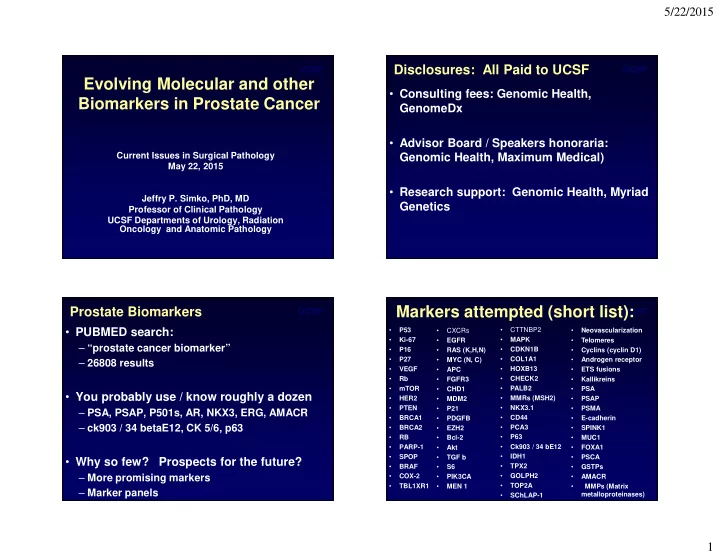
Prostate Biomarkers

  • PUBMED search:

– “prostate cancer biomarker” – 26808 results

  • You probably use / know roughly a dozen

– PSA, PSAP, P501s, AR, NKX3, ERG, AMACR – ck903 / 34 betaE12, CK 5/6, p63

  • Why so few? Prospects for the future?

– More promising markers – Marker panels

UCSF

Markers attempted (short list):

  • P53
  • Ki-67
  • P16
  • P27
  • VEGF
  • Rb
  • mTOR
  • HER2
  • PTEN
  • BRCA1
  • BRCA2
  • RB
  • PARP-1
  • SPOP
  • BRAF
  • COX-2
  • TBL1XR1
  • CXCRs
  • EGFR
  • RAS (K,H,N)
  • MYC (N, C)
  • APC
  • FGFR3
  • CHD1
  • MDM2
  • P21
  • PDGFB
  • EZH2
  • Bcl-2
  • Akt
  • TGF b
  • S6
  • PIK3CA
  • MEN 1
  • Neovascularization
  • Telomeres
  • Cyclins (cyclin D1)
  • Androgen receptor
  • ETS fusions
  • Kallikreins
  • PSA
  • PSAP
  • PSMA
  • E-cadherin
  • SPINK1
  • MUC1
  • FOXA1
  • PSCA
  • GSTPs
  • AMACR
  • MMPs (Matrix

metalloproteinases)

  • CTTNBP2
  • MAPK
  • CDKN1B
  • COL1A1
  • HOXB13
  • CHECK2
  • PALB2
  • MMRs (MSH2)
  • NKX3.1
  • CD44
  • PCA3
  • P63
  • Ck903 / 34 bE12
  • IDH1
  • TPX2
  • GOLPH2
  • TOP2A
  • SChLAP-1
slide-2
SLIDE 2

5/22/2015 2

UCSF

Markers (by pathway, e.g. akt):

  • P53
  • Ki-67
  • P16
  • P27
  • VEGF
  • Rb
  • mTOR
  • HER2
  • PTEN
  • BRCA1
  • BRCA2
  • RB
  • PARP-1
  • SPOP
  • BRAF
  • COX-2
  • TBL1XR1
  • CXCRs
  • EGFR
  • RAS (K,H,N)
  • MYC (N, C)
  • APC
  • FGFR3
  • CHD1
  • MDM2
  • P21
  • PDGFB
  • EZH2
  • Bcl-2
  • Akt
  • TGF b
  • S6
  • PIK3CA
  • MEN 1
  • Neovascularization
  • Telomeres
  • Cyclins (cyclin D1)
  • Androgen receptor
  • ETS fusions
  • Kallikreins
  • PSA
  • PSAP
  • PSMA
  • E-cadherin
  • SPINK1
  • MUC1
  • FOXA1
  • PSCA
  • GSTPs
  • AMACR
  • MMPs (Matrix

metalloproteinases)

  • CTTNBP2
  • MAPK
  • CDKN1B
  • COL1A1
  • HOXB13
  • CHECK2
  • PALB2
  • MMRs (MSH2)
  • NKX3.1
  • CD44
  • PCA3
  • P63
  • Ck903 / 34 bE12
  • IDH1
  • TPX2
  • GOLPH2
  • TOP2A

UCSF

Markers use (diagnosis):

  • P53
  • Ki-67
  • P16
  • P27
  • VEGF
  • Rb
  • mTOR
  • HER2
  • PTEN
  • BRCA1
  • BRCA2
  • RB
  • PARP-1
  • SPOP
  • BRAF
  • COX-2
  • TBL1XR1
  • CXCRs
  • EGFR
  • RAS (K,H,N)
  • MYC (N, C)
  • APC
  • FGFR3
  • CHD1
  • MDM2
  • P21
  • PDGFB
  • EZH2
  • Bcl-2
  • Akt
  • TGF b
  • S6
  • PIK3CA
  • MEN 1
  • Neovascularization
  • Telomeres
  • Cyclins (cyclin D1)
  • Androgen receptor
  • ETS fusions
  • Kallikreins
  • PSA
  • PSAP
  • PSMA
  • E-cadherin
  • SPINK1
  • MUC1
  • FOXA1
  • PSCA
  • GSTPs
  • AMACR / P504s
  • MMPs (Matrix

metalloproteinases)

  • CTTNBP2
  • MAPK
  • CDKN1B
  • COL1A1
  • HOXB13
  • CHECK2
  • PALB2
  • MMRs (MSH2)
  • NKX3.1
  • CD44
  • PCA3
  • P63
  • Ck903 / 34 bE12
  • IDH1
  • TPX2
  • GOLPH2
  • TOP2A

UCSF

Markers (Prognosis):

  • P53
  • Ki-67
  • P16
  • P27
  • VEGF
  • Rb
  • mTOR
  • HER2
  • PTEN
  • BRCA1
  • BRCA2
  • RB
  • PARP-1
  • SPOP
  • BRAF
  • COX-2
  • TBL1XR1
  • CXCRs
  • EGFR
  • RAS (K,H,N)
  • MYC (N, C)
  • APC
  • FGFR3
  • CHD1
  • MDM2
  • P21
  • PDGFB
  • EZH2
  • Bcl-2
  • Akt
  • TGF b
  • S6
  • PIK3CA
  • MEN 1
  • Neovascularization
  • Telomeres
  • Cyclins (cyclin D1)
  • Androgen receptor
  • ETS fusions
  • Kallikreins
  • PSA
  • PSAP
  • PSMA
  • E-cadherin
  • SPINK1
  • MUC1
  • FOXA1
  • PSCA
  • GSTPs
  • AMACR
  • MMPs (Matrix

metalloproteinases)

  • CTTNBP2
  • MAPK
  • CDKN1B
  • COL1A1
  • HOXB13
  • CHECK2
  • PALB2
  • MMRs (MSH2)
  • NKX3.1
  • CD44
  • PCA3
  • P63
  • Ck903 / 34 bE12
  • IDH1
  • TPX2
  • GOLPH2
  • TOP2A
  • SChLAP-1

UCSF

Markers use (Panels):

  • P53
  • Ki-67
  • P16
  • P27
  • VEGF
  • Rb
  • mTOR
  • HER2
  • PTEN
  • BRCA1
  • BRCA2
  • RB
  • PARP-1
  • SPOP
  • BRAF
  • COX-2
  • TBL1XR1
  • CXCRs
  • EGFR
  • RAS (K,H,N)
  • MYC (N, C)
  • APC
  • FGFR3
  • CHD1
  • MDM2
  • P21
  • PDGFB
  • EZH2
  • Bcl-2
  • Akt
  • TGF b
  • S6
  • PIK3CA
  • MEN 1
  • Neovascularization
  • Telomeres
  • Cyclins (cyclin D1)
  • Androgen receptor
  • ETS fusions
  • Kallikreins
  • PSA
  • PSAP
  • PSMA
  • E-cadherin
  • SPINK1
  • MUC1
  • FOXA1
  • PSCA
  • GSTPs
  • AMACR / P504s
  • CTTNBP2
  • MAPK
  • CDKN1B
  • COL1A1
  • HOXB13
  • CHECK2
  • PALB2
  • MMRs (MSH2)
  • NKX3.1
  • CD44
  • PCA3
  • P63
  • Ck903 / 34 bE12
  • IDH1
  • TPX2
  • GOLPH2
  • TOP2A

Pollack, et al., Clin Cancer Res. 20(24): 6379-88 (2014)

slide-3
SLIDE 3

5/22/2015 3

UCSF

Clinically significant ones:

  • P53
  • Ki-67
  • P16
  • P27
  • VEGF
  • Rb
  • mTOR
  • HER2
  • PTEN
  • BRCA1
  • BRCA2
  • RB
  • PARP-1
  • SPOP
  • BRAF
  • COX-2
  • TBL1XR1
  • CXCRs
  • EGFR
  • RAS (K,H,N)
  • MYC (N, C)
  • APC
  • FGFR3
  • CHD1
  • MDM2
  • P21
  • PDGFB
  • EZH2
  • Bcl-2
  • Akt
  • TGF b
  • S6
  • PIK3CA
  • MEN 1
  • Neovascularization
  • Telomeres
  • Cyclins (cyclin D1)
  • Androgen receptor
  • ETS fusions
  • Kallikreins
  • PSA
  • PSAP
  • PSMA
  • E-cadherin
  • SPINK1
  • MUC1
  • FOXA1
  • PSCA
  • GSTPs
  • AMACR / P504s
  • CTTNBP2
  • MAPK
  • CDKN1B
  • COL1A1
  • HOXB13
  • CHECK2
  • PALB2
  • MMRs (MSH2)
  • NKX3.1
  • CD44
  • PCA3
  • P63
  • Ck903 / 34 bE12
  • IDH1
  • TPX2
  • GOLPH2
  • TOP2A

???

UCSF

Biomarker uses (General):

  • Screening (serum PSA)
  • Diagnosis (Bx)
  • Prognosis
  • Predictive (Likelihood of response to Rx)

– Reimbursement most likely – Develop drugs based on targets

  • Disease monitoring

UCSF

Why little success in Prostate?

  • Specific Clinical Indication

– What application? (disease state) – Localized disease: Clinical parameters already do a decent job (Gleason = high bar to reach). – Metastatic Disease: Success with anti- androgens and lack of study material

  • Tumor Multifocality

UCSF http://www.onclive.com/publications/obtn/2012/december-2012/ sequencing-of-novel-prostate-cancer-agents-is-a-work-in-progress/2 Clinical Indications: Summary Map of therapies Docetaxel Dx: Active surveillance Inc. PSA

slide-4
SLIDE 4

5/22/2015 4

UCSF Primary Treatment & ? additional treatment needed? “Aggressive tumors” GS > 3+4 = 7 “Indolent Tumors” GS < 7 No treatment needed ? Active surveillance Primary Treatment curable? Prostatectomy Radiation “Continuum of aggressiveness”

PCa at Primary Diagnosis

UCSF Primary Treatment & ? additional treatment needed? “Aggressive tumors” GS > 3+4 = 7 “Indolent Tumors” GS < 7 No treatment needed ? Active surveillance Primary Treatment curable? Prostatectomy Radiation “Continuum of aggressiveness”

PCa at Primary Diagnosis

UCSF

Active Surveillance as Rx:

  • Epstein Criteria (JHU): Insignificant Cancer

– cT1c, No Gleason > 3, PSAD<0.15ng/mL, < 3 cores +, < 50% Ca/core

  • Multiple Other Criteria:

– D’Amico: PSA < 10, cT2a or less, No Gleason >3 – Dall’Era: No Gleason > 3, PSA < 10, <33% + cores, < 50% / core – Van As: cT2a or less, PSA<15, GS<=7,< 50% cores +

  • F/U schedule?

Bastian et al., Eur Urol 55: 1321-1332 (2009) UCSF Outcome chart Klotz, J Clin Oncol. 28: 126-31 (2010) Rare deaths: All had PSA doubling time < 2 years

slide-5
SLIDE 5

5/22/2015 5

UCSF

Risk assessment Tools:

  • Kattan Nomograms: PSA, c stage, GS
  • CAPRA: PSA, c stage, GS, of + cores, Age
  • NCCN: PSA, c stage, GS

http://www.tri-kobe.org/nccn/guideline/urological/english/prostate.pdf

  • Many others: Partin Tables, D’Amico,

Stephenson, etc.

Lughezzani, et al., Eur Urol 57(4): 562-8 (2010) UCSF Kattan nomograms Kattan: Preoperative Nomogram for BCR after RP Graefen, J Clin Oncol. 20(15): 3206-3212 (2002) UCSF CAPRA Cooperberg, et al., Cancer 107(10): 2384-2391 (2006) UCSF CAPRA Cooperberg, et al., Cancer 107(10): 2384-2391 (2006) CAPRA: Preoperative prediction of BCR after RP

slide-6
SLIDE 6

5/22/2015 6

UCSF Tumor Multifocality: What gets biopsied? UCSF

Tumor Heterogeneity and Sampling:

  • Did the cancer get sampled?
  • Did the clinically significant cancer?

UCSF

Marker Examples:

  • Management of localized disease

– ETS Fusions – PTEN – Various Marker Panels

  • Management of Systemic Disease

– AR-V7

UCSF http://www.onclive.com/publications/obtn/2012/december-2012/ sequencing-of-novel-prostate-cancer-agents-is-a-work-in-progress/2 Clinical Indications: Summary Map of therapies Docetaxel Dx: Active surveillance Inc. PSA

slide-7
SLIDE 7

5/22/2015 7

UCSF

ETS Fusions:

  • Roughly 50% of PCa -> most common

translocation currently known!

  • Androgen regulated gene to a growth factor

Science 310: 644-648 (2005) UCSF

ETS Fusions:

  • TMPRSS2 (Transmembrane protease serine 2)

– Serine protease family member (PSA, kallikreins, etc.) – Highly expressed in normal and malignant prostate – EXPRESSION REGULATED BY ANDROGEN – ANDROGEN RESPONSE ELEMENT PRESERVED IN FUSION – Other Genes rarely in its place.

  • ETS Family: Transcription factors / growth

– Involved in other tumor translocations (Ewing’s sarc.) – ERG most common (45 - 50%) – ETV1 (~10%), ETV4 (~5%), FLI1(~1%), others rare. Science 310: 644-648 (2005) UCSF Udager, Prostate 74(12): 1199 -1208 (2014). TMPRSS2-ERG: Detect by IHC, FISH or PCR across the breakpoint IHC relative to FISH: 86% sensitive 89% specific

Chaux, et al. AJSP 35(7): 1014-20 (2011)

Various Antibodies Avail. UCSF ERG IHC +++ in 30-70% PCa, Intraductal-CA ~20% HG-PIN Field effect (+B9 at PCa) Otherwise, Highly specific for PCa (+ in Endothelium) ? Diagnosis? (28% of ASAP to PCa, Shah, Human Path 44(5): 786-94 (2013)). Pseudohyperplastic? Atrophic?

Chaux, et al. AJSP 35(7): 1014-20 (2011)

slide-8
SLIDE 8

5/22/2015 8

UCSF

ETS Fusions: Prognostic?

Gopalan, et al., Cancer Res 69(4): 1600-1604 (2009). Hoogland, et al. Mod Pathol 25: 471-79 (2012) N=521 f/u = 8yrs. 42% prim 40% mets N = 481 65% prev.

UCSF

PTEN for prognosis?

  • PI3 kinase pathway master NEG. regulator

– Tumor suppressor gene – mTor, akt, MDM2, BCL-2, etc.

  • PTEN loss in 10 – 25% of PCa

– Correlates with higher grade, stage, mets. – Prognostic marker?

  • Detect by many methods

– Chromosome 10q23 loss, FISH, IHC, NGS

UCSF Majchrzak, Molecules 19(9): 14304 (2014) UCSF

2 copies PTEN, protein intact PTEN IHC PTEN FISH 0 copies PTEN, protein lost PTEN IHC PTEN FISH

PTEN CEN10 Flanking genes

Courtesy of T. Lotan M.D., Johns Hopkins U.

slide-9
SLIDE 9

5/22/2015 9

UCSF

1 copy PTEN, protein intact PTEN IHC PTEN FISH 1 copy PTEN, protein lost

PTEN CEN10 Flanking genes

Courtesy of T. Lotan M.D., Johns Hopkins U. UCSF

IHC vs. FISH ?

  • Similar to Her 2 status.

– Protein vs. gene. – Difference is PTEN is loss, Her 2 amplified

  • Data being generated.

UCSF Courtesy of T. Lotan M.D., Johns Hopkins U. UCSF Modern Pathol 28: 128-137 (2015)

slide-10
SLIDE 10

5/22/2015 10

UCSF

Clinical Utility

  • Loss is predictive of aggressive

disease at prostatectomy.

– Marker for Active surveillance?

  • Analytical validation and Interpretation

– Heterogeneity of signals

  • Focal loss vs. artifact?

– Can be difficult to interpret

  • Faint staining? + or - ?
  • Look at the benign (internal control)

UCSF Picture of ERG IHC Morais, et al., AJSP 39(2): 169-78 (2014). PTEN for IDC vs. HG-PIN IDC = 76% had PTEN loss HG-PIN = 0% PTEN loss Borderline = 52% PTEN loss UCSF

Marker Panels: Predict RFS for AS

  • Cell cycle progression (Prolaris, Myriad)

– Bx or RP: 31 CCP genes, 15 controls, RT-PCR

  • Oncotype Dx (GHI)

– Bx: RT-PCR, 12 genes with 5 controls

  • Decipher (GDx): 22 mRNAs on an affymetrix

chip (1.4 Mil. spots) for RFS after prostatectomy

  • Others (ProMark): 8 proteins via IF of FFPE
  • ALL Use FFPE tissue, various controls

– Heterogeneity issues? Select highest grade. – ETS fusions do not appear in any of these.

UCSF

Marker Panel Usage:

  • Validation with outcomes needed.

– Prostate cancer has long natural history – Assume ALL technology in place now -> at least 5 years to really validate.

  • Best clinical use
  • NEXT GEN SEQUENCING:

– Aggressive Tumor subsets? – Molecular Classification of Prostate Cancer?

slide-11
SLIDE 11

5/22/2015 11

UCSF Typical Oncotype report UCSF Typical Prolaris report UCSF http://www.onclive.com/publications/obtn/2012/december-2012/ sequencing-of-novel-prostate-cancer-agents-is-a-work-in-progress/2 Clinical Indications: Summary Map of therapies Docetaxel Dx: Active surveillance Inc. PSA UCSF

Androgen Receptor Splice Variant AR-V7:

  • One of many variants of AR
  • Lacks Ligand binding domain
  • Shown to correlate with new drug resistance

– Circulating tumor cells from 62 patients – RT-PCR of the ARV7 splice variant – When present, outcome was dismal

  • Recently shown not to effect Taxane Rx.
  • ? New predictive marker? (Bxs coming?)

Antonarakis, et al., NEJM 371(1): 1028-38 (2014)

slide-12
SLIDE 12

5/22/2015 12

UCSF AR: Androgen Receptor Gene and mRNA splice variants UCSF Lotan IHC Antonarakis, et al., NEJM 371(1): 1028-38 (2014) UCSF Antonarakis, et al., NEJM 371(1): 1028-38 (2014) Full length AR vs. AR-V7 RNA ISH FFPE specimens NO IHC yet UCSF

Near Future?

  • More markers for certain.
  • Molecular classification of Prostate cancer?
slide-13
SLIDE 13

5/22/2015 13

UCSF Iafrate lung cancer types Kris, et al., JAMA 311(19): 1998-2006 (2014) Lung Adenocarcinoma Mutation Frequencies UCSF

GenomeDx Biosciences Confidential 22/05/2015 50

No-metastasis (n=893) Metastasis (n=355) 38 % 38 % 46 % 44% 9 % 10 % 7 % 8 %

Molecular subtypes are not associated with prostate cancer outcome

Prognostic? Courtesy of SA Tomlins, U. MICH, Eur Urol (in press). UCSF

Summary:

  • Issues with developing PCa markers

– Clinical application, tumor sampling

  • New markers ready for clinical use

– PTEN – ARV7

  • Many Marker Panels Developed

– Awaiting clinical validation

  • Future Molecular classifications likely

– Need defined clinical utility