
SLIDE 1
Evolution – Life Through Time
- J. D. Price
Natural Science II – ERTH 1040
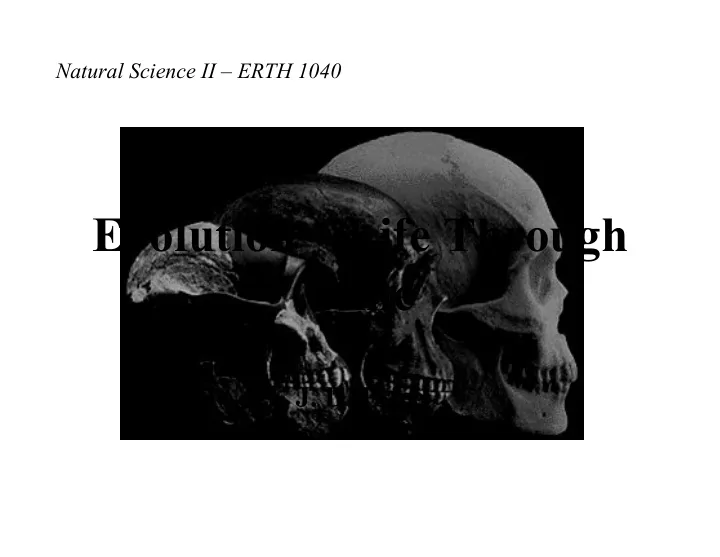
Evolution Life Through Time J. D. Price Evolution remains at the - - PowerPoint PPT Presentation
Natural Science II ERTH 1040 Evolution Life Through Time J. D. Price Evolution remains at the center of controversy in many communities. Oklahoma, Alabama, Kansas, Virginia are some of the states that have taken political action to
Natural Science II – ERTH 1040
Message from the Oklahoma State Textbook Committee: This textbook discusses evolution, a controversial theory, which some scientists present as scientific explanation for the origin of living things, such as plants and humans. No one was present when life first appeared on earth. Therefore, any statement about life's origins should be considered as theory, not fact. The word evolution may refer to many types of change. Evolution describes changes that occur within a species. (White moths, for example, may evolve into gray moths). This process is micro evolution, which can be observed and described as fact. Evolution may also refer to the change of one living thing into another, such as reptiles into birds. This process, called macro evolution, has never been
undirected forces produced a world of living things. There are many unanswered questions about the origin of life, which are not mentioned in your textbook, including: Why did the major groups of animals suddenly appear in the fossil record, known as the Cambrian Explosion? Why have no new major groups of living things appeared in the fossil record in a long time? Why do major groups of plants and animals have no transitional forms in the fossil record? How did you and all living things come to possess such a complete and complex set of instructions for building a living body? Study hard and keep an open mind. Someday you may contribute to the theories of how living things appeared on earth.
Evolution remains at the center of controversy in many communities. Oklahoma, Alabama, Kansas, Virginia are some of the states that have taken political action to devalue this theory in science education Here’s the approved statement for biology textbooks in Oklahoma (1999):
Theory is the basis of science
Theory is necessary because it is impossible to observe all systems in all places at all times (as you are reading this you are theoretically generating a myriad of proteins – this is theoretical, because you are not actually evaluating your body chemistry). “Fact” or “Truth” is the goal of every Scientific Theory Some Theories have more lines of evidence The evidence for the Theory of Plate Tectonics comes from a number of places and times, over several length scales. As of now, we have only one example of the origins and development of life. Models built on one example can be internal consistent, but not externally verifiable.
What of life’s origins Science
routine struck by meteorites with dates of 4.5 Ga
Non Science
incorrect.
Pseudoscience
If you believe in the Genesis account recorded in Judeo-Christian scripture as literal natural history The correct is response is:
The Earth may look old and life may look interrelated, but I believe life developed from a supernatural source (a non-science philosophy)
Not:
The Earth does not appear old and/or life does not appear interrelated, and I will attempt to use natural processes to show how the supernatural act occurred. (a pseudoscience philosophy) The latter is the modus of so-called “creation science” and “intelligent design”: which typically call on unique physical processes to maintain a consistency with the Genesis text.
Message from Dr. Price: This lecture discusses evolution, a scientific theory, much like the theories developed for gravitation, electrical conduction, magnetism, the parts of an atom, covalent bonding, the dissolution of ions, plate tectonics, lithification of sediments, grain boundary energy, the interaction of trophic systems, genotypes, and protein synthesis. In each case, explanations are made to explain observations; these are tested repeatedly and refined such that each approaches universality (applicable anywhere at any time). No person was present when life first appeared on earth some 3 or more billion years ago. However, an extensive record of the remains of ancient biota are preserved within the rocks of the near-surface of the
increasing time, the diversity of life increases substantially: fossils record more complicated multicellular
in aquatic environments. Perhaps more substantially, all life on earth shares common characteristics and chemistry. All living things contain long chains of deoxyribonucleic acid that interface with ribonucleic acid to produce complex molecules, called proteins, out of 20 amino acids. Changes in the sequence of deoxyribonucleic acid occur through several processes; such changes can be dramatic on relatively short time scales, and are logically thought to be extensive when considering geologic time. All living things respire and regulate respiration, grow, respond to stimuli, and may reproduce. Changing conditions, such as the result of a dynamic lithosphere, hydrosphere, and atmosphere, largely fueled by the nonrandom conditions of imposed by a cooling planet revolving around a planetary body massive enough to fuse hydrogen into helium, may support certain genetic codes at the expense of others. There are many unanswered questions about the origin of life, which are not answered by our current understanding of the Earth, including: Why did life become rapidly diverse in rocks dating from 540 million years ago? What is the nature of transition in life diversity? How did you and all living things come to possess such a complete and yet simple sequential set of instructions for building a living body? Study hard and keep an open mind, and actually learn how to evaluate observations scientifically. Someday you may contribute to the theories of how living things appeared on earth.
So, my disclaimer (based on the one for Oklahoma):
In short: creation science and intelligent design are not science - they are philosophies They have no legitimate place in a science class.
Analyses of DNA make it suggest that all of life on Earth is related back to one single
Chemically, we’re all very similar.
The remnants of many organisms are left behind in accumulating sediments. Skeletal materials, made of dense minerals can be particularly well preserved. In places entire ecosystems are buried and lithified.
Note: these are categorized by morphology and environment (not genetics)
Q: what type of rock is this?
Keep in mind the fossil record is by no means an accurate depiction of ancient life Fossilization favors Organisms with simple skeletons (few pieces)
in aquatic environments with rapid depostion that are small enough to buried quickly that are abundant and well distributed that existed over substantial periods of time Note the oldest observed fossil certainly may not be the oldest individual for that organism Note fossils contain no organic materials; there is only a little chemical evidence to be gleaned from them.
4.6 billion years ago Q: From what materials is our solar system made?
The Moon shows evidence of heavy bombardment up to 3.8 Ga Undoubtedly, the Earth is being impacted simultaneously – the impacts would make the surface of the Earth unsuitable for liquid
Or maybe not… Recent evidence shows that the oldest materials on earth, Jack Hills Zircons, are 4.4 biliion years old. These record crystallization temperatures in the 600-750 ºC range - implying wet magmatic conditions and the possible establishment of the hydrosphere.
NASA’s Earth Observatory
But prior to 4.4 Ga, there are a number of problems with the early Earth.
depth)
All except last are reduced through gravitation and
temperatures.
In 1953, Miller and Urey conducted an experiment in which methane, ammonium, hydrogen, and water were subjected to an electrical
15% of C formed organic compounds, 2% as amino acids. Suggests that a primitive atmosphere could produce life compounds.
Remember these? Meteorites called carbonaceous chondrites
The juxtaposition of very high temperature components (chondrules and inclusions made of silicates) and very low temperature components (complex carbon compounds).
24-515 Figure 24.24
Amino acids are a long way from proteins and nucleic acid The next step is the subject of ongoing investigations. One current theory: the RNA world RNA has the ability to copy itself, modify as an enzyme, and bond with amino acids. Many viruses proliferate with nothing more than RNA and protein (although few think viruses were the first life – too dependant on cellular life) Q: what’s the next step and why?
The existence of life deep in the
extreme conditions has led many to conclude that early life may have used the heat of the Earth for energy We are still a long way from understanding how life chemistry came together initially. Q: What are the two sources of external energy on planet Earth used by life?
http://projects.edtech.sandi.net/miramesa/Organelles/fossilbact.html
Cellular life The oldest fossils – not much to look at, but appears to be a filamentous bacteria from 3.5 billion years ago.
Q: the oldest life belongs to what Kingdom?
Cyanobacteria from the Bitter Springs chert of central Australia, a site dating to the Late Proterozoic, about 850 million years old.
Stromatolite
Meet BIF (Banded Iron Formation)
Rock is 2.5 billion years old (found world wide from 3 - 1.8 Ga) Dark: Hematite (Fe2O3) Red: Quartz (with iron) Yellow: Crocidolite (blue asbestosform) The accumulation of iron as seafloor sediments is thought to result from early photosynthesis on the ocean surface under N2 – CO2 rich conditions. A lack of atmospheric O2 permits Fe ions in surface seawater – these bond with O2 produced by photosynthesis.
24-507 Figure 24.4
Scientists think that the first
(producers) depleted an initially CO2 rich atmosphere, enriching it in
Q: what process may have enriched O2 in the atmosphere?
24-506 Figure 24.3
Earliest life is prokaryotic Double-walled membrane
with energy, mitochondria and chloroplasts, indicate that these eukaryotic
been separate prokaryotes that were incorporated into the cell structure. Q: what is the endosymbiotic theory?
Eukaryotes can be single cellular or multicellular. Specialized cells developed. Some cells in complex organisms can be quite complicated. Recall that sponges (poriphera) are examples of animals Note, sponges, are extensive in the fossil record, beginning 540 Ma – a hard skeleton made of calcite or quartz makes them incredibly durable.
Specialized cells apparently arose by 650 Ma, with the Vendian
like casts of soft parts – but not much is known about these critters. Fungi also arise at the same
monocellular, colonial, or multicellular.
The one in the picture (right) is
Chert, Scotland.
Starting at 570 and leading to 540 million years ago, life
they organisms have different morphologies. Many of these
Segmented arthropods: trilobites Sponges Bryozoa Corals Brachiopods
The reason is the source of serious scientific debate, but
and chemical conditions in the ocean.
Recall that plants are very close to algae in genetic structure Algae are another organism that has its oldest fossils in the Cambrian. Plants occur much higher in the record – 440 million years ago, and are found in rocks that formed on land. Plants are simple to complex multicellular
specialized cells to extract moisture, amino acids, nitrates, phophates, and minerals from soils (roots). Some of the earliest fossils are fern-like in morphology Note: modern land plant height is limited by gravitational constraints of lifting water.
Animals are heterotrophs – they need to eat autotrophs to get carbohydrates. Until recently, fossil land animals were found to be all younger than fossil plants However, a 470 Ma fossil of a millipede, discovered in 2004, is now thought to be the
autotrophs existed or this millipede stayed close to the water. The conversion from water to land (or vice versa) is a difficult one Most (but not all) aquatic heterotrophs organisms extract oxygen from water*, and autotrophs carbon dioxide from water. Most land heterotrphs extract oxygen from air. Life is largely made of water, and therefore is similar in density. Most
factor on dry land.
*the attempt to extract oxygen from water in organisms that extract it from air is the phenomena known as drowning.
The fossil record not only tells of the development of life, it speaks to the termination of organisms. Extinction is when a type of organism (species) fails to appear past a certain time horizon in the fossil record, or ceases to exist in modern ecosystems. Extinctions happen throughout time, but there have been six to seven points in earth history when a significant number of organism types became extinct. 650, 540, 510, 440, 340, 248, 65 million years The cause of mass extinctions is not known, but most theories point to global catastrophe Bolide impacts (likely for the K-T) Large-scale volcanism Rapid climate change Slow magnetic reversals
The end of the world occurred 248 million years ago - the Permian extinction
Ninety to ninety-five percent of marine species were eliminated as a result of this Permian event.
Gone:
Reduced
Why This was a long time ago - some ideas
In contrast, the Cretaceous extinction was a mild event
Sixty percent of all species were eliminated as a result of this Permian event.
Clay layers from this boundary typically include enriched iridium.
The prevailing theory for this extinction involves bolide impact at the Yucatan Peninsula - the Chicxalub structure.
million years without a single mass extinction
20-424 Figure 20.50
Oldest humanoid fossil 4.3 Ma Oldest fossil plants 440 Ma Oldest chordates 510 Ma Oldest fossil green algea 530 Ma Oldest shelled invertebrates 570 Ma Oldest animal fossils (Vendian) Oldest fossil fungi 650 Ma Oxygenated atmosphere 1.7 Ga Oldest fossil organism 3.5 Ga Oldest rock 3.9 Ga Q: what is the significance of plants with respect to environment?
Humans are relative new comers to life
By the early 1800’s, it became clear that the Earth had a long history preserved in the rocks. Many of these organisms exhibited small changes in morphology with time The complexity of life increased with time People started to wonder how this diversity could arise through natural processes.
Jean Baptiste Pierre Antoine de Monet, Chevalier de Lamarck
24-513a Figure 24.16a
Lamarck advocated that organisms could adapt within a
was right about bacteria)
Charles Darwin Alfred Russel Wallace
24-513b Figure 24.16b
Darwin and Wallace concluded that adaptations were
changes in requirements died out, removing their hereditary traits from a population
Darwin-Wallace evolution has been summarized as “survival of the fittest.” Organisms that can’t adapt, die, and in most cases won’t reproduce. True story: In the early 1930’s, the Soviet Union developed an agricultural process under T.D. Lysenko based on Lamarkian evolution, purportedly because Darwinian evolution was contrary to Stalinist ideals. Lysenko claimed that winter wheat would adapt into spring wheat if planted later in the year. (He also later claimed that wheat would transform into barley or rye given the right conditions). The results were devastating.
Q: What is the difference between Lamark and Darwin-Wallace theories?
24-509 Figure 24.9
Short clovers are selected on the side of the fence with the cows, because the long phenotype is removed.
Selection was not a new idea in Darwin’s
Species discusses breeding and husbandry development of domesticated animals. Darwin and Wallace saw the same processes with the environment choosing the preferred features
Q: how and when did a specific breed of dog arise (a German Shepard, for example)?
All members of C. familiarus are likely descendents
The traditional view of natural selection means that small changes to organisms would happen all the time. If organism A is related to Organism B, then there should be some intermediate organism that links the two and shows the gradual progression. Much of the fossil record does not show this. Many morphological types of organisms (i.e. species) persist for long periods of time in the fossil record. Organisms appear and disappear quite quickly. In the early seventies, Niles Eldredge and Stephen Gould suggested that adaptation happens very quickly – giving rise to organisms that are well suited for long periods of time Punctuated equilibrium
1. Modern life constrains the ancient 2. New species split from populations 3. Most new species are in geographical isolation. 4. Large, widespread species usually change slowly, if at all. 5. Daughter species are typically geographically limited. 6. Daughter species limited in time 7. The fossil record largely static with few rapid changes. 8. Adaptive change in lineages occurs with speciation. 9. Trends in adaptation occur mostly through species selection.
Q: How does punk eek differ from the more traditional, gradual view of evolution?
Gradualism Punk Eek Q: what’s the difference?
24-511 Figure 24.14
Most new species arise from a single species that becomes geographically divided. Q: in what ways would plate tectonics influence evolution?
Morphology DNA deviations Repetition Successful changes
Perhaps evolution is best attempt of organisms to find lowest energy form over time (like any chemical phase)?
24-514 Figure 24.17
Q: how old is mankind’s direct ancestors? Where did humanoids first develop?
Spencer Wells
the y-chromosome is a parcel of DNA, passed
basically unchanged for generations save random mutations. By looking at modern individuals y-chromosome DNA, a migration path for H. sapiens is revealed.
Q: What would have prompted this migration at 50,000 years?