SLIDE 1
Extinction What is evolution? What is evolution? The change in the - - PowerPoint PPT Presentation
Origins of Life and Extinction What is evolution? What is evolution? The change in the genetic makeup of a population over time Evolution accounts for the diversity of life on Earth Natural selection is the major driving mechanism
SLIDE 2
SLIDE 3
What is evolution?
- The change in the genetic makeup of a
population over time
- Evolution accounts for the diversity of life
- n Earth
- Natural selection is the major driving
mechanism of evolution
SLIDE 4
Evidence for Evolution
- Charles Darwin used evidence to develop his
theory of evolution by natural selection
- Examples?
- Today?
SLIDE 5
Evidence of Biological Evolution
- Geographic – Distribution of living things
- Geological – Fossils
- Physical – Comparative Morphology/Embryology
- Chemical – DNA nucleotide and protein
sequences
- Mathematical – Molecular Clocks or Radiometric
Dating of Fossils
SLIDE 6
Scientific evidence supports various models of the natural
- rigin of life on Earth.
1.D.1 (a)
SLIDE 7
When did Earth form? Earliest life forms?
SLIDE 8
Origin of Life on Earth
- Oparin’s Hypothesis
- Primordial Soup Model
(J.B.S. Haldene)
- Urey-Miller Experiment
- RNA World Hypothesis
- Theory of Endosymbiosis
SLIDE 9
Oparin’s Hypothesis
- Proposed that early life formed through a
series of reactions that made simple compounds gradually into more complex
- rganic molecules
- Catalyzed by UV radiation and lightening
- 3.9 to 3.5 billion years ago
SLIDE 10
Primordial Soup Model (Haldane)
- Primitive Earth provided inorganic precursors
(such as H2O, CO2, NH3) from which organic molecules could be synthesized
- Inorganic precursors served as monomers for
the formation of complex organic molecules
- Monomers produced polymers with the ability
to replicate, store and transmit information
SLIDE 11
Primordial Soup Model
SLIDE 12
Urey-Miller Experiment
- 1953 - Chemical experiment that showed it
was possible to form complex organic molecules from inorganic molecules in the absence of life
SLIDE 13
SLIDE 14
RNA World Hypothesis
- Proposes that RNA could have been the
earliest genetic material, rather than DNA
- Supported by the discovery of ribozymes
- Ribozymes are capable of self-replication
SLIDE 15
Evolution of Early Life
Organic Molecules Nonphotosynthetic Prokaryotes Photosynthetic Prokaryotes Unicellular Eukaryotes Multicellular Eukaryotes Protocells
SLIDE 16
Theory of Endosymbiosis
- Describes how cells ingested other cells and
became dependent on one another for survival (symbiosis), resulting in a permanent relationship
- Prokaryotes to eukaryotes
SLIDE 17
SLIDE 18
Geological evidence provides support for models of the origin
- f life on Earth.
1.D.2 (a)
SLIDE 19
Formation of Earth
- Earth formed approximately 4.6 billion years
ago
- Environment was too hostile for life until
approximately 3.9 bya
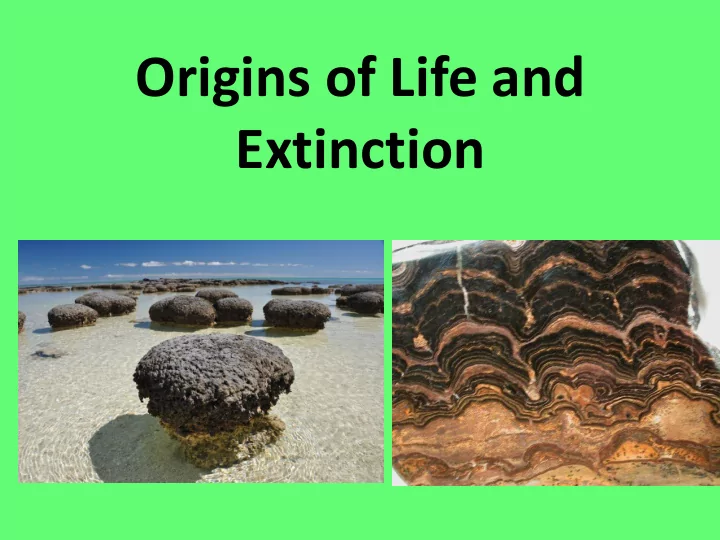
- Fossil evidence for life dates to 3.7 bya –
stromatolites (fossilized microbial mats of primarily cyanobacteria)
SLIDE 20
SLIDE 21
Fossil Evidence of Early Life
SLIDE 22
Geological Evidence of Atmospheric Oxygen
- Free O2 dissolved in surrounding water,
eventually reacting with dissolved iron
- Produces iron oxides which accumulate in
sediments
SLIDE 23
Oxygen Revolution (2.5 to 2.7 bya)
SLIDE 24
Single-Celled Eukaryotes
- Oldest fossils of eukaryotes are about 2.1
billion years old
- Evidence for endosymbiosis?
SLIDE 25
Multicellular Eukaryotes
- Oldest known fossils are of small algae from
1.2 billion years ago
- Animals during the Cambrian Explosion (535-
525 mya) – Cnidarians, Porifera, Mollusca
- Colonization of land around 500 mya – fungi,
plants, and animals
- Earliest fossil tetrapods – 365 mya
Choanoflagellates
SLIDE 26
SLIDE 27
Tetrapods
- Tetrapods (four limbs) evolved from lobe-
finned fish
- “Tiktaalik” – transitional fossil of fish to first
tetrapods (375 mya)
SLIDE 28
SLIDE 29
Continental Drift
- What is continental drift?
- How does continental drift contribute to
evolution?
SLIDE 30
Continental Drift
- Reshapes physical features of the planet
- Alters habitats in which organisms live
- Causes changes in climate
- Promotes allopatric speciation by interrupting
gene flow
SLIDE 31
Evidence for Continental Drift
SLIDE 32
Species extinction rates are rapid at times of ecological stress.
1.C.1(b)
SLIDE 33
Five Major Extinctions
- Ecological stress?
SLIDE 34
Five Major Extinctions
- Ordovician-Silurian – wiped out 85% sea life,
blamed on an ice age
- Late Devonian – wiped out 75% of ALL
species, asteroids, climate change, new plants
- Permian – “Great Dying”, 96% of ALL species,
enormous volcanic eruptions (flood basalt), warmed Earth by 6°C, drop in oxygen levels
SLIDE 35
Five Major Extinctions
- Triassic-Jurassic – wiped out 50% of ALL live,
blamed on climate change, asteroids, plants were not as affected as animals
- Cretaceous-Tertiary (K/T) – death of the
dinosaurs, evidence of asteroid impact
SLIDE 36
Extinction and Evolution
- Mass extinctions alter ecological communities
- Fossil record indicates that within 5-10 million
years, diversity of life recovers to previous years
- Why?
SLIDE 37
Human Impact on Ecosystems and Species Extinction Rates
- 6th mass extinction
- How are humans modifying the global