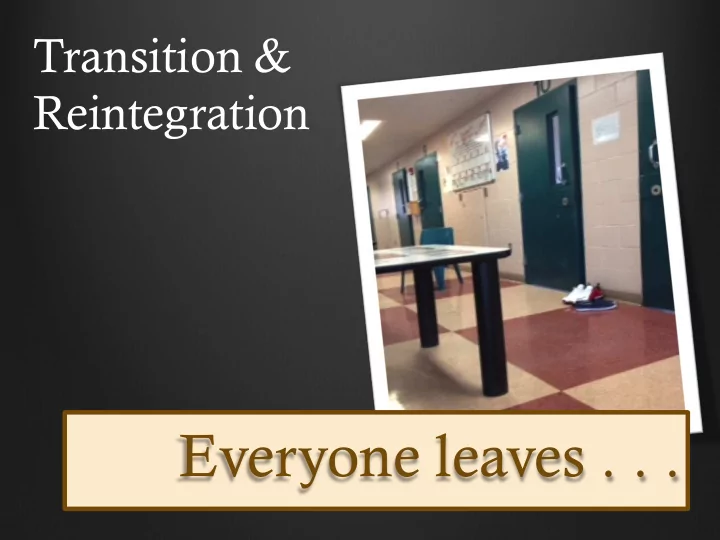
Everyone leaves . . . Nationally . . . 2009 US Census: 94,875 youth - - PowerPoint PPT Presentation
Transition & Reintegration Everyone leaves . . . Nationally . . . 2009 US Census: 94,875 youth under the age of 21 in 3,257 publicly and privately owned institutions. (2009 US Census; Tannis, 2014; Read & OCummings, 2011; Snyder
Nationally . . .
- 2009 US Census: 94,875 youth under the age
- f 21 in 3,257 publicly and privately owned
institutions.
(2009 US Census; Tannis, 2014; Read & O’Cummings, 2011; Snyder and Sickmund, 2006)
Meaning . . .
Roughly 100,000 youth need quality transition programs and reintegration plans
Transition & Reintegration
- Providing effective
transition services and supporting quality reintegration plans means ending/ slowing the . . .
“revolving door” of recidivism & recommitment, The PIPELINE TO PRISON
Transition & Reintegration
- Multiple transitions & reintegration
- Each brings anxiety and questions
- Delicate and integral process
- Connects professionals and care
givers
- Assist youth in acquiring skills and
confidence
The struggle for youth is too many transitions.
Multiple Transitions & Reintegrations
Family School Community Employment
- More anxiety
- High recidivism rates
- Lack appropriate coping &
corrective behaviors
- Stressful family/personal
situations
Effective Transition & Reintegration Planning
Needs: advocacy, relationships, engagement, challenge, and opportunity for success.
Transition “Out” Looks Like…
- A seamless connection
- Family/School/Community culture integration
- Parent/Administrative and teacher/Mentor
advocacy
- Personalized learning and planning
- Youth input
- Communication with teachers and staff
Follow through; follow up; and follow the trail…
- Transition specialist “In” and
Transition Team “Out”
- Eliminate labels, red flags,
ease adult anxiety
- Connect adults on both sides
- f transition process
- Speak same language
Just like with our own children . . . Some level of hand-holding or emotional connections necessary.
Best Practice
Potential Problems
- Deep rooted negative habits,
practices, social and family connections
- Unrealistic expectations of
transition without misstep
- How schools, families,
communities handle error
- Lack of patience or
flexibility
- No creativity in problem
solving
- Passive acceptance of
labeling
- When the honeymoon is over
- Not enough chances
Transition & Reintegration Gaps
Access Cooperation/ Collaboration Communication Alternatives
Transition/ Reintegration
Example
Job Skills – KCJH Detention
- Jr. Chef –
KRESA EFE ILC Culinary Arts Program- KVCC Employment- Downtown Restaurant Grp.
Transition’s Key Message
“We value you. We care about you. We welcome you to our family, school, community and we want to help you be successful.”