Evaluating net effects of wet meadow restoration on water and - - PowerPoint PPT Presentation

evaluating net effects of wet meadow restoration on water
SMART_READER_LITE
LIVE PREVIEW

Evaluating net effects of wet meadow restoration on water and - - PowerPoint PPT Presentation

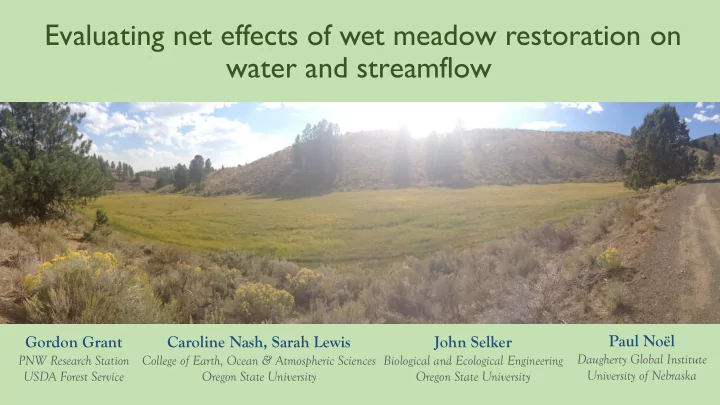
Evaluating net effects of wet meadow restoration on water and streamflow Paul Nol Gordon Grant Caroline Nash, Sarah Lewis John Selker Daugherty Global Institute PNW Research Station College of Earth, Ocean & Atmospheric Sciences


slide-1
SLIDE 1

Caroline Nash, Sarah Lewis

College of Earth, Ocean & Atmospheric Sciences Oregon State University

Gordon Grant

PNW Research Station USDA Forest Service

John Selker

Biological and Ecological Engineering Oregon State University

Paul Noël

Daugherty Global Institute University of Nebraska

Evaluating net effects of wet meadow restoration on water and streamflow

slide-2
SLIDE 2

Familiar landscape in the West

slide-3
SLIDE 3

Illustrations by Restoration Design Group for American Rivers

Restoration

Photo: USDA Forest Service Region 5

Plug-and-pond

Photo: NOAA NW Fisheries Science Center

Beaver analogs/reintroduction

Photo: Oregon Watershed Enhancement Board

Channel re-alignment

slide-4
SLIDE 4

Sagebrush Riparian

4 years prior to restoration 4.5 years after restoration

Camp Creek Silvies River Basin, OR

Post-restoration landscape demonstrates “greening” of valley bottom

(example from SilviesValley Ranch)

slide-5
SLIDE 5

How do we evaluate the effects of wet meadow restoration

  • n water and streamflow?

?

Time Discharge Incised Restored Increased streamflow

slide-6
SLIDE 6

Restored Incised A water budget identifies relevant fluxes

P P ET ET Qin Qin

S

S

Qout Qout

∆ Q = Qin + ∆ Storage + ∆ Evapotranspiration

slide-7
SLIDE 7

T

  • tal drainable storage = water that can flow out of floodplains

by force of gravity

Incised (3 meters) Restored (0.33 meter)

Maximum water table elevation

More storage Less storage

slide-8
SLIDE 8

Laterally drainable storage = quantity of water that can flow laterally into channel

Incised (3 meters) Restored (0.33 meter)

More incision = taller drainage face = larger wedge of laterally drainable water

Less storage More storage

Maximum water table elevation

slide-9
SLIDE 9

Loheide and Gorelick, 2007

Mesic plants use more water than xeric plants ET peaks are later and higher in restored meadows

Hammersmark et al., 2008

Restored meadows use more water for ET

Restored Incised

slide-10
SLIDE 10

∆𝑅𝑝𝑣𝑢 = less drainable storage + more evapotranspiration

P P ET ET Qin Qin

S

S

Qout Qout

Both changes suggest restoration decreases late summer streamflow

Restored Incised

slide-11
SLIDE 11

Incised & restored meadow scenarios - Discharge

September 1 Range in start times ( June 1-15) Deeply Incised (3 meters) Moderately Incised (1m) Restored (0.3m)

Time (day of year) Discharge (m3/s)

0.1 m3/day = 0.000001 cms = 0.00004 cfs

All scenarios produce very small volumes of water in late summer

Log Q

slide-12
SLIDE 12

Volume of ET is larger in restored meadows

Incised & restored meadow scenarios - Evapotranspiration

Volume (m3) Time (day of year)

slide-13
SLIDE 13

Q

For all scenarios, ET is much greater than discharge

Volume of Water (m3) Time (day of year)

ET

slide-14
SLIDE 14
  • Although restoration increases total storage in the

floodplain, the amount of water available for streamflow actually decreases.

  • Floodplains are not the major source of water -

volumes of water available for drainage are very small in ALL scenarios.

  • Restoration does make more water available for

plants, who happily use it.

  • Clear benefits to riparian vegetation and habitat

from more plant available water.

Wet meadow restoration is not likely to increase late- summer streamflow

slide-15
SLIDE 15

Thinking about restoration as a learning environment

  • There are many things we don’t yet understand

about how wet meadow restoration affects watersheds

  • Downstream effects (both quality and quantity)
  • Effects on fire (introducing fire breaks into

landscape)

  • Effects on plant, animal, and aquatic communities

Restorations are full scale experiments…how best to capitalize on them?

slide-16
SLIDE 16

Thank you to our funding sources, collaborators, and field assistants

For more information contact: Gordon Grant, Gordon.grant@oregonstate.edu USDA PNW Research Station USDA PNW Climate Change HUB USDA Northwest Climate Science Center