EV Purchase Preferences Annual Passenger Cars Sold 2.58 Annual - - PowerPoint PPT Presentation

ev purchase preferences
SMART_READER_LITE
LIVE PREVIEW

EV Purchase Preferences Annual Passenger Cars Sold 2.58 Annual - - PowerPoint PPT Presentation

35 3 EV Purchase Preferences Annual Passenger Cars Sold 2.58 Annual BEVs Sold among Chinese Buyers 30 2.5 Annual PHEVs Sold Annual Passenger Cars Sold (1 million vehicles) NEV Cumulative Sales 25 2 Annual NEV Sold (1 million vehicles)


slide-1
SLIDE 1

EV Purchase Preferences among Chinese Buyers

Ziwen Ling1 (ziwen.ling@vdot.virginia.gov) Christopher R Cherry2 (cherry@utk.edu) Yi Wen2 (ywen4@vols.utk.edu)

1Virginia Department of Transportation 2University of Tennessee, Knoxville

TE3 Conference at University of Michigan. Oct 18, 2019

1

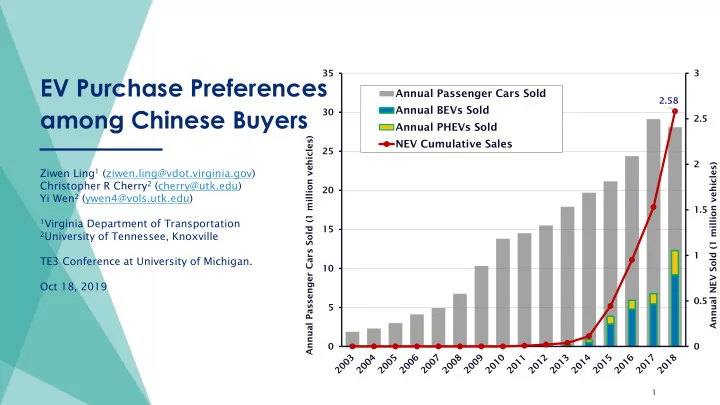
2.58 0.5 1 1.5 2 2.5 3 5 10 15 20 25 30 35 Annual NEV Sold (1 million vehicles) Annual Passenger Cars Sold (1 million vehicles)

Annual Passenger Cars Sold Annual BEVs Sold Annual PHEVs Sold NEV Cumulative Sales

slide-2
SLIDE 2
  • 1. China has sold 2.58 million EVs since 2003.
  • 2. In 2018, China sells close to half of the EVs in the

world.

  • 3. Nationwide, China is committed to reduce its

carbon intensity of the GDP by 60-65% by 2030 from 2015’s values.

  • 4. The country is shifting towards electric buses and

electric taxis rapidly.

  • 5. Purchase subsidies are available, EVs are not

restricted to license plate registration and traffic controls in some cities, public charging stations are being built massively.

Background

2

Electric Taxis in Shenzhen, China (Image Source: Shenzhen Shopper)

slide-3
SLIDE 3
  • 1. Survey of 1216 people in Beijing, China in 2015
  • 1. Beijing is the capitol city of China
  • 2. Beijing has well-known air pollution issues
  • 2. Collected data on
  • 1. Demographic information
  • 2. Understanding of CVs, PHEVs, BEVs and e-bikes
  • 3. Household vehicle purchase history and future plan
  • 3. The sample is relatively representative of the

population in Beijing.

  • 4. Statistical analysis models were applied to

understand what factors contribute to a higher chance of EV (PHEV and BEV) purchase.

Methodology

3

Smog Pollution in Beijing, China (Image Source: The Washington Post)

slide-4
SLIDE 4
  • 1. (+) Male (PHEVs and BEVs)
  • 2. (+) Higher household income (PHEVs and BEVs)
  • 3. (+) Number of e-bikes in the household (PHEVs)
  • 4. (+) Prior experience with driving or riding EVs (BEVs)
  • 5. (-) Pre-existing inclination towards CV (PHEVs)
  • 6. (-) Planning to have a driver’s license in the next 3 years (PHEVs)
  • 7. (-) Longer ownership of first motorized vehicle (PHEVs)
  • 8. (-) Already having a driver’s license (BEVs)
  • 9. (-) Higher purchase budget (BEVs)

10.(+) Purchase subsidies, charging stations (50%) 11.(+) Free battery charging, license plate registration waivers (30%)

Findings

4

Positive Contributors Negative Contributors Preferred EV Policies

slide-5
SLIDE 5
  • 1. More direct monetary benefits
  • 2. More public charging stations
  • 3. More EV experience activities
  • 1. Test drive
  • 2. Test ride, ride-hailing (Uber/Lyft)
  • 3. EV car share/rental
  • 4. Target on mid-level income and below markets
  • 5. Provide diverse EV options for high-end customers
  • 6. Attract new and future drivers

Policy Implications

5

EV Ride-hailing Services in China (Image Source: Cheyun.com)

slide-6
SLIDE 6
  • 1. The soil of EV development in China
  • 1. More political support
  • 2. Level 2 charging is the standard (220V AC Outlet in China)
  • 3. License plate registration and traffic control waivers
  • 4. Familiarity with electrified transportation (e-bikes)
  • 2. EVs are also vehicles by nature which consume

roadway capacity, parking infrastructure, and energy. The promotion of EVs may lead to more congestion.

  • 3. How can we make sure that EV friendly policies are

switching drivers from regular vehicles to EVs, but not non-drivers from other modes to driving.

  • 4. Smaller EVs (mini-EVs) and EV car-sharing may be

promoted to reduce impacts of vehicles while keeping the benefits of EVs.

6

Discussion Points

Mini EVs are gaining popularity in China (Image Source: The Wall Street Journal)