
SLIDE 1
EUSO-TA Y.Kawasaki (RIKEN)
共同利用課題 紫外線撮像望遠鏡によるTAサイトでの空気シャワー蛍光の観測 旅費 75万円
1 / 1 7
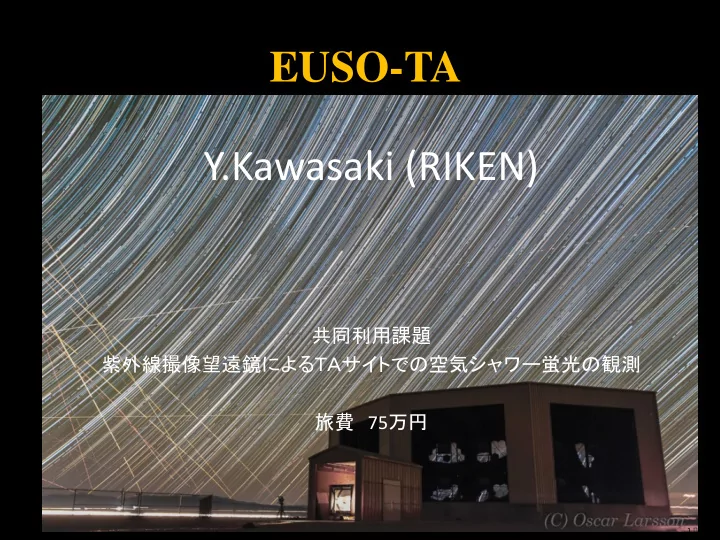
EUSO-TA Y.Kawasaki (RIKEN) - - PowerPoint PPT Presentation
EUSO-TA Y.Kawasaki (RIKEN) 75 1 / 1 7 The EUSO program Ultra-High Energy cosmic rays from space 1. EUSO-TA: Ground
共同利用課題 紫外線撮像望遠鏡によるTAサイトでの空気シャワー蛍光の観測 旅費 75万円
1 / 1 7
1. EUSO-TA: Ground
detector installed in 2013 at Telescope Array site: currently operational
2. EUSO-BALLOON: 1st
balloon flight from Timmins, CA (French Space Agency) Aug 2014; 2nd flight: 2016, NASA Ultra long duration flight: 2017
3. MINI-EUSO (2017):
Precursor from International Space Station (ISS: 30kg 2017). Approved by Italian and Russian Space agencies
4. K-EUSO (2019 JFY):
ISS Approved by Russian Space Agency
Ultra-High Energy cosmic rays from space
MINI-EUSO 400 km
EUSO-TA (2013-)
EUSO-BALLOON 40 km EUSO-TA
JEM-EUSO
2 / 1 7
3 / 1 7
4 / 1 7
2013年3月22日
5 / 1 7
EUSO-TA campaigns
So far EUSO-TA had 5 observation campaigns:
February/March 2015 Detector installation Focusing, initial calibration Initial CLF and CSOM laser observations May 2015 Cosmic ray observations – one UHECR detected CLF and CSOM laser observations Flat screen and LED calibration September 2015 Cosmic ray observations – analysis ongoing CLF and CSOM laser observations October 2015 Cosmic ray observations – analysis ongoing Internal trigger tests on the balloon PDM board – successful triggering
CLF and CSOM laser observations November 2015 Cosmic ray observations CLF laser observations
Next campaign – February 2016?
6 / 1 7
Central Laser Facility
Distance from EUSO-TA: 21 km Energy: ∼3-7 mJ (4 mJ ≃ 1019.2 eV)
Empirical flat fielding applied – Z scale arbitrary See the talk by Shin Hengsu
7 / 1 7
Laser tests
Preliminary Colorado School of Mines’ laser results for three campaigns: We can detect on some frames vertical laser with 1 mJ energy, ∼ 33 km from EUSO-TA We could see some shots from 100 km, but we need to check what was the pointing of the laser (if towards us, than the beam was closer when seen) We could swipe the whole focal surface – additional detector sensitivity tests See talk by Lawrence Wiencke
8 / 1 7
Stars
Stars in EUSO-TA with Hipparchos catalogue superimposed Current superimposing can not be perfect due to very complicated EUSO-TA PDM geometry.
9 / 1 7
Plane triggers
A scheme of triggers caused by a plane during a half hour run of EUSO-TA.
1 / 1 7
Meteors
5 candidates so far, but I started to distinguish them from planes last Friday TA triggers (probably) on meteor brightening, or on something else – number of packets with meteors limited All cross >2◦ in <1 s (5 mach airplane 100 m above does <1◦ in 1 s)
1 1 / 1 7
Clouds
Sometimes well visible when flat frame used More in the talk by Simon Mackovjak
1 2 / 1 7
UHECR, confirmed track
Found in some TA UHECR candidate data (preliminary analysis) by Shin Hengsu Preliminary data from TA: E ≃ 1018 eV Distance: 2.5 km
1 3 / 1 7
UHECR, confirmed track
Found in November data last Friday Very preliminary data from TA: E ≃ 1018.36 eV (highly uncertain) Distance: 2.6 km
1 4 / 1 7
UHECR, confirmed track
First moving event! (even though only 2 frames) It was first mismached with a “diffused” event (due to time matching problems) Very preliminary data from TA: E ≃ 1018.63 eV (highly uncertain) Distance: 6.7 km
1 5 / 1 7
1 6 / 1 7
1 7 / 1 7