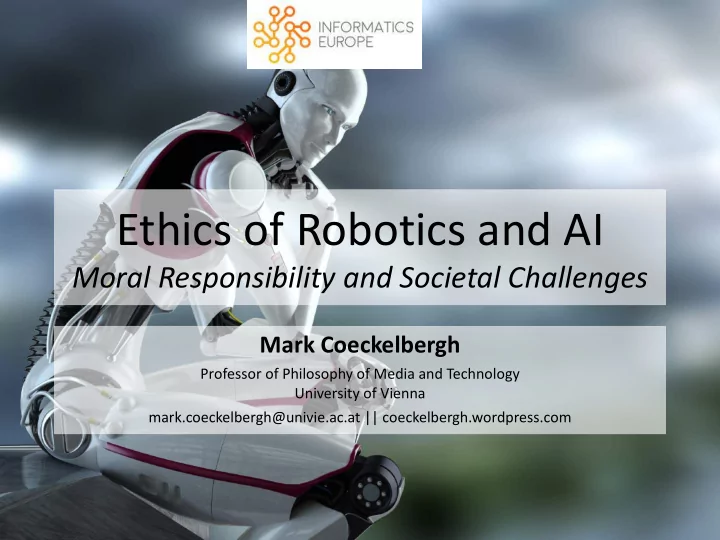
SLIDE 1 Ethics of Robotics and AI
Moral Responsibility and Societal Challenges
Mark Coeckelbergh
Professor of Philosophy of Media and Technology University of Vienna mark.coeckelbergh@univie.ac.at || coeckelbergh.wordpress.com
SLIDE 2 PHILOSOPHY OF TECHNOLOGY
Philosophy Interdisciplinarity Policy
SLIDE 3
Robophilosophy 2018
SLIDE 4
SLIDE 5 PHILOSOPHY OF TECHNOLOGY
Thinking about and for technology, but also using technology to think about philosophical issues
SLIDE 6 PHILOSOPHY OF TECHNOLOGY
Focus: robots and AI
SLIDE 7 PHILOSOPHY OF TECHNOLOGY
Ethics Philosophical anthropology Epistemology Aesthetics …
SLIDE 8
WHAT IS THE HUMAN?
SLIDE 9 WHAT IS THE HUMAN?
Using robotics and AI to think about humans
SLIDE 10 WHAT IS THE HUMAN?
Negative anthropology: what the human is NOT
SLIDE 11 WHAT IS THE HUMAN?
Negatieve anthropologie: wat the human is NOT e.g. not a chimp
SLIDE 12 WHAT IS THE HUMAN?
Negatieve anthropologie: wat the human is NOT e.g. not a machine or more than a machine
SLIDE 13 WHAT IS THE HUMAN?
Positive anthropology: what the human is e.g. a computational or information being
SLIDE 14 TOWARDS AN ARTIFICIAL
HUMAN?
Brain-based: enhancement and/or Robots and AI
SLIDE 15 CYBORGS
Merging of humans and machines
SLIDE 16
ROBOTS: HUMAN-LIKE
SLIDE 17
ROBOTS: NOT NECESSARILY HUMAN-
LIKE
SLIDE 18
AI: SCIENCE FICTION
SLIDE 19
AI: IN YOUR POCKET
SLIDE 20
ETHICS!
SLIDE 21
SCIENCE FICTION ALARM
SLIDE 22 “AI is a fundamental existential risk for human civilization”
(Elon Musk)
SLIDE 23 “we humans are like small children playing with a bomb”
(Nick Bostrom)
SLIDE 24 “the Singularity is a future period during which the pace of technological change will be so fast and far-reaching that human existence on this planet will be irreversibly altered”
(Ray Kurzweil)
SLIDE 25
FRANKENSTEIN
SLIDE 26
ROMANTICISM
SLIDE 27
AGAINST ALARMISM
SLIDE 28
URGENT ISSUES NEAR FUTURE
SLIDE 29
INDUSTRY
SLIDE 30
DAILY LIFE
SLIDE 31
IN THE OFFICE
SLIDE 32
FINANCE
SLIDE 33
TRANSPORT
SLIDE 34
HEALTH CARE
SLIDE 35
MILITARY APPLICATIONS
SLIDE 36
DATA
SLIDE 37
ALL THINGS - EVERYWHERE
SLIDE 38
CHANGES TO OUR DAILY LIFES
SLIDE 39
ETHICAL AND LEGAL PROBLEMS
SLIDE 40 DEFINITION PROBLEMS
Problem for regulation:
- Due to nature of new technologies:
robots, AI, algorithms, code, smart tech, internet of things, ‘cyber- physical systems’ … ?
- How autonomous, intelligent, etc.?
SLIDE 41 PRIVACY, SECURITY, SURVEILLANCE
- The AI records what you do
and transfers data… to whom? Company? Third Party?
hacked?
SLIDE 42
HEALTH
SLIDE 43
ADDICTION
SLIDE 44 REPLACEMENT, AUTONOMY, LOSS OF
AGENCY?
- Robot/AI - human teams
- Degrees of autonomy
- Distributed agency
SLIDE 45 MORAL AND LEGAL RESPONSIBILITY
- Who?
- AI/robot as moral agent?
- Legal questions
SLIDE 46 MORAL AND LEGAL RESPONSIBILITY
Examples
financial markets
in factory
into group of children
wrong medication
- Killer robot kills civilian
- Child gets too attached
to educational robot
SLIDE 47 MORAL AND LEGAL RESPONSIBILITY
Some problems
responsibility?
responsibility traces back to humans? human in control?
- insurance?
- regulating or ban?
- new legal instruments or
not? (e.g. debate in European context about legal personhood robots versus using existing liability law)
SLIDE 48 MORAL AND LEGAL RESPONSIBILITY
Some problems
– accident and death more acceptable if human agent, e.g. human driver – why is automated flying acceptable and automated driving not?
SLIDE 49 MORAL AND LEGAL RESPONSIBILITY
– E.g. gradations of autonomous driving; there is already automation in existing cars:
- Cruise control
- Lane departure correction
systems
- Collision avoidance systems
- Automated parking
- …
>> how different are fully autonomous technologies, e.g. autonomous cars? >> new legal framework needed?
SLIDE 50 MORAL AND LEGAL RESPONSIBILITY
Example: Classificaton Society of Automotive Engineers (SAE) 5 levels of self-driving: – Level 0: monitoring, warnings – Level 1: adaptive cruise control, automated parking – Level 2: automated driving, but driver must be alert and be able to take over any time … – Level 5: no human intervention needed
SLIDE 51 MORAL AND LEGAL RESPONSIBILITY
Information and knowledge
understand the system and its limitations?
manufacturers? Important for discussions about liability and negligence Difference with aviation, which is highly regulated and relatively safe
SLIDE 52 RESPONSIBILITY
Case: Fatal accident
autonomous mode causes accident in Arizona: pedestrian dies (March 2018)
accident
SLIDE 53 RESPONSIBILITY
Case: Fatal accident
Volvo? Uber? Vehicle
Pedestrian? State of Arizona? Problem of “many hands”
Uber/driver failed to exercise reasonable care
- Draw on product liability
law: Volvo and Uber
- Conduct pedestrian: accident
avoidable?
- State of Arizona: sufficient
regulation? E.g. one could require someone to be in driver seat – but enough?
SLIDE 54 RESPONSIBILITY
Case: Fatal accident
versus criminal law (but robots/AI cannot be charged with a crime)
technology and more regulation (or ban? Or self-regulation by private companies (laissez-faire)? Too early or too late?
SLIDE 55 MORAL STATUS OF AIS/ ROBOTS
Moral agents?
- What capacities needed for moral
judgment? Also emotions?
- Rules enough?
- Too anthropocentric?
SLIDE 56 MORAL STATUS OF AIS/ ROBOTS
Moral patients?
- Thing or more than that?
- Machine as (quasi)other?
- Vulnerability humans versus mach
SLIDE 57
SLIDE 58
MORAL STATUS OF AIS/ ROBOTS
Philosophically interesting, but also practical issue?
SLIDE 59 TECHNOLOGY CHANGES MORALITY
- Privacy today
- How will AI and robotics
change our values?
SLIDE 60
VULNERABLE USERS, ATTACHMENT AND DECEPTION
SLIDE 61
SAFETY
SLIDE 62
HUMAN DIGNITY AND AUTONOMY
SLIDE 63
ADAPTING TOO MUCH?
Do we want to adapt to robots or should robots adapt to us?
SLIDE 64
MORAL DISTANCE
SLIDE 65
MORAL DISTANCE
SLIDE 66
MORAL DISTANCE
SLIDE 67 SOCIETAL IMPLICATIONS
- Justice, fairness, power
- Inclusive society?
- Biased and non-
transparent algorithms >>
intimate relations
- Sustainable economy?
- Future of work >>
SLIDE 68 THE FUTURE OF WORK
- Replacement?
- Working conditions and
experience of work?
distribution of tasks?
SLIDE 69
SLIDE 70 BIASED ALGORITHMS
learning: AI trains on dataset that may contain a bias (e.g. favors young white men)
society, or both? How to deal with this?
SLIDE 71 BIASED ALGORITHMS
but we can explicitly discuss, analyze, and intervene (kind of bias, degree of bias)
something about our societies (see also digital humanities: use AI!)
SLIDE 72 NON-TRANSPARENT ALGORITHMS
- Problem with new approaches to AI:
Decision AI/algorithm black box, I am affected by its decision but do not know how it came to its decision
- Right to be informed, “Right to
Explanation of Automated Decision Making” (Wachter et al. 2017) but is that possible?
SLIDE 73 TRUST AND TRANSPARENCY
- Trust in system (technology:
reliability) vs trust in people (also emotions)
- Transparency of data, process,
- rganisation: again, it depends on
people
SLIDE 74
GENDER ISSUES WITH DESIGN
SLIDE 75
SLIDE 76
GENDER ISSUES AND HUMAN RELATIONSHIPS
SLIDE 77 November 10, 2017 mark.coeckelbergh@univie.ac.at 77
SLIDE 78 ETHICS: APPROACH
- Bottom up
- Pro-active
- Global
- Positive
SLIDE 79
Ethical & legal theory and principles
Experience – Practices
SLIDE 80
SLIDE 81
Ethical & legal theory and principles
Experience – Practices
SLIDE 82
ETHICS AND REGULATION: LET’S
TRY TO BE PRO-ACTIVE
SLIDE 83
ETHICS: HOW NOT TO DO IT
SLIDE 84 ETHICS: PRO-ACTIVE IN RESEARCH
AND INNOVATION
- Regulation: needed, but always too
late?
- Work also through standards, see IEEE
- Certification
SLIDE 85 GLOBAL ACTION NEEDED
- Due to nature of new technologies
- Do we have suitable institutions for
this?
SLIDE 86
ALSO NON-GOVERNMENTAL ACTORS!
SLIDE 87 POSITIVE: ETHICS AND THE GOOD
LIFE
- Not just constraints and what not
to do, but also what to do and how to live (good life, virtue, community/society)
SLIDE 88 EXPLORE NEW POSSIBILITIES
- New experiential and action
possibilities
SLIDE 89 INNOVATION, DESIGN, ART
SLIDE 90
Policy needed
Everyone affected, need for vision and policy NOW
SLIDE 91
“It’s the principles, stupid”
SLIDE 92
No, it’s not only about principles, values, norms, theory, etc. Challenge is to change technological practices (design, innovation and use) and principles, theory, etc. are instruments to do that
SLIDE 93
reflecting on experience
SLIDE 94 What to do?
Usually ethics focuses on what (not) to do, but often we agree on what (not) to do; there are also other questions:
- Who does what?
- How to do things (best)?
>> practical wisdom
SLIDE 95 What to do?
Morality: constraints, red lines, sactions Ethics: the good life, the best life
SLIDE 96
Who and how?
How can we work together to ensure that AI and robotics will contribute to a future we want? Also think about PROCESS Experts, citizens, and mediators needed
SLIDE 97 Who and how?
Role researchers, governmental, intergovernmental, and non-governmental
- rganisations/civil society includes: raise awarness
and bring people together, initiate new processes: HOW can we reach these goals?
SLIDE 98 Who and how?
Power differences (e.g. big companies versus individual citizens) Cultural differences (global, Europe)
SLIDE 99 SOME BARRIERS
- Lack of sufficient transdisciplinary
expertise
- Lack of connections academia –
policy makers and short-term views
- Insufficient institutional support for
more participatory decision making
- Not taking into account lessons
learnt, re-inventing the wheel
SLIDE 100 ADDRESS PROBLEMS
- More support for transdisciplinary
research
- Further institutionalize links academia
– policy makers and make room for development of long-term vision
- Collaborate with other, non-
governmental and non-academic actors in society
- More studies taking into account work
already done, including work in the areas of philosophy of technology and robot ethics
SLIDE 101
THE FUTURE OF AI (& INFORMATICS)
Beyond fear Ethical Interdisciplinary, incl. humanities Connected to wider society Europe: expertise in tech ethics
SLIDE 102
THE FUTURE OF AI (& INFORMATICS)
The future of AI will be ethical or it will not be.
SLIDE 103 Thanks!
Mark Coeckelbergh
Professor of Philosophy of Media and Technology University of Vienna mark.coeckelbergh@univie.ac.at || coeckelbergh.wordpress.com