ETHICS IN PUBLIC SERVICE Chapter 42.52 R CW WAC 292-110 BPPM/E - - PDF document

ethics in public
SMART_READER_LITE
LIVE PREVIEW

ETHICS IN PUBLIC SERVICE Chapter 42.52 R CW WAC 292-110 BPPM/E - - PDF document

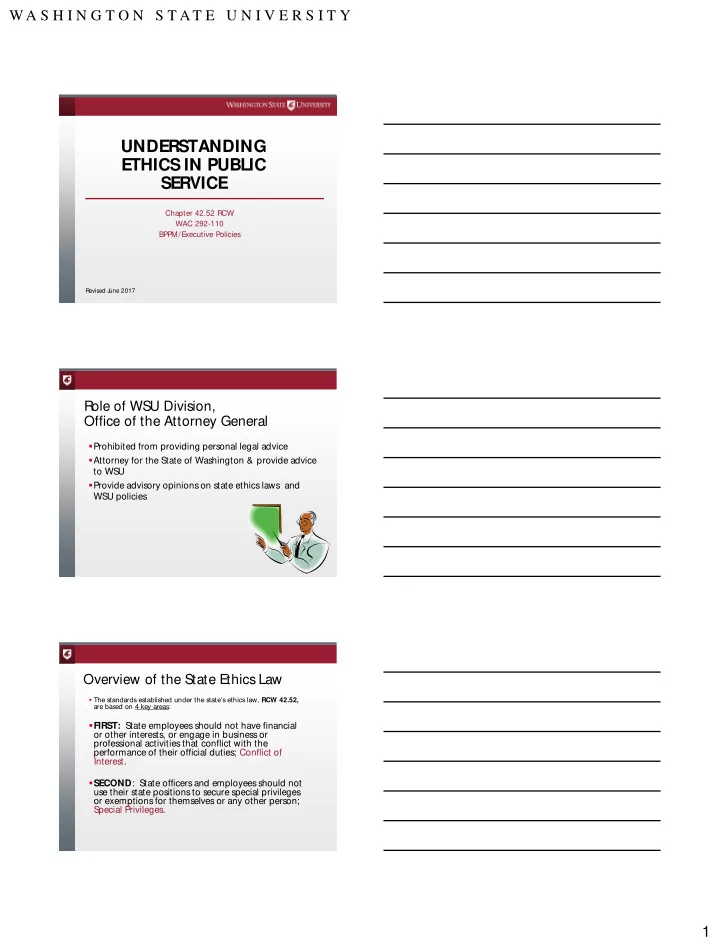
W A S H I N G T O N S T AT E U N I V E R S I T Y UNDERSTANDING ETHICS IN PUBLIC SERVICE Chapter 42.52 R CW WAC 292-110 BPPM/E xecutive Policies R evised J une 2017 R ole of WSU Division, Office of the Attorney General Prohibited


slide-1
SLIDE 1

1 W A S H I N G T O N S T AT E U N I V E R S I T Y

UNDERSTANDING ETHICS IN PUBLIC SERVICE

Chapter 42.52 R CW WAC 292-110 BPPM/E xecutive Policies

R evised J une 2017

R

  • le of WSU Division,

Office of the Attorney General

  • Prohibited from providing personal legal advice
  • Attorney for the S

tate of Washington & provide advice to WS U

  • Provide advisory opinions on state ethics laws and

WS U policies

Overview of the State E thics Law

  • The standards established under the state’s ethics law, RCW 42.52,

are based on 4 key areas:

  • FIRST: S

tate employees should not have financial

  • r other interests, or engage in business or

professional activities that conflict with the performance of their official duties; Conflict of Interest.

  • SECOND: S

tate officers and employees should not use their state positions to secure special privileges

  • r exemptions for themselves or any other person;

S pecial Privileges.

slide-2
SLIDE 2

2 W A S H I N G T O N S T AT E U N I V E R S I T Y

  • THIRD: S

tate employees should not receive compensation from a source other than the S tate

  • f Washington for the performance or non-

performance of an official duty; Outside Compensation.

  • FOURTH: S

tate employees should not receive a gift if it could be reasonably expected to influence or reward the performance of their

  • fficial duties.
  • Gifts are restricted.

E SSE NTIAL R E SOUR CE S

  • E

xecutive E thics Board (E E B) Web Page (www.ethics.wa.gov.)

  • E

thics Act and R ules

  • Advisory Opinions
  • Training (On-line quiz)
  • BPPM 10.21 ---S

ummary of E thics Policies for the University

  • BPPM 20.37 ---Personal use of University R

esources

  • E

xecutive Policy 4 --- E lectronic Communication Policy

  • E

xecutive Policy 27 ---E thics & Conflicts of Interest

E NFOR CE ME NT How do E thics Violations Happen?

  • From news scandals, we know it includes: corruption, bias,

bribery, theft, cronyism, fraud, abuse of office, quid pro quo, graft, breach of confidentiality, bid rigging, kickbacks, extortion, malfeasance, profiteering, dishonesty, nepotism, and fraud.

  • E

ven the appearance of ethical violations must be avoided.

slide-3
SLIDE 3

3 W A S H I N G T O N S T AT E U N I V E R S I T Y

SANCTIONS AND PE NALTIE S

  • Fines: The greater of $5,000 or three times the benefit
  • Damages sustained by the state plus costs
  • Disciplinary action up to and including termination
  • Negative publicity and perceptions of the violator, WS

U, and the S tate of Washington Special Note: E very action taken by the E xecutive E thics Board is a public record and published on line. Personal Responsibility: R esponsibility and accountability for the appropriate use of state resources ultimately rests with the individual state employee, or with the state employee who authorizes such work. WAC 292-110-010(1)

  • In other words: Ignorance of the law won’t work.

Washington State E thics Law Covers the Following General Areas:

  • Use of S

tate R esources

  • Gifts
  • Conflicts of Interest, Including Outside

E mployment

  • Compensation for Official Duties
  • Nepotism & S

pecial Privileges

  • Post-S

tate E mployment

  • Political Activities
  • Confidential Information
  • Public R

ecords

Use of State R esources State resources are to be used for the conduct of state business only

  • The State’s ethics law protects and limits the use of state

resources for the conduct of official state business, with only very narrow exceptions as determined by the E E B.

  • State R

esources Include:

  • E

quipment, computers, cell phones, cameras, general supplies

  • Office/Conference R
  • oms and university facilities
  • Vehicles
  • Personnel, co-workers, and work time
  • THE UNIVERSITY WIRELESS SYSTEM
slide-4
SLIDE 4

4 W A S H I N G T O N S T AT E U N I V E R S I T Y

De Minimis (minimal) Use E xception

  • De Minimis: Use May be allowed if the use results in:
  • No Cost to the S

tate

  • Does not Interfere with the performance of official duties, and
  • Is Brief in duration and accumulation
  • WAC 292-110-010
  • HOWEVER: S

tate resources May Never be used to:

  • S

upport an outside business (either profit or nonprofit unless approved by WS U)

  • Private use of state property away from WS

U

  • For Commercial Activities (ads, sales, or solicitations)
  • For Political Activities -- Campaigning for/against candidates or initiatives
  • r lobbying
  • Any use prohibited by law or WS

U policy In these situations, the de minimis use exception will not apply.

De Minimis FAQ

  • What does “ occasional,” “ brief,” and “ infrequent”

really mean?

  • While these terms have not been formally defined,

the E E B has interpreted them to mean just that: so long as there is no disruption to your work or to the work of others.

State R esources & De Minimis Use: Day-to-Day E xamples

  • Phones: Landline local calls for reasonable personal business are

permitted, i.e. medical & dental appointments, child care, transportation, etc. Long distance must be placed on personal phone.

  • Agency Cell Phones: Generally limited to business purposes but De

Minimis will likely apply. (Don’t use it as your everyday cellphone.)

  • Note: R

eimbursing costs for use will not mitigate the possible violation.

slide-5
SLIDE 5

5 W A S H I N G T O N S T AT E U N I V E R S I T Y

DAY TO DAY USE OF INTE R NE T

  • Limited personal use of the internet is allowed so long as such use

supports organizational effectiveness and does not undermine public trust.

  • Computers/S
  • ftware belong to the state
  • S

tate may access and monitor your office computer/lab top

  • Anything you write, including email, may be subject to a possible

public records request.

  • It is acceptable to send brief private emails and forward emails to

private computer as long as there is no cost to the state, is brief in duration, and does not interfere with duties. (This likely applies to state issued smart phones)

  • DO NOT
  • Use a state computer to listen to Internet R

adio (exceptions may apply)

  • Use a state computer to download music or upload a private play list
  • The safe bet: Don’t mix S

mart-Phone and work computer

E E B FAQs

  • An employee visits several humor and joke sites. While at a site,

he downloads a joke file and emails it to several co-workers.

  • This is an ethical violation. By emailing a file to co-workers, the

employee disrupts other state employees and obligates them to make a personal use of state resources. In addition, downloading files and distributing them to co-workers can damage state property or compromise databases.

  • R

E ME MBE R : It can always become a public record!!

E xecutive Policy 4 E lectronic Communication Policy

  • Appropriate Use
  • WS

U’s IT resources may be used for legitimate WS U purposes only. Appropriate use of IT resources are as follows:

Use by faculty, administrators, and staff directly related to instruction, research, and scholarly, professional, and administrative endeavors on behalf of WS U that are within the scope of WS U employment. WS U IT resources shall not be used for: Conducting personal activities unrelated to any WS U or student educational purpose.

  • Unless otherwise allowed by this policy…see De Minimis Use.
  • What does this all mean?
  • Don’t spend all day on E

S PN picking a fantasy team

  • Don’t read the newspaper all day
  • Do check it during the day to stay on top of things
  • Common sense, professional setting
slide-6
SLIDE 6

6 W A S H I N G T O N S T AT E U N I V E R S I T Y

Social Media Use

  • E

P 4 Social Media Policy

  • WSU may ask that employees maintain work-related, approved

social media accounts or blogs

  • Can be managed and updated during business hours
  • Professional v. Private: Personal networking sites should remain

personal and not used for work-related purposes. No university account should be used to maintain personal social network accounts.

  • Protect your WSU.EDU good name
  • Any communication can become a public record
  • Someone may be watching

WSU E xecutive E thics Board Case

During the period J anuary 16, 2006 through J une 4, 2006, a University Faculty member visited 37 non-work-related websites including humor, news, weather, sports, air travel, shopping, banking and dating sites. Of those 37 websites, 19 were related to dating. Of those 19 websites, 16 were visited by the employee only once. There was no evidence the employee downloaded any files from those websites. One of the websites did contain pictures of young women in various stages of

  • undress. There was no evidence the employee downloaded any files from that

website. Outcome:

  • WS

U issued a letter of concern

  • E

E B sanction: $750.00 penalty

  • Outcome of investigation was made available to the public and local media

E xecutive E thics Board UW Case

  • Director, UW Office of S

tudent Publications

  • UW tracked internet use from 4-26-07 to 6-5-07

E mployee performed the following personal uses of state computer:

  • Accessed her personal blogs
  • Accessed a video site to search for song lyrics
  • Continual access to Hotmail account
  • Access to shopping sites, such as Amazon

UW Administrative Policy (WS U BPPM/E P) requires that internet use be short in duration, infrequent, no cost to the state, not interfere with employee’s performance, and not distract from the conduct of state business.

slide-7
SLIDE 7

7 W A S H I N G T O N S T AT E U N I V E R S I T Y

UW E E B Case Outcome

  • UW issued a letter of reprimand
  • R

eceived a 2% salary increase compared to UW average 4.5%

  • E

E B sanction: $500 civil penalty ($250 suspended) Careful, even if the E E B doesn’t provide for large sanction, WS U can. Remember: BPPM’s & E P’s apply.

R CW 42.52.140 GIFTS

  • RULE: No state officer or state employee may

receive, accept, take, seek or solicit, directly or indirectly, any thing of economic value as a gift

  • r favor from a person if it could be:

(1) reasonably expected that the gift or favor would influence the vote, action, or judgment of the officer or employee, or (2) be considered part of a reward for action or inaction.

GIFTS, GR ATUITIE S, & FAVOR S

  • When neither of these conditions are present, you

may accept a gift or gifts up to $50 in value per calendar year.

  • S

tate ethics laws also provide for the acceptance of certain items that are either:

  • 1. Not included in the definition of “ gift”
  • 2. Items that are gifts but are presumed not to

influence unless circumstances indicate

  • therwise
slide-8
SLIDE 8

8 W A S H I N G T O N S T AT E U N I V E R S I T Y

GIFTS BASICS

  • GIFTS DO NOT INCLUDE

:

  • Items from family & friends with clear purpose not to

influence

  • Customary items related to an outside business
  • Items exchanged at social events by coworkers
  • R

easonable expenses for a speech or seminar

  • Discounts available to individuals as a member of a broad-

based group. E x: Discount Mariner tickets for state employees…

GIFTS BASICS

  • $50 limit does not apply to:
  • Flowers, plants, and floral arrangements
  • Advertising and promotional items of a nominal value
  • Plaques and awards
  • Items received for professional evaluation
  • Publications related to official duties
  • Food and beverages at hosted receptions
  • Admissions to charitable events
  • Gifts from dignitaries
  • Meals on infrequent occasion if related to official duties

What to do with a gift you can’t accept?

  • If someone gives you a gift you cannot accept you

may, within 30-days:

  • R

eturn it to the sender

  • Donate it to a charity
  • Sometimes a gift may be accepted on behalf of an
  • ffice or department.
  • Make a record (essentially a receipt) of what you did

with the gift and hold on to it.

slide-9
SLIDE 9

9 W A S H I N G T O N S T AT E U N I V E R S I T Y

GIFTS, R CW 42.52.150(4) Section 4 E mployees

  • SECTION 4 EMPLOYEES MEET ALL THREE CRITERIA:
  • Work for an agency that seeks to acquire goods or services
  • Gift-giving person seeks to provide goods or services to the

agency

  • E

mployee participates in those contractual matters with that gift-giving person

  • If your duties include decisions about contracting or

purchasing, the Sec. 4 restrictions apply to gifts from any past, current or potential future contactors or vendors

  • Sec. (4) E

mployees may NOT Accept Gifts

  • If the gift giver has been or could ever be a party in

a contracting relationship with you in your official capacity, do not accept the gift.

  • There will be few, if any, times when it will be

acceptable for you to accept any kind of gift.

  • Certain exceptions apply, call AGO if you have a

question

  • Sec. 4 E

mployees May Accept

  • Advertising and promotional items of a nominal value
  • Plaques and awards
  • Items received for evaluation if not beneficial interest attaches
  • Publications related to official duties
  • Food and beverages at hosted receptions
  • Admission to charitable events
  • Items from family and friends
  • Customary items related to outside business
  • Items exchanged at social events by coworkers
  • Items returned or donated to charity within 30 days
  • Discounts available to individuals as members of broad-based group
slide-10
SLIDE 10

10 W A S H I N G T O N S T AT E U N I V E R S I T Y

CONFLICTS OF INTE R E ST

  • R

CW 42.52.020: No state employee may have an interest, financial or otherwise, direct or indirect, or engage in a business or transaction or professional activity, or incur an obligation of any nature, that is in conflict with the proper discharge of the state employee’s official duties.

  • Conflicts boil down to benefits & bias.
  • You Cannot:
  • Have direct or indirect financial interest
  • E

ngage in a business or transaction or professional activity

  • Incur any obligation

With anyone you regulate or contract with

CONFLICT OF INTE R E ST

  • The key questions to consider is that an employee shall not use

his or her position with the University to create the opportunity for private gain:

  • Will your private interest benefit as a result of your official

action?

  • Would a reasonable person conclude that a private or

personal interest impairs your independent judgment in the exercise of official duties?

  • NO BE

NE FIT… NO CONFLICT

However, they are not always easy to spot and can be complex.

  • Determined on a case-by-case basis: E

rr on the side of caution and ask for advice when you are unsure.

CONFLICTS OF INTE R E ST

Questions to ask yourself when evaluating a potential conflict of interest:

1. Will your private interest benefit as a result of your official action? 2. Would a reasonable person conclude that a private or personal interest impairs your independent judgment in the exercise of official duties?

slide-11
SLIDE 11

11 W A S H I N G T O N S T AT E U N I V E R S I T Y

E E B No. 07-014, Dean Knight UW Law School

  • For a period of six months, Knight used his UW email

address to conduct business with State Farm as a member

  • f their board of directors. Knight received or sent

communications via UW email system with State Farm 191 times. These emails contained a variety of content including travel arrangements for board meetings, board committee meeting notes, and other information regarding State Farm.

  • Fined $750 by E

E

  • B. No longer Dean of UW Law School.

Compensation for Official Duties

  • R

CW 42.52.110: Not state employee may, directly or indirectly, ask for or give or receive or agree to receive any compensation, gift, reward, or gratuity from a source for performing or omitting or deferring performance of any official duty. (Certain Higher E d exceptions apply).

  • No extra or outside compensation for your official duties
  • r for not doing your duties.
  • E

x: Working in Accounting, you process credit card payments to the university. A major bank send you a $50 award for services provided. Can you keep it?

Nepotism & Special Privileges

  • A state employee may not use his or her official position to

secure special privileges for himself or herself or any other person.

  • WSU employees may not supervise or participate in

employment decisions affecting:

  • Family members
  • Household members
  • Intimate partners
  • BPPM 60.14
  • Purpose: Minimize conflicts of interests
  • E

mployee has the responsibility to self-report possible conflicts related to family members.

slide-12
SLIDE 12

12 W A S H I N G T O N S T AT E U N I V E R S I T Y

Special Privileges

  • If you are a supervisor, this means you cannot use your

supervisory authority to exempt a subordinate from the ethics

  • law. For example, if a subordinate asks you if they can use

email to give and receive client orders for their private business and you say yes, you just gave that person a special privilege or exemption from the E thics Law.

  • You cannot use your position as a state employee to benefit
  • r support an outside business or promote any private

commercial enterprise.

  • You use your position to obtain goods or services that would

not otherwise be available to all employees. (R CW 42.52.070).

Political Campaigns Candidates and Initiatives

  • Basic Rule: A state employee may not use state

resources for political campaigns

  • This prohibition applies to knowing acquiescence:

A state employee, with authority to direct, control,

  • r influence the actions of another

employee, may not knowingly acquiesce in the

  • ther employee’s

use of state resources for a political campaign.

Political Campaign Violations

  • Examples:

Faculty member sent an email on state provided computer to 30 state representatives regarding employee salaries and retirement plan funding. E thics Board found violation based

  • n political activity.

E mployee sent 8 emails within a week and received 8 emails that dealt with campaign potlucks, brochure drafting, and volunteer support. Although the Board acknowledged de minimis use, still a violation because it is political activity.

slide-13
SLIDE 13

13 W A S H I N G T O N S T AT E U N I V E R S I T Y

Post-State E mployment

  • Under certain circumstances, WSU employees may be affected by

post-state employment restrictions designed to prevent former state employees from personally benefitting as a result of actions and decisions made while serving the public.

  • Like other conflicts of interest, a determination of whether post-state

employment guidelines could apply to you is made on a case-by- case basis.

  • Additional restrictions exist for accepting employment when

employment was offered for the purpose of influencing or rewarding the performance of official duties; or when related to the fulfillment of a contract the officer or employee negotiated or administered while in state service.

Confidential Information

  • WSU employees are often in positions where they have access

to confidential information. If you have access to such information, you may not disclose it, unless provided for by law; or by an agreement between the agency and the person.

  • Under no circumstances may the confidential information be

used for personal benefit or for the benefit of others. R CW 42.52.050

  • Examples: student records, employee records, medical

records, certain internal memos

  • If you receive a request for a record that may be

confidential, contact the AG’s office

Public R ecords R CW 42.52

  • You may receive requests for public records.
  • Contact the WSU Office of Procedures, R

ecords and Forms if you receive such a request. They will assist you in responding.

  • E

thical Duty under R CW 42.52.050(4): No state officer or state employee may intentionally conceal a record if the

  • fficer or employee knew the record was required to be

released under the Public R ecords Act, was under a personal

  • bligation to release the record, and failed to do so.
slide-14
SLIDE 14

14 W A S H I N G T O N S T AT E U N I V E R S I T Y

Charities and Volunteer Projects

  • May state employees use state resources to

coordinate statewide volunteer projects or charities?

  • No. It is likely that coordinating these projects

would use state resources beyond those permitted by WAC 292-110-010 and has potential to interfere with the performance of official duties.

  • Why is it not okay to engage in fund raising

activities for people and organizations who really need help?

  • The E

thics in Public Service Act prohibits using state resources for private gain. It is not possible for WSU to support all charitable organizations.

Charities

  • Can I sell items from my child’s charitable organization such

as a school fund-raiser that sell candy or magazines?

  • Maybe. If the activity falls within “ organizational

effectiveness.” That means that the agency head has approved the activity and encompasses activities that enhance or augment the agency’s ability to perform its mission.

  • WSU provides a list of approved activities and charities that

employees may contribute to. If you want to engage in a charitable activity, ask a supervisor.

SUMMAR Y

  • Accept gifts with caution
  • De Minimis personal use
  • f state resources
  • Don’t use state resources

for political campaigns

  • Don’t accept outside

compensation related to your state employment

  • R

espond appropriately to PR R ’s

  • Avoid financial interest in

state transactions you work on

  • Plan employment

following state service to avoid conflict

  • Don’t accept any special

privilege related to state employment

  • Be careful with

confidential information

slide-15
SLIDE 15

15 W A S H I N G T O N S T AT E U N I V E R S I T Y

CONTACT INFOR MATION

Adam Malcolm Assistant Attorney General adam.malcolm@ wsu.edu 509-335-2636 If you attended this live training session and wish to have your attendance documented in your training history, please notify Human Resource Services within 24 hours of today's date:

hrstraining@wsu.edu

This has been a WSU Training Videoconference