Esca & Petri disease are caused by the same fungi Older plants - - PowerPoint PPT Presentation

esca petri disease are caused by the same fungi
SMART_READER_LITE
LIVE PREVIEW

Esca & Petri disease are caused by the same fungi Older plants - - PowerPoint PPT Presentation

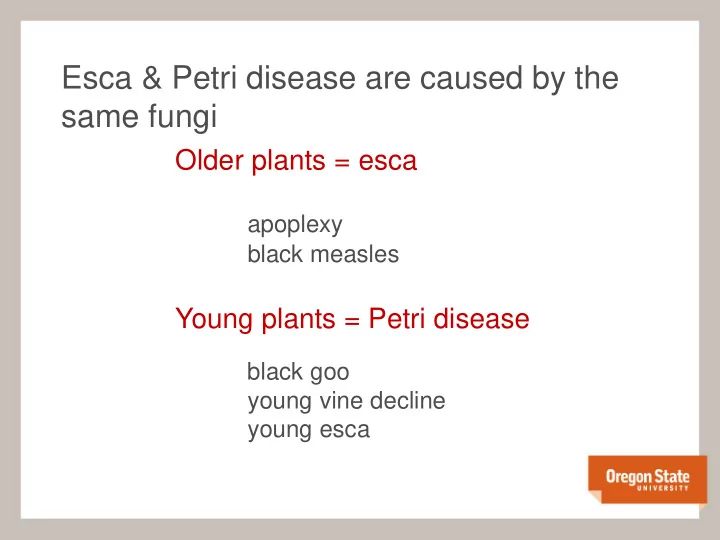
Esca & Petri disease are caused by the same fungi Older plants = esca apoplexy black measles Young plants = Petri disease black goo young vine decline young esca Esca J. rbez-Torres J. rbez-Torres J. rbez-Torres Esca J.


slide-1
SLIDE 1

Esca & Petri disease are caused by the same fungi

Older plants = esca

apoplexy black measles

Young plants = Petri disease

black goo young vine decline young esca

slide-2
SLIDE 2
  • J. Úrbez-Torres

Esca

slide-3
SLIDE 3
  • J. Úrbez-Torres
slide-4
SLIDE 4
  • J. Úrbez-Torres
slide-5
SLIDE 5
  • J. Úrbez-Torres

Esca

slide-6
SLIDE 6

Petri disease

slide-7
SLIDE 7
slide-8
SLIDE 8
slide-9
SLIDE 9
slide-10
SLIDE 10
  • J. Úrbez-Torres
slide-11
SLIDE 11

Cause of Petri disease/esca in the US

Phaeomoniella chlamydospora Togninia minima (Phaeoacremonium aleophilum)

  • T. fraxinopennsylvanica (P. mortoniae)
  • T. viticola (P. viticola)
  • P. parasiticum
  • P. inflatipes
  • P. angustius
  • P. scolyti
  • P. alvesii
  • P. rubrigenum

Teleomorph (perfect stage) Anamorph (imperfect stage)

slide-12
SLIDE 12

Disease cycle of Petri disease and Esca Fall Winter Pruning wounds Infection of wood & toxin production Spring Decline Summer Fruiting bodies form

  • J. Úrbez-Torres

After W. D. Gubler, et al., UC Davis

Gubler, et al. Gubler, et al. Gubler, et al.

slide-13
SLIDE 13

Diplodia

slide-14
SLIDE 14
slide-15
SLIDE 15

Fruiting bodies of Diplodia

slide-16
SLIDE 16

Other diseases & poor vine performance Black foot disease (vines to 8 yrs) “Cylindrocarpon” species Closely related to:

  • poor nursery stock
  • overcropping
  • water stress
  • wounding at planting…..
slide-17
SLIDE 17

Symptoms resemble water stress

slide-18
SLIDE 18

“Cylindrocarpon”

slide-19
SLIDE 19
slide-20
SLIDE 20
slide-21
SLIDE 21
slide-22
SLIDE 22

Management Prevention!

  • Sort nursery stock – leave questionable material.
  • Delay fruiting. Cropping several tons in the 2nd year after

planting has been associated with these diseases.

  • Use of grow tubes also has been associated with these

diseases.

  • Irrigate new plantings for a few years before switching to

dryland production.

  • Soak dormant cuttings 30 min in hot water (122 F ). This has

not always been effective and must be combined with other methods.

slide-23
SLIDE 23

Other diseases & poor vine performance Phytophthora root rot – various species

slide-24
SLIDE 24
  • J. Cortell
slide-25
SLIDE 25

Other diseases & poor vine performance Armillaria root rot – “A. mellea”

slide-26
SLIDE 26
slide-27
SLIDE 27
slide-28
SLIDE 28

Botryosphaeria Eutypa

slide-29
SLIDE 29

“Cylindrocarpon” Esca

  • J. Úrbez-Torres
slide-30
SLIDE 30
slide-31
SLIDE 31

Fungi found in Oregon on diseased grapevines

Armillaria sp. Phytophthora sp. Aspergillus niger Phaeoacremonium spp. Bionectria ochroleuca Phaeomoniella chlamydospora Botryosphaeria spp. Phoma spp. “Cylindrocarpon” destructans Phomopsis spp. “C.” obtusisporum Roesleria subterranea (=R. hypogaea) Diplodia sp. Seimatosporium spp. Eutypa lata Verticillium sp.

slide-32
SLIDE 32

“Bot” and “Eutypa” cankers

  • Neighboring trees?

Petri disease

  • Weeds?
slide-33
SLIDE 33

Diseases look similar

Management may not be We don’t know what is in OR

Early detection is important Unnoticed disease = lost $

slide-34
SLIDE 34

Acknowledgements

  • Dr. José Úrbez-Torres

Pacific Agri-Food Research Centre, Summerland, BC

  • Dr. George M. Leavitt

Madera Co., CA Farm Advisor, Emeritis

  • Dr. W. D. Gubler & lab

UC Davis