ERISA Section 510 Retaliation and Interference Claims: Navigating - - PowerPoint PPT Presentation

erisa section 510 retaliation and interference
SMART_READER_LITE
LIVE PREVIEW

ERISA Section 510 Retaliation and Interference Claims: Navigating - - PowerPoint PPT Presentation

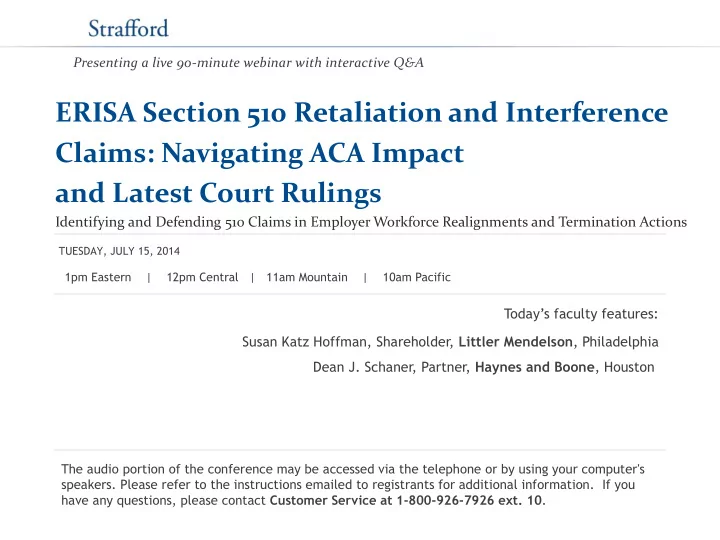
Presenting a live 90-minute webinar with interactive Q&A ERISA Section 510 Retaliation and Interference Claims: Navigating ACA Impact and Latest Court Rulings Identifying and Defending 510 Claims in Employer Workforce Realignments and


slide-1
SLIDE 1

ERISA Section 510 Retaliation and Interference Claims: Navigating ACA Impact and Latest Court Rulings

Identifying and Defending 510 Claims in Employer Workforce Realignments and Termination Actions

Today’s faculty features:

1pm Eastern | 12pm Central | 11am Mountain | 10am Pacific

The audio portion of the conference may be accessed via the telephone or by using your computer's

  • speakers. Please refer to the instructions emailed to registrants for additional information. If you

have any questions, please contact Customer Service at 1-800-926-7926 ext. 10.

TUESDAY, JULY 15, 2014

Presenting a live 90-minute webinar with interactive Q&A Susan Katz Hoffman, Shareholder, Littler Mendelson, Philadelphia Dean J. Schaner, Partner, Haynes and Boone, Houston

slide-2
SLIDE 2

Sound Quality If you are listening via your computer speakers, please note that the quality

  • f your sound will vary depending on the speed and quality of your internet

connection. If the sound quality is not satisfactory, you may listen via the phone: dial 1-866-258-2056 and enter your PIN when prompted. Otherwise, please send us a chat or e-mail sound@straffordpub.com immediately so we can address the problem. If you dialed in and have any difficulties during the call, press *0 for assistance. Viewing Quality To maximize your screen, press the F11 key on your keyboard. To exit full screen, press the F11 key again.

FOR LIVE EVENT ONLY

slide-3
SLIDE 3

For CLE purposes, please let us know how many people are listening at your location by completing each of the following steps:

  • In the chat box, type (1) your company name and (2) the number of

attendees at your location

  • Click the SEND button beside the box

If you have purchased Strafford CLE processing services, you must confirm your participation by completing and submitting an Official Record of Attendance (CLE Form). You may obtain your CLE form by going to the program page and selecting the appropriate form in the PROGRAM MATERIALS box at the top right corner. If you'd like to purchase CLE credit processing, it is available for a fee. For additional information about CLE credit processing, go to our website or call us at 1-800-926-7926 ext. 35.

FOR LIVE EVENT ONLY

slide-4
SLIDE 4

If you have not printed the conference materials for this program, please complete the following steps:

  • Click on the ^ symbol next to “Conference Materials” in the middle of the left-

hand column on your screen.

  • Click on the tab labeled “Handouts” that appears, and there you will see a

PDF of the slides for today's program.

  • Double click on the PDF and a separate page will open.
  • Print the slides by clicking on the printer icon.

FOR LIVE EVENT ONLY

slide-5
SLIDE 5

ERISA Section 510 Retaliation and Interference Claims: Identifying and Defending 510 Claims in Employer Workforce Realignments, Termination Actions, and ACA Implementation

Strafford Publications – July 15, 2014

5

slide-6
SLIDE 6

Presented by:

Susan Katz Hoffman

Littler Mendelson, P.C.

Dean J. Schaner

Haynes and Boone LLP

6

slide-7
SLIDE 7

Section 510 – the Statute

  • Retaliation – “It shall be unlawful for any

person to discharge, fine, suspend, expel, discipline, or discriminate against a participant

  • r beneficiary for exercising any right to which

he is entitled under the provisions of an employee benefit plan ...”

  • Interference – “for the purpose of interfering

with the attainment of any right to which such participant may become entitled under the plan...”

  • Whistleblower – “because he has given

information or has testified or is about to testify in any inquiry or proceeding...”

7

slide-8
SLIDE 8

“Typical” Cases

  • Participant discharged on eve of vesting in pension

benefits

  • Participant terminated due to high usage of

medical benefits

  • Worker classified as an independent contractor to

avoid benefit obligations

  • Employee subjected to adverse employment action

for complaining about plan administration

8

slide-9
SLIDE 9

Adverse Employment Action

  • Must Section 510 implicate the employment relationship?
  • Yes - Stiltner v. Beretta U.S.A. Corp., 74 F.3d 1473 (4th Cir.

1996); Haberern v. Kaupp Vascular Surgeons Ltd. Defined Benefit Pension Plan, 24 F.3d 1491 (3rd Cir. 1994)

  • No - Mattei v. Mattei, 126 F.3d 794 (6th Cir. 1997) (Section

510 claim need not implicate employment relationship)

  • Maybe - Teamsters Local Union No. 705 v. Burlington

Northern Santa Fe, LLC, 741 F.3d 819 (7th Cir.2014 ) (non- employers can be proper defendants if they can adversely affect the employment relationship)

9

slide-10
SLIDE 10

Adverse Employment Action

  • Tirone v New York Stock Exchange, Inc., 2006 U.S. Dist.

LEXIS 69591 (S.D.N.Y. Sep. 28, 2006) (termination of former employee on LTD for fifteen years was not “adverse employment action” since it only impacted his health benefits)

  • Busse v. Shaklee Corp., 2010 U.S. Dist. LEXIS

68879 (N.D. Cal. July 9, 2010) (recharacterization of bonus to avoid pension benefits was covered by Section 510 even though it did not impact terms and conditions

  • f employment)

10

slide-11
SLIDE 11

Procedural Issues Proper Defendant

  • “It shall be unlawful for any person . . .”
  • A “person” is "an individual, partnership, joint

venture, corporation, mutual company, joint stock company, trust, estate, unincorporated

  • rganization, association, or employee
  • rganization." 29 U.S.C. § 1002(9).
  • Roy v. Kimble Chase Life Science and Research

Prods., 2013 U.S. Dist. LEXIS 94439 (E.D. Tenn. July 8, 2013) – individual/supervisor who engages in conduct prohibited by Section 510 may be liable

11

slide-12
SLIDE 12

Procedural Issues Exhaustion

  • Shine v. Univ. of Chicago, 2013 U.S. Dist. LEXIS

44063 (N.D. Ill. Mar. 28, 2013) – requiring exhaustion of retaliation claim (or exception to exhaustion), citing the goal of “minimiz[ing] frivolous lawsuits, promot[ing] a non-adversarial dispute resolution process, and decreas[ing] the cost and time of claims settlement.“

  • Courts in some circuits do not require exhaustion
  • f statutory claims, but may if Section 510 issue

turns on plan interpretation. See Burds v. Union Pacific Corp., 223 F.3d 814, 817 (8th Cir. 2000)

12

slide-13
SLIDE 13

Hot Topic - Employee Complaints

  • George v. Junior Achievement of Cent. Ind., Inc., 694 F.3d

812 (7th Cir. 2012)

  • an employee's grievance is within § 510's

scope whether or not the employer solicited information

  • It does not mean that § 510 covers

trivial bellyaches—the statute requires the retaliation be "because" of a protected activity

  • the grievance must be a plausible one

13

slide-14
SLIDE 14

Employee Complaints

  • Sexton v. Panel Processing of Coldwater, Inc.,

2014 WL 1856692 (6th Cir. May 9, 2014)

  • Because ERISA protects only “giving information”

in an “inquiry or proceeding” it does not protect informal, unsolicited complaints.

  • The Fifth and Ninth Circuits have held that

unsolicited complaints are not protected. The Second, Third, Fourth and Sixth Circuits have now held that unsolicited internal complaints are not protected.

14

slide-15
SLIDE 15

Preemption

  • If not covered by Section 510, is it still

preempted?

  • Sexton v. Panel Processing, 2012 U.S. Dist.

LEXIS 156869, at *1-2 (E.D. Mich. Oct. 30, 2012) (concluding that, even though unsolicited internal complaint not protected by § 510, state law claims are preempted under the “relate to” clause)

15

slide-16
SLIDE 16

The Remedy

  • “The provisions of section 1132 of this title shall be

applicable in the enforcement of this section.”

  • Courts have held that Section 510 is only

enforceable through Section 502(a)(3) allowing for “appropriate equitable relief.” Eichorn v. AT&T Corp., 484 F.3d 644, 653 (3d Cir. 2007)

  • Amara likely of no assistance since employers are

not fiduciaries

16

slide-17
SLIDE 17

Back pay and front pay

  • Millsap v McDonnell Douglas Corp., 368 F.3d 246 (10th Cir. 2004) -

back pay is usually not an equitable remedy, but front pay is if it is a substitute for the equitable remedy of reinstatement

  • But see Hicks-Wagner v. Qwest, Inc., 462 F. Supp. 2d 1163, 1170-71

(D. N.M. 2006) (front pay not available as equitable relief in wrongful termination ERISA case)

  • Greenburg v. Life Ins. Co. of North America, 2009 U.S. Dist. LEXIS

39062 (N.D. Cal. Apr. 23, 2009) ("Reinstatement of employment, front pay and back pay may be an appropriate remedy under § 1132(a)(3) if an employer discharges or otherwise discriminates against an employee . . . in retaliation for exercising rights under a benefit plan.")

17

slide-18
SLIDE 18

Back pay and front pay

  • Delapaz v. Magnifique Parfumes & Cosmetics, Inc., 2012

U.S. Dist. LEXIS 140176 (N.D. Ind. Sep. 26, 2012):

  • No back pay remedy, and no loss of benefits remedy

because both are compensatory

  • No future pay remedy because the plaintiff was totally

disabled and would not have been able to earn any future pay

18

slide-19
SLIDE 19

Section 510 Prohibitions in RIFs

  • Section 510 Prohibitions in Layoff Context
  • Section 510 generally prohibits employers from

discharging employee/plan participants to prevent them from earning/receiving ERISA-covered benefits.

19

slide-20
SLIDE 20

ERISA COVERAGE

  • Section 510 Only Applies to ERISA-Covered

Plans – ERISA Plan generally requires an ongoing administrative scheme; a covered Plan requires more than an employer cutting a lump sum check

  • RIF/Reorganization Plans – Not necessarily ERISA

Plans

– Ongoing administrative scheme – Is it an easy to administer lump sum benefit payment as part of an “ad hoc” plan limited to a specific RIF? Or is it a plan with a longer duration containing ongoing administrative requirements, such as termination for “cause” or “good reason” resignation determinations?

20

slide-21
SLIDE 21

Workforce Reduction Plan-Release Agreements

  • Jefferson v. Vickers, 102 F.3d 960 (8th Cir. 1996)

(rejecting claim that employer violated § 510 by conditioning willingness to “bridge” laid off employees to retirement plan milestone on execution of release; court relied on Lockheed v. Spink, 517 U.S. 882 (1996).

  • Release agreements generally valid in RIF/ERISA

context.

  • Courts have rejected Section 510 claims based on

RIF-Plan severance pay release requirement.

21

slide-22
SLIDE 22

Layoffs that Violate ERISA

  • 1. In layoff context, primary significance of § 510—

prohibits layoff selections that are made for purpose to decrease the costs of providing ERISA-covered benefits.

  • 2. Extent of prohibition is unclear, but case law has

revealed trends.

22

slide-23
SLIDE 23

Burden of Proof

  • Similar to Title VII – Participant has ultimate

burden to prove intent to interfere/deprive participant of ERISA benefits or benefits vesting.

  • Arduous burden in RIF/Reorganization context –

RIF usually appears to constitute a facially neutral, non-retaliatory business justification based on economic factors unrelated to any “intent” to interfere with a participant’s plan benefits.

23

slide-24
SLIDE 24

Must Produce Specific Evidence

  • Speculation or conjecture is insufficient
  • Emails/ESI/Documents/Testimony to support

finding that layoff motivated by intent to decrease/deprive employee-participant of ERISA benefits.

24

slide-25
SLIDE 25

Example: Early Retirement Eligibility Proof

  • Plaintiff participant must adduce specific evidence
  • f intent to place participant on layoff status to

render participant ineligible for early retirement program.

  • Heavy burden in Section 510 context – specific

intent to interfere requirement; review email, documents and HR testimony concerning selection decisions

  • HR/legal must carefully document selection

criteria and decisions.

25

slide-26
SLIDE 26

Example: Legitimate Employer Disciplinary Action Versus Improper Benefits Motivation

  • Employer must take adverse employment action;

discipline alone likely insufficient.

  • Performance Improvement Plans (PIP); Common

Employer Counseling Device; not an adverse employment action.

  • Case example: Participant failed to prove

employer placed employee on intolerable PIP to set up employee for failure.

26

slide-27
SLIDE 27

Feret v. First Union Corp., No. Civ. A. 97-6759, 1999 WL 80374 at * 8 (E.D. Pa. Jan. 25, 1999).

  • Plaintiffs produced sufficient evidence of Section

510 prima facie case.

  • Expert testimony: $9 million savings from laying
  • ff plaintiffs and rehiring them through consulting

firm without benefits.

  • Board of Directors’ minutes – referred to significant

benefit cost savings.

  • Consulting firm told employer that deal would lead

to higher shareholder earnings.

27

slide-28
SLIDE 28

Benefit Motivated Layoffs

  • Mere fact that employment termination may cause loss of

future benefits, coverage or accrual insufficient to prove Section 510 claim.

  • Even if employer realizes benefits-related savings and

terminates employees with the intention to cut company costs – may be insufficient to satisfy ultimate burden of proof.

  • If benefit loss is the consequence of, and not the motivating

factor behind, participant’s discharge, then it is likely not unlawful.

  • Section 510 claim usually stated when primary reason for

layoff is to reduce benefits or benefit costs.

28

slide-29
SLIDE 29

Wrongful Retention Claims

  • Courts have rejected wrongful retention theories

under Section 510, holding that the statute requires an employer adverse employment action or intentional interference with vested or potential benefit rights.

  • Ex: Bodine v. Employers Casualty Company, 352

F.3d 245 (5th Cir. 2003) (Fifth Circuit rejected Section 510 claim that an employer had wrongfully refused to layoff 25 employees in order to avoid paying them enhanced retirement benefits).

29

slide-30
SLIDE 30

Loss of Customer Contracts

  • No intent to interfere with benefit rights when

employees were discharged because the employer lost a customer contract.

– Ex: Teamsters Local 705 v. Burlington N. Santa Fe, LLC, 741 F.3 819 (7th Cir. 2014) (Seventh Circuit rejected Section 510 claim when employees were discharged after their employer lost a client contract. Employees could re-apply to work directly for the client, but would receive less favorable compensation and

  • benefits. Court found no intent to prevent employees

from obtaining pension benefits.).

30

slide-31
SLIDE 31

The Future OF ACA Litigation

  • Here we go . . . . . .

31

slide-32
SLIDE 32

ACA Litigation Will Cognizable Claims Exist for Workforce Reorganizations and Modifications?

  • ACA mandates that employers offer healthcare to

full-time employees who work at least 30 hours per week or pay a penalty (“pay or play”).

  • Employer mandate delayed until:

– 2015 for large employers (100+ employees). – 2016 for mid-sized employers (50 – 99 employees).

32

slide-33
SLIDE 33

Can Employer Circumvent Mandate?

  • Restructure parts of workforce to reduce

certain employee hours to part time and less than 30 hours per week?

  • Reduce 40-hour-a week employee below 30

hours and use part-time employees instead?

33

slide-34
SLIDE 34

Would Employer Restructuring/Alignment Changes Violate Section 510?

  • Adverse action because participant exercised ERISA right?
  • Interference with the attainment of a right?
  • Case example: Rejecting employer’s (12)(b)(6) dismissal

motion, Court concluded that a part-time employee’s suit may proceed based on allegations that employer interfered with his attainment of medical benefits by refusing to move him into a full-time position. – Sanders v. Amerimed, Inc., 2014 WL 1664472 (S.D. Ohio Apr. 25, 2014).

34

slide-35
SLIDE 35

ACA Section 510 Litigation

  • Can employer articulate legitimate business

reasons for restructure or realignment?

  • Does avoiding penalties constitute a legitimate

business reason?

35

slide-36
SLIDE 36

Questions?

36

slide-37
SLIDE 37

Susan Katz Hoffman Littler Mendelson, P.C.

shoffman@littler.com

Dean J. Schaner Haynes and Boone LLP

dean.schaner@haynesboone.com