Equality Sometimes two terms denote the same individual. Example: - - PowerPoint PPT Presentation

equality
SMART_READER_LITE
LIVE PREVIEW

Equality Sometimes two terms denote the same individual. Example: - - PowerPoint PPT Presentation

Equality Sometimes two terms denote the same individual. Example: Clark Kent & superman. 4 4 & 11 + 5. The projector we used last Friday & this projector. Ground term t 1 equals ground term t 2 , written t 1 = t 2 , is


slide-1
SLIDE 1

Equality

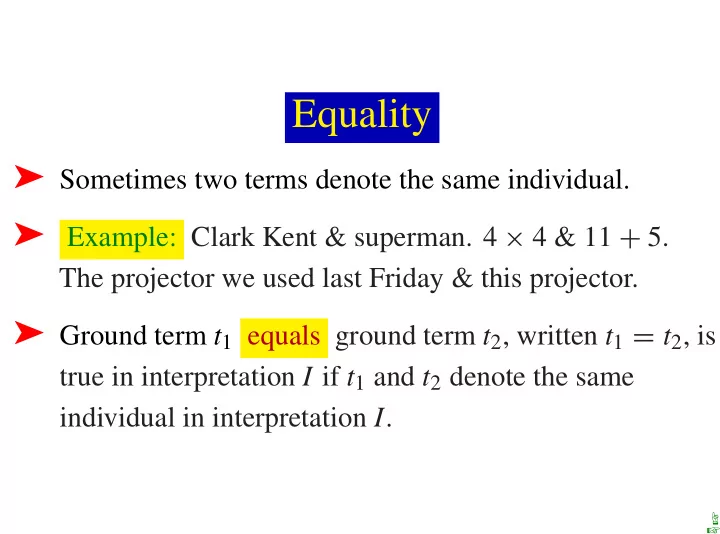
➤ Sometimes two terms denote the same individual. ➤ Example: Clark Kent & superman. 4 × 4 & 11 + 5.

The projector we used last Friday & this projector.

➤ Ground term t1 equals ground term t2, written t1 = t2, is

true in interpretation I if t1 and t2 denote the same individual in interpretation I.

☞ ☞

slide-2
SLIDE 2

Equality doesn’t mean similarity

chair 1 chair 2 chair1 = chair2 chair_on_right = chair2 chair_on_right is not similar to chair2, it is chair2.

☞ ☞ ☞

slide-3
SLIDE 3

Allowing Equality Assertions

➤ Without equality assertions, the only thing that is equal to

a ground term is itself. This can be captured as though you had the assertion X = X. Explicit equality never needs to be used.

➤ If you allow equality assertions, you need to derive what

follows from them. Either:

➣ axiomatize equality like any other predicate ➣ build special-purpose inference machinery for

equality

☞ ☞ ☞

slide-4
SLIDE 4

Axiomatizing Equality

X = X. X = Y ← Y = X. X = Z ← X = Y ∧ Y = Z. For each n-ary function symbol f there is a rule of the form f (X1, . . . , Xn) = f (Y1, . . . , Yn) ← X1 = Y1 ∧ · · · ∧ Xn = Yn. For each n-ary predicate symbol p, there is a rule of the form p(X1, . . . , Xn) ← p(Y1, . . . , Yn) ∧ X1 = Y1 ∧ · · · ∧ Xn = Yn.

☞ ☞ ☞

slide-5
SLIDE 5

Special-Purpose Equality Reasoning

paramodulation: if you have t1 = t2, then you can replace any occurrence of t1 by t2. Treat equality as a rewrite rule , substituting equals for equals. You select a canonical representation for each individual and rewrite all other representations into that representation. Example: treat the sequence of digits as the canonical representation of the number. Example: use the student number as the canonical representation for students.

☞ ☞ ☞

slide-6
SLIDE 6

Unique Names Assumption

The convention that different ground terms denote different individuals is the unique names assumption. for every pair of distinct ground terms t1 and t2, assume t1 = t2, where “=” means “not equal to.” Example: For each pair of courses, you don’t want to have to state, math302 = psyc303, … Example: Sometimes the unique names assumption is inappropriate, for example 3 + 7 = 2 × 5 is wrong.

☞ ☞ ☞

slide-7
SLIDE 7

Axiomatizing Inequality for the UNA

➤ c = c′ for any distinct constants c and c′. ➤ f (X1, . . . , Xn) = g(Y1, . . . , Ym) for any distinct function

symbols f and g.

➤ f (X1, . . . , Xn) = f (Y1, . . . , Yn) ← Xi = Yi, for any

function symbol f . There are n instances of this schema for every n-ary function symbol f (one for each i such that 1 ≤ i ≤ n).

➤ f (X1, . . . , Xn) = c for any function symbol f and

constant c.

➤ t = X for any term t in which X appears (where t is not

the term X).

☞ ☞ ☞

slide-8
SLIDE 8

Top-down procedure and the UNA

➤ Inequality isn’t just another predicate. There are

infinitely many answers to X = f (Y).

➤ If you have a subgoal t1 = t2, for terms t1 and t2 there are

three cases:

➣ t1 and t2 don’t unify. In this case, t1 = t2 succeeds. ➣ t1 and t2 are identical including having the same

variables in the same positions. Here t1 = t2 fails.

➣ Otherwise, there are instances of t1 = t2 that succeed

and instances of t1 = t2 that fail.

☞ ☞ ☞

slide-9
SLIDE 9

Implementing the UNA

➤ Recall: in SLD resolution you can select any subgoal in

the body of an answer clause to solve next.

➤ Idea: only select inequality when it will either succeed

  • r fail, otherwise select another subgoal. Thus you are

delaying inequality goals.

➤ If only inequality subgoals remain, and none fail, the

query succeeds.

☞ ☞