EPR-steering Inequalities from Entropic Uncertainty Relations James - - PowerPoint PPT Presentation

epr steering inequalities from entropic uncertainty
SMART_READER_LITE
LIVE PREVIEW

EPR-steering Inequalities from Entropic Uncertainty Relations James - - PowerPoint PPT Presentation

EPR-steering Inequalities from Entropic Uncertainty Relations James Schneeloch, 1 Curtis J. Broadbent, 1,2 Stephen P. Walborn, 3 Eric G. Cavalcanti, 4,5 and John C. Howell 1 1 Department of Physics and Astronomy, University of Rochester, Rochester,


slide-1
SLIDE 1

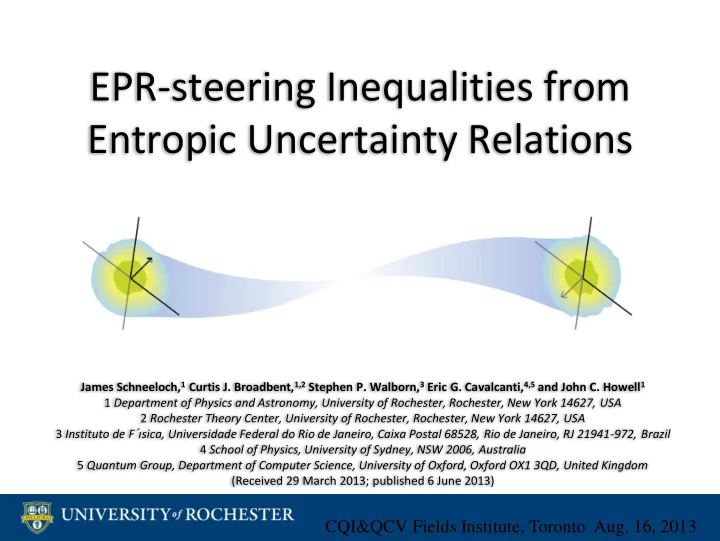
EPR-steering Inequalities from Entropic Uncertainty Relations

James Schneeloch,1 Curtis J. Broadbent,1,2 Stephen P. Walborn,3 Eric G. Cavalcanti,4,5 and John C. Howell1 1 Department of Physics and Astronomy, University of Rochester, Rochester, New York 14627, USA 2 Rochester Theory Center, University of Rochester, Rochester, New York 14627, USA 3 Instituto de F´ısica, Universidade Federal do Rio de Janeiro, Caixa Postal 68528, Rio de Janeiro, RJ 21941-972, Brazil 4 School of Physics, University of Sydney, NSW 2006, Australia 5 Quantum Group, Department of Computer Science, University of Oxford, Oxford OX1 3QD, United Kingdom (Received 29 March 2013; published 6 June 2013)

CQI&QCV Fields Institute, Toronto Aug. 16, 2013

slide-2
SLIDE 2
  • What we have shown
  • If you have an entropic uncertainty relation…

…Then you have a steering inequality.

  • Why this is important
  • They are intuitive entanglement witnesses.
  • They are (much) easier to use than doing state

tomography.

CQI&QCV Fields Institute, Toronto Aug. 16, 2013

slide-3
SLIDE 3

What is EPR-steering?

  • It is a degree of nonlocality.
  • Bell nonlocality (all LHVs)
  • EPR steering (All LHS’s, some LHV’s)
  • Implies correlations strong enough to

demonstrate EPR “paradox”.

  • It signifies what you can do with these

correlations.

  • You can verify entanglement even when one

party’s measurements are untrusted!

CQI&QCV Fields Institute, Toronto Aug. 16, 2013

slide-4
SLIDE 4

The situation in EPR-steering

CQI&QCV Fields Institute, Toronto Aug. 16, 2013

  • Alice prepares A and B, and sends B to Bob.
  • Bob tells Alice to measure (

𝑦 or 𝑞) of A, choosing randomly.

  • Alice reports to Bob her measurements.
  • Bob examines the correlations between his and her

measurement results.

slide-5
SLIDE 5

The situation in EPR-steering

CQI&QCV Fields Institute, Toronto Aug. 16, 2013

How can Alice prove there’s entanglement?

  • If Alice were preparing and sending states to Bob, the

measurement correlations could only be so high.

  • Bob could tell Alice to measure

𝑦 even though she sent a state with definite 𝑞.

  • A steering inequality gives an upper limit for these local

correlations.

slide-6
SLIDE 6

Where do steering inequalities come from?

  • Models of local hidden states (LHS):
  • Models where (Alice) is preparing and sending states to (Bob).
  • Models where (Bob’s) state is known and classically correlated

to (Alice’s) results.

  • All LHS models for Bob have joint measurement probabilities
  • f the form…

𝜍 𝑦𝐵, 𝑦𝐶 = 𝑒𝜇 𝜍(𝜇)𝜍(𝑦𝐵|𝜇)𝜍𝑟(𝑦𝐶|𝜇) P 𝑆𝐵, 𝑆𝐶 =

𝜇

𝑄 𝜇 𝑄 𝑆𝐵 𝜇 𝑄

𝑟(𝑆𝐶|𝜇)

CQI&QCV Fields Institute, Toronto Aug. 16, 2013

slide-7
SLIDE 7

From Uncertainty to EPR-steering

From the relative entropy between 𝜍 𝑦𝐶, 𝜇 𝑦𝐵 and 𝜍 𝜇 𝑦𝐵 𝜍 𝑦𝐶 𝑦𝐵 being ≥ 0, we get LHS constraints:

  • Continuous variable [2]:

ℎ 𝑦𝐶 𝑦𝐵 ≥ 𝑒𝜇𝜍(𝜇)ℎ𝑟(𝑦𝐶|𝜇)

  • Discrete variable [1]:

𝐼 𝑆𝐶 𝑆𝐵 ≥

𝜇

𝑄(𝜇)𝐼𝑟(𝑆𝐶|𝜇)

CQI&QCV Fields Institute, Toronto Aug. 16, 2013

slide-8
SLIDE 8

EPR-steering inequalities (CV)

Because of our LHS constraint ℎ 𝑦𝐶 𝑦𝐵 ≥ 𝑒𝜇 𝜍(𝜇)ℎ𝑟(𝑦𝐶|𝜇) we can use the uncertainty relation [3], ℎ𝑟 𝑦𝐶 + ℎ𝑟 𝑙𝐶 ≥ log 𝜌𝑓 , to get the steering inequality [2], ℎ 𝑦𝐶|𝑦𝐵 + ℎ 𝑙𝐶|𝑙𝐵 ≥ log 𝜌𝑓 .

CQI&QCV Fields Institute, Toronto Aug. 16, 2013

slide-9
SLIDE 9

EPR-steering inequalities (DV)

Because of our LHS constraint 𝐼 𝑆𝐶 𝑆𝐵 ≥

𝜇

𝑄(𝜇)𝐼𝑟(𝑆𝐶|𝜇) We can use the uncertainty relation [4], 𝐼𝑟 𝑅𝐶 + 𝐼𝑟 𝑆𝐶 ≥ log(Ω𝐶), to get the steering inequality [1] 𝐼 𝑆𝐶|𝑆𝐵 + 𝐼 𝑇𝐶|𝑇𝐵 ≥ log Ω𝐶 .

CQI&QCV Fields Institute, Toronto Aug. 16, 2013

Ω𝐶 ≡ min

𝑗,𝑘

1 𝑅𝑗

𝐶|𝑆𝑘 𝐶 2

slide-10
SLIDE 10

Entropic EPR-steering inequalities

  • Because LHS constraints deal with only one
  • bservable at a time…
  • We can get EPR-steering inequalities from

any entropic uncertainty relation.

  • Between any pair of observables, whether

continuous, discrete, or both (e.g. angular position/momentum)

  • Between any complete set of mutually unbiased
  • bservables [5]
  • Between pairs of POVMs [6]

CQI&QCV Fields Institute, Toronto Aug. 16, 2013

slide-11
SLIDE 11

Hybrid steering inequalities

  • The LHS joint probability doesn’t have to be of

the same observables P 𝑀𝐵, 𝜏𝐶 = 𝜇 𝑄 𝜇 𝑄 𝑀𝐵 𝜇 𝑄

𝑟(𝜏𝐶|𝜇)

𝐼 𝜏𝐶 𝑀𝐵 ≥

𝜇

𝑄(𝜇)𝐼𝑟(𝜏𝐶|𝜇)

  • You can have EPR-steering between disparate

degrees of freedom

e.g. (orbital) angular momentum to spin 𝐼 𝑀𝑦

𝐶 𝜏𝑦𝐵 + 𝐼 𝑀𝑨 𝐶 𝜏𝑨𝐵 ≥ log 𝑂

𝐼 𝜏𝑦𝐶 𝑀𝑦

𝐵 + 𝐼 𝜏𝑨𝐶 𝑀𝑨 𝐵 ≥ 1

CQI&QCV Fields Institute, Toronto Aug. 16, 2013

slide-12
SLIDE 12

Symmetric EPR-steering inequalities

  • Definition: steering inequality whose violation

rules out LHS models for both parties.

  • Examples:

𝐽 𝑆𝐵: 𝑆𝐶 + 𝐽 𝑇𝐵: 𝑇𝐶 ≤ max

𝐵,𝐶 log

𝑂2 {Ω𝐵, Ω𝐶} ℎ 𝑦𝐵 ± 𝑦𝐶 + ℎ 𝑙𝐵 ∓ 𝑙𝐶 ≥ log 𝜌𝑓 (for two-qubit systems) 𝐽 𝜏𝑦𝐵: 𝜏𝑦𝐶 + 𝐽 𝜏𝑧𝐵: 𝜏𝑧𝐶 + 𝐽 𝜏𝑨𝐵: 𝜏𝑨𝐶 ≤ 1

CQI&QCV Fields Institute, Toronto Aug. 16, 2013

slide-13
SLIDE 13

Steering and QKD

  • Symmetrically steerable states guarantee

nonzero secret key rate in intercept resend attack.

  • Open questions:
  • Do symmetrically steerable states allow some

form of device independent QKD?

  • Steerable states allow for one sided device

independent QKD [7].

  • Are symmetrically steerable states Bell nonlocal?

CQI&QCV Fields Institute, Toronto Aug. 16, 2013

slide-14
SLIDE 14

Open Question: Are there “one-way” steerable states?

  • Definitely maybe!

CQI&QCV Fields Institute, Toronto Aug. 16, 2013

𝐼 𝜏𝑦𝐶|𝜏𝑦𝐵 + 𝐼 𝜏𝑧𝐶|𝜏𝑧𝐵 + 𝐼 𝜏𝑨𝐶|𝜏𝑨𝐵 ≥ 2

slide-15
SLIDE 15

Conclusion/Related Work

  • With any entropic uncertainty relation, we get

a viable entanglement witness (practically) for free. Related work:

  • “Continuous variable EPR-steering with discrete

measurements”: (PRL 110, 130407 (2013)).

  • “Quantum Memories and EPR-steering

inequalities”: (arXiv) (in submission)

CQI&QCV Fields Institute, Toronto Aug. 16, 2013

slide-16
SLIDE 16

Thanks for listening!

We gratefully acknowledge support from DARPA DSO InPho Grant No. W911NF-10-1-0404. C.J.B. acknowledges support from ARO Grant No. W911NF-09-1-0385 and NSF Grant No. PHY-1203931. S.P.W. acknowledges funding support from the Future Emerging Technologies FET-Open Program, within the 7th Framework Programme of the European Commission, under Grant No. 255914, PHORBITECH, and Brazilian agencies CNPq, CAPES, FAPERJ, and INCTInformac¸ ˜ao Quˆantica. E.G.C. acknowledges funding support from ARC Grant No. DECRA DE120100559.

CQI&QCV Fields Institute, Toronto Aug. 16, 2013

slide-17
SLIDE 17

Works Cited

1) Schneeloch, J., Broadbent, C. J., Walborn, S. P., Cavalcanti, E. G., & Howell, J. C. (2013). Einstein-Podolsky-Rosen steering inequalities from entropic uncertainty relations. Physical Review A, 87(6), 062103. 2) Walborn, S. P., Salles, A., Gomes, R. M., Toscano, F., & Ribeiro, P. S. (2011). Revealing hidden einstein-podolsky- rosen nonlocality. Physical Review Letters, 106(13), 130402. 3) Białynicki-Birula, I., & Mycielski, J. (1975). Uncertainty relations for information entropy in wave mechanics. Communications in Mathematical Physics, 44(2), 129-132. 4) Maassen, H., & Uffink, J. B. (1988). Generalized entropic uncertainty relations. Physical Review Letters, 60(12), 1103-1106. 5) Sánchez-Ruiz, J. (1995). Improved bounds in the entropic uncertainty and certainty relations for complementary observables. Physics Letters A, 201(2), 125-131. 6) Krishna, M., & Parthasarathy, K. R. (2002). An entropic uncertainty principle for quantum measurements. Sankhyā: The Indian Journal of Statistics, Series A, 842-851. 7) Branciard, C., Cavalcanti, E. G., Walborn, S. P., Scarani, V., & Wiseman, H. M. (2012). One-sided device- independent quantum key distribution: Security, feasibility, and the connection with steering. Physical Review A, 85(1), 010301. 8) Berta, M., Christandl, M., Colbeck, R., Renes, J. M., & Renner, R. (2010). The uncertainty principle in the presence of quantum memory. Nature Physics. 9) Schneeloch, J., Dixon, P. B., Howland, G. A., Broadbent, C. J., & Howell, J. C. (2013). Violation of Continuous- Variable Einstein-Podolsky-Rosen Steering with Discrete Measurements. Physical review letters, 110(13), 130407.
slide-18
SLIDE 18

Steering with quantum memory?

  • Berta et.al’s improved uncertainty relation [8]

𝐼𝑟 𝑅𝐶 + 𝐼𝑟 𝑆𝐶 ≥ log Ω𝐶 + 𝑇( 𝜍𝐶) does not give us a better steering inequality. H 𝑆𝐶|𝑆𝐵 + 𝐼 𝑇𝐶|𝑇𝐵 ≥ log Ω𝐶 + 𝑇 𝜍𝐶

  • Why?

CQI&QCV Fields Institute, Toronto Aug. 16, 2013

Ω𝐶 ≡ min

𝑗,𝑘

1 𝑅𝑗

𝐶|𝑆𝑘 𝐶 2