Envision Cambridge Advisory Committee November 27, 2017 ECAC | - - PowerPoint PPT Presentation

envision cambridge advisory committee november 27 2017
SMART_READER_LITE
LIVE PREVIEW

Envision Cambridge Advisory Committee November 27, 2017 ECAC | - - PowerPoint PPT Presentation

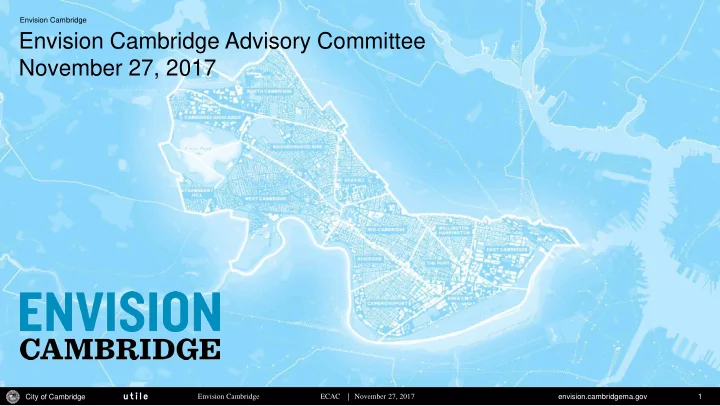
Envision Cambridge Envision Cambridge Advisory Committee November 27, 2017 ECAC | November 27, 2017 City of Cambridge Envision Cambridge envision.cambridgema.gov 1 Agenda Community Interaction Revised goals and indicators (10 mins)


slide-1
SLIDE 1

envision.cambridgema.gov Envision Cambridge 1 City of Cambridge ECAC | November 27, 2017

Envision Cambridge Advisory Committee November 27, 2017

Envision Cambridge
slide-2
SLIDE 2

envision.cambridgema.gov Envision Cambridge 2 City of Cambridge ECAC | November 27, 2017

Agenda

Community Interaction

  • Revised goals and indicators (10 mins)
  • Discussion (20 mins)

Urban Form

  • Goals and indicators (10 mins)
  • Strategies and actions (40 mins)
  • Discussion (40 mins)

Next steps

slide-3
SLIDE 3

envision.cambridgema.gov Envision Cambridge 3 City of Cambridge ECAC | November 27, 2017

Community Interaction

slide-4
SLIDE 4

envision.cambridgema.gov Envision Cambridge 4 City of Cambridge ECAC | November 27, 2017

Community Interaction Goals

A. Inclusion of Diversity and Social Cohesion: Maintain and enhance the diversity of Cambridge’s population, highlight a set of shared values and spaces, and enable interaction and cohesion across demographic lines. B. Social and Racial Equity: Design for equity and promote social capital among economically and socially disadvantaged populations and historically disadvantaged racial and ethnic groups. C. Civic Engagement: Empower all people to participate in public life, whether that participation is through formal political processes, community organizations, or informal community life. D. Healthy Living: Enable all people to engage in healthy behaviors, live healthy lifestyles, and access health treatment. E. Learning and Play: Facilitate lifelong learning and encourage healthy and enriching play and entertainment for people of all ages. F. Art and Expression in Public Life: Embed cultural and artistic expression in all parts of Cambridge life. Cultivate creative expression among all people in Cambridge.

slide-5
SLIDE 5

envision.cambridgema.gov Envision Cambridge 5 City of Cambridge ECAC | November 27, 2017

Community Interaction Indicators

Goal Proposed Indicators Directional Targets A Racial, ethnic, and income diversity over time Maintain or increase proportions of racial and ethnic minorities; as well as low-, middle-, and moderate-income households B Economic mobility for low income populations and historically disadvantaged racial and ethnic groups Parity in economic mobility between the groups assessed B Minority representation on City committees and City government Committee membership reflects the racial and socioeconomic diversity of Cambridge C Voter turnout by precinct Parity in voter turnout between precincts, and a majority of eligible voters participating in local elections B, D Life expectancy by race and income Parity in life expectancy between the groups assessed E, F Per capita City spending on recreation, arts, libraries, and non-K-12 education Maintenance or increase in per capita spending on identified items F Number of arts organizations, performance/exhibition venues, and permits for public events Maintenance or increase in the number of identified items

slide-6
SLIDE 6

envision.cambridgema.gov Envision Cambridge 6 City of Cambridge ECAC | November 27, 2017

Discussion

  • Do you feel the indicators adequately track progress toward achieving the goals?
  • Which are the most important indicators for tracking progress?
  • Is there anything you would add to the list of actions? Is there anything you would

remove?

slide-7
SLIDE 7

envision.cambridgema.gov Envision Cambridge 7 City of Cambridge ECAC | November 27, 2017

Urban Form

slide-8
SLIDE 8

envision.cambridgema.gov Envision Cambridge 8 City of Cambridge ECAC | November 27, 2017

Urban Form Goals

  • A. Patterns of City Development: Strengthen the existing patterns of the city, which are marked by distinct

neighborhoods, squares, corridors, institutional districts, and open spaces.

  • B. Transitions between Uses and Districts: Ensure that new development acknowledges and complements

the existing city fabric, especially at the seams between different types and scales of districts.

  • C. Human-Scaled Urban Form: Shape new development, including uses that favor large footprints, so that it

creates human-scaled experience and an active public realm.

  • D. Public Life: Shape the design of public and publicly-accessible private spaces so they are inclusive of all

people and encourage social interaction.

  • E. Open Space: Create a connected network of high-quality open spaces that link all residents to local and

regional natural assets that provide a range of activities and experiences.

  • F. Regulatory and Development Review Process: Streamline the development review process to ensure

transparent procedures, predictable outcomes, and high-quality design.

slide-9
SLIDE 9

envision.cambridgema.gov Envision Cambridge 9 City of Cambridge ECAC | November 27, 2017

Urban Form Indicators

Proposed Indicators (to be tracked annually) Directional Targets Percentage of frontage along Mass Ave, Cambridge Street, Prospect Street, Main Street, Binney Street that has active uses. Maintain or increase the percentage of active frontage

  • n primary and secondary corridors.

New publicly accessible open space as a percentage

  • f net new development.

Increase the percentage of publicly accessible open space negotiated through private development. Percentage of residents within a 5-minute walk of an uninterrupted, high-quality pedestrian route connecting to a major open space. Increase access to areas underserved by safe and pleasant routes to major open spaces.

slide-10
SLIDE 10

envision.cambridgema.gov Envision Cambridge 10 City of Cambridge ECAC | November 27, 2017

Urban Form Strategies and Actions

  • Form of Corridors
  • Active Uses along the Corridors
  • Design of the Street Wall
  • Potential Areas of Change
  • Open Space Network
  • Publicly Accessible Private Open Space
  • Development Review Process
slide-11
SLIDE 11

envision.cambridgema.gov Envision Cambridge 11 City of Cambridge ECAC | November 27, 2017

Form of Corridors

Urban Form Actions

  • Develop a form-and-performance-based code along the corridors.
  • Base the zoning on context-responsive “character zones”
  • Require a 7’ minimum setback at the fourth or fifth floor (depending on the character zone) to create a

horizontal datum appropriate to the scale of the street.

  • No façade plane can be longer than 200’ in order to make large new development projects fit into the existing

physical fabric.

  • Allow for height bonuses based on a flexible menu of social and environmental policies that include an

additional percentage of affordable housing, higher than mandated environmental performance, the inclusion of district energy, etc.

slide-12
SLIDE 12

envision.cambridgema.gov Envision Cambridge 12 City of Cambridge ECAC | November 27, 2017

Urban form along the corridors

Corridor B: 4-over-1 Corridor C: 5-over-1 + bonus

300 Mass Ave 1924 Mass Ave.

Urban Form Actions

slide-13
SLIDE 13

envision.cambridgema.gov Envision Cambridge 13 City of Cambridge ECAC | November 27, 2017

Case for regulating number of floors (vs. height)

Urban Form Actions Source: Léon Krier, 2009, Drawing for Architecture.

slide-14
SLIDE 14

envision.cambridgema.gov Envision Cambridge 14 City of Cambridge ECAC | November 27, 2017

Corridor Character Zones along Mass. Ave.

Urban Form Actions

Roseland St. – Alewife Brook Pkwy Pleasant St. – Putnam Ave. Waterhouse St. – Shepard St.

slide-15
SLIDE 15

envision.cambridgema.gov Envision Cambridge 15 City of Cambridge ECAC | November 27, 2017

Draft Corridor Character Zones

Urban Form Actions Zone A 3-over-1 B 4-over-1 C 5-over-1 (up to 70’) D High rise

slide-16
SLIDE 16

envision.cambridgema.gov Envision Cambridge 16 City of Cambridge ECAC | November 27, 2017

Active Uses along the Corridors

Urban Form Actions

  • Prohibit parking within 40’ of the front lot line.
  • Eliminate parking requirements (let the market decide).
  • Allow curb cuts on the corridors only if the parcel only has frontage on the corridor and garage entrance is no

more than 20% of the width of the façade or 12’ (whichever is larger).

  • Loading and service areas are prohibited along corridors; access must be provided from side streets or service

alleys.

  • Eliminate the minimum ground-level open space area requirement for parcels that are 0.25 acres in area or less.
  • Require sidewalk-activating uses for a minimum percentage of the front lot frontage (TBD).
  • Restrict areas dedicated to lobbies to 40% of the frontage or 40 LF (whichever is larger).*
  • For buildings with ground floor areas larger than 10K, require at least one storefront that is between 800-1200

SF*

  • Revise the use table to incentivize “third place” uses that have a social component.

*To encourage entrepreneurial retail

slide-17
SLIDE 17

envision.cambridgema.gov Envision Cambridge 17 City of Cambridge ECAC | November 27, 2017

Active Uses along the Corridors

Urban Form Actions

345 West Broadway, South Boston 918 Cambridge Street, Cambridge

What the code should prevent

slide-18
SLIDE 18

envision.cambridgema.gov Envision Cambridge 18 City of Cambridge ECAC | November 27, 2017

Design of the Street Wall

Urban Form Actions

  • A single storefront design can be no longer than 70’ in order to create visual variety at the sidewalk level.
  • Require the ground floor façade to be at least 75% transparent to encourage visual connections between

the public realm and lobbies and shops.

  • Require primary building entrances to be located on the corridors to create visual variety and to encourage

the mixing of building residents, shoppers, and pedestrians passing by.

  • Require developers to install a minimum number of street trees, as determined by the corridor character

zones and the length of the parcel frontage.

slide-19
SLIDE 19

envision.cambridgema.gov Envision Cambridge 19 City of Cambridge ECAC | November 27, 2017

Design of the Street Wall

Urban Form Actions

Central Square, 1960s Assembly Row, Somerville

slide-20
SLIDE 20

envision.cambridgema.gov Envision Cambridge 20 City of Cambridge ECAC | November 27, 2017

Potential Areas of Change

Urban Form Actions

  • Develop plans for “Potential Areas of Change” as recommended in the Envision Cambridge plan to inform new

form-and-performance based codes

  • Recommend a mix of uses in each Potential Area of Change to guide a district-wide land use plan and the

development review process.

  • Appoint an advisory committee when plans in the Potential Area of Change are launched to help shape the plan

and review subsequent development projects.

slide-21
SLIDE 21

envision.cambridgema.gov Envision Cambridge 21 City of Cambridge ECAC | November 27, 2017

Potential Areas of Change

Urban Form Actions K2C2 North Point Mass Ave. Corridor Cambridge St. Corridor Charles St. Cambridgeport South Cambridgeport Riverfront Alewife Area Plan Star Market Prospect St. Inman East Recent planning areas Proposed areas for corridor analysis Potential Areas of Change Alewife study area Lechmere Square West

slide-22
SLIDE 22

envision.cambridgema.gov Envision Cambridge 22 City of Cambridge ECAC | November 27, 2017

Open Space Network

Urban Form Actions

  • Design and implement clear wayfinding for biking and walking routes to the City’s open spaces.*
  • Build the connections to integrate “Alewife Square”** into the fabric of the City.*
  • Commit funds to implement priority multi-use paths.*
  • Commit funds to improve pedestrian and bicycle comfort and safety on priority streets*
  • Build partnerships with local non-profit and community organizations to develop additional year-round park

programming for all ages.

  • Launch a targeted advocacy campaign to encourage DCR to allow for more active uses along the Charles

River, including canoe/kayak launches, boat rentals, public swimming, and restaurants and cafes.

*As recommended in the Envision Cambridge open space network plan **The site of the Fresh Pond Mall

slide-23
SLIDE 23

envision.cambridgema.gov Envision Cambridge 23 City of Cambridge ECAC | November 27, 2017

Cambridge’s open space circuit – Links to neighborhoods, corridors

Urban Form Actions Somerville Community Path Emerald Necklace Watertown Greenway On-street connections

Existing Planned / proposed

Multi-use paths and linear parks Buildings with Retail Clusters Note: The open space network map is in progress and pending revisions per ECAC feedback. Garden St. Lakeview-Coolidge Museum of Science Connect Kendall Fresh Pond to Danehy Park connections

slide-24
SLIDE 24

envision.cambridgema.gov Envision Cambridge 24 City of Cambridge ECAC | November 27, 2017

Publicly Accessible Private Open Space

Urban Form Actions

  • When a new development is proposed on a parcel larger than 0.75 acres, require the development team to do a

neighborhood open space study to help frame and justify the location and amenities of on-site open space(s).

  • Create incentives that encourage abutting property owners to collaborate on public realm benefits.
  • Require the addition of on-site pathways on large development sites that create new neighborhood pedestrian

and bicycle connections.*

  • Develop citywide programming and design guidelines for publicly accessible private open space (POPs).

*As recommended in the Alewife plan and future Transformative Area plans

slide-25
SLIDE 25

envision.cambridgema.gov Envision Cambridge 25 City of Cambridge ECAC | November 27, 2017

Publicly Accessible Private Open Space

Urban Form Actions

Berklee College of Music musicians in front of the Marriott in Kendall Square Roasting marshmallows at the Harvard Science Center Plaza

slide-26
SLIDE 26

envision.cambridgema.gov Envision Cambridge 26 City of Cambridge ECAC | November 27, 2017

Development Review Process

Urban Form Actions

  • Create new form-and-performance-based codes that make the urban design outcome of projects

appropriate to their specific neighborhood context and more predictable to stakeholders and developers.

  • Require an initial meeting with the City’s urban design team before developers hold community meetings.

This will allow the City to frame the essential urban design issues of a project, as defined by Envision Cambridge and other relevant plans, before conceptual design commences.

  • Create a design review advisory committee, modeled on the Boston Civic Design Commission, to review

development projects larger than 50K SF during early conceptual design and Schematic Design phases. This body would make recommendations to the Planning Board.

  • Institute and enforce term-limits for neighborhood Advisory Committees and the future design review

committee.

slide-27
SLIDE 27

envision.cambridgema.gov Envision Cambridge 27 City of Cambridge ECAC | November 27, 2017

Development Review Process

Urban Form Actions

slide-28
SLIDE 28

envision.cambridgema.gov Envision Cambridge 28 City of Cambridge ECAC | November 27, 2017

Discussion

  • Do you feel the indicators adequately track progress toward achieving the goals?
  • Which are the most important indicators for tracking progress?
  • Is there anything you would add to the list of actions? Is there anything you would

remove?