ENVIRONMENTAL PROTECTION Ljubljana, June 27 th - July 17 th , 2016 - - PDF document

environmental protection ljubljana june 27 th july 17 th
SMART_READER_LITE
LIVE PREVIEW

ENVIRONMENTAL PROTECTION Ljubljana, June 27 th - July 17 th , 2016 - - PDF document

I N T E R N A T I O N A L S U M M E R S C H O O L ENVIRONMENTAL PROTECTION Ljubljana, June 27 th - July 17 th , 2016 Ljubljana, European Green Capital 2016 www.let-group.com


slide-1
SLIDE 1

I N T E R N A T I O N A L S U M M E R S C H O O L

ENVIRONMENTAL PROTECTION Ljubljana, June 27th - July 17th, 2016

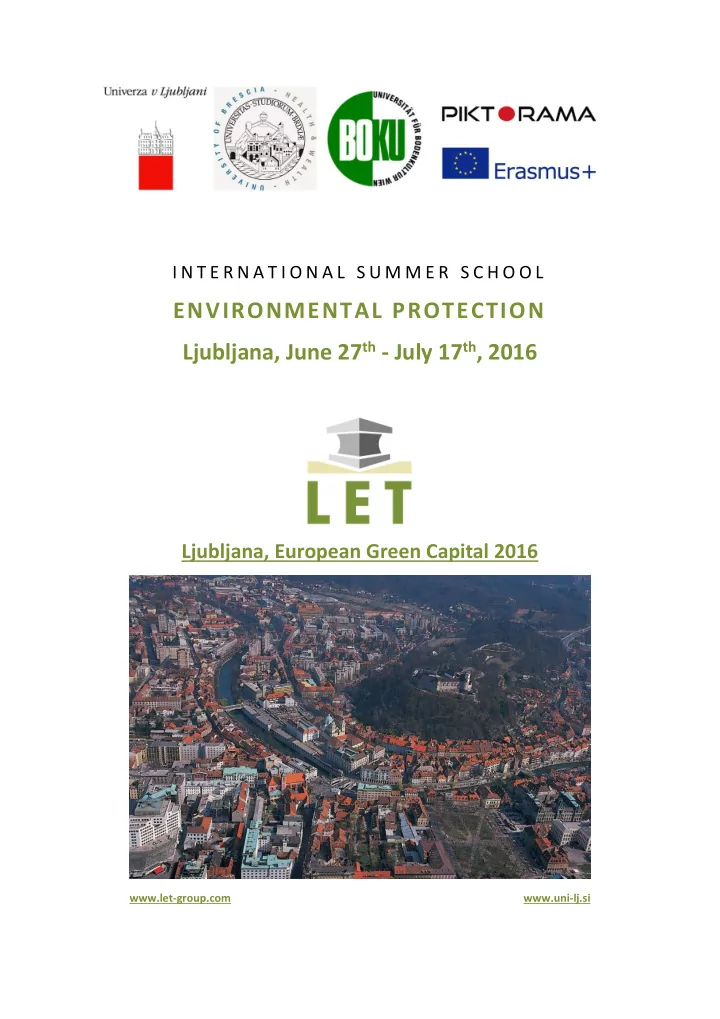
Ljubljana, European Green Capital 2016

www.let-group.com www.uni-lj.si
slide-2
SLIDE 2

UNIVERZA V LJUBLJANI / UNIVERSITY OF LJUBLJANA International Summer School, Environmental Protection Ljubljana, Summer School: June 27th - July 14th, 2016 Academic Committee: A. Žgajnar Gotvajn (SI), W. Blum (A), G. Grossi (I), F. Lobnik (SI), Task force Summer school: M. Šraj (SI), J. Hübl (A), R. Ranzi (I), M. Brilly (SI), M. Lobnik (SI) Head of School: A. Žgajnar Gotvajn Deputy Head: F. Lobnik Video: M. Lobnik Organization: Ž. Šubic, K. Sapač, M. Lobnik Wording: F. Lobnik, M. Lobnik, A. Žgajnar Gotvajn Invited live lectures:

  • F. Evers, (Netherland)
  • J. Peterlin, University of Ljubljana (Slovenia)
  • V. Parisio, University of Brescia (Italy)
  • G. Grossi, University of Brescia (Italy)
  • F. Batič, University of Ljubljana (Slovenia)
  • W. Blum, University of Natural Resources and Life Sciences -BOKU (Austria)
  • A. Žgajnar Gotvajn, University of Ljubljana (Slovenia)
  • G. Kalčikova, University of Ljubljana (Slovenia)
  • H. Grčman, University of Ljubljana (Slovenia)
  • A. Lisec, University of Ljubljana (Slovenia)
  • F. Lobnik, University of Ljubljana (Slovenia)
  • J. P. Rauch, University of Natural Resources and Life Sciences -BOKU (Austria)
  • U. Pitha, University of Natural Resources and Life Sciences - BOKU (Austria)

Invited video lectures:

  • W. Blum, University of Natural Resources and Life Sciences -BOKU (Austria)
  • J. Peterlin, University of Ljubljana (Slovenia)
  • V. Parisio, University of Brescia (Italy)
  • R. Ranzi, University of Brescia (Italy)
  • S. Barontini, University of Brescia (Italy)
  • J. Barry, Queen’s University Belfast (Northern Ireland)
  • M. Kibblewhite, Cranfield University (UK)
  • J. Mencinger, University of Ljubljana (Slovenia)
  • J. Schiefer, University of Natural Resources and Life Science - BOKU (Austria)
  • G. J. Lair, University of Natural Resources and Life Science - BOKU (Austria)
  • J. Rakovec, University of Ljubljana (Slovenia)
  • H. Grčman, University of Ljubljana (Slovenia)
  • A. Žgajnar Gotvajn, University of Ljubljana (Slovenia)
  • A. J. Englande, Tulane University (USA)
  • H. Wiggering, ZALF (Germany)
  • M. Veber, University of Ljubljana (Slovenia)
  • L. Kajfež Bogataj, University of Ljubljana (Slovenia)
  • B. Lampič, University of Ljubljana (Slovenia)
  • K. Vintar Mally, University of Ljubljana (Slovenia)
  • M. Berovič, University of Ljubljana (Slovenia)
  • M. Ogrin, University of Ljubljana (Slovenia)
  • M. Marinšek, University of Ljubljana (Slovenia)
  • H. Prosen, University of Ljubljana (Slovenia)
slide-3
SLIDE 3

Fieldtrips: TBA, University of Ljubljana, (Slovenia), 1. Field trip

  • M. Zupan, University of Ljubljana (Slovenia), 2. Field trip

Illustrations and Pictures: Archives of the Council for Environmental Protection Graphics and printing: Univerza v Ljubljani Editors: F. Lobnik, A. Žgajnar Gotvajn, M. Lobnik

CIP - Kataložni zapis o publikaciji Narodna in univerzitetna knjižnica, Ljubljana xxxxxxxx University of Ljubljana, International Summer School (2016 ; Ljubljana) Environmental Protection (UL) International Summer School, Ljubljana, July 27th - July 17th, 2016 [editors: Franc Lobnik, Andreja Žgajnar Gotvajn, Matjaž Lobnik ; illustrations and pictures Archive of the Council for Environmental Protection of the Republic of Slovenia].

  • Ljubljana: University, 2016

ISBN xxxxxxxxxxx.

  • Gl. stv. nasl. 2. Lobnik, Franc, 1942-xxxxxxxxxxxxxxx
slide-4
SLIDE 4

1 Dear Student, We invite you to the International Summer School on

Environmental Protection

which will be held in Ljubljana from June 27th to July 17th, 2016

This summer school is a joint initiative of University of Ljubljana (Slovenia), University of University Brescia (Italy) and University of Natural Resources and Life Sciences - BOKU (Austria) universities. It brings together students and academic staff from partner institutions in the beautiful city of Ljubljana to study and discuss environmental issues in an interactive and intensive way. The academic staff comes from different European countries, making the summer school a truly international and multidisciplinary experience. The aim is to invite 40 well-motivated, advanced graduate or postgraduate students with at least four years of academic experience, regardless of their fields of study to experience this new and, hopefully, rewarding opportunity. Enclosed you will find information on the Republic of Slovenia and its capital city of Ljubljana, information on the University of Ljubljana (SI), and links to Brescia (I) and BOKU (A) universities together with practical details about your stay. If you have any additional questions do not hesitate to contact our representatives: Prof. Dr. Andreja Žgajnar Gotvajn (andreja.zgajnar@fkkt.uni-lj.si) or Žiga Šubic (ziga@piktorama.si) or Prof. Dr. Franc Lobnik (franc.lobnik@bf.uni-lj.si).

  • All universities involved are encouraged to grant their students academic recognition for their

participation in this intensive seminar. The total workload is measured at 5 ECTS credits. This includes attendance at all lectures and seminars, presentation and successful completion of the final assay.

slide-5
SLIDE 5

2

I N T E R N A T I O N A L S U M M E R S C H O O L

ENVIRONMENTAL PROTECTION

Ljubljana, June 27th - July 17th, 2016

Introduction to the International Summer School:

  • We constantly interact with the environment.
  • It influences us and we modify it in everything we do.
  • We respond to the environment and to how we perceive it.
  • If it stimulates us in ways we do not like, we do something about it.
  • We can manipulate the environment with human activities. When we do so, we may have a long-

term impact on the environment.

  • What can we do to promote harmony between our actions and the environment we construct with

thought?

  • Sometimes the relationships have strong biological, geological, chemical, physical roots, and with

time are the products of experience and culture. The objectives are to present the scientific knowledge about environmental and resource management, give an explanation of the vulnerability of the environment owing to different sources

  • f pollution, and ways to solve environmental problems with the coordination of all relevant

participants with the best available technologies. Then the essential question of the transfer of the results to policy makers, local authorities and engineering companies will be debated to get an

  • verview of the future of some techniques in the management of different pollution sources and

problems. University of Ljubljana, Slovenia (Rectorate)

slide-6
SLIDE 6

3

GENERAL INFORMATION

Target group About 40 students will be selected to participate in the summer school. The target group will consist

  • f advanced graduates and postgraduates, irrespective of their academic background, though some

affinity with the subject is recommended. Major selection criteria will include maturity skills, and a clear indication as to the motivation and expectations the program will bring and the impact on your further study. Working language and language proficiency The working language of the Summer school is English. In order to assure active participation of all students, a good skills in English in all of its aspects (spoken, written and comprehension) is a prerequisite. Fees This summer school is a joint initiative of Ljubljana, Brescia, BOKU universities and Piktorama under the Erasmus+ program (KA2-HE-14-15 Contract) Environmental Protection (2016) and Natural Disasters (2017) project which made possible, to organize Summer school 2016 at the University of

  • Ljubljana. 20 students from partner universities are free of tuition. For the rest tuition is 800 Euro and

covers study materials, organized field trips and accommodation in double rooms with breakfast and

  • lunch. For those which are not present at Summer school but are participating on long distance, 300

Euro must be paid. Application procedure Students can apply before 5 May, 2016. Please complete the application form available on http://www.let-group.com/online/application-form.php A confirmation letter and a full information pack-age will be addressed to all selected students in the 2nd half of May. It will include practical information as well as reading material available at http://www.let-group.com as an essential preparation for successful attendance of the program. Lecturers from different countries will hold courses amounting to a workload of 5 ECTS credits. We invite you to apply and look forward to meet you in Ljubljana! Students are requested to contact the international relations office of their University in order to apply for a potential scholarship. Universities are encouraged to contribute by making an extra small student grant available for those which are over the number of the twenties free of charge of tuition.

slide-7
SLIDE 7

4

Program

All the technical knowledge in the world does not necessarily lead societies to change environmentally damaging behavior. Hence a critical under-standing of socio-economic, political and cultural processes and structures has been acknowledged of central importance in approaching environmental problems. An increasing number of environmental courses is now being introduced at many universities. The Credit system in Europe is allowing a much more intensive student exchange program and Summer Schools are effective tools for getting students together from different cultural and social

  • surroundings. The Summer School 2016 Program will provide short topic - centered lectures on

environmentally relevant areas. This will reflect the fact that students will approach their subject matter from a great variety of different disciplinary backgrounds; not just within social sciences and humanities, but from natural and technical sciences too. And for those students who may not be familiar with the background to some of the topics, they will be intensively co-opted via video lectures and in the workshop program, which will be guided by the lecturers. To achieve the right mix of flexibility, depth and breadth, and volume, as with most modular courses, the program is designed carefully to create maximum accessibility from a variety of backgrounds. Each lecture leads into its topics by giving an adequate introduction, and each leads out by pointing towards complexities and areas for further development and study. Data, case studies, overview diagrams, summary charts and self-check questions and exercise are some of the pedagogical devices that will be found. We hope that Summer School 2016 will provide sufficient depth to maintain the interest of students with relevant backgrounds because program will cover public policies, human resource management, environmental conflicts, environmental law, landscape architecture and environment, air quality and global changes, water management, land use and soil pollution, agriculture, food and society indicators and sustainability, sustainable energy management, spatial analysis and the use of GIS in environmental management etc. We have to acknowledge that sustainable development must fulfill economic, social and environmental objectives. Because the survival of the natural environment it is crucial for economic and social development in the long run, they have focused on the environmental dimension of sustainability. The aims of the summer school are:

  • To develop a comprehensive environment for a European program addressing in particular trans-

boundary environmental problems.

  • To provide a sound basis for effective measures strategies and policies to address environmental

problems nationally and regionally; and

  • To inform the participants and raise awareness about our common responsibility for the

environment.

slide-8
SLIDE 8

5

Brief outline of “Environmental Protection” Summer School

University of Ljubljana June 27 – July17, 2016, Ljubljana, Slovenia www.let-group.com andreja.zgajnar@fkkt.uni-lj.si , franc.lobnik@bf.uni-lj.si June 27 – July 1 Video Lectures July 2, 3 Arrivals July 4 Monday 10:00 – 10:15 WELCOME Rector of Ljubljana University, Prof. Dr. Ivan Svetlik 10:15 – 10:30 WELCOME Andreja Žgajnar Gotvajn, Head of Summer School Environmental Protection 10:30 – 11:00 Introduction to the “Environmental Protection” summer school Franc Lobnik, University of Ljubljana, Slovenia 11:00 – 12:30 Introduction to negotiating for sustainability development by the mutual gains approach Frans W. Evers, Netherlands 12:30 – 14:00 Lunch 14:00 – 16:00 Site seeing Tour Ljubljana July 5 Tuesday 09:00 – 11:00 Negotiating for sustainability development by the mutual gains approach / MGA Frans W. Evers, Netherlands 11:00 – 11:15 Break 11:15 – 13:15 MGA / Frans W. Evers 13:15 – 14:30 Lunch 14:30 – 16:30 MGA / Frans W. Evers 16:30 – 16:45 Break 16:45 – 17:30 MGA / Frans W. Evers July 6 Wednesday 09:00 – 11:00 MGA simulation Frans W. Evers 11:00 – 11:15 Break 11:15 – 13:15 MGA simulation 13:15 – 14:30 Lunch 14:30 – 16:30 MGA analysis, turning point questions 16:30 – 16:45 Break 16:45 – 17:30 MGA analysis, turning point questions July 7 Thursday 09:00 – 10:00 Social innovation: from locust to honeybee approach to leadership theory

  • J. Peterlin, University of Ljubljana (Slovenia)

10:00 – 11:00

  • J. Peterlin: Case studies

11:00 – 11:15 Break 11:15 – 12:15 The general legal principles on the protection of environment (precautionary principles) prevention principles, polluter –payer

  • V. Parisio, University of Brescia (Italy)

12:15 – 13:15 Water management in Europe

  • V. Parisio, University of Brescia (Italy)

13:15 – 14:30 Lunch 14:30 – 15:30 Green Urban Infrastructures - Plant use for livable cities

  • U. Pitha, University of Natural Resources and Life Sciences (Austria)

15:30 – 16:30

  • U. Pitha: Case studies

16:30 – 16:45 Break 16:45 – 17:30 Instructions for student presentations July 8 Friday 09:00 – 10:00 Land Administration System (LAS), for Sustainable Spatial Development

  • A. Lisec, University of Ljubljana (Slovenia)

10:00 – 11:00

  • A. Lisec: Case studies
slide-9
SLIDE 9

6

11:00 – 11:15 Break 11:15 – 12:15 Past, present and futures (Policing in Central and Eastern Europe)

  • B. Dobovšek, University of Maribor (Slovenia)

12:15 – 13:15

  • B. Dobovšek: Case studies

13:15 – 14:30 Lunch 14:30 – 15:30 European Land Quality as a Foundation for the Sustainable Intensification of Agriculture

  • W. Blum, University of Natural Resources and Life Sciences (Austria)

15:30 – 16:30

  • W. Blum: Case studies

16:30 – 16:45 Break 16:45 – 17:30 Instructions for student presentations July 9 Saturday 9:00 – 14:00 Fieldtrip / TBA / to be announced July 10 Sunday BREAK July 11 Monday 09:00 – 10:00 Soil Sealing: Impact assessment of highway siting on agricultural land

  • H. Grčman, University of Ljubljana (Slovenia)

10:00 – 11:00

  • H. Grčman: Case studies

11:00 – 11:15 Break 11:15 – 12:15 Green Urban Infrastructures - Plant use for livable cities H.P. Rauch, University of Natural Resources and Life Sciences (Austria) 12:15 – 13:15 H.P. Rauch: Case studies 13:15 – 14:30 Lunch 14:30 – 15:30 Bioindication in terrestrial ecosystems with lichens and plants Franc Batič, University of Ljubljana (Slovenia) 15:30 – 16:30 Franc Batič: Case studies 16:30 – 16:45 Break 16:45 – 17:30 Instructions for student presentations July 12 Tuesday 09:00 – 10:00 Emerging Pollutants in Wastewaters: Persistent Chemicals and Microplastics

  • A. Žgajnar Gotvajn, Gabriela Kalčiková, University of Ljubljana (Slovenia)

10:00 – 13:15

  • A. Žgajnar Gotvajn, Gabriela Kalčiková: Case studies/Lab course

13:15 – 14:30 Lunch 14:30 – 15:30 LID- Low impact development in storm water management

  • G. Grossi, University of Brescia (Italy)

15:30 – 16:30

  • G. Grossi: Case studies

16:30 – 16:45 Break 16:45 – 17:30 Instructions for student presentations July 13 Wednesday 09:00 – 10:00 FINAL TEST 10:00 – 13:15 Preparations for student presentations 13:15 – 14:30 Lunch 14:30 – 17:30 Preparations for student presentations July 14 Thursday 09:00 – 13:15 Student presentations 13:15 – 14:30 Lunch 14:30 – 17:30 Student presentations 20:00 – 22:00 Farewell dinner and granting of certificates July 15, 16 2 days Field trip: Celje, Thermo electrical plant Šoštanj, Mežica lead mine

  • M. Zupan, University of Ljubljana (Slovenia)

July 17 Sunday Departure

slide-10
SLIDE 10

7

Summary of the Summer School Programme

July 4, Monday WELCOME: Ivan Svetlik, Rector of the University of Ljubljana Andreja Žgajnar Gotvajn, Head of Summer School Environmental Protection Welcome words and information about doctoral study Environmental Protection at the University of Ljubljana. INTRODUCTION TO THE ENVIRONMENTAL PROTECTION SUMMER SCHOOL Franc Lobnik, University of Ljubljana, Slovenia July 5th, Tuesday till July 8th, Friday NEGOTIATING FOR SUSTAINABILITY DEVELOPMENT BY THE MUTUAL GAINS APPROACH (FTOF) Frans W. Evers, Netherlands Sustainable development evolved as a geopolitical answer to the conflicts in the eighties between the social-economic interests of developing countries and the concerns in the western world over the rapid disappearance of natural resources. It is also an answer to the enormous pollution that resulted from the economic activities in the western world. It is very useful when trying to make sustainable development operational, to present dynamic vision of sustainable development. Sustainable development is not a characteristic of a static situation and it is therefore difficult to capture it in a fixed set of criteria or in a precise definition. Maybe, sustainable development can be best described as a dynamic process of permanent negotiation between often opposing convictions and interests. In the course of this process the parties must continuously search for a common framework of norms and values. And since these norms and values will depend on time and place, the concrete content of sustainable development will also continue to change. This process is of course a negotiation process, where participants try to build an optimum for themselves and for the other stakeholders, a consensus. Consensus is essential for sustainable development, since participants try to find an optimum result. A compromise is never an optimum, a result that participants want to defend at home before their constituency. Traditional negotiating to find a compromise, as politicians usually do, can never result in sustainable development. Effective design and management of participation, consultation and consensus building processes helps to ensure the transparency, credibility and ultimate acceptability of development decisions. Consensus building is a way to structure and facilitate this process of multi-stakeholder, multi-issue negotiation, using several steps and tools. As we can learn from recent negotiations about climate change and other items on Agenda 21, development decisions are often framed by negative history among parties to be successful, parties must all be involved (including government, multilaterals, NGOs, community orgs and the private sector). They must share information, learn each other’s interests, explore options jointly, and build consensus. Using the mutual gains approach to negotiation increases the likelihood

  • f achieving and maintaining stakeholder consensus on sustainable development issues. This approach

is different from conventional negotiations tactics for development issues. It seeks to maximize joint gains, and then distribute them through agreed upon criteria. This process can help to ensure the transparency, credibility and ultimate acceptability of development decisions through the framing of process goals, engagement of appropriate stakeholders, development of ground rules & work plans that clarify stakeholder roles and responsibilities for

slide-11
SLIDE 11

8 information sharing; joint fact-finding and option development and binding decisions. The mutual gains approach has five basic principles: focus on interests, not positions; know your BATNA (Best Alternative to a Negotiated Agreement), create value before you distribute value and make sure to agree on follow through. It takes a certain kind of conversation - one that is cooperative, creative, has positive energy where stakeholders are able to see possibilities. The first step is to identify stakeholders, assessing their interests, capacities, and potential for reaching consensus-based

  • agreements. In the field of international development, intergovernmental agencies like UNDP

frequently play a convenor role, e.g., in bringing together government and international agencies to build agreement on development priorities, design and implement programs. Public officials, Advisory councils and bodies, NGOs and foundations can also play convenor roles when they meet the criteria listed above. The second step is to determine whether to proceed with a consensus building process, and starting the process with clear goals, ground rules, work plan and timetable. After the stakeholders have reviewed this assessment, the convenor should hold one or more organizational meetings so that stakeholders can consider and modify the process that has been proposed, and determine whether they want to participate. The third step is to use joint fact finding to resolve technical and factual questions and help the group focus on the development of feasible options. Joint fact finding is a process to help stakeholders build a shared understanding of technical and scientific issues and their implications for policy. It can also help resolve disputes about scientific and technical methods, data, findings and interpretations. The fourth step is to manage the process of deliberation among those stakeholders to maximize the chances for reaching agreements that are technically sound and politically acceptable. This is the stage of a consensus building process where individuals can make major contributions to achieving agreed goals by using the mutual gains approach: preparing effectively, focusing on interests, exploring options without committing, and developing shared criteria to guide decision-making, promoting consensus agreements where possible, and enabling near- consensus alternatives when full consensus is not possible. After the group has gone through the process of joint fact finding, clarifying interests, brainstorming to invent options, and developing multiple proposals for each possible clause, it will still need to reach agreement. The fifth step is to provide opportunities for stakeholders to revisit and revise their agreements as necessary during the implementation phase. At the end of a consensus building process, stakeholders are asked to endorse the final recommendations. It is extremely important to devise a means of holding the parties to their commitments. Some agreements can be nearly self-enforcing, because they are closely aligned with the interests of all stakeholders and no additional resources are needed to implement them. Others may require legal or regulatory changes, additional resources and/or

  • rganizational capacity building to be fully implemented.

SOCIAL INNOVATION: FROM LOCUST TO HONEYBEE APPROACH TO LEADERSHIP THEORY Judita Peterlin, University of Ljubljana, Slovenia Building resilient business community (van der Vegt, Essens, Wahlström & George, 2015) requires collaboration of different stakeholders of higher education institutions, companies, communities, cities and countries. „Social innovation refers to new ideas that resolve existing social, cultural, economic and environmental challenges for the benefit of people and planet. A true social innovation is systems changing“(The Centre for Social Innovation, 2015). Innovation is a social innovation if new idea has the potential to improve the quality or quantity of life (Pol & Ville, 2009). It represents activities and services which aim to satisfy social needs and are performed in organizations which primary mission is social well-being (Mulgan in Mesojedec et al., 2012). It provides innovative solutions for social problems where the provided solutions are more efficient and effective, more sustainable than existing ones and their impact is not intended for an individual benefit only, but for society as a

  • whole. It is conducted through a complex process of the development of new products and services

that brings lasting end efficient changes of behavior in the social and natural environment. Lecture focuses on social innovation methodology, cases and sustainable leadership as its tool. It also provides future research options.

slide-12
SLIDE 12

9 INTERNATIONAL AND EUROPEAN LAW PRINCIPLES FOR THE PROTECTION OF NATURAL RESOURCES: THE CASE OF WATER RESOURCES

  • V. Parisio, University of Brescia, Italy

In the lecture the international and European principles provided for the protection of natural resources will be analyzed. The Stockholm declaration where the principle of sustainable development was written , in addition to the principle that all the damages caused to environmental resources have as a consequence the raise of State liability and obliges the author of the damage to restore it. The enforcement of the sustainable development principle means also that the present generation is not the owner of natural resources, but a simple guardian of them, who has to preserve them for future generations. This point will be stressed in its consequences mainly in the light of Aarhus convention where a very wide standing to sue right is provided for to give a wider protection to natural

  • resources. During the exam of the international sources of law the importance of soft law principles

will be stressed. Soft and hard law principles are melting. The first one are very flexible and constitute the base on which all the States agree about a certain matter. Precautionary principle will be analyzed too as it has become the fundament for an effective protection of natural resources. The same can be said for the principle “pollueur – payeur”. Special attention will be given to the protection of water resources in the light of the principle of the sustainable development. Directive 2000/60 will be the fill rouge of the lecture. Water resources protection in the Italian legal system will be shortly described in a comparative perspective. The water service management will be shortly analyzed to feature if Europe has chosen a private or public way to manage the water service in order to show if the public way guarantees much better the enforcement of the sustainable development principle. 11th July, Monday till 14th July, Thursday SOIL SEALING: IMPACT ASSESSMENT OF HIGHWAY SITING ON AGRICULTURAL LAND Helena Grčman, University of Ljubljana, Slovenia Soil sealing is one of the most acute threats to soil all over the world. Between 1990 and 2000, at least 275 hectares of soil were lost per day in the EU, amounting to 1000 km² per year. In some member states the situation is more worrying than others. Slovenia has less than 3000 m2 of agricultural land and only 800 m2 of arable land per inhabitant. Between years 1990 and 2015, soil loss due to soil sealing amounted to more than 70.000 ha. The highest rate of soil loss was in the period of intensive highway construction, from 1995 to 2007, when daily soil loss was between 5 and 7 ha or of the size

  • f one average Slovenian farm. Mostly very fertile soils on alluvial plains were sealed. During the

lecture we will discuss the reasons for present situation and weakness of existing law. Some novelties in the field of land use planning and agriculture will be presented: (I) establishment of areas with protected agricultural land and (II) a new methodology for impact assessment of highway siting on agricultural land. The new methodology enables objective calculation of integral rating, considering different influences, such as land use, soil characteristics and land fragmentation. LID- LOW IMPACT DEVELOPMENT IN STORM WATER MANAGEMENT Giovanna Grossi, Università degli studi di Brescia, Italy Stormwater management in urban areas: conventional and non-conventional urban drainage systems. The concept of Low Impact Development is introduced in the framework of sustainable urban drainage with the aim of limiting the effects of urbanization on the water cycle. Best practices assessed so far according to the LID concept are compared to the effects of conventional urban drainage devices. At the catchment scale different LID solutions may be applied. They mainly aim at: i)minimizing stormwater impacts to the extent practicable, ii)reducing imperviousness and conserving natural resources and ecosystems, iii) maintaining natural drainage courses, reducing use of pipes iv)providing runoff storage measures dispersed uniformly, v) maintaining predevelopment time of concentration by strategically routing flows to maintain travel time and control the discharge. The efficiency of LID solutions and how it can change in time can be evaluated through continuous hydrological simulations. Design criteria are defined for some sites and according to regional or national guidelines.

slide-13
SLIDE 13

10 POLLUTION OF SOIL BY INDUSTRIAL WASTE DEPOSITION Stefano Barontini, Università degli Studi di Brescia, Italy For the last forty years, ferroalloy industries have been working nearby the city of Brescia (Italy), producing particulate emissions enriched in manganese (Mn), lead (Pb), zinc (Zn), copper (Cu), cadmium (Cd), chromium (Cr), iron (Fe), and aluminum (Al). Although some of these metals are required trace elements for most living organisms and can be largely found in natural environment (e.g. Mn being the fifth most abundant metal in the Earth crust), they all lead to toxic effects in the exposed population when they contaminate the environmental matrices (soil, air, water) of the surrounding urban ecosystem. Aiming at contributing to quantify the exposure of the population to pollution in the environmental matrices around the factory, the lecture will (1) introduce the main processes of water and solute transport in the Earth Critical Zone, with a focus on metals' behavior; (2) evidence the role played by the soil hydrological properties at affecting the water redistribution and the movement of pollutants in the soil vadose zone; (3) present the adopted methodology and the

  • btained results of an investigation conducted in some test sites chosen, around a ferroalloy industry,

for their proneness to particulate matter deposition. SOILS AND FOOD SECURITY UNDER GLOBAL CHANGE

  • W. Blum, University of Natural Resources and Life Sciences-BOKU, Austria

Global change is caused by the increase of world population and change in spatial distribution, loss of fertile soil through urbanisation, industrialisation and further human impacts, changes in lifestyle and demands for food, increasing demands for bioenergy, changes in world economy, climate change and decrease in fresh water supply. We describe the influence of these changes on global food security, and the delivery of further goods and services to humankind and the environment by soils, based on their six main functions. Keywords: world soils, soil functions, global change, food security EUROPEAN LAND QUALITY AS A FOUNDATION FOR THE SUSTAINABLE INTENSIFICATION OF AGRICULTURE Winfried E.H. Blum, Jasmin Schiefer and Georg J.Lair, University of Natural Resources and Life Sciences-BOKU, Austria Soils produce agricultural commodities but also serve as a filter, buffer and transformation medium and as a gene reserve. These additional functions are severely endangered by the actual agricultural practice, which has even to be intensified for meeting the food requirements of the growing world

  • population. The concept of sustainable intensification in agriculture (SI) aims to produce more with

less adverse environmental impacts. We identified arable soils in Europe which show the best natural resilience and performance to produce food and to protect simultaneously biodiversity, groundwater and surface water quality or other environmental assets. Six indicators were chosen and assessed (Slope, soil depth, SOC, pH, clay and silt content, and CEC) in order to define soils which are suitable for SI. Data have been taken from arable sites across 25 EU- member states from LUCAS topsoil survey 2009 and from the European Soil Data Base (ESDB) 2.0 1:1,000,000. A map with different scores according to defined threshold levels was created for every indictor and finally all maps were overlaid in ArcGIS to receive potentials for SI. The results show that more than half of the actually used agricultural cropping area (59 %) cannot be recommended for SI. 4% of this area should even be extensified in order to avoid environmental harm. Only 41 % of arable soils in Europe can be used for

  • SI. Combining these final results with potential productivity indicators and additional information will

allow for delineating soils where SI can be implemented, thus allowing to predict the potential of Europe for a sustainable agricultural intensification at the present state of knowledge. The total report “The Sustainable Intensification of European Agriculture” is available under www.risefoundation.eu

slide-14
SLIDE 14

11 EMERGING POLLUTANTS IN WASTEWATERS: PERSISTENT CHEMICALS AND MICROPLASTICS Andreja Žgajnar Gotvajn, Gabriela Kalčiková, University of Ljubljana, Slovenia Water is every day used by industries, agriculture and by the general population for different purposes and thus various compounds are released in wastewaters. Beside pollutants that are commonly found in wastewaters and easily removed during conventional wastewater treatment there are many emerging pollutants with unknown degradability and effect on human health and aquatic

  • environments. The removal and/or inactivation of these compounds are therefore critical for

sustainable resource management. In the framework of the International Summer School treatment methods for removal of emerging pollutants will be reviewed and the most promising technique will be employed for wastewater treatment. Furthermore, occurrence of microplastics that have recently been considered as possible emerging pollutants will be discussed and their presence in personal care products will be determined. LAND ADMINISTRATION SYSTEM (LAS), FOR SUSTAINABLE SPATIAL DEVELOPMENT Anka Lisec, University of Ljubljana, Slovenia Land has always remained at the foundation of human life in the way of providing space for humans to live on and act, by providing food, and in the market economy also by presenting an important source of capital. The land must be seen not as an isolated physical unit, but as something integrated into the whole of a society with its rule, institutions and socio-economic characteristics. For sustainable development, suitable land management is of crucial importance. Land management is a comprehensive expression for activities aiming to fulfil defined goals for the use of certain land

  • resources. These activities may have the purpose of promoting efficient land use within existing

patterns, or have the aim to change land use. In both cases, the goals (strategy) have to be clearly

  • defined. One of the principle bases is knowledge – information about the relevant existing conditions

as well as of the needs and trends for the future. Here, the land administration system (LAS) can be understood as conceptualization of rights, restrictions, and responsibilities related to people, policies and land. Thousands of pieces are gathered in the mosaic that governs the land administration system and consequently land tenure in a country – from legislations, regulations to formal and informal institutions. Land administration system together with land and other spatial data is the basis for land management by providing information support and the framework for implementing the measures of land management. BIOINDICATION IN TERRESTRIAL ECOSYSTEMS WITH LICHENS AND PLANTS Franc Batič University of Ljubljana, Slovenia The presentation gives an overview about bioindicators’ use in the terrestrial ecosystems with an emphasis in their usage in Slovenia. From short definitions and descriptions of bioindicator types their use in phytosociology and plant ecology is briefly presented. Greater part of presentation deals with the use of bioindicators in connection with human impact on terrestrial ecosystemy, especially with air pollution and its impact on forest decline in the last century. Major part is dedicated to epiphytic lichens as indicators of air pollution in connection with forest decline studies in Slovenia. Apart from bioindication methods with epiphytic lichens, used for biomonitoring of air pollution also methods where mosses and higher plants are used for biomonitoring are shortly described from case studies in Slovenia.

slide-15
SLIDE 15

12 Friday July 15th, and Saturday July 16th FIELD TRIP II. CELJE, THERMOELECTRICALLY PLAN ŠOŠTANJ, MEŽICA LEAD MINE

  • M. Zupan, University of Ljubljana, Slovenia

Second field trip is two day tour to the areas where various negative impacts of human activities/technologies were caused environmental problems:

  • Celje municipality with soils polluted by Zn, Cd and Pb,
  • Velenje in Šalek valley with lignite mine and thermo power plant,
  • Mežica valley with closed lead-zinc mine and lead smelter.

Celje is the third largest city in Slovenia (Municipality area 95km2; 48.000 inhabitants). It lies in the middle of Slovenia in the basin surrounded by Alpine foothills. Pollution of air, water and soil were severe before 1970: metallurgy, brickwork, steel-works, enamel coating, traffic, etc. The main source

  • f industrial pollution was zinc smelter; company was established in 1873 and operated near city

centre more than 100 years. Majority of the problems are nowadays solved (air and water quality, waste disposal), except contaminated soils and abandoned industrial sites (brownfield). Soils are contaminated mostly with heavy metals Zn, Cd and Pb where Cd represents main threat to the humans and animals due to high bioavailability. Several issues are discussed on the site like extension of pollution, uptake of HM to plants, accumulation of Cd in edible parts of vegetables and crops, home gardening on polluted soils, remediation measures, ecoremediation projects, brownfield redevelopment, etc. The Šalek valley with the centre Velenje is a young Pliocene basin situated in the Subalpine part of Slovenia near the Austrian border. Huge lignite-coal reserves are the crucial factor of human caused changes and pollution of the Šalek valley. The Velenje Colliery is the largest Coal-mine in Slovenia (4 million tons a year) and among the largest underground lignite coal-mines in the world. The thermal power plant located nearby in Šoštanj (ŠTPP) is the biggest power plant in Slovenia. Consequently, all that resulted in a large inhabitant concentration, intensive urbanization and pollution

  • f the small sub-alpine Šalek Valley. The most remarkable consequence of coal-mining is subsidence
  • lakes. The surface of the Šalek valley has subsided for more than 110 million m3 until now,

approximately 6 km2 of the valley surface, and the lakes surface is 2,1 km2, and their volume is over 40 million m3. In the last decade a lot of environment protection measures have been carried out. And the environment in the Šalek valley has been improved. The development of the subsided area is directed to a better environment. The lake shore is being restored and a lot of recreation and sport activities are already take place there. The Upper Meža area with settlements Mežica, Žerjav and Črna na Koroškem is a narrow valley in hilly area on border with Austria. More than three hundred years of active lead mining and smelting gives

  • pportunity for economical development, however mining and smelting caused environmental

damages due to poor technology in the past. Soils in the valley are highly polluted with heavy metals, especially with Pb, Cd and Zn, and surrounding of smelter was without vegetation because of sulphur emissions - the area of Žerjav was known as ‘death valley’. In 1990 lead mining in Mežica stopped, smelter in Žerjav is still work in purpose of recycling old car batteries. Although the lead smelting processing technology was changed in the last decades and lead and sulphur emissions drastically decline, meadow soil and forage in the Upper Meža valley are still polluted. An accidental fire at the landfill in Mežica in December 1995 caused additional pollution. However, people in this area try to find alternative way to survive with environmental limitations and low resources for industrial development.

slide-16
SLIDE 16

13 SUMMARIES OF VIDEO RECORDED LECTURES Monday June 27th till Friday July 1st POLITICAL AND ETHICAL THEORY AND SUSTAINABLE DEVELOPMENT (Video lecture)

  • J. Barry, Queen’s University Belfast, Northern Ireland

Sustainable development is more than a 'technical' issue, although it is often presented as such. Sustainable development as a concept and policy orientation has normative, ethical and philosophical dimensions which need to be explored in order to understand it as well as to develop one's own sense

  • f what it means. These meanings of sustainable development can range from 'business as usual',

'weak' or 'narrowly environmental' versions which seek to enhance resource productivity and lower pollution, but do not examine or challenge the underlying political and economic structures of capitalist development; to more radical versions which see sustainable development as a commitment

slide-17
SLIDE 17

14 to live in a different type of society which includes commitments to citizen empowerment, democratization and decentralization of the state, greater regulation of private enterprise and a commitment to lowering socio-economic inequalities and achieving global justice. At the ethical level, sustainable development includes debates about obligations to new vulnerable groups, namely 1) future generations 2) non-nationals and 3) the non-human world, alongside commitments of justice to national communities and fellow citizens. In all three cases there are ethical and political issues to be discussed - not least the pressing issue of how we can develop policies and establish institutions to discharge obligations to these vulnerable communities. Other ethical dimensions of sustainable development involve the issue of technological change and the ethical and political regulation of such change. For example, if biotechnology and genetically engineered crops (and animals) can be environmentally sustainable, does this present any political or ethical problems in terms of sustainable development? In summary, this lecture will outline the reasons why 'sustainable development' is not an 'ethical or political free zone', but that sustainable development (unlike narrow conceptions of 'resource efficiency and management) is a deeply ethical and political project, that is as much about philosophy as it is about the physical sciences, and that this interdisciplinarity is something that needs always to be made central to discussions of 'sustainable development'. GLOBAL ECONOMIC CRISIS AND GREEN NEW DEAL (Video lecture)

  • J. Mencinger, University of Ljubljana, Slovenia

The sub-prime mortgages were just the trigger for the current economic crisis; without “financial innovations” it would not have gone global. When the crisis is over the world will be different. Will it be better? Perhaps. There are several indications that creation of virtual wealth will come back when current panic on financial markets calms, when states intervene with billions of new “assets” and when a significant amount of the lost “wealth” is recovered. Shall we again become obsessed with limitless competitiveness? The crisis is generating possibilities for a break with the present, and the search for a new economic order. The economy could be restarted by increased demand which could be generated if we resolve social problems and protect the environment. ESSENTIAL GOVERNING PRINCIPLES OF THE BIOSPHERE AND ECOLOGICAL ENGINEERING (Video lecture)

  • W. Blum University of Natural Resources and Life Sciences-BOKU, Austria

Understanding the essential governing principles of the biosphere is a prerequisite for judging human activities in relation to sustainability, including the use of energy. The essential governing principles can be described as solar orientation (reducing entropy), closing material cycles, using energy and material in cascades and concentrating surplus (minimizing entropy production). Finally, for enhancing ecological stability, nature is working with a maximum of varieties (maximum of biological, chemical, mechanical and other options) and is networking in decentralized systems.

  • These principles will be explained in detail, giving examples. Based on this, it is shown how these

principles are used in ecological engineering, in two directions:

  • in preventive and structuring ecological engineering, e.g. the use of constructed wetlands, soil

bioengineering, solid and liquid waste management and others;

  • in curative and remediative ecological engineering, e.g. phytoremediation, biofiltration and other
  • approaches. The concept of ecological engineering is "let nature do the job". What nature cannot do,

we will do, by supplementary measures. SUSTAINABLE (REGIONAL) DEVELOPMENT – PROGRESS EVALUATION (Video lecture) Katja Vintar Mally, University of Ljubljana, Slovenia Evaluation of the progress towards the sustainable development goals is of key importance for successful policy making at all spatial levels (international, national, regional, or local). In the past

slide-18
SLIDE 18

15 years, numerous initiatives worldwide have proposed diverse research models and sets of sustainable development indicators, designed to monitor changes in social, economic, and environmental aspects

  • f development. Whereas some composite measures of development attempt to encompass all

sustainability dimensions in order to provide strong political messages, other initiatives build on extensive sets of indicators, analysing individual indicators, examining past and predicting future trends as well as exploring the relationships between different variables. Each approach has certain advantages and/or proves to be more suitable for a particular spatial level (e.g. composite measures at (inter)national level vs. sets of individual indicators at regional and local level). Regardless of the method used to evaluate the progress, these endeavours should – according to the fundamental requirement of sustainable development – facilitate socio-economic development within the existing environmental limits. RAPID CLIMATE CHANGE: CAN CIVILISATION COPE? CONVENTIONAL AND ABRUPT CLIMATE CHANGES (Video lecture) Lučka Kajfež Bogataj, University of Ljubljana, Slovenia Climate change – both through its direct impacts and the implications of measures to tackle the problem through reducing greenhouse gas emissions – is likely to be a major influence upon global socio-economic development during this century. The fundamental mechanics of climate change are well understood; the world is warming; and much of the warming is due to human emissions of greenhouse gases. There is mounting evidence that climate, at least regionally, has changed much more rapidly in the past decades, and there are suspicions that human-induced global warming could trigger rapid and abrupt climate changes in the future. The Fourth assessment report of the Intergovernmental Panel on Climate Change (IPCC, 2007) projected an increase in global average temperature of between +1.8°C [likely 1.1-2.9°C] and 4°C [likely 2.4-6.4°C] by 2100, a rate of increase without precedent over at least the last 10,000 years. Rapid or abrupt climate changes can be defined to be either a step change in climate regime or a rate of change outside the IPCC range. Studying the interaction between different components of the climate system, and related natural systems, we should be concern about various possible instabilities. The North Atlantic ocean circulation is the best known, but is by not the only example. Some studies question the stability of monsoon patterns particularly on the Indian subcontinent. Climate changes over Amazonia might lead to loss of the rainforest during this century. Other very long term possibilities include the melting or collapse of the Greenland and West Antarctic Ice sheets. The scale of threats posed by structural disruption; for example, to African rainfall patterns are extremely hard to evaluate, but clearly should not be ignored. There are also feedbacks which concern climatologists. Drying of the Amazonian rainforest system would feed more carbon back into the atmosphere. Thawing permafrost in the far north is likely to release frozen methane. There are inherent uncertainties about such systems; the dynamics that keep them stable, and their limits, are not well known. But especially given the inertia in all these systems by the time limits are fully understood they may already be unavoidable. Systemic changes in monsoon patterns; desertification of the Amazon; and perhaps collapse of salinity shifts in the Thermohaline, may only be clearly identifiable through observational data but by the time changes can be observed in the data with scientific certainty, the inertia in all the systems concerns may well mean that the consequences can no longer be avoided - potentially with dramatic consequences. Three characterizations of rapid climate change will be presented .The first describes an accelerated climate change, caused by the additional release of greenhouse gases from permafrost and the oceans as climate warms. The second represents the potential climatic implications of a collapse of the thermohaline circulation in the North Atlantic, resulting in cooling across Europe. The third characterization describes the rapid rise in sea level that would result from disintegration of the West Antarctic Ice Sheet.

slide-19
SLIDE 19

16 There are many fundamental problems for society associated with outcomes of rapid climate change. One of them is that the future changes in climate currently being anticipated and prepared for may reverse and, second, the probability of such a scenario occurring remains fundamentally unknown. It is premature to argue therefore that abrupt climate change represents a catastrophic impact of climate change, but it still poses the implications for future research and policy formation. EX-ANTE IMPACT ASSESSMENT OF MULTIFUNCTIONAL LAND USE (Video lecture)

  • H. Wiggering, ZALF, Germany

European policy making is devoted to the European Sustainable Development Strategy (EC 2003), which puts forward ex-ante sustainability impact assessment as an important tool for policy

  • decisions. Sustainable land use is considered to be intrinsically linked to the concept of

multifuntionality (PR(99)88F1). Its underlying rationale is to address the interdependence of social, economic, and environmental effects of land use in a conclusive way, taking into account commodities and negative/positive externalities. As the term suggests, land use provide a variety of “functions” or “goods and services”, covering aspects of production, regulation, habitat and information. Multifunctionality can thus be seen as a key feature for impact assessment. The Centre for Agricultural Landscape Research (ZALF) has initiated and is coordinating a European Integrated Project with the acronym SENSOR. This IP aims at delivering ex-ante Sustainability Impact Assessment Tools (SIAT) to support decision making on policies related to multifunctional land use in European regions. The project is based on three key assessment streams: (1) European-wide, indicator-based driving force and impact analysis of land use policy scenarios; (2) region specific problem, risk and threshold assessment making use of spatial reference systems and participatory processes; and (3) case-study BASED sensitive area studies using detailed information on specific sustainability issues. In the introduction session key features of ex-ante impact assessment of multifunctional land use will be

  • presented. Subsequently, the workshop will give deeper insights into the process of sustainability

impact assessment. TRAFFIC RELATED AIR POLLUTION AND MODERN SOLUTIONS (Video lecture) Matej Ogrin, University of Ljubljana, Slovenia Road traffic experienced a very big increase in the second half of the 20th century and in developed countries it soon became the prevailing traffic subsystem. Today developing countries are experiencing the same process. The dramatic growth of fuel consumption is accompanied with traffic pollution of the air, which in the case of many pollutants (such as NOx, O3, VOC, PM2, 5, PM10) causes a considerable part of global emissions. In Slovenia we are facing the same trends as in developed

  • countries. Namely, the quickly growing road freight and passenger transport are causing more and

more negative environmental effects. In the lecture we show the global and local impacts of traffic related air pollution, a spatial distribution of air pollution along the roads and we also show some possible solutions for environmental, social and spatial problems, which are related to strong motorization. MATERIALS FOR FUEL CELLS (Video lecture) Marjan Marinšek, University of Ljubljana, Slovenia Due to their high efficiency and environmentally-friendly nature, fuel cells (FCs) are considered to be

  • ne of the most promising energy converters for the future.1,2 They transform chemical energy of

reactants directly to electricity. Several types of fuel cells, according to their operating temperature, are described in the literature including the so called low temperature fuel cells (LTFCs) and high temperature fuel cells (HTFCs). Each type of the FCs has its own advantages or disadvantages and is intended for some specific applications. For instance, HTFCs or also called Solid oxide fuel cells (SOFCs) have several advantages over other types of fuel cells, including flexibility of fuels used, high reaction kinetics due to high temperature operation and relatively inexpensive materials for cell construction. The main disadvantages of SOFCs are technical problems connected to relative high operating temperature and not completely solved story regarding materials used in such fuel cells. SOFCs are

slide-20
SLIDE 20

17 predominantly intended as energy converters in stationary applications. For portable applications low temperature fuel cells (LTFCs) are much stronger candidate. Due to relatively low operating temperatures in LTFCs appropriate materials are (more or less) known, however, low operating temperature also dictates also the use of pure hydrogen as feeding fuel in LTFCs which may be considered as the main disadvantage of LTFCs. The lecture is a story about materials used in various types of FCs. DETERMINATION OF ORGANIC POLLUTANTS IN ENVIRONMENTAL SAMPLES (Video lecture) Helena Prosen, University of Ljubljana, Slovenia Analytical chemistry plays an important role in the protection of the environment. It is necessary to determine pollutant concentration in different environmental compartments, to globally monitor pollutant spreading, to isolate and identify the degradation and transformation products of pollutants, to elucidate the degradation mechanisms and intermediates, to monitor pollutant effects on the living

  • rganisms via determination of concentration in tissues and also to monitor the success of pollutant

removal strategies. Each step of the analytical process should be carefully chosen and controlled in

  • rder to minimize the uncertainty of the result. In this lecture, we take a look at different steps of

analytical process for the determination of organic pollutants in environmental samples. The discussed topics are: sampling and bulk sample preparation; various techniques of sample preparation for

  • rganic analytes in gaseous, liquid and solid environmental samples; analytical techniques that are

most often applied to the determination of organic pollutants; evaluation of analytical results. This lecture should offer an overview of the approaches to determine organic pollutants in the environment. ADAPTION TO CLIMATE CHANGE IN WATER ENGINEERING (Video lecture) Roberto Ranzi, Università degli Studi di Brescia, Italy In this lecture a contribution of the IAHR-International Association for Hydro-Environment Engineering and Research Working Group on Climate Change to the scientific and technical debate on this global challenge in the water sector is summarized. Some experts in different fields reviewed and recommended structural and non-structural adaptation measures being taken or to be taken in the hydro-environment engineering community to mitigate the impact of climate change on humans, nature and infrastructures. Results on trend analyses on precipitation and runoff are presented together with downscaling and adaptation methods to urban hydrology, case studies on the impact of time shifts and runoff volume changes in mountain watersheds on hydropower generation. Examples

  • f adaptation in groundwater management and drought management will be shown.

LAND-BASED NATURAL CAPITAL: POLICY, MANAGEMENT AND SCIENTIFIC CHALLENGES (Video lecture)

  • M. Kibblewhite, Cranfield University, UK

After introducing / re-visiting some key concepts relating to natural capital, we will explore its nature in land-based systems, leading to an identification of soil as its dominant form. Drawing on the idea of soil as a ‘biological engine’, we will investigate how the soil system maintains its capacity to do work delivering ecosystem services, and the relationship of this capacity to levels of natural capital. From this investigation the importance will emerge of different stores of carbon, including soil organic carbon, in the management of land-based natural capital. The outcome will be confirmation of the strategic importance of soil resources. Finally, the extent of the global challenge presented by soil degradation will be summarized. This will be followed by a case study which is intended to provide insights and some understanding about how scientific information about soil resources and their management can be used to inform the development of policy measures, at the continental scale.

slide-21
SLIDE 21

18 QUALITYOF LIFE DEPENDENCE TO NATURAL RESOURCES: SOIL, LAND USE AND AGRICULTURE (Video lecture)

  • F. Lobnik, University of Ljubljana, Slovenia

Soil is a product of complex interactions between climate, vegetation, biological activity and the effect

  • f time and land use. Soil is essentially a non-renewable resource with potentially rapid degradation

rates and extremely slowly formation and regeneration processes. Only some of the disturbed functions in degraded soils can be renewed usually at a very high cost and with no guarantee of full

  • recovery. Prevention and precaution should be at the core of soil protection policies. Soil has a

considerable storage and buffering capacity, heavily depending on its organic matter content. This applies not only to water, minerals, and gasses, but also to a multitude of chemical substances. These include pollutants, which often build up in soil but whose subsequent release can follow very divergent

  • patterns. Anticipatory policies based on monitoring and early warning systems are therefore essential

to prevent damage to the environment and threats to public health. Land use is changing under the influence of human activities. Research plays a crucial role to ensure that environmental information properly reflects findings, especially those concerned with mechanisms of land-use planning, their interactions with human induced pressures and natural diversity. Soils are a vital and largely non- renewable resource increasingly under pressure. The importance of soil protection is recognized both internationally and within EU. APPLICATION OF FUNGI IN COMPREHENSIVE BIOTECHNOLOGY AND ENVIRONMENTAL ENGINEERING (Video lecture) Marin Berovič, University of Ljubljana, Slovenia In the forests in nature the dead trees are somehow magically disappearing, but who is cleaning? This is the question that appearing for the millenniums. And the answer belongs to the magic world of microbiology, namely to the world of fungi. In the genesis there were fungi those microorganisms that were born in hot sea water, but later they were exiting the water and they had adapted to the living

  • n the solid ground. Kingdom of fungi is built of filamentous fungi and higher fungi. In the forests higher

fungi are had specialized for degrading lignocellulose material, while filamentous fungi are those

  • rganisms that are degrading also the other kinds of organic material.

In comprehensive biotechnology this knowledge is used for many industrial processes. Filamentous fungi are productive organisms in many crucial industrial processes of bulk and fine biotechnology. Citric acid, amino acids, some antibiotics and fungal polysaccharides are those industrial processes based on application of filamentous fungi. On the other side higher fungi are applied for production of pharmaceutically active compounds as polysaccharides or terpenoides used as antitumor substances

  • r natural immunostimulants. The mechanism of fungal growth in liquid as well as in solids substrates

would be present. The principles of submerged bioprocessing, bioreactors, comprehensive instrumental control, and the basic of up-stream and down-stream processing would be presented. The principles of solid state bioprocessing, including the exploitation of large palette of secondary waste material from food, wood and agriculture industry, the basic mechanisms of fungal growth on solid matrix, bioreactors for solid state bio processing as well as the instrumental control of bio processing would be presented. As the examples of application of fungi in submerged bio processing biotechnology of citric acid biosynthesis and bio processing of medicinal mushrooms polysaccharide production would be presented. This process would be compared to solid state production of the same product and the economics of both processes would be compared. The principles for application of fungi in microbial pre-cleaning would be discussed. PERSISTANT POLLUTANTS (Video lecture) Andreja Žgajnar Gotvajn, University of Ljubljana, Slovenia Many chemicals are used daily in all aspects of human activities. To list organic chemicals that may be found in municipal and industrial wastewater is difficult if not impossible, primarily because of the numerous species existing, some of which may be formed by interactions with each other. Many

slide-22
SLIDE 22

19

  • rganics are relatively new and the long-term health effects are unknown, as are potential synergistic
  • effects. Numerous organics have been detected in water and wastewater at very low levels; however,

many remain unidentified. Many of them could also be found in different lists of so called priority

  • pollutants. Worldwide, regulatory agencies are working to improve its understanding of a number of

chemicals, particularly pharmaceuticals and personal care products (PPCPs) and endocrine disrupting compounds (EDCs) among others. In the lecture some of the problematic substances and their characteristics are overviewed as well as methods for determination of their environmental characteristics are presented. INDUSTRIAL WASTEWATER TREATMENT (Video lecture) Andreja Žgajnar Gotvajn, University of Ljubljana, Slovenia Industrial wastewaters are generated in different types of industry and their composition and quantity could vary according to the changes in industrial processes. The magnitude of this variations depend

  • n the diversity of products manufactured and of process operations contributing wastes and on

whether the operations are batch or continuous. In the lecture different types of wastewaters are addressed, their sources overviewed, important characteristics presented as well as basic analytical methods described. The most important groups of pollutants important for selection of treatment methods using toxicity reduction evaluation and determination are summarized followed by overview

  • f modern treatment methods (AOPs, membranes, MBBR, etc.) together with conventional treatment

methods, future trends and perspectives. INTEGRATED WATER MANAGEMENT: HISTORICAL PERSPECTIVE, CURRENT PRACTICE AND FUTURE NEEDS (Video lecture) Andrew J. Englande, Tulane University, USA Focus will be on advances in management of industrial and municipal water resources across the full water cycle. Historical developments from end of pipe treatment to conservation, reuse and sustainability practices and issues will be covered. Treatment of wastewaters to high quality is increasingly important as water resources continue to become scarcer and more valuable. Today’s water management alternatives are based on minimizing water supply demand, producing less waste and treatment options having less energy requirements, less greenhouse gas emissions and integrated technologies at low cost. Discussion will include regulatory considerations regarding toxicity issues; persistent pollutants; contaminants of emerging concern (CECs); etc. Broader integrated water management issues consider wastewater as a resource rather than a waste. Options available for upgrading existing treatment facilities and for constructing new facilities to comply with current and potential future regulations will be addressed. Integrated treatment technologies to produce a safe, reusable effluent and saleable residue at minimal capital and operating/maintenance costs is the ultimate goal. To accomplish this, a holistic approach such as life cycle analysis is needed. For industrial wastewaters, water management across the entire supply chain must be evaluated. Research and developments needed to better achieve sustainability goals will also be addressed. SOME ASPECTS OF THE DETERMINATION OF METALS IN ENVIRONMENTAL SAMPLES (Video lecture) Marjan Veber, University of Ljubljana, Slovenia The determination of metals in environmental samples is important because of their potential toxicity and on the other side their essentiality. There are several methods and techniques that enable their determination in different concentration levels. Among them spectroscopic methods (atomic absorption and emission spectrometry and elemental mass spectrometry and modern electro analytical techniques prevails. In the lecture the most important analytical techniques for trace determination of metals will be presented. Basic principles of techniques will be explained and their capabilities and limitations will be presented. Special attention will be devoted to the sample preparation and evaluation of the results. Besides problems related with the determination of total concentration modern approaches for the determination of various chemical species using hyphenated techniques will be presented and discussed.

slide-23
SLIDE 23

20

SLOVENIA AS A NATURAL GARDEN AT THE CROSSROADS OF EUROPE

The Republic of Slovenia, a sovereign state since 1991 and a member of the United Nations from 1992, was founded in 1945 with the uniting of the continental part and the Slovene Coast (this was invaded and occupied from the end of the 1st world war until the end of the 2nd) and established as a national republic within the former federation of Yugoslavia. Slovenia has only short statesmanship from 1991

  • nwards, but a long national history.

Slovenians now live on the present territory, which was larger earlier, from the creation of the Western European states. It was at first also an independent principality, but from ancient times and the middle Ages the Slovenian ancestors survived the old Roman Empire, Austro-Hungarian monarchy and other supremacies or occupations. Despite such historical, political and social pressures Slovenes have saved their arable land, forests and culture. Even the representatives of spiritual, cultural and intellectual life, poets, writers and other patriots were progressive rousers of liberation and movements of self- management. The capital of Slovenia is Ljubljana, a town with almost 300.000 residents. It lies in the central part of the country, in Ljubljana valley with international junction. Slovenia is growing as a polycentric system, Slovenia has three historical parts-central, western and eastern, but other regional centers too. Ljubljana is the biggest university, scientific and cultural centre in the country. The second regional and university centre is Maribor. The coastal centre with a new university seat is Koper - Capodistria, but in the Mediterranean part you will also find a regional centre of Nova Gorica too. Then on top of these are regional centers, also Kranj, Novo mesto, Celje, Velenje, Ravne, Ptuj, Murska Sobota. Slovenia has a very interesting profile. On the borders of Slovenia are in close touch the Slavonic national group (and Slovenes belong to them) with Roman (westerly), German (northerly) and Ugro-Finnish (easterly) national groups. Our neighboring states are Italy, Austria, Hungary and Croatia. The sense of this is also the cohabitation of different cultures, but the Slovenian culture is not behind them.

slide-24
SLIDE 24

21 An important factor is that the Adriatic Sea as a part of from the Mediterranean comes very deep into the continent of Europe, near the Alps and the Middle Europe, and Slovenia has a small coast line in the northern part of the sea. All over the Slovenian territory, from Trieste Bay and Port of Koper, the easiest way between the Alps and Dinaric Karst with roads and railways that elongates the ocean ways directly to Middle and Eastern

  • Europe. Scenic and biotic diversity with all curiosities are characteristic too. All of the present Slovenes

number nearly 2, 2 million, but in the Republic of Slovenia, which has a population of 2 million, there are 1,720.000 of them. Many of the older Slovenian emigrants are living in America (USA, Canada and Argentina), in some west European countries and new emigration group is living in Australia. Slovenia has minorities in border regions of neighboring countries like Austria, Italy, Croatia and Hungary. There are associated factors for co-operation in all parts, sometimes still asking for more understanding and

  • equality. Meanwhile Italian and Hungarian minorities live in Slovenia, with bilingual cultural and official

rights, including some Germans and newer settlers who want to find jobs and a home in this country. All citizens of Slovenia, minorities included, have equal official and democratic rights and institutions belonging to the nation and nationalities. New capital inflows are bringing new closer relations. Marina Izola

slide-25
SLIDE 25

22 Besides this, Slovenia is a very interesting country for foreign tourists. The social and physical structure

  • f Slovenia is similar to western European countries. As different and attractive the geographical and

demographical pictures are, the varied the nature is too. This is caused by changeable climatic inflows from Atlantic, Mediterranean and continental sources from East Europe, and to very heterogeneous relief with naturally different regions. Almost 60 % of the country is covered with forest. There is near to 44 % of the elementary karst, named by the original land of Karst in SW Slovenia. There are more than 6000 caves, from which 27 are accessible and open for tourist visits. Among them are the Rakov Škocjan caves, which are included in the UNESCO register of World heritage. Also the Postojna caves, the Vilenica cave as a cultural meeting place, periodic Cerknica lake and other curiosities are known

  • worldwide. The lakes Bled and Bohinj are beauties as the remnants of the glacial period in the Alps.

Furthermore, there are vineyards, hilly regions in Slovenia, skiing resorts, clean rivers for water sports and fishing etc. Slovenia as a mountainous country has only 18 % of its territory composed of valleys and depressions, where you find the agricultural land, rivers and water resources and towns where most of population is living, with factories and traffic systems crowded together in a really limited space. Mountain hiking At pre-sent 29 % of rivers are slightly polluted, but by the Republic environmental developing plan the sanitation of waters is a priority task and many cleaning systems are in construction. This plan could be achieved only with the second priority of eco-management of the waste and developing of local infra-structures. Many factories develop the ‘co-natural technologies’, bringing in to use environmentally acceptable non dangerous means, modernizing the production and services. The environmental legislation is compatible with that of the European Union. More has to be done in the development of monitoring, in the sector of logistics, in regional planning and with engagement of the public. We are specially interested to protect the biotic diversity, because in the small part of 0,013 % of land

  • f our planet Earth which belongs to Slovenia (20.2 73 km2) are at present to be found more than 1 %
  • f all in world known species, among them these in carstic underground. Slovenia has some hundred

endemic species, and has also the bear, wolf, lynx, salmon trout, thorough bred Lipica’s horses, Carniolan (Slovenian) bee, many birds and protected marshland for them etc. Another valuable natural

slide-26
SLIDE 26

23 resource is the mineral and thermal waters. Slovenia has 18 health resorts and several well known climatic mountain resorts like Bled, Kranjska gora, Bovec and Soča valley, Logarska and Savinja valley, Rogla etc. Different though are the hills with vineyards from Brda in the west side to Goricko. Bled lake Mountains, forest, lakes - place for relaxation Slovenia has a part of coastal Istria too. Rafting Tourism is important too: in hotels and other tourist facilities Slovenia welcomes yearly more than two million guests (58 % of foreigners), nearly equally concentrated between health resorts, coastal, climatic and other tourist localities. The economy is in transition from technological, environmental and economical points of view. At agriculture’s disposal is 34 % of the land. Cattle breeding are prevailing and with quality meat, fruit and

slide-27
SLIDE 27

24 a range of wines, al-so some special products (e.g. air-dried ham) are known and esteemed on the world market. Most of primary and industrially produced goods are still exported to EU countries. The exchange with other countries is growing. There is steel, machine and car production, white technique, electrical, pharmaceuticals, chemicals, pneumatics, furniture, typographic etc. Slovenia has the crossing of two trans European traffic corridors: the fifth in the south of the Alps between West and East Europe (from Italian Po to Pannonian valley), and the tenth between Middle Europe, Adriatic Sea and Southeast of Europe. Slovenian borders are crossed by several million cars and trucks yearly. The Port of Koper is important national and international harbor. Traffic, industry and other productions centered around urbanization are causing serious environmental problems; traffic with vehicle fumes, noise and hazardous cargo. More of the road transport should be redirected to the railways. It is interesting to know that country with a population

  • f 2 million, has 3 universities with approx. 80.000 students, 53 museums, 9 professional theatres with

two operas and four orchestras, good radio and TV broadcasting, etc. There is 44 % of active population, which is similar to EU countries. Many foreign tourists visit famous health resorts, the seaside, mountain places, and phenomena of Karst and historical places, all of which are a good reference to enlarge our co-operations. Ljubljana is smaller than one would expect for a capital with a government and parliamentary building, all administrative services, foreign embassies, the head offices of banks and companies, university and many cultural institutions. But it is nice. Legend relates that the Argonauts fled with the Golden Fleece from the Black Sea to the Adriatic along the river Ljubljanica. A history however speaks of the Romans and the town of Emona, which was established here at the turn of the 1st century A.D. and flourished until its destruction by the Huns. The town was first recorded as Luwigana in 1144. From 1335 this town with a Slavic soul acquired Germanic administrative feature and life style, because the Habsburgs ruled here until the First World War, except a few years as an Illyrian province and centre under

  • Napoleon. Ljubljana entertained the third congress of Holly Alliance 1821, Ljubljana Congress 1870 and
  • ther significant meetings or events since it’s and Slovenian liberation in 1945 and attainment of

independence in 1991. Ljubljana has an important geographical position with heavy frequented road and railway crossing, linking the Mediterranean and inner of European continent. Traffic, commercial, administrative and cultural centre and life form a modern image of the town. The streets under castle and along the river Ljubljanica were fostered by the Baroque style, while Romanic cultures were revered by the founders of the Academia Operosorum, the first intellectual club and precursor of the subsequent Academy of Arts and Science. In 1701, this was followed by the Academia Philharmonicorum, the predecessor of the present-day Slovene Philharmonic. The city is also seat of the Ljubljana archdiocese. A new middle European image got the town in renewal after earthquake in

  • 1895. From 1918 up to present urban development Ljubljana increased fourfold in population and got

many new buildings, institutions and curiosities, mainly in last decades of 20th and even in the beginning of the 21th century.

Franc Lobnik, Avguštin Lah

slide-28
SLIDE 28

I N T E R N A T I O N A L S U M M E R S C H O O L

ENVIRONMENTAL PROTECTION Ljubljana, June 27th - July 17th, 2016

Ljubljana, European Green Capital 2016