Environmental, Energy Market, and Health Characterization of Four - - PowerPoint PPT Presentation

environmental energy market and health characterization
SMART_READER_LITE
LIVE PREVIEW

Environmental, Energy Market, and Health Characterization of Four - - PowerPoint PPT Presentation

Environmental, Energy Market, and Health Characterization of Four Wood-Fired Hydronic Co-Investigators: John Kinsey, NRMRL Heater Technologies William Linak, NRMRL Ian Gilmour, NHEERL Brian K. Gullett, Ph.D. Dan Loughlin, NRMRL


slide-1
SLIDE 1

Office of Research and Development

NYSERDA – Environmental Monitoring, Evaluation, and Protection. Albany, NY. November 15, 16, 2011.

Brian K. Gullett, Ph.D.

gullett.brian@epa.gov

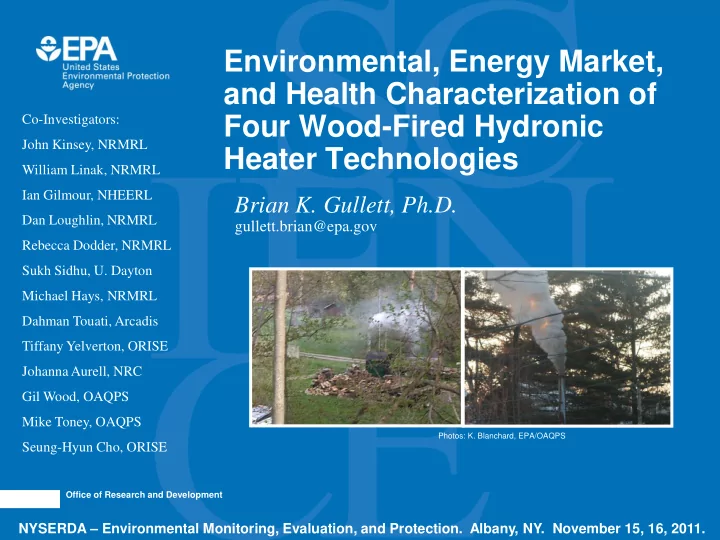
Environmental, Energy Market, and Health Characterization of Four Wood-Fired Hydronic Heater Technologies

Co-Investigators: John Kinsey, NRMRL William Linak, NRMRL Ian Gilmour, NHEERL Dan Loughlin, NRMRL Rebecca Dodder, NRMRL Sukh Sidhu, U. Dayton Michael Hays, NRMRL Dahman Touati, Arcadis Tiffany Yelverton, ORISE Johanna Aurell, NRC Gil Wood, OAQPS Mike Toney, OAQPS Seung-Hyun Cho, ORISE

Photos: K. Blanchard, EPA/OAQPS

slide-2
SLIDE 2

NYSERDA – Environmental Monitoring, Evaluation, and Protection. Albany, NY. November 15, 16, 2011. NYSERDA – Environmental Monitoring, Evaluation, and Protection. Albany, NY. November 15, 16, 2011. NY

Project Approach

  • Test four OWHHs

–Common, new, and multi-stage models –Fully characterize emissions, emission factors –4/5 Fuel types

  • Test under realistic, homeowner firing scenarios

–24 h, cordwood

  • Health risk characterization
  • Emission inventory projections for NY
  • MARKAL technology assessment

1

slide-3
SLIDE 3

NYSERDA – Environmental Monitoring, Evaluation, and Protection. Albany, NY. November 15, 16, 2011.

2

Conventional/Single Stage HH

Natural updraft, fan-assisted, single-stage combustion (250,000 BTU/h). Rectangular firebox surrounded by a high capacity water jacket. The gases are forced into a combustion chamber where additional super-heated air is added, increasing the gas

  • temperature. Load demand satisfied by regulation of an air damper.
slide-4
SLIDE 4

NYSERDA – Environmental Monitoring, Evaluation, and Protection. Albany, NY. November 15, 16, 2011.

Three Stage HH

3

Three-stage combustion process (160,000 BTU/h) in which wood is gasified in the primary combustion firebox. The hot gases are forced downward and mixed with super-heated air starting the secondary

  • combustion. Final combustion occurs in a third, high temperature

reaction chamber. Like the Conventional/Single Stage HH, this Three Stage HH is regulated by the opening and closing of a temperature controlled air damper.

slide-5
SLIDE 5

NYSERDA – Environmental Monitoring, Evaluation, and Protection. Albany, NY. November 15, 16, 2011.

4

European Two-Stage Pellet Boiler

This unit is a pellet burning HH rated at 40 kW (137,000 Btu/hour). Combustion occurs

  • n a round burner plate where

primary air is supplied. Secondary air is introduced through a ring above the burner plate. Fuel is automatically screw-conveyed from the bottom. Operation of the screw feeder is regulated by a thermostat. During normal

  • peration, the fan modulates

based on the measured

  • xygen level in the exhaust

gas, maintaining 8-10%

  • xygen
slide-6
SLIDE 6

NYSERDA – Environmental Monitoring, Evaluation, and Protection. Albany, NY. November 15, 16, 2011.

5

U.S. Two-Stage Downdraft Burner

A two-stage heater (150,000 BTU/h) with both gasification and combustion chambers. Air is added to the firebox continuously and is blown

  • downwards. A thermal

storage unit was simulated with the addition of a water/air heat exchanger.

slide-7
SLIDE 7

NYSERDA – Environmental Monitoring, Evaluation, and Protection. Albany, NY. November 15, 16, 2011.

Fuels

6

Properties Fuel Pine Red Oak Pellets Ash 0.44% 1.46% 0.52% Loss on Drying (LOD) 9.68% 22.52% 7.24% Volatile Matter 88.50% 84.23% 84.27% Fixed Carbon 11.06% 14.31% 14.11% C: Carbon 51.72% 48.70% 50.10% Cl: Chlorine 36 ppm 38 ppm 44 ppm H: Hydrogen 6.57% 5.96% 5.86% N: Nitrogen <0.5% <0.5% <0.5% S: Sulfur <0.05% <0.05% <0.5%

slide-8
SLIDE 8

NYSERDA – Environmental Monitoring, Evaluation, and Protection. Albany, NY. November 15, 16, 2011.

7

HH Sampling and Analytical Methods

Pollutant Method(s) Duration Total PM ASTM 2515M5G Integrated run PM mass and size Dilution + TEOM, ASTM 2515 for tot for total mass and ELPI for size distributions, ELPI or SMPS Real time & size distribution CO NDIR Method 10B Real time CO2 NDIR Method 3A Real time O2 Paramagnetic Method 3A Real time EC/OC NIOSH 5040 Integrated run PAHs, SVOCs Method 0010, GC/MS Integrated run GaseousVOCs Summa canister, TO15 Integrated run Aromatics REMPI-TOFMS Real time PCDD/F Method 23 Integrated run THC FID Method 25A Real time CH4 FID with reduction catalyst Real time N2O GC Integrated run

slide-9
SLIDE 9

NYSERDA – Environmental Monitoring, Evaluation, and Protection. Albany, NY. November 15, 16, 2011.

8

HH test facility

QStack

Heat exchanger Hot water recirculation loop Chilled water Hot water to building

Internal sampling platform

Building wall

8” OD stack 10” Stainless duct

To inhalation chambers

Indoor sampling duct

CEM Flow Measurements Particulate Measurements CEM M-23 ELPI/TEOM PAHS Volatiles EC/OC REMIPI/TOFMS ATOFMS

Air pollution system

Qinput Qoutput

External sampling platform

Qother losses

Hot water recirculation loop Hot water recirculation loop

Primary dilution Secondary dilution

slide-10
SLIDE 10

NYSERDA – Environmental Monitoring, Evaluation, and Protection. Albany, NY. November 15, 16, 2011.

9

Appliance Heat Load Profile

  • The heat load profile used throughout the testing program (non-

exposure tests) was derived from Tom Butcher’s Energy-10 simulation for a 2500 sq-ft area home in Syracuse, New York.

  • This heat load profile was calculated using an average hour per

hour heat load for the first two weeks of January.

  • 200

200 400 600 800 1000 1200 1400 1600 20000 22000 24000 26000 28000 30000 32000 34000 36000 38000 40000 42000

Output Heat Load (BTU/Hour)

Cumulative Time (min)

Simulated Cycle Syracuse Heat Load Cycle

slide-11
SLIDE 11

NYSERDA – Environmental Monitoring, Evaluation, and Protection. Albany, NY. November 15, 16, 2011. NYSERDA – Environmental Monitoring, Evaluation, and Protection. Albany, NY. November 15, 16, 2011. NY

10

CO and CO2 Emissions as a function of Syracuse Heat Load Demand, 24 h test Conventional/Single Stage HH, Red Oak

Damper Close = Open Damper Open = Gray Green = CO2 Blue = CO

20000 24000 28000 32000 36000 40000 4 8 12 16 20

200 400 600 800 1000 1200 1400

Damper Open/Close Sequence

Conitinuous Burn Time (min)

Heat Load Demand (BTU/hr) CO and CO2 Concentration (%)

The emission profiles are ~ independent of the heat

  • load. Rather they appear

to be primarily related to the fuel charging cycle under our conditions.

2nd Charge

1st Charge

slide-12
SLIDE 12

NYSERDA – Environmental Monitoring, Evaluation, and Protection. Albany, NY. November 15, 16, 2011.

Heat Release Rate

Representative Run

11

4 8 12 16 20 24 200000 400000 600000 800000 1000000 20 40 60 80 100 120 140 160 180 200

Heat Release Rate

Heat Release rate (BTU/hr) Run Time (Hours)

Outlet Water Temperature Inlet Water Temperature

Heater Inlet/Outlet Temperature (

  • F)

Conventional/Single Stage HH, Red Oak Heat release during damper openings

slide-13
SLIDE 13

NYSERDA – Environmental Monitoring, Evaluation, and Protection. Albany, NY. November 15, 16, 2011.

Heat Release Rate

Representative Run

12 1 2 3 4 5 6

0.0 2.0x10

4

4.0x10

4

6.0x10

4

8.0x10

4

1.0x10

5

1.2x10

5

1.4x10

5

1.6x10

5

1.8x10

5

2.0x10

5

2.2x10

5

2.4x10

5

20 40 60 80 100 120 140 160 180 200

Heat Release Rate

Heat Release rate (BTU/hr) Run Time (hr)

Outlet Water Temperature Inlet Water Temperature High Heater Temperature Set Point Low Heater Temperature Set Point

Heater Outlet Water Temperature (

οF)

European 2-Stage Pellet Burner

slide-14
SLIDE 14

NYSERDA – Environmental Monitoring, Evaluation, and Protection. Albany, NY. November 15, 16, 2011.

Heat Release Rate

Representative Run

13

0.0 0.5 1.0 1.5 2.0 2.5 3.0 3.5 4.0 100000 200000 300000 400000 500000 600000 20 40 60 80 100 120 140 160 180 200 220

Heat Release Rate

Heat Release Rate (BTU/hr) Run Time (Hours)

Outlet Water Temperature Set Point Temperature

Water temperature (

  • F)

U.S. 2-Stage Downdraft Burner with Thermal Storage Unit with simulated heat storage has non-cyclical heat release.

slide-15
SLIDE 15

NYSERDA – Environmental Monitoring, Evaluation, and Protection. Albany, NY. November 15, 16, 2011.

Efficiencies

14

Units Thermal Efficiency (%) Boiler Efficiency Combustion Efficiency

Conventional/Single Stage HH/Red Oak Average 22 NC 74 STDV 5 3.0 Conventional/Single Stage HH/Red Oak and refuse Average 31 NC 87 STDV 2.2 3.4 Conventional/Single Stage HH/White Pine Average 29 NC 82 STDV 1.8 3.2 Three Stage HH/Red Oak Average 30 NC 86 STDV 3.2 1.8 European 2-Stage Pellet Burner Average 44 86 98 STDV 4.1 3.5 0.16 U.S. 2-Stage Downdraft Burner Red Oak Average IM 83 90 STDV 0.71 0.79

NC = Not calculated. IM = Insufficient measurements taken for this calculation

slide-16
SLIDE 16

NYSERDA – Environmental Monitoring, Evaluation, and Protection. Albany, NY. November 15, 16, 2011.

Mass of Fuel Needed for a 24 Hour Syracuse Heat Load

15

C

  • n

v e n t i

  • n

a l H H R O C

  • n

v e n t i

  • n

a l H H W P T h r e e S t a g e H H R O E u r

  • p

e a n P e l l e t U S D

  • w

n D r a f t

50 100 150 200 250 300 350 400 450

Mass of Fuel Needed for the 24-h Syracuse Heat Load (lbs)

Hydronic Heater Unit and Fuel Type

slide-17
SLIDE 17

NYSERDA – Environmental Monitoring, Evaluation, and Protection. Albany, NY. November 15, 16, 2011.

CO Stack Concentration as a Function of Damper Opening and Time of Fuel Charging, Conventional/Single Stage HH.

16

3 6 9 12 15 18 21 24 1x10

4

2x10

4

3x10

4

4x10

4

5x10

4

6x10

4

7x10

4

8x10

4

Run Time (hr)

Damper Open 2

nd charge

CO Emissions at the Stack (ppmv)

Emissions are primarily related to time-since- charging rather than heat load demand.

1st Charge

slide-18
SLIDE 18

NYSERDA – Environmental Monitoring, Evaluation, and Protection. Albany, NY. November 15, 16, 2011.

Carbon Monoxide Emission Factors

17 Conventional HH RO Conventional HH WP Conventional HH RO + Ref Three Stage HH RO European Pellet US DownDraft 5 10 15 20 25 30

Heat Input

Hydronic Heater Unit and Fuel Type

20 40 60 80 100 120

Carbon Monoxide Emission Factor (lb/10

6BTU)

Heat Output

NA

slide-19
SLIDE 19

NYSERDA – Environmental Monitoring, Evaluation, and Protection. Albany, NY. November 15, 16, 2011.

PM Generated per Syracuse Day for All Six Unit/Fuel Combinations

18 Conventional HH RO Conventional HH WP Conventional HH RO + Ref Three Stage HH RO European Pellet US DownDraft RO

2 4 6 8 10 12 14 16 Total PM Emitted per Daily Syracuse Heat Load demand (lbs)

Hydronic Heater Unit and Fuel Type

slide-20
SLIDE 20

NYSERDA – Environmental Monitoring, Evaluation, and Protection. Albany, NY. November 15, 16, 2011.

PM Emission Factors

19 Conventional HH RO Conventional HH WP Conventional HH RO + Ref Three Stage HH RO European Pellet US DownDraft RO 1 2 3 4 5 6

Heat Input

Hydronic Heater Unit and Fuel Type

4 8 12 16 20

Total PM Emission Factor (lb/10

6BTU)

Heat Output

NA

slide-21
SLIDE 21

NYSERDA – Environmental Monitoring, Evaluation, and Protection. Albany, NY. November 15, 16, 2011.

20

  • PM. Comparison of Current Data to

EPA Method 28 OWHH

This project Others’ work, EPA Method 28

Conventio nal HH RO Three Stage HH European 2-Stage Pellet U.S. 2- Stage Downdraft Other Conventio nal HH Multistage HH

Large variation in PM emissions from different technologies

slide-22
SLIDE 22

NYSERDA – Environmental Monitoring, Evaluation, and Protection. Albany, NY. November 15, 16, 2011.

OC/EC Emission Factors

21

Significant organic carbon contribution with emission factor a function of technology type.

Conventional HH RO Conventional HH W P Conventional HH RO + Ref Three Stage HH RO European Pellet US DownDraft RO 10 20 30 40 50

OC, EC and Inorganic PM EMission Factors (g/kgFuel dry) Hydronic Heater Unit and Fuel Type

Organic Carbon Inorganic Carbon Inorganic PM

slide-23
SLIDE 23

NYSERDA – Environmental Monitoring, Evaluation, and Protection. Albany, NY. November 15, 16, 2011.

Total PAH Emission Factors

22

Higher PAHs from White Pine

slide-24
SLIDE 24

NYSERDA – Environmental Monitoring, Evaluation, and Protection. Albany, NY. November 15, 16, 2011.

PCDD/PCDF (Dioxin)

23

Fuel and technology-induced variations in Dioxin emissions.

slide-25
SLIDE 25

NYSERDA – Environmental Monitoring, Evaluation, and Protection. Albany, NY. November 15, 16, 2011.

Market for Residential Space Heating for “Baseline” Optimization Scenario

24 100 200 300 400 500 600 700 800 900 1000 2005 2010 2015 2020 2025 2030 PJ useful energy

Conventional HH Newer Wood Stoves Existing Wood Stoves Electricity Natural Gas Liquified Petroleum Gas Kerosene Heating Oil

In the Mid-Atlantic region (including New York, New Jersey, and Pennsylvania),

  • ptimization based solely on costs and technology efficiency predicts that

wood heat is likely to remain a relatively small market share of total residential space heating demands.

slide-26
SLIDE 26

NYSERDA – Environmental Monitoring, Evaluation, and Protection. Albany, NY. November 15, 16, 2011.

10 20 30 40 50 60 70 80 90 2005 2010 2015 2020 2025 2030 Emissions (ktonne/yr) Conventional OWHH Newer Wood Stoves Existing Wood Stoves Electricity Natural Gas LPG Kerosene Heating Oil

PM Emissions for Total Residential Energy Use for “Baseline” Optimization Scenario

25

In the scenarios analyzed, wood heat units had a limited impact on the broader market for residential fuels and electricity However, wood heat emissions dominated the total PM emissions from total residential energy usage over all scenarios

slide-27
SLIDE 27

NYSERDA – Environmental Monitoring, Evaluation, and Protection. Albany, NY. November 15, 16, 2011.

Total Residential PM Emissions “Baseline” and Four Alternative Scenarios

26

The evolution of the technology mix within the market for wood heat will have a major impact on both residential PM emissions and, consequently, total PM emissions. Depending on the rate of changeover from less efficient, higher emitting units and emissions performance of newer units, residential PM emissions could increase substantially, peaking in the next 5-10 years, or drop by nearly half.

slide-28
SLIDE 28

NYSERDA – Environmental Monitoring, Evaluation, and Protection. November 15, 16, 2011.

0.0 0.1 0.2 0.3 0.4 0.5 0.6 0.7 0.8 0.9 1.0 25 50 75 100 125 150 175 200 225 250 275 300 Advanced HH thermal efficiency target Price of Wood ($/cord)

wood price (stacked, aged, delivered) advanced OWHH efficiency lower NPV cost than a high efficiency indoor boiler with hot water storage Alb

Comparative Technology Costs

27

* At typical HH efficiencies and co wood prices, an HH has a higher lifetime cost than competing technologies * Fuel price and device efficiency are the primary components of heating costs, not the capital cost equipment

any

*

, T NY

h

. e low efficiency of HHs

contributes to their high relative lifetime cost * A free or very low cost wood supply can tilt the lifetime cost balance in favor of HHs * Under these conditions, HHs ar considerably more expensive tha high efficiency indoor boilers with hot water storage, however rd

  • f

e n

slide-29
SLIDE 29

NYSERDA – Environmental Monitoring, Evaluation, and Protection. Albany, NY. November 15, 16, 2011. NYSERDA – Environmental Monitoring, Evaluation, and Protection. Albany, NY. November 15, 16, 2011. NY

28

Emission Conclusions

  • In general, over a 20-fold variation in emissions was
  • bserved between these four technologies.
  • Thermal efficiencies (heat delivered/heat input) varied

by 2-fold, depending on technology.

  • Emissions are highly cyclic for the units that respond to

heat demand with damper openings.

  • For these same units, nuisance odor was significant

despite use of the building’s air cleaning system.

  • The magnitude of emissions depend on the amount of

time passage after charging the appliance with fuel rather than on the heat load.

slide-30
SLIDE 30

NYSERDA – Environmental Monitoring, Evaluation, and Protection. Albany, NY. November 15, 16, 2011. NYSERDA – Environmental Monitoring, Evaluation, and Protection. Albany, NY. November 15, 16, 2011. NY

29

Emission Conclusions

  • White pine had the highest total PM and PAH mass

emissions.

  • The identified and quantified SVOCs account for 9%

w/w of the PM emitted, of which ~25% was levoglucosan

  • CH4 is about 10% of the THC emissions.
  • CO concentrations on the order of 1-8% were observed

This research was funded by the New York State Energy Research and Development Authority (NYSERDA) with additional support provided by the U.S. Environmental Protection Agency (EPA), Office of Research and Development, through a Cooperative Agreement, CR05058. This report was prepared in the course of performing work sponsored by the New York State Energy Research and Development Authority and the U.S. Environmental Protection Agency’s Office of Research and Development. The opinions expressed in this report do not necessarily reflect those of NYSERDA or the State of New York, and reference to any specific product, service, process, or method does not constitute an implied or expressed recommendation or endorsement of it. Further, NYSERDA and the State of New York make no warranties or representations, expressed or implied, as to the fitness for particular purpose or merchantability

  • f any product, apparatus, or service, or the usefulness, completeness, or accuracy of any processes, methods, or other information contained, described,

disclosed, or referred to in this report. NYSERDA and the State of New York make no representation that the use of any product, apparatus, process, method, or other information will not infringe privately owned rights and will assume no liability for any loss, injury, or damage resulting from, or occurring in connection with, the use of information contained, described, disclosed, or referred to in this report.
slide-31
SLIDE 31

NYSERDA – Environmental Monitoring, Evaluation, and Protection. Albany, NY. November 15, 16, 2011. NYSERDA – Environmental Monitoring, Evaluation, and Protection. Albany, NY. November 15, 16, 2011. NY

30

Acknowledgements

  • NYSERDA: Ellen Burkhard, Nathan Russell
  • Members of the PAC for their comments
  • Final Report reviewers
  • Heater suppliers