ENVIRONMENTAL EFFECTS OF GATED SURGE BARRIERS H. L. Carey Tunnel - - PowerPoint PPT Presentation

environmental effects
SMART_READER_LITE
LIVE PREVIEW

ENVIRONMENTAL EFFECTS OF GATED SURGE BARRIERS H. L. Carey Tunnel - - PowerPoint PPT Presentation

NEW YORK NEW JERSEY HARBOR AND TRIBUTARIES STUDY (HATS): EVALUATION OF ENVIRONMENTAL EFFECTS OF GATED SURGE BARRIERS H. L. Carey Tunnel between Manhattan and Brooklyn flooded during Hurricane Sandy, October 2012 S. Kyle McKay, Ph.D.,


slide-1
SLIDE 1

NEW YORK – NEW JERSEY HARBOR AND TRIBUTARIES STUDY (HATS): EVALUATION OF ENVIRONMENTAL EFFECTS OF GATED SURGE BARRIERS

  • S. Kyle McKay, Ph.D., P.E.

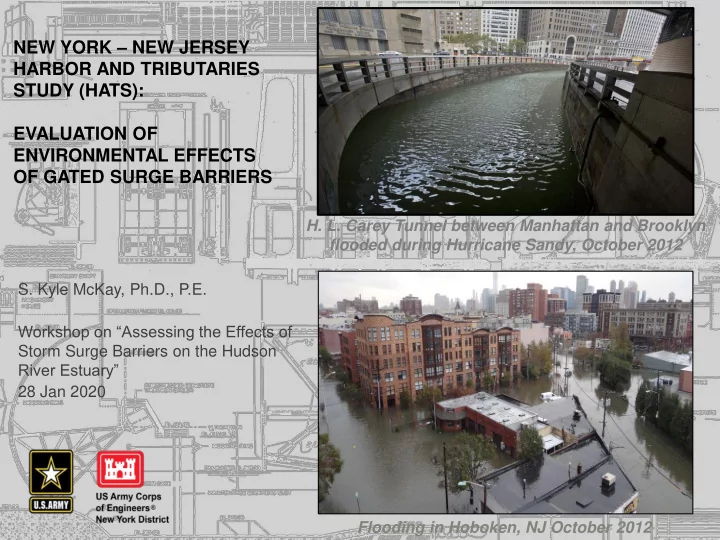
Workshop on “Assessing the Effects of Storm Surge Barriers on the Hudson River Estuary” 28 Jan 2020 Flooding in Hoboken, NJ October 2012

  • H. L. Carey Tunnel between Manhattan and Brooklyn

flooded during Hurricane Sandy, October 2012

slide-2
SLIDE 2

REGIONAL FLOOD RISK MANAGEMENT STUDIES

2

slide-3
SLIDE 3

NEW JERSEY BACK BAYS (NJBB)

  • Coastal New Jersey is big!
  • 936 square miles, 3,398 miles shoreline, 247,692 structures
  • Subdivided into five regions based on problems,
  • pportunities, and hydrologic connectivity
  • Multiple families of alternatives considered in each region
  • Non-structural actions, Storm surge barriers, Perimeter plans,

Natural and nature-based features

  • Multiple “cycles of planning”
  • Cycle 0 qualitatively "screened out" perimeter measures that had

zero damageable structures. No cost, no benefits.

  • Cycle 1 quantitatively analyzed all perimeter measures (0% design).
  • Cycle 2 (Dec 2018) quantitative analysis of economically viability.

– Alternatives reduced from 50 to 20 – Level of design = 5% (with cost update) – Screening out 7 storm surge barriers and 3 perimeter plans

  • Cycle 3 (Jan 2020) quantitative incremental justification of sites.

– Alternatives: 20 to ~8 (and soon a “Tentatively Selected Plan”) – Level of design = 15% (with cost update) – Screening out additional surge barriers and perimeter plans

3

slide-4
SLIDE 4

HYDRODYNAMIC MODELING OF STORM SURGE BARRIER INDIRECT IMPACTS

  • ERDC-CHL developed Adaptive

Hydraulics (AdH) model to inform evaluation of indirect impacts of storm surge barriers

  • Present analyses: tides, velocities, salinity, and

residence time

  • Future analyses: navigation, sediment transport,

water quality

  • Calibrated to 2019 ADCP field data at 3

inlets and long-term tide/salinity stations

  • Investigate sensitivity to storm surge

barrier design:

  • Alignment, sill elevation, sector gate size, number
  • f vertical lift gates,…

4

Existing Conditions A1-Design B1-Design A3-Design

Figures: Preliminary AdH Velocities at Barnegat Inlet

slide-5
SLIDE 5

NJBB STUDY MILESTONES

SCOPING

ALTERNATIVES FORMULATION

DRAFT REPORT RECOMMEND PLAN FINAL REPORT ALTERNATIVES FORMULATION Identify Problems & Opportunities Identify Tentatively Selected Plan Get Public Input Public Review & Comment Complete Final Analysis Identify Recommended Plan Provide Recommendation to Congress

Alternative Measures Milestone Dec 2016 Tentatively Selected Plan January 2020 Agency Decision Milestone January 2021 Chief’s Report April 2022

Upcoming Public Meetings April 2020

Release Report March 2020

Conduct Analysis

slide-6
SLIDE 6

ENVIRONMENTAL IMPACT ASSESSMENT

6

slide-7
SLIDE 7

Multiple laws, executive orders and regulations are considered as part of the NEPA process.

  • National Historic Preservation Act, as amended

Preserves historic and archaeological sites

  • Clean Water Act

Prevents water pollution

  • Endangered Species Act

Protects plants and animals from extinction

  • Clean Air Act

Prevents air pollution

  • Environmental Justice

Addressing equity in adverse and beneficial environmental effects

  • State laws

7

NATIONAL ENVIRONMENTAL POLICY ACT (NEPA)

Atlantic Sturgeon. Piping Plover.

slide-8
SLIDE 8

8

TYPES OF NEPA ANALYSIS

  • Categorical Exclusion
  • Environmental Assessment (EA)
  • Environmental Impact Statement (EIS)
  • Tiered Environmental Impact

Statement (EIS)

Level of Analysis & Number

  • f

Reviews

Least Most

slide-9
SLIDE 9

9

ENVIRONMENTAL CONSIDERATIONS

Regional Ecosystems

Air Quality Water Quality Navigation Cultural Resources Occupational Safety and Health Special Status Species HTRW Sites Community Uses

slide-10
SLIDE 10

COMPARING DISSIMILAR OUTCOMES ON A CONSISTENT SCALE

10

DRAFT CONCEPTUAL EXERCISE

Impact Rating Description 5 - High Impacts to the resource would have substantial consequences, locally and/or regionally, to the resource. Impacts would exceed regulatory standards. Mitigation measures to offset the adverse effects would not be enough to reduce impacts and therefore, impacts to the resource would not be environmentally acceptable. 4 - Moderate to High Impacts to the resource would be locally and/or regionally

  • significant. Impacts would be within regulatory standards;

however, existing resource conditions are expected to be affected in the near-term, but not necessarily in the long term. Mitigation measures to reduce any potential adverse impacts would be necessary. 3 - Moderate Impacts to the resource are expected to be moderate in the near- term and localized. Impacts would be within or below regulatory standards, as applicable, and the use of mitigation measures would reduce potential adverse impacts, if applicable. 2 - Low Impacts to the resource would either be negligible or, if detectable, have minor temporary impacts locally to the resource. The impacts would be well below regulatory standards, as applicable, and mitigation measures may be implemented to sustain low to no impact to the resource. 1 - No Impact The resource would have no impacts because the resource would not be affected.

slide-11
SLIDE 11

WHAT WOULD THIS LOOK LIKE IN PRACTICE?

11

1: No Action 2: Sandy Hook to Breezy Point Barrier 3A: Regional barriers 3B: Mid-size barriers 4: Small barriers 5: Perimeter only solutions Physical Resources 1 1 4 2 3 3 Hydrological Processes 1 4 1 3 4 1 Water Quality 1 4 1 2 4 4 Air Quality 1 4 5 5 2 1 Regional Climate 1 2 5 4 4 2 Regional Ecosystems 1 5 3 4 3 3 Regional Ecological Resources 1 1 4 1 5 4 Special Status Species 1 5 3 3 5 2 Protected Areas 1 1 4 4 5 5 Cultural Resources 1 1 5 1 1 5 Hazardous, Toxic and Radioactive Waste 1 1 4 3 3 1 Infrastructure 1 4 1 5 3 3 Navigation 1 4 1 4 5 4 Communities 1 1 3 4 2 4 Occupational Safety and Health 1 3 4 2 1 3 Alternatives All values are random numbers for demonstration purposes. RESOURCE CATEGORIES

1: No Action 2: Sandy Hook to Breezy Point Barrier 3A: Regional barriers 3B: Mid-size barriers 4: Small barriers 5: Perimeter only solutions Hydrological Processes 1 3 4 5 1 5 Hydrology (inland) 1 4 1 2 4 4 Hydrology (coastal) 1 3 4 1 1 3 Currents and velocities 1 2 4 2 3 5 Circulation 1 1 5 4 1 3 Tidal range 1 1 1 4 3 4 Tidal exchange 1 5 5 4 1 3 RESOURCE CATEGORIES Alternatives All values are random numbers for demonstration purposes. 1: No Action 2: Sandy Hook to Breezy Point Barrier 3A: Regional barriers 3B: Mid-size barriers 4: Small barriers 5: Perimeter only solutions Regional Ecosystems 1 5 1 1 1 4 Marine, deepwater 1 1 1 2 4 2 Marine, subtidal 1 3 3 3 5 4 Marine, intertidal 1 3 5 3 4 3 Estuarine, subtidal 1 2 5 5 4 3 Estuarine, intertidal 1 2 1 4 3 3 Tidal fresh 1 5 1 2 3 5 Systemwide connectivity 1 4 1 5 5 1 RESOURCE CATEGORIES Alternatives All values are random numbers for demonstration purposes.

Hydrodynamic Models (AdH) Habitat Models (NYBEM)

slide-12
SLIDE 12

DEVELOPING A NEW YORK BIGHT ECOLOGICAL MODEL (NYBEM)

12

slide-13
SLIDE 13

WHAT WE’RE WORKING TOWARD

13

ALL VALUES ARE FICTIONAL AND PURELY REPRESENTATIVE OF THE TYPES OF POTENTIAL ANALYTICAL OUTCOMES

slide-14
SLIDE 14

NEW YORK BIGHT ECOSYSTEM

14

slide-15
SLIDE 15

EXAMPLE OF PATCH-SCALE MODELS: MARINE, DEEPWATER ECOSYSTEM

Conceptual Model

“How the system works”

Quantitative Model

(“Suitability Index”)

Model Application

(parameterized with hydro models and available data)

slide-16
SLIDE 16

SYSTEMS-SCALE MODEL FOR ORGANISMAL CONNECTIVITY

16

Ecological Reserve Design

(Liu et al. 2015, Ecological Modeling)

Oyster Larval Transport

(Kjelland et al. 2015, Ecological Modeling)

Fish Passage Prioritization

(McKay et al. 2017, Ecological Modeling)

Adopt a network-based approach from a long history of ecological applications

  • Network topology
  • Habitat patches &

home range

  • “Passage” rate

between patches Passage Rate Assessment

  • Professional judgment
  • “Rules” (e.g., velocity < 2 ft/s)
  • Statistical models
  • Agent-based models

Guilding focal taxa

  • Marine mammals (e.g., whales)
  • Andromous, pelagic fish (e.g., herring)
  • Anadromous, benthic fish (e.g., sturgeon)
  • Drifting organisms (e.g., larvae)
  • Others?
slide-17
SLIDE 17

PHASED MODEL DEVELOPMENT: SHARPENING THE PENCIL OVER TIME

17

Interim Report (to date) Winter 2020 Draft Report (Phase 1 Model) Winter 2021 Final Report (Phase 2 Model) Scope of environmental impacts Direct / footprint Direct / footprint Indirect / offsite Change / switching Direct / footprint (refined) Indirect / offsite (refined) Change / switching (refined) Cumulative impact across studies Extent of environmental effects Project footprint Footprint for alternatives + Range of offsite impacts (by ecosystem type) Footprint for alternatives + Range of offsite impacts (by ecosystem type and quality) + Actual mitigation requirements Potential Inputs Footprint Footprint + Tidal Range + Salinity + Hydro + Habitat Maps Footprint + Tidal Range + Salinity + Hydro + Habitat Maps + Sediment+ Temperature + Waves + Water Quality + Other Time window Snapshot One-year of tidal forcing Multiple sea levels 50 year planning horizon Multiple years of tidal forcing Multiple sea level rise scenarios 50+ year planning horizon

slide-18
SLIDE 18

NYBEM DEVELOPMENT PROCESS

A series of workshops to iteratively develop models with research and synthesis between meetings.

  • Preliminary workshop with Philadelphia District (Jan 2019)
  • USACE workshop with two Districts (Mar 2019)
  • Interagency conceptual modeling workshop (Jun 2019)
  • Interagency numerical modeling update (Nov 2019)
  • Phase-1 Model application to NJBB (Jan/Feb 2019)
  • Phase-1 Model application to HATS (Mar/Apr 2020)
  • Phase-1 Ecological model documentation (Mar 2019)
  • USACE model certification (i.e., external review)
  • Phase-2 development and application (TBD)

18

Ecological Model Development Process

(Herman, McKay, et al. 2019)

slide-19
SLIDE 19

EXECUTING NUMERICAL MODELS

19

Model Parameterization:

Adaptive Hydraulics (AdH) MARCO Data Portal Other GIS Data

R Statistical Software:

EcoRest Package (beta) Geospatial functionality Watershed connectivity tools

Rmarkdown Documentation:

Real-time report assembly NJBB / HATS outputs USACE model certification

Model Structure:

Workshop-based synthesis Literature review Analysis of existing data

slide-20
SLIDE 20

ADDITIONAL STUDY NEEDS (KYLE’S THOUGHTS ONLY)

Near-term

Connectivity-related

  • What is the seasonal pattern of

taxa presence / absence?

  • How does each taxa respond to

alternative infrastructure design parameters (e.g., cross-sectional area, width, velocity)?

  • How would operational duration

and timing alter movement rates? Habitat-related

  • What drives critical thresholds in

regional habitat switching?

  • How well does NYBEM perform at

predicting habitat distributions?

  • How do tidal ecosystems respond

to different rates of sea level rise?

20

Long-term

Connectivity-related

  • How do changes in habitat or connectivity lead to

population decline or increase (e.g., thresholds in processes)?

  • What is the rate-of-change of population recovery

times? How do recovery rates relate to potential barrier

  • perational patterns?
  • What is the relationship between migration patterns and

the influence of storms (e.g., avoidance vs. attraction)? Habitat-related

  • Is existing habitat degradation a limiting factor with or

without the influence of HATS?

  • How do sequential events influence trajectories of

ecosystem outcomes?