Environmental DNA (eDNA) A Revolutionary Sampling Technique for - - PowerPoint PPT Presentation

environmental dna edna
SMART_READER_LITE
LIVE PREVIEW

Environmental DNA (eDNA) A Revolutionary Sampling Technique for - - PowerPoint PPT Presentation

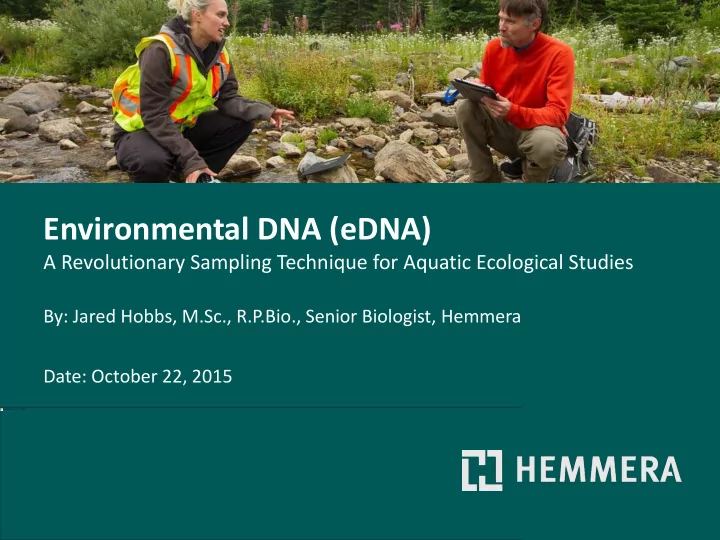
Environmental DNA (eDNA) A Revolutionary Sampling Technique for Aquatic Ecological Studies By: Jared Hobbs, M.Sc., R.P.Bio., Senior Biologist, Hemmera Date: October 22, 2015 Outline What is eDNA Methodology Considerations

slide-1
SLIDE 1

Environmental DNA (eDNA)

A Revolutionary Sampling Technique for Aquatic Ecological Studies

By: Jared Hobbs, M.Sc., R.P.Bio., Senior Biologist, Hemmera Date: October 22, 2015

slide-2
SLIDE 2

000

Outline

  • What is eDNA
  • Methodology
  • Considerations (timing, feasibility)
  • Efficiencies and limitations
  • Current Applications
  • Hemmera – current projects and

experience

  • Potential Applications
slide-3
SLIDE 3

The Basics…

  • Deoxyribonucleic acid (DNA) molecules

carry an organism's genetic information.

  • Base pair sequences are unique between
  • rganisms: these differences provide a

unique way to identify species, populations and individuals.

  • With eDNA, the use of mitochondrial DNA

is preferred –it’s more abundant than nuclear DNA and Genbank has more sequence data.

slide-4
SLIDE 4

What is eDNA

  • Environmental DNA (eDNA)
  • Relies on the detection of naturally occurring genetic materials that

can be collected from the environment

  • gametes, dead skin cells, feathers, hair, feces, urine, egg plasma, saliva
slide-5
SLIDE 5

Primer and Probe Design

  • Primers need to incorporate the full

range of genetic variation for the target species to avoid false negatives

  • Primers need to incorporate the full

range of genetic variation for closely related, co-occurring species to avoid false positives. A good primer will contain an inclusive consensus sequence that incorporates all within-species variability for a species in a well-known sequence of DNA. Primers can be reviewed against sequences published in GenBank or against sequences obtained from tissue samples of target and co-occurring closely related species.

slide-6
SLIDE 6

How are eDNA inventories conducted?

slide-7
SLIDE 7

Four methods for field sampling have been developed to date:

  • 1. Collection of 15 mL of water which is

then preserved using ethanol and sodium acetate. Then frozen immediately

  • 2. Filter water through a glass fiber filter.
  • 3. Filter water through carbonate filter.
  • 4. Filter water through a cellulose nitrate

filter.

Option #4 allows off-site filtering and is the most practical method for field use.

Field Sampling Methodology – Step 1

slide-8
SLIDE 8
  • Unless filtering in the field samples must be stored, during prior to

filtration, in a refrigerator.

  • “Back at the camp” (or lab) eDNA is concentrated using filtration with a

peristaltic pump or a suction pump

  • Once filtration is complete, the filter paper can be frozen or

dehydrated in vials with molecular-grade ethanol*.

*Molecular grade ethanol is required and requires a permit to purchase – OTC ethanol will denature the DNA! **We’re exploring alternative methods for preservation

Field Filtering Methodology – Step 2

slide-9
SLIDE 9

Laboratory Requirements – Step 3

Hemmera works collaboratively with Dr. C. Goldberg – WSU; Caren played a lead role in the development of this new method.

  • eDNA extractions and qPCR setups should

be conducted in a PCR-free laboratory space where concentrated (such as from tissue) DNA samples have not been handled.

  • Thermocyclers and real-time PCR

machines should be located outside of this space.

slide-10
SLIDE 10

Eliminating Type 1 & Type 2 Errors

Like any field-based sampling, protocols must be followed:

  • replicate samples are required to estimate
  • ccupancy while accounting for uncertainty
  • Include known sites in study design to

measure efficacy.

  • Site sampling could include sites outside the

range, or habitat tolerances, of target taxa to test potential for false positives.

  • Distilled water can also be used (lab blind-

test) to control for contamination during both the filtering process AND during lab-testing.

  • Clean field procedures are required (different

requirements at different stages depending

  • n contamination risk)
slide-11
SLIDE 11

Eliminating Type 1 & Type 2 Errors

Primer development requires a comprehensive screening process to exclude sympatric and parapatric species

  • Type 1 error: false positive detection
  • Type 2 error: false negative detection

Target Taxa: Red-legged frog Sympatric Taxa: LICL, LICA, RAPR, PSRE

Eliminating Type 1 & Type 2 Errors

slide-12
SLIDE 12

Project & Survey Design Considerations

Consider sampling requirements to ensure conditions are appropriate for the system you're sampling…

slide-13
SLIDE 13

Project & Survey Design Considerations

Know the species’ life history

  • Is there a permanently aquatic life history phase…
  • …or does your target taxa tadpole mature in three days, or 6 years???
slide-14
SLIDE 14

What are the advantages of eDNA?

  • more cost effective
  • more accurate
  • less invasive
slide-15
SLIDE 15

 Useful for detection of inconspicuous species.

  • Detection is challenging, using

conventional methods, for cryptic species that occur in low densities, have discontinuous distributions or secretive life-histories (nocturnal, low observability).

  • eDNA facilitates early detection

and monitoring for species of management and/or regulatory concern.

eDNA: Key Strengths

slide-16
SLIDE 16

When to use eDNA: CBA

slide-17
SLIDE 17

When to use eDNA: CBA

Attribute Conventional Methods eDNA Efficacy Low-High High Multi-species No Yes Retro-active addition of taxa No Yes Adaptive design/testing No Yes Observer and detectability bias High Low Permitting required Yes No Invasiveness High Low Pathogen transfer risk High Low Timing Restrictive Less Restrictive Special equipment/training Medium-high Low Safety considerations Medium-high Low Abundance and proximity Yes (with appropriate design) No

CBA that neglects full consideration of each of these methodological attributes may be misleading.

slide-18
SLIDE 18

Limitations of eDNA

What eDNA can tell us today (Binary answer):

  • If the target taxa was present at the site during, or immediately prior to,

the time of sampling

What eDNA won’t tell us (yet?) (Abundance):

  • Target taxa abundance and density
  • Duration, frequency and temporal proximity of use
  • Precise physical proximity of target taxa ( hard to define transport

potential)

slide-19
SLIDE 19

Reporting Results

  • “Identifying sources of error or uncertainty is a critical process in any

study, especially for monitoring programs where results could influence future management decisions” (USGS. 2013)

  • “eDNA detectability and concentration depend on production rates of

individuals, environmental conditions, density of animals, and their residence time” (Pilliod et al. 2014).

Like any new or emerging science – perfection of methods and techniques is an evolving process based on adaptive feedback. Responsible reporting, clearly outlining limitations and describing assumptions, are required…but despite these caveats eDNA methods show great potential for inventory and monitoring aquatic species (USGS. 2014).

slide-20
SLIDE 20

Hemmera and eDNA as a service offering

Our experiences….and we’re just getting started!

slide-21
SLIDE 21

Hemmera: Current BC Projects

Rocky Mountain Tailed Frog Tiger Salamander Spadefoot Red-legged Frog Coastal Tailed Frog Pacific Water Shrew

slide-22
SLIDE 22

Hemmera: Current Yukon Projects

Western Toad Columbia Spotted Frog Chinook Salmon Bull Trout Ranavirus Bd

slide-23
SLIDE 23
  • In 2014 we authored an internal

eDNA protocol detailing collection procedures, primer development, sample transport and lab testing requirements.

  • In 2015 we developed a provincial

standard, for MOE, for application by

  • ther practioners in BC and beyond.
  • This standard is intended for

adoption as a RISC standard in BC.

Standard Operating Procedures

slide-24
SLIDE 24

Current Applications

  • Useful for early detection of invasive species.

“Some intensive eradication programs for invasive species fail when a few surviving individuals recolonize the ecosystem. eDNA methods may provide a means of confirming eradication of all invaders” (USGS 2012)

  • eDNA facilitates early detection and monitoring (Presence/Not-

detected) for management for:

  • Species of regulatory concern
  • Pathogens
  • Invasive species
slide-25
SLIDE 25

Future Expanded Application

  • Inventory for an increasing number of S@Risk
  • Assess effectiveness of restoration programs
  • Support environmental assessment processes
  • Assess effectiveness of control programs for invasive

species

  • Develop monitoring programs for management

purposes (relative abundance estimates of multiple sites on a temporal scale) Hemmera is the first to apply eDNA in a commercial (non- academic) setting in western Canada, we’re excited by its potential to:

slide-26
SLIDE 26

Contact Us

Jared Hobbs

Hemmera 1221 Broad Street Suite 303 Victoria, BC V8W 2A4

Thank you. Questions?

slide-27
SLIDE 27

Existing Primers

Common name Scientific name

Amphibians Rocky mountain tailed frog Ascaphus montanus Northern red-legged frog* Rana aurora Great Basin Spadefoot* Spea intermontana Tiger salamander* Ambystoma mavortium Columbia spotted frog Rana luteiventris Northern leopard frog Lithobates pipiens Western toad Anaxyrus boreas Coastal giant salamander Dicamptodon tenebrous Oregon spotted frog Rana pretiosa Cascades frog Rana cascadia Long-toed salamander Ambystoma macrodactylum Fishes Chinook salmon Oncorhynchus tshawytscha Lake trout Salvelinus namaycush Bull trout Salvelinus confluentus Brook trout Salvelinus fontinalis Mammals Pacific Water Shrew* Sorex benderii

* Hemmera developed and maintains IP.

slide-28
SLIDE 28

Requested Primers

Common name Scientific name

Fishes Dolly Varden Salvelinus malma Least Cisco Coregonus sardinella Pygmy whitefish Prosopium coulterii Arctic grayling Thymallus arcticus Aquatic Invasives of Concern Didymo Didymosphenia geminata Zebra (dreissenid) mussels Dreissenidae New Zealand Mud Snail Potamopyrgus antipodarum Water Weeds Elodea spp. Eurasian Milfoil Myriophyllum spicatum VHSV Viral hemorrhagic septicemia virus Myxosporean parasite Myxobolus cerebralis Fanwort Cabomba sp Spiny Water Flea Bythotrephes longimanus Goldfish Carassius auratus auratus Rainbow Trout Oncorhynchus mykiss Arctic Char Salvelinus alpinus Threespine Stickleback Gasterosteus aculeatus Silver Carp Hypophthalmichthys molitrix Northern Snakehead Channa argus Rusty Crayfish Orconectes rusticus Invertebrates Rocky Mountain Ridged Mussel Gonidea angulata