Environmental Analysis & Decision-Making Region 6 Roundtable - - PowerPoint PPT Presentation

environmental analysis decision making region 6 roundtable
SMART_READER_LITE
LIVE PREVIEW

Environmental Analysis & Decision-Making Region 6 Roundtable - - PowerPoint PPT Presentation

Environmental Analysis & Decision-Making Region 6 Roundtable February 22-23, 2018 Portland, OR Abbreviated Agenda: 10:00 a.m. Welcome and Meeting Overview 10:20 a.m. National Overview and Introduction of EADM Effort Chris French


slide-1
SLIDE 1

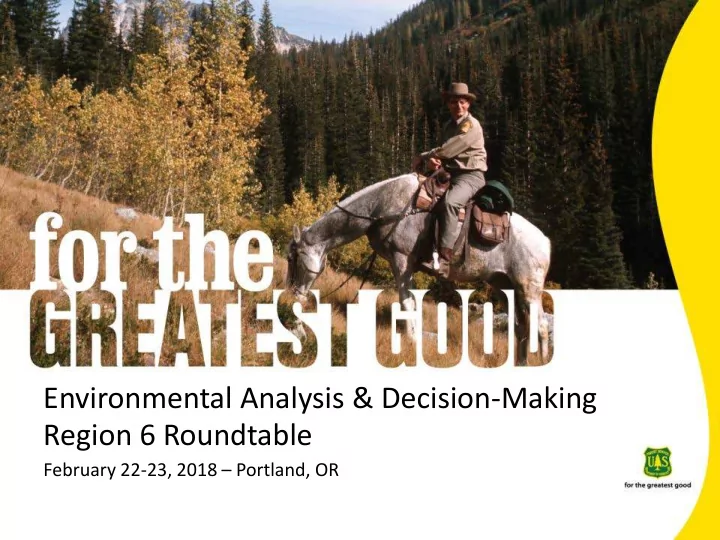
Environmental Analysis & Decision-Making Region 6 Roundtable

February 22-23, 2018 – Portland, OR
slide-2
SLIDE 2

Abbreviated Agenda:

10:00 a.m. Welcome and Meeting Overview 10:20 a.m. National Overview and Introduction of EADM Effort – Chris French 11:05 a.m. Regional Overview and Perspectives on EADM Effort 12:15 p.m. Lunch on your own 1:30 p.m. Small group reflections and sharing 2:30 p.m. Break 2:45 p.m. Break-out Session #1 4:15 p.m. Summarize and Closeout for the Day 4:45 pm. Adjourn

slide-3
SLIDE 3

Region 6 EADM Cadre Members:

  • Julia Riber - Regional Office, Director
  • Julie Knutson - Regional Office, Environmental Coordinator
  • Christy Merritt - Regional Office, Environmental Coordinator
  • James Capurso - Regional Office, Fisheries Biologist
  • Jane Beaulieu - Umpqua NF, Environmental Coordinator
  • Joe Rausch - Malheur NF, Forest Botanist
  • Kris Stein - Wallowa-Whitman NF, District Ranger
  • Kristen McBride - Deschutes NF, Staff Officer
  • Mike Williams - Okanogan-Wenatchee NF, Forest Supervisor
  • Steve Beverlin - Malheur NF, Forest Supervisor
  • Steve Gibson - Ochoco NF, Range Program
  • Yewah Lau - Olympic NF, District Ranger
  • Ben Goodin - Fremont-Winema NF, Range Program
  • Clint Emerson - Rogue River-Siskiyou NF, Botanist
slide-4
SLIDE 4

Talk to your ur N Neighbors

  • What do you see as barriers to efficient and

effective environmental analysis and decision- making by the Forest Service?

  • What innovations or solutions could help

improve the efficiency or effectiveness of the Forest Service’s environmental analysis and decision-making?

slide-5
SLIDE 5

Small Group Discussion Topics - Day 1

1. Training: How can we prepare or equip Forest Service staff to conduct environmental analysis and decision-making in ways that enable us to care for the land and serve people more effectively? 2. Policy: How can the Forest Service reform our policies to improve implementation of the National Environmental Policy Act and other environmental laws? 3. Technology: How can the Forest Service use technology to modernize, simplify, or standardize public engagement

  • pportunities or other aspects of environmental analysis and

decision-making? 4. Performance: What performance measures can the Forest Service use to strengthen accountability and assess the efficacy of environmental analysis and decision-making? 5. Consultation: How can the Forest Service improve our consultation processes under the Endangered Species Act, National Historic Preservation Act, or other laws to improve interagency communication and enhance transparency?

slide-6
SLIDE 6

Barriers & Challenges, in your own words:

slide-7
SLIDE 7

Opport rtunities & & Solutions, in your o

  • wn w

words:

slide-8
SLIDE 8

Small G ll Group D Discu cussio ion T Top

  • pics

ics - Day 2 2

“World Café” style – Be ready to rotate to different tables!

  • 1. Rulemaking Process: What points in the process are

important for focused engagement (e.g., are participants focused on formal comment process? Information sharing? Etc.)

  • 2. In-person engagements: Are there upcoming events

(meetings, workshops, conferences, etc.) that you know about that might be a good opportunity to share and discuss EADM efforts?

  • 3. Targeted outreach: Who else should be engaged who is

not in the room?

  • 4. Leveraging partner networks: What can each participant

commit to do within our own networks to support further engagement? (For example, serve as a point of contact for a meeting).

slide-9
SLIDE 9

THANK YOU

for helping the USDA Forest Service sustain the health, diversity, and productivity of the Nation's forests and grasslands to meet the needs of present and future generations.