
SLIDE 1
ENTREPRENEURSHIP
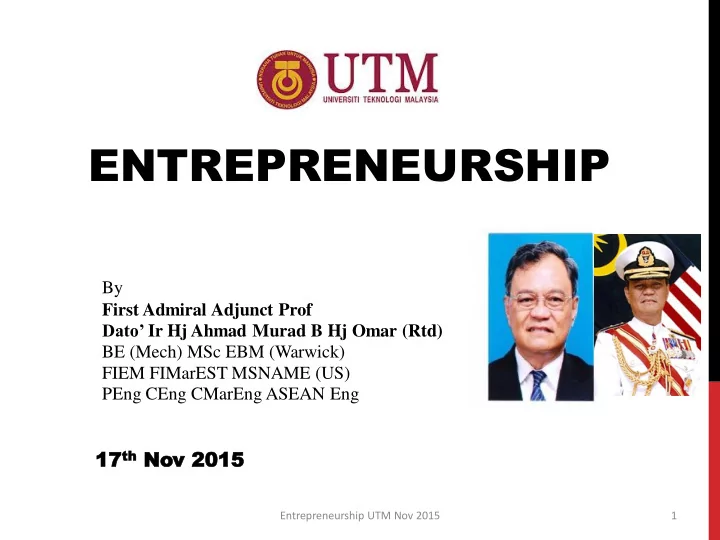
By First Admiral Adjunct Prof Dato’ Ir Hj Ahmad Murad B Hj Omar (Rtd) BE (Mech) MSc EBM (Warwick) FIEM FIMarEST MSNAME (US) PEng CEng CMarEng ASEAN Eng
1 Entrepreneurship UTM Nov 2015
17 17th
th No
Nov 2015
ENTREPRENEURSHIP By First Admiral Adjunct Prof Dato Ir Hj Ahmad - - PowerPoint PPT Presentation
ENTREPRENEURSHIP By First Admiral Adjunct Prof Dato Ir Hj Ahmad Murad B Hj Omar (Rtd) BE (Mech) MSc EBM (Warwick) FIEM FIMarEST MSNAME (US) PEng CEng CMarEng ASEAN Eng 17 17 th th No Nov 2015 Entrepreneurship UTM Nov 2015 1 First Admiral
By First Admiral Adjunct Prof Dato’ Ir Hj Ahmad Murad B Hj Omar (Rtd) BE (Mech) MSc EBM (Warwick) FIEM FIMarEST MSNAME (US) PEng CEng CMarEng ASEAN Eng
1 Entrepreneurship UTM Nov 2015
17 17th
th No
Nov 2015
Languages Key Strengths Working experience Education
Office: Kuala Lumpur
Position: Executive Chairman Omahams Corp Sdn bhd/Leadership Coach
1982 - BE (Mechanical) UTM 2003 - MSc Business Engineering Management Warwick UK Joined the Royal Malaysian Navy 1974 . Served :
MARIKH
Shipyard Scotland
LEKIR (Corvette)
Command as Staff Marine Engineering Officer
Defence
Engineering Ministry of Defence
(First Admiral)
Joined MTI Sdn Bhd as CEO 2007 to 2009 Joined Genaixis Sdn Bhd as Chairman 2009 to 2010 2010 – current OMAHAMS Corp Sdn Bhd 1999 - 2000
Skills (Hard & Soft Skills)
shipbuilding.
professional body – Institute of Marine Engineering Science & Technology (IMarEST) UK (Position held: Vice President).
Board of Engineers Malaysia (BEM).
2
Nationality: Malaysian
First Admiral Dato’ Ir Ahmad Murad B Omar (Rtd)
Key projects
Projects managed through-out career:
in Bae Shipyard Scotland.
Trucks for Malaysian Army
Industri Sdn Bhd as a Remanufacturing hub for MTU engines.
Naval Shipyard
National Oceanography Blueprint with MOSTI.
Shipbuilding & Ship Repair Industry with MiGHT
Capacity Integration Project for Boustead Naval Shipyard.
Entrepreneurship UTM Nov 2015
Syed Nor Al-Bukhary merupakan seorang ahli perniagaan dan usahawan Melayu yang terkaya di Malaysia.
RM2.93 billion pada 2005 seterusnya menjadi orang ketujuh terkaya di Malaysia pada 2005.
1951.
Entrepreneurship UTM Nov 2015 3
is a Malaysian entrepreneur and the founder of Tune Air Sdn. Bhd., who introduced the first budget no-frills airline, AirAsia, to Malaysians with the tagline "Now everyone can fly".
Followed mother to TUPPERWARE parties when young.
Entrepreneurship UTM Nov 2015 4
Entrepreneurship UTM Nov 2015 5
engineer, CEO of General Electric for two decades.
uncaring and rigid character.
Massachussets USA.
(aprox 3.4 billion Ringgit Malaysia)
– opportunities and pursue it relentlessly, – allocate resources and – create value
Entrepreneurship UTM Nov 2015 6
and assumes the risks of a business or
agent of change.
Entrepreneurship UTM Nov 2015 7
resources.
up company offering an innovative product, process
Entrepreneurship UTM Nov 2015 8
IT IS ABOUT SEARCHING THE MARKET PLACE AND CONSOLIDATING RESOURCES.
assuming
risk planning
9 Entrepreneurship UTM Nov 2015
HABITUAL ENTREPRENEURS’ HAVE 5 CHARACTERISTICS IN MIND They passionately look at new opportunities They pursue opportunities with enormous discipline. They pursue only the very best opportunities exhausting themselves and their organization by chasing every single
They focus on execution especially adaptive execution. They engage the energies of everyone in the domain.
10 Entrepreneurship UTM Nov 2015
Entrepreneurship UTM Nov 2015 11
1978 USA- land of meat and fast food John never had business training neither did his girlfriend (Renee) Both 25 and 21 respectively Collected 45k from close friends and relatives to start a natural food store Named it “Safeway” First year sales was 300k but actually loss 23k. After 2 years John wanted to relocate but shareholders were against it. Moved from selling vegetarian food to meat and poultry. First natural food store – “Whole Food Markets” open in 1980. Food was from natural growers and farmers. Quality high and sales went up.
1978 USA- land of meat and fast food John never had business training neither did his girlfriend (Renee) Both 25 and 21 respectively Collected 45k from close friends and relatives to start a natural food store Named it “Safeway” First year sales was 300k but actually loss 23k. After 2 years John wanted to relocate but shareholders were against it. Moved from selling vegetarian food to meat and poultry. First natural food store – “Whole Food Markets” open in 1980. Food was from natural growers and farmers. Quality high and sales went up.
12 Entrepreneurship UTM Nov 2015
CASE STUDY 1 - summary
USA.
NASDAQ stock exchange.
Food Markets
America, 54,000 staff the world‟s largest retailer in organic foods.
13 Entrepreneurship UTM Nov 2015
BUILDING A BUSINESS
14 Entrepreneurship UTM Nov 2015
ELEMENTS CONTRIBUTING TO SUCCESSFUL BUSINESS
15 Entrepreneurship UTM Nov 2015
FOUR FACTORS OF LEADERSHIP
Leader
Follower Communication Situation
16 Entrepreneurship UTM Nov 2015
1,9 CountryClub 9,9 TeamLeader Impoverished 1,1 Authoritarian 9,1
LEADERSHIP GRID
(BLAKE & MOUTON MANAGERIAL GRID)
C
c e r n
p e
l e
1 2 3 4 5 6 7 8 9
Concern of Results
9 8 7 6 5 4 3 2 1 Middle of the Road
17 Entrepreneurship UTM Nov 2015
Autocratic leadership. Being in control commands the staff to do and how to do it. Overdoing results in staff losing creativity and respect. Used sparingly and at the right instance will bring good to the organization. Laissez faire leadership. Lay back kind of style and allows the staff to make decisions and run how they think best. Continue along this track may result in total loss of control and direction. Effective when managing experts to facilitate creative thinking. Shared leadership. It’s a partnership where the leadership of individual is shared between the leader and the staff member. Aimed at delivering optimum performance in a motivated and cooperative environment. Simon Cooper “Brilliant Leader”
18 Entrepreneurship UTM Nov 2015
Leadership
Purpose 3 PRINCIPLES OF LEADERSHIP Passion Performance
19 Entrepreneurship UTM Nov 2015
DRUCKER’S 3 LEADERSHIP GUIDELINES
VOLUNTEER MAKE MISTAKES & LEARN NEVER STOP LEARNING EXPECT SOME FAILURE BUT KEEP AT IT
Entrepreneurship UTM Nov 2015 20
LEADERS ARE BORN? Competency Based Leadership Model
Level 1 No competence Level 2 Par al competence Level 3 Broadly competence Level 4 Fully competence
Key decision point Hands-on leadership style Hands-off leadership style
21 Entrepreneurship UTM Nov 2015
Cosmetics Corporation with only USD5000.
unknowing what leadership is about.
three when her father was sick and her mother had to care for her father.
faith, family and career.
Entrepreneurship UTM Nov 2015 22
LEADERSHIP - Traits
Self-esteem Values and standard setting Clear vision and mission Make sound timely decisions Motivation
23 Entrepreneurship UTM Nov 2015
DEFINING VISION & MISSION
– A vision is essential as it refers to a picture in the future with some implicit or explicit commentary on why people should strive to create that future.
– In a change process a Vision serves three different purposes:
24
heading to.
remarkably fast and efficient way.
Entrepreneurship UTM Nov 2015
DEFINING VISION
some point of time in the future often stated in competitive terms.
broad, all-inclusive and forward-thinking.
before it sets out to reach them. It describes aspirations for the future, without specifying the means that will be used to achieve those desired ends.
…….Leading Change by John P Kotter, Library of Congress Publication, 1996, p 67
25 Entrepreneurship UTM Nov 2015
DEFINING MISSION
Mission statement;
translated into written form. It makes concrete the leader’s view of the direction and purpose of the
statement of goals and priorities.
customer and the difference that your product or service is going to make in their lives.
26 Entrepreneurship UTM Nov 2015
SURROUND YOURSELF AMONG GREAT PEOPLE
expensive in any organization is its people.
Savvy Hardworking Ambitious Nice in a constructive way adding value
27 Entrepreneurship UTM Nov 2015
OFFER A PRODUCT OR SERVICE
28 Entrepreneurship UTM Nov 2015
DESIGN A MARKETING PLAN
Is market big
enough? To pursue? Market
concentrated enough
Is there
market? Who is competitor?
29 Entrepreneurship UTM Nov 2015
IS THERE MARKET IS MARKET BIG ENOUGH MARKET CONCENTRATED ENOUGH WHO IS THE COMPETITOR
FOCUS ON MARKETING PRINCIPLES
differentiation concentration segmentation specialization
30 Entrepreneurship UTM Nov 2015
PERFECT A SALES PROCESS
Customer
delight
Returning
customer Must
generate
return
(income) profitability Customer
interface
31 Entrepreneurship UTM Nov 2015
CUSTOMER
response reliability Responsible
CREATE A CUSTOMER EXPERIENCE
Selection Specialized
service
Quality Delivery
Employee
satisfaction Commitment by
employees
32 Entrepreneurship UTM Nov 2015
garage.
computer created.
Entrepreneurship UTM Nov 2015 33
disappointment.
post revenues in excess of USD100Bn .
34 Entrepreneurship UTM Nov 2015
Entrepreneurship UTM Nov 2015 35
Entrepreneurship UTM Nov 2015 36
future
leadership role
environment
37
This (6) guidance describes the role of professional engineers in sustainability.
Ref: Engineering Council UK (www.engc.org.uk)
sustainability.
sustainability of resources.
value and minimize environmental impact.
connections.
38
The role of professional engineers in sustainability
the world to satisfy their basic needs and enjoy a better quality life without compromising future generations.
– Living within environmental goals – Ensuring a strong , healthy and just society – Promoting good governance – Achieving sustainable economy – Using sound science responsibly
39
Sustainable development
activity towards building a sustainable world.
– Recognize through their activity may be local and immediate but the impacts of their work may be global and long-lasting. – Understand other relevant social and cultural structures outside own community practice. – Understand important potential role of engineers in the sustainable development of communities. – Recognize impacts of engineering projects on communities, global and local and consider views of community. – Understand important role of engineers.
40
Contribute to build a sustainable society , present and future
sound judgment engineers should:
– Look at broad picture. – Ensure knowledge n sustainable development is current. – Be prepared to influence the decision-maker of a project. – Identify all issues and options to the decision-maker such that the decisions are sound. – Identify options and take note of global, economic, social and environmental outcome. – Endure solutions and options offered will contribute to sustainability. – Be aware that there are inherent conflicting and un-measurable aspects of sustainability.
41
Apply professional and responsible judgment and take a leadership role
alone is insufficient and engineers should:
– Strive to go beyond minimum where possible anticipating future legislation. – By their example help others to improve. – Drive future legislation. – Alert relevant authorities if there are deficiencies in legislation and if sustainable outcomes can be endangered by regulation change. – Use technical expertise to influence development of new legislation and codes.
42
Do more than just comply to legislation and codes
responsibility to society to create more useful products with lowest possible use of raw materials , water and energy.
– Understand there are environmental limits and finite resources. – Reduce resource demands. – Reduce waste production. – Use systems and products that reduce embedded carbon , energy and water use, waste and pollution. – Adopt strategies for re-use, recycling, decommissioning and disposal
– Minimize any adverse impacts on sustainability at design stage. – Work to repair any damage.
43
Use resources efficiently and effectively
engineers working alone can no longer address all issues:-
– Engage with stakeholders and all professionals at every stage of a
– Avoid working in isolation. – Utilize cross discipline knowledge and diverse skills. – Promote important leadership role of the engineer in finding solutions to sustainability challenges for benefit of society. – Seek a balanced approach.
44
Seek multiple views to solve sustainability challenges
, where they should:
– Harness skills to minimize damage to people or environment from engineering process and products. – Undertake comprehensive risk assessment before project launch. – Ensure risk management include potential environment , economic and social impacts beyond he economic life of the project. – Recognize the long term risk impact. – Give sustainability the benefit of any doubt , adopt a precautionary approach where scientific knowledge is not conclusive. – Investigate monitoring systems so that any environmental or social impacts are identified early.
45
Manage risk to minimize adverse impact to people or the environment
Challenges for engineers in contributing towards sustainability is plenty Political might and drive Integration between various technologies Leadership The ever changing needs and requirements of society
Engineers contribution to society can be effective if:
Integration between science and technology coupled with creativity and innovation augmented by planning and design excellence in meeting society demands.
Some examples of Engineer’s contribution to society, the profession and environment are:-
Advancement in manufacturing towards improved end user satisfaction and material ad cost optimization. Solving existing problems and useful to society Energy enhancements contributing to society comfort improvements Averting natural disasters and containing damange and risks. Conducting research and development towards improving planet earth environmental sustainability and negative impacts. Improving transportation modes for ease and time optimization for mankind.
BOOKS RECOMMENDED FOR FURTHER READING
Now Build A Great Business by Mark thomson/Brian Tracy, American management Association 2011. Brilliant Leader by Simon Cooper, Prentice Hall , 2008. Entrepreneurship, by Peggy A Lambing & Charles R Kuehl, 3rd Ed, Prentice Hall 2003. How They Started in Tough Times, by David Lester & Beth Bishop, Advantage Quest Publications, 2010. Entrepreneurship 101, Michael E Gordon PhD, John Wiley & Sons, 2007.
49 Entrepreneurship UTM Nov 2015
50 Entrepreneurship UTM Nov 2015