1 Text for power point presentation made by Kurdish Lobby Australia - - PDF document

1 text for power point presentation made by kurdish lobby
SMART_READER_LITE
LIVE PREVIEW

1 Text for power point presentation made by Kurdish Lobby Australia - - PDF document

1 Text for power point presentation made by Kurdish Lobby Australia to the NSW Labour Conference, Sydney Town Hall - Druitt Street Foyer On 13 February 2016 Slide 1 Thank you for coming here today to discuss The Kurdish Question in 2016. NSW


slide-1
SLIDE 1

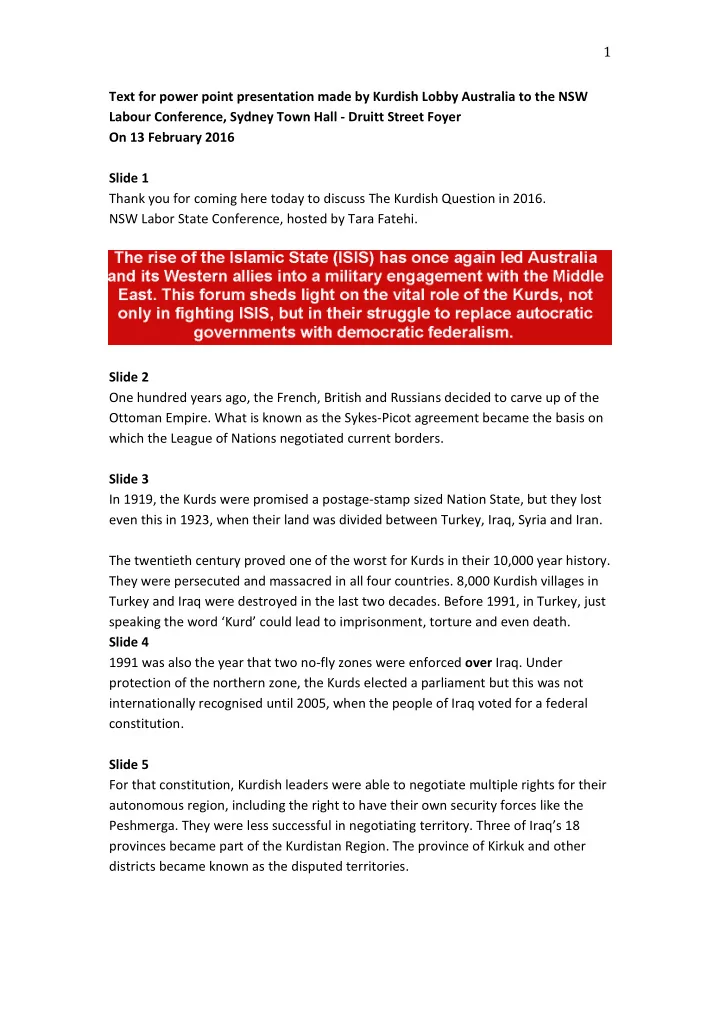
1 Text for power point presentation made by Kurdish Lobby Australia to the NSW Labour Conference, Sydney Town Hall - Druitt Street Foyer On 13 February 2016 Slide 1 Thank you for coming here today to discuss The Kurdish Question in 2016. NSW Labor State Conference, hosted by Tara Fatehi. Slide 2 One hundred years ago, the French, British and Russians decided to carve up of the Ottoman Empire. What is known as the Sykes-Picot agreement became the basis on which the League of Nations negotiated current borders. Slide 3 In 1919, the Kurds were promised a postage-stamp sized Nation State, but they lost even this in 1923, when their land was divided between Turkey, Iraq, Syria and Iran. The twentieth century proved one of the worst for Kurds in their 10,000 year history. They were persecuted and massacred in all four countries. 8,000 Kurdish villages in Turkey and Iraq were destroyed in the last two decades. Before 1991, in Turkey, just speaking the word ‘Kurd’ could lead to imprisonment, torture and even death. Slide 4 1991 was also the year that two no-fly zones were enforced over Iraq. Under protection of the northern zone, the Kurds elected a parliament but this was not internationally recognised until 2005, when the people of Iraq voted for a federal constitution. Slide 5 For that constitution, Kurdish leaders were able to negotiate multiple rights for their autonomous region, including the right to have their own security forces like the

  • Peshmerga. They were less successful in negotiating territory. Three of Iraq’s 18

provinces became part of the Kurdistan Region. The province of Kirkuk and other districts became known as the disputed territories.

slide-2
SLIDE 2

2 Slide 6 Between 2005 and 2014, Iraqi Kurdistan witnessed unprecedented peace and

  • prosperity. It put the rest of Iraq to shame. But the Baghdad government has not

paid Kurdistan its allocated revenue for the last two years. Although Kurdistan began exporting oil through Turkey independently, the oil is selling for US$20 a barrel, which means the Kurdistan Regional Government or KRG has a monthly shortfall of

  • ver US$400 million.

Slide 7 This financial crisis is exacerbated by the war with ISIS. When Iraqi Security Forces withdrew from northern Iraq in June 2014, Peshmerga immediately advanced to south of the disputed territories. They have successfully defended a 1000 kilometre frontline, which by last November extended another 600 kilometres. Slide 8 These Peshmerga are unpaid and have inadequate weapons, clothes and medical

  • treatment. This is because the KRG is bankrupt and Baghdad refuses to pay or supply
  • them. The US, Australia, UK and others insist on supplying everything through
  • Baghdad. But Baghdad is not supplying Kurdish or Sunni Arab forces because

Baghdad fears a post-ISIS war with both. Slide 9 Two million refugees and IDPs have flooded into Kurdistan. That is a 35% increase in the population. The KRG is receiving some help from international aid agencies, $15 million from oil companies and $200 million from Kuwait, but not enough to provide for all these people. Nor is Iraq undertaking any reconstruction of war-damaged areas so people can return home. And despite the US-led coalition’s reliance on Kurdish forces, there has been no political pressure to resolve disputes between Baghdad and Kurdistan, other than to preserve the “unity” of Iraq. Slide 10 Kurdistan faces even more problems. With PKK having bases in Iraqi Kurdistan, Turkey is bombing Iraqi Kurdistan and closing the border for weeks at a time. Turkey is also deploying tanks and troops into Mosul and Kurdistan. This has huge implications for the future. Slide 11 These multiple crises have led to a political implosion in Kurdistan’s parliament and

  • government. Government workers have not been paid for five months. Ministers
slide-3
SLIDE 3

3 have been sacked. Even police and peshmerga are going on strike. Despite these problems, Kurdistan’s President, Massoud Barzani, announced a 2016 referendum

  • n independence.

Slide 12 In 2015, ISIS lost 20% of its territory but still holds 6 million people hostage in towns and villages. Although Iraqi forces retook Tikrit, Badji and Ramadi, these areas remain subject to ISIS attack. It has been Kurdish forces from all four Kurdish regions that have fought ISIS and kept territory safe from ISIS in both Iraq and Syria. To military defeat ISIS, the cities of Mosul and Raqqa will need to be freed. It is a huge undertaking made more complicated by the difficulty in distinguishing between ISIS supporters and ISIS victims. Peshmerga have been asked to join an offensive on Mosul, as Sunni Arabs fear Shia militias. The city has 1 million people and up to 10,000 ISIS militants. In Syria, there are two wars. Russia’s intervention has propped up the Assad regime, and expanded the territory under Assad’s control. Opposition groups are fighting back, and Turkey is threatening to send in troops to support them. There will be no easy military victory. Hence, the push for a political solution. Slide 13 The other war is with ISIS. This is being fought by Syrian Kurdish fighters who became famous during the four-month siege of Kobani. A year later, in October 2015, another force was established to fight ISIS. The Syrian Democratic Forces are 75% Kurdish and 25% Arab, Assyrian and Turkmen. They have retaken territory in four provinces and are now closing in on Raqqa. But it will be political transformations that will ultimately defeat ISIS. Slide 14 In 2013, Syrian Kurds established an autonomous region called Rojava in the north. By the following January, they had set up three multi ethnic multi religious autonomous administrations and in June, after retaking Tel Abyad, they set up a fourth. Turkey considers the existence of Rojava a national security threat, far worse than

  • ISIS. Turkish forces frequently attack Rojava and Turkey is blocking all humanitarian

and reconstruction aid from getting through. Rojava extends 800 kilometres along the border. In the remaining 100 kilometres, Turkey funnels weapons and supplies to ISIS, Turkmen and Salafi groups, joined by

slide-4
SLIDE 4

4

  • Turks. It was Turkmen who shot and killed a Russian pilot, and the pilot of a rescue

helicopter, after Turkey shot down Russia’s Su-24 fighter on 24 November. Despite the US-led coalition’s heavy reliance on Syrian Kurdish forces, Syrian Kurds were not invited to Geneva I and II, or the Riyadh conference meant to form a united Opposition to negotiate with Assad. Nor were Syrian Kurds invited to the Geneva negotiations on 1 February. This is because Turkey threatened to boycott talks if they attended. Instead, the Riyadh committee came to Geneva. This committee includes Islamic extremists backed by Turkey, Saudi and Qatar who want to create an Islamic state based on sharia law. In contrast, the Syrian Kurds and their allies want a multi ethnic multi religious democratic federal system of government, made up of autonomous regions. Unsurprisingly, negotiations collapsed on 4 February because the Russian backed Assad Regime intensified attacks on these Islamic extremists back in Syria. Slide 15 Since July 2015, the Turkish government has launched a war on PKK and 1.3 million Kurdish civilians in eastern Turkey. Turkey fears Kurds more than ISIS because modern Turkey is based on a fierce form of nationalism. Although President Erdogan’s AKP government agreed to a bilateral ceasefire with the PKK in 2013, the success of a pro-Kurdish political party in Turkey’s national elections in June, caused Erdogan to call another election in November, meanwhile embarking on mass arrests, a media crackdown and a civil war to attract Nationalist voters. Slide 16 Truth and civilians are the casualties of this war. Back in October 2015, two explosions killed 102 people in Ankara. They were protesting for peace, yet the government blamed the explosions on PKK, ISIS and ‘secret powers’. After winning a parliamentary majority in November, the AKP government vowed to annihilate every Kurdish terrorist. Slide 17 56 curfews and sieges have been imposed on 7 Kurdish cities and 20 towns. Inside these sieges it is a war zone. People are subject to 24-hour curfews. Tanks, armoured vehicles, helicopters and snipers shoot at anyone who goes outside, also bombing and shooting at buildings and vehicles. Some people, including babies, are being shot inside their houses. People trying to tend the wounded or retrieve corpses are shot. Since August, state forces have killed more than 500 civilians. 400,000 students have not attended school for five months. Electricity, phones and water are cut. In three towns, curfews and sieges have entered their third month. People are suffering food

slide-5
SLIDE 5

5

  • shortages. 200,000 people have been forced to evacuate their homes. Otherwise,

no-one is allowed to enter or leave these areas. Slide 18 Militant youths sympathetic to PKK ideology are resisting by building barricades and digging trenches, and fighting security forces with grenades and Kalashnikovs. Between 14 December and 31 January, security forces killed 649 of these youths in three towns. Many more died in February, including 60 youths and civilians trapped in a basement for 12 days. Government sources claim security forces and airstrikes have killed 3,100 PKK since July. PKK claims only 220 guerillas were killed in 2015. Slide 19 Kurdish parliamentarians and anyone protesting the war are accused of being

  • terrorists. Charismatic leader of the most popular pro-Kurdish party, Selahattin

Demirtas is being criminally investigated for being a separatist. In August, 15 Kurdish towns declared autonomy. 156 Kurdish mayors and officials have been taken to court for threatening the unity of the state. These officials have been replaced with government appointments. 31 are already in prison. The PKK and pro Kurdish political parties advocate a democratic federal system of government in Turkey, which allows for autonomous regions and provinces. Instead President Erdogan wants to change the constitution to give himself extraordinary presidential powers. Meanwhile, the PKK leader, Abdulla Ocalan, who was instrumental in negotiating the 2013 ceasefire, has been languishing in an island prison since 1999. No-one has been allowed to visit him since last April. Slide 20 The Kurds in Iran are likewise oppressed, politically, socially and economically. They make up 50% of all executions. Hence, in 2016, Kurdish leaders in the four Kurdish regions are demanding democratic federal systems of government, where people are able to form autonomous regions and administrations that reflect the ethnic and religious diversity of the Middle East. Slide 21 The Kurdish people have long dreamed of an independent Kurdistan, but without international support, it is difficult to achieve. As horrific as the ISIS state building enterprise is, it has opened unprecedented opportunities to review the status quo: that of autocratic governments serving an elite, and leaving the huge swell of educated young people unemployed and disenfranchised.

slide-6
SLIDE 6

6 Slide 22 To prevent perpetual war, the group I belong to, Kurdish Lobby Australia, advocates that the international community support

  • Multi ethnic multi religious democratic federal systems of government that

allow autonomous regions;

  • An economic reconstruction plan linked to political milestones;
  • Kurdish representation at all negotiations;
  • An definition of terrorism that clearly distinguishes terrorism from an armed

resistance movement with legitimate grievances and democratic aspirations; Slide 23 For particular countries we ask the international community to support:

  • A multilateral ceasefire and political negotiations in Turkey;
  • Local democratic representative administrations in Syria, to build alternatives

to the Assad Regime and Islamic extremists;

  • The enactment of the federal constitution of Iraq, and
  • A federal independent Kurdistan, if this is the will of the people.

Slide 24 We argue that Australia, as a non-imperialist power with a military, political and economic involvement in the Middle East since World War I, could support this international effort.

Close & Return to KLA Activities page