Enterprise Risk Management for Hospital Systems: What Counsel Needs - - PowerPoint PPT Presentation

enterprise risk management for hospital systems what
SMART_READER_LITE
LIVE PREVIEW

Enterprise Risk Management for Hospital Systems: What Counsel Needs - - PowerPoint PPT Presentation

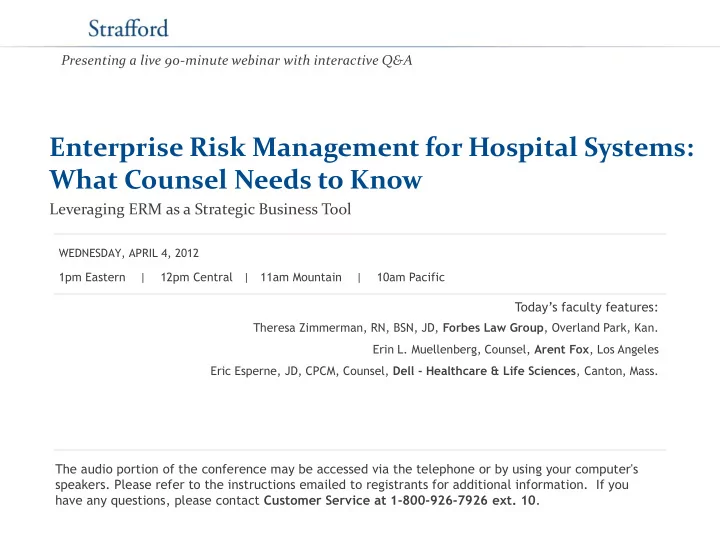
Presenting a live 90-minute webinar with interactive Q&A Enterprise Risk Management for Hospital Systems: What Counsel Needs to Know Leveraging ERM as a Strategic Business Tool WEDNESDAY, APRIL 4, 2012 1pm Eastern | 12pm Central |


slide-1
SLIDE 1

Enterprise Risk Management for Hospital Systems: What Counsel Needs to Know

Leveraging ERM as a Strategic Business Tool

Today’s faculty features:

1pm Eastern | 12pm Central | 11am Mountain | 10am Pacific

The audio portion of the conference may be accessed via the telephone or by using your computer's

  • speakers. Please refer to the instructions emailed to registrants for additional information. If you

have any questions, please contact Customer Service at 1-800-926-7926 ext. 10.

WEDNESDAY, APRIL 4, 2012

Presenting a live 90-minute webinar with interactive Q&A

Theresa Zimmerman, RN, BSN, JD, Forbes Law Group, Overland Park, Kan. Erin L. Muellenberg, Counsel, Arent Fox, Los Angeles Eric Esperne, JD, CPCM, Counsel, Dell - Healthcare & Life Sciences, Canton, Mass.

slide-2
SLIDE 2

Conference Materials

If you have not printed the conference materials for this program, please complete the following steps:

  • Click on the + sign next to “Conference Materials” in the middle of the left-

hand column on your screen.

  • Click on the tab labeled “Handouts” that appears, and there you will see a

PDF of the slides for today's program.

  • Double click on the PDF and a separate page will open.
  • Print the slides by clicking on the printer icon.

2

slide-3
SLIDE 3

Continuing Education Credits

For CLE purposes, please let us know how many people are listening at your location by completing each of the following steps:

  • Close the notification box
  • In the chat box, type (1) your company name and (2) the number of

attendees at your location

  • Click the SEND button beside the box

FOR LIVE EVENT ONLY

3

slide-4
SLIDE 4

Tips for Optimal Quality

Sound Quality If you are listening via your computer speakers, please note that the quality of your sound will vary depending on the speed and quality of your internet connection. If the sound quality is not satisfactory and you are listening via your computer speakers, you may listen via the phone: dial 1-866-927-5568 and enter your PIN -when prompted. Otherwise, please send us a chat or e-mail sound@straffordpub.com immediately so we can address the problem. If you dialed in and have any difficulties during the call, press *0 for assistance. Viewing Quality To maximize your screen, press the F11 key on your keyboard. To exit full screen, press the F11 key again.

4

slide-5
SLIDE 5

5

ERM: General Overview for Health Law Attorneys

Terie Zimmerman, RN, BSN, JD, ARM, CPHRM, DFASHRM 913-341-8612 tzimmerman@forbeslawgroup.com

slide-6
SLIDE 6

6

  • This presentation contains general information. It is being

provided for general informational purposes and the user should not rely on information in this presentation as legal

  • advice. The information provided herein is not intended to

establish an attorney-client relationship. Forbes Law Group, LLC provides legal advice only to individuals or entities with which it has established an attorney-client relationship and such advice is based on the particular facts and circumstances

  • f each matter.
slide-7
SLIDE 7

7

  • WHY. . . . . . .
slide-8
SLIDE 8

8

DEFINITION and DECISION MAKING

  • ENTERPRISE RISK MANAGEMENT – an ongoing

business decision making process instituted and supported by the healthcare organization’s board of directors, executive administration, and medical staff leadership.

  • DECISION MAKING TOOL - ERM recognizes the

synergistic effect of risks across the continuum of care, and has as its goals to assist the organization reduce uncertainty and process variability, promote patient safety and maximize the return on investment through asset protection, and the recognition of actionable risk

  • pportunities.
slide-9
SLIDE 9

9

INSURANCE INSTITUTE OF AMERICA

RISK MANAGEMENT PROCESS

– 1. IDENTIFY RISK AND ANALYZE AN ORGANIZATIONS EXPOSURE TO LOSS – 2. EXAM ALTERNATE RISK TECHNIQUES – 3. SELECT THE BEST TECHNIQUE(S) – 4. IMPLEMENT THE TECHNIQUE(S) CHOSEN – 5. MONITOR AND MAKE CHANGES AS APPROPRIATE

slide-10
SLIDE 10

10

RISK DOMAINS

  • OPERATIONAL
  • FINANCIAL
  • HUMAN CAPITAL
  • STRATEGIC
  • LEGAL REGULATORY
  • TECHNOLOGY
  • HAZARD
slide-11
SLIDE 11

11

RISK RELATIONSHIPS

  • Pure Risk – implies no possibility of gain. Either a loss is

realized or the status quo is maintained.

  • Speculative Risk – there is a possibility of gain/profit or

loss.

slide-12
SLIDE 12

12

RISK IDENTIFICATION AND ANALYSIS

TYPES

  • INTERNAL RISKS
  • EXTERNAL RISKS

TIMING OF IDENTIFICATION

  • RETROSPECTIVELY
  • CONCURRENTLY
  • PRE-INTERVENTIONAL
  • PROSPECTIVELY
slide-13
SLIDE 13

13

Sample Areas of Risk Assessment

  • Insurance and Risk Financing
  • Claims Management
  • Contracts
  • Volume
  • Capital
  • Payment/Reimbursement Threats
  • Tax Reporting
  • Maintaining Tax Exempt Status
  • Use of Property by Tax-Exempt Bonds
  • Energy Management
  • Environmental Compliance
slide-14
SLIDE 14

14

Sample Areas of Risk Assessment

  • Employment Relationships and Regulation
  • OSHA and other regulatory exposures
  • Adverse Event Reporting
  • Human Research and IRB’s
  • Compliance
  • Clinical Issues
  • Peer Review and Credentialing
  • Medical Staff Exposures
  • Quality Issues
  • Patient Experience
  • Public Relations and Marketing
slide-15
SLIDE 15

15

Sample Areas of Risk Assessment

  • Managed Care
  • Medical Tourism
  • Electronic Health Records
  • Radio Frequency Identification/Interference
  • Rising Violence Rates
  • AND SO ON . . . . .
slide-16
SLIDE 16

16

SAMPLE RISK FORMULA

(PROBABILITY + TIME TO IMPACT) X SEVERITY = RISK SCORE

slide-17
SLIDE 17

17

HEAT RISK MAP

slide-18
SLIDE 18

18

SAMPLE FEMA RISK MAP

http://www.fema.gov/plan/p revent/fhm/rm_main.shtm

slide-19
SLIDE 19

19

Health Attorney - Areas of Influence

Mediation of claims vs. litigation or no alternative to claim/complaint resolution Board’s fiduciary duty to protect organization’s assets - adopt an ERM approach Identification and removal or mitigation of legal/regulatory/compliance and other risks that expose the health system to avoidable or series risks Active Participation in ERM process (from identification and contracting of consultants to taking place in the process.) Support and encourage entities commitment to the ERM process Help garner support of other leaders

slide-20
SLIDE 20

20

ERM SUCCESS FACTORS

LEADERSHIP SUPPORT AND POSITIVE CULTURE BROAD-BASED EMPLOYEE INVOLVEMENT CONSISTENCY QUANTIFYING AND BENCHMARKING RESULTS DECREASED VARIABILITY THROUGH EVIDENCED BASED PRACTICES ONGOING MONITORING AND EVALUATION INTERNAL AND EXTERNAL

slide-21
SLIDE 21

Supplier Transaction Risk Management: A Key But Often Overlooked Component of Enterprise Risk Management

Eric Esperne, Counsel, Dell Healthcare & Life Sciences

  • ffice +1 781-401-2107

Eric_Esperne@Dell.com

21

slide-22
SLIDE 22

Enterprise Risk Management (ERM) Frameworks

 Committee of Sponsoring Organizations of the

Treadway Commission (COSO) Enterprise Risk Management – Integrated Framework

 American Health Lawyers Association (AHLA) Risk

Management Handbook for Healthcare Entities

 American Society for Healthcare Risk Management

(ASHRM) Risk Management Handbook for Healthcare Organizations

22

slide-23
SLIDE 23

CONTRACT RISK MANAGEMENT ACTIVITIES

Based on COSO “Guidance on Monitoring Internal Control Systems, Volume III—Application Techniques,” June, 2008

23

slide-24
SLIDE 24

Risk Management Principles of Objectives

Risk is the probable occurrence of a future event with either negative or positive impact on

  • rganization goals and objectives.

24

slide-25
SLIDE 25

Risk Management Principle of Cause

Risks have a root cause and can come from many

  • sources. Major risk domains include:

Technical Managerial Financial Legal Here we are discussing risks that occur within supplier transactions.

25

slide-26
SLIDE 26

Risk Management Principle of Impact

Individual risks are qualified by multiplying likelihood of a risk event occurring x impact of the

  • ccurrence on an objective(s).

26

slide-27
SLIDE 27

Risk Statement

CAUSE EVENT IMPACT No Guidance on Confidentiality Confidentiality Breach Loss of Intellectual Property Unrealistic Price (Low Ball) Non-Performance Higher Effective Price Change in Laws Violation Penalty, Bad Record

27

slide-28
SLIDE 28

Strategic Objectives in Healthcare

Three Overarching Strategic Objectives for Healthcare Providers:

  • 1. Quality of Patient Care
  • 2. Compliance with Laws and Accreditation
  • 3. Financial Stewardship and Value in Services

What risks in supplier transactions negatively impact these objectives?

28

slide-29
SLIDE 29

FINANCES/VALUE RISKS

29

slide-30
SLIDE 30

Patient Care and Supplier Risks

Objectives: Patient safety. Access to medical

  • records. Clean hospital facilities and medical

equipment in good working order. Supplier Risks: Threats and moral hazards from supplier personnel with access to hospital facilities and systems. No contractual service levels. Subcontracted services. Thin warranties and lack of technical competency. Technological obsolescence.

30

slide-31
SLIDE 31

Compliance and Supplier Risks

Objectives: Compliance with The Joint Commission accreditation standards, Medicare regulations, HIPAA/HITECH , and hospital employee policies. Supplier Risks: No contractual adoption of or training in hospital safeguards and standards by

  • suppliers. No certifications or auditing of supplier

by third parties.

31

slide-32
SLIDE 32

Finances/Value and Supplier Risks

Objectives: Completion of projects within budget. Fulfillment of requirements. Demonstration of value for money from projects (lower costs, improved performance). Supplier Risks: Poor project management. Moral hazards of overly narrow interpretation of project scope and hidden cost cutting by supplier. Contractual payment terms without condition on performance

32

slide-33
SLIDE 33

Risk Management Principle of Treatment Risks can be treated in one of four ways:

 Avoidance—e.g., reduce scope, perform work remotely  Acceptance—e.g., determine risk is out of control, make judgment that reward outweighs risk  Mitigation—e.g., implement project management, auditing, and training activities  Allocation and Transfer—e.g., negotiate terms like shared responsibilities, back-sourcing

33

slide-34
SLIDE 34

Real World Application of Risk Management to Healthcare Supplier Transactions

HIPAA/HITECH: Will the supplier really use or disclose protected health information (PHI)? Can PHI be eliminated from the work? Will PHI be downloaded to supplier systems? The Joint Commission (TJC) Credentialing: Do supplier personnel need to work on site at the hospital? In patient care areas? Can the supplier’s

  • nboarding process or credentialing by other

customers be leveraged?

34

slide-35
SLIDE 35

Real World Application of Risk Management to Healthcare Supplier Transactions

Consequential Damage Waivers and Indemnification Clauses for Patient Claims: Do the supplier’s services really constitute healthcare delivery? Can pre-production testing and acceptance of deliverables eliminate concerns? Can service levels and post-production maintenance programs treat risks better than retroactive legal remedies? Medicare Fraud Laws: Is the supplier a health care provider who will submit Medicare claims? Does the law need to apply to the entire supplier entity?

35

slide-36
SLIDE 36

Real World Application of Risk Management to Healthcare Supplier Transactions

Pricing: Does lower price ultimately generate value? Can non-pricing terms like knowledge sharing and end-of-life transition generate value better than lower price? Future M&A and Accountable Care Organizations (ACO’s): Is termination for convenience really necessary due to uncertainty? Is the inclusion of

  • ther hospitals and physician practice groups in

transaction built into the contract?

36

slide-37
SLIDE 37

Presented by Erin L. Muellenberg April 4, 2012

37

slide-38
SLIDE 38

 Culture Change

  • Leadership committment

 Alternatives –

  • Risk Oriented Approach

 What are the most important risks the company faces?

  • Metric Oriented Approach

 What are the main events or factors that would have the greatest impact on cash flow from operations?

  • Objective-oriented approach

 What risks or events could cause the organization to not meet its goals and objectives?

38

slide-39
SLIDE 39

 Alternatives – cont’d.

  • Opportunity-oriented approach

 If we could eliminate any risks we wanted to, what

  • pportunities could we take that would make us even

more successful?

  • Risk-components approach

 Collect the risk drivers, untangle them, and understand how they impact the top risk. Key: Communication with the people that own the risk

39

slide-40
SLIDE 40

 How much risk can you take?

  • Rank the top risks
  • Quantify the risks

 Financial value  Likelihood ranking Risk Appetite is the measure of how much risk the company is willing to take to achieve its goals

40

slide-41
SLIDE 41

 Stanford University

  • Strategic Decision and Risk Management Program

 http://strategicdecisions.stanford.edu/

  • Risk Mapping
  • Risk Analysis
  • Risk Opportunity

41

slide-42
SLIDE 42

 Strategic Business Tool  University of California

  • COSO framework adopted in 1986
  • Data Driven Program
  • ERMIS – Enterprise Risk Management Information

System

 Cognos web-based Business Intelligence solution customized to the UC

42

slide-43
SLIDE 43

 Better quantitative objective analysis  Improved analytical and reporting capabilities  Support for leading risk governance and

compliance processes

 System wide visibility with local flexibility  Scalability without additional burden on UC staff

43

slide-44
SLIDE 44

 How do you know you are doing well?  What information do you need to know when

you are doing well?

 What data do you have and how often

is/should it be updated?

 Automation of data to support a risk and

  • pportunity analysis

44

slide-45
SLIDE 45

 Department Role of Risk Assessment

  • System ERM program serves internal clients
  • Appropriate tools developed and available to

Departments

 Data Aggregation

  • Supported by System

 Using the Data

  • Relating number of claims or payments to

 insurance costs  number of beds  revenue  types and numbers of physicians

45

slide-46
SLIDE 46

 Retrospective review for root causes of

problems

  • Compare Metrics

 Data re: unit’s financial control indicators compared to hazard risk  Compare seemingly unrelated problems; e.g., poor financial performance, increased costs, claims increase

 leadership or management problem?

46

slide-47
SLIDE 47

 ERM System Teams Supports Planning

  • Consider data based assessment
  • Potential pitfalls
  • Mitigation strategies
  • Opportunities

47

slide-48
SLIDE 48

 Risk Services http://www.ucop.edu/riskmgt  ERM http://www.ucop.edu/riskmgt/erm  General Risk Review Tool:

http://www.ucop.edu/riskmgt/erm/riskrevwb.html

 Budget Changes Risk Workbook Tool:

http://www.ucop.edu/riskmgt/erm/budgetwb.html

 New Initiative Risk Review Tool:

http://www.ucop.edu/riskmgt/erm/riskmitwb.html

 Risk Program Maturity Tools:

http://www.ucop.edu/riskmgt/erm/tools.html#fra mework

48

slide-49
SLIDE 49

 Broad Approach

  • What are the issues that the organization

has never looked at, but which could threaten its ability to survive or achieve its strategic objectives?

49

slide-50
SLIDE 50

 ERM Leadership Team

  • CEO, CFO, COO & CRO

 Reports to Audit Committee of the Board  Process –

  • Develop List of Risks

 Group Interviews  Intranet survey

  • Prioritize

 Assigned severity  Assigned Frequency  Assigned dollar values

50

slide-51
SLIDE 51

 Resources focused on risks with greatest

potential for reduction

 Identified risks

  • Lack of change readiness
  • Lack of leadership
  • Poor physician alignment
  • Misalignment of strategic and business planning

processes at the system and local levels

  • Unaddressed infrastructure concerns resulting form

pressure to invest in new clinical equipment to he detriment of buildings and other physical components

51

slide-52
SLIDE 52

 Task Force

  • Assigned to identified Risks

 Monitoring & Support

  • Board Audit Committee

 ERM System Reports  Task Force Reports

 Financing Risk

  • Self insured captive

 Finance losses  loss prevention grants

52

slide-53
SLIDE 53

 Premise: Risk is an integral part of

productive activity

 Process – Risk is defined by the operational

departments

 Culture –

  • Early-warning system for adverse occurrences
  • Empowerment to report problems without fear of

retribution

  • Prompt response to adverse occurrences
  • Investigations conducted with integrity

53

slide-54
SLIDE 54

 Culture – cont’d

  • Information shared with leadership
  • Communication pro-active, honest and respectful
  • Regular assessment of the effectiveness of the ERM

practices

 Structure

  • Custom designed
  • ERM Steering Committee

 Operational leaders  Risk Management Process Owners

 Responsible to develop plans to deal with risks

54

slide-55
SLIDE 55

 Process

  • Steering Committee identified & prioritized risks
  • Risk Management Process Owners accountable to

Steering Committee

  • On-going monitoring & reassessment
  • Meetings of all Risk Management Process Owners

 Increased communication  No over-engineering/no charts & graphs  Focus on continued communications and visibility

55

slide-56
SLIDE 56

 Establishing an environment that supports

and welcomes interdisciplinary input

 Tools are not the essence of ERM; it is a

philosophy

 ERM is part of management training  New programs/services  Challenge: establish meaningful metrics

  • Continuously evolving

56

slide-57
SLIDE 57

 Leadership commitment  Leadership Transformation Teams  Integrated into operations  Value stream mapping of processes  Collaborative teams  Breakthrough transformation (new)  Base business transformation (existing)  Resulting culture change  Transparency  On-going value based analysis

57

slide-58
SLIDE 58

 ERM Champion  Leadership Commitment  Culture Change  Integration into operations  Communication  Broad vision  Formal tools not necessary  Continuous and consistent monitoring,

reassessment and feedback

58

slide-59
SLIDE 59

Enterprise Risk Management for Healthcare: Where & How to Begin Kathryn Wire, JD, MBA, FASHRM, CPHRM American Health Lawyers Association 2011 American Health Lawyers Association Enterprise Risk Management Task Force Educational Calls – Second Thursday of each month (April 12) 11:00 a.m. EST (800) 979- 2504, access code 914728#

59

slide-60
SLIDE 60

Erin L. Muellenberg Arent Fox LLP. 555 West Fifth Street, 48th Floor Los Angeles, CA 90013-1065 muellenberg.erin@arentfox.com

60