Ensuring Quality Chil ildren develop and learn more rapidly than at - - PDF document

ensuring quality chil ildren develop and learn more
SMART_READER_LITE
LIVE PREVIEW

Ensuring Quality Chil ildren develop and learn more rapidly than at - - PDF document

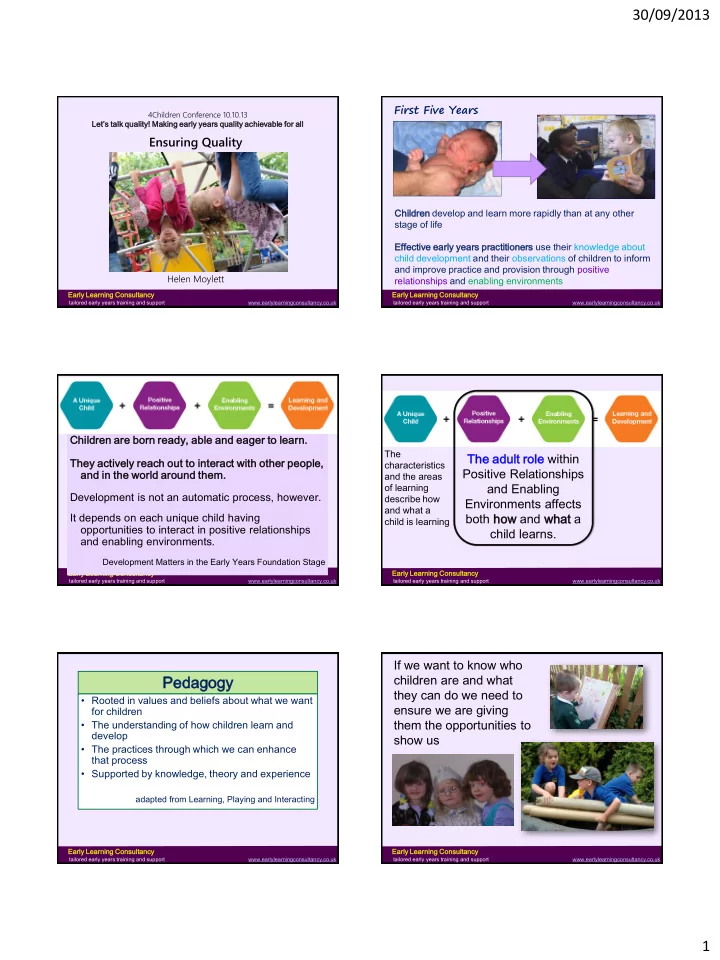
30/09/2013 First Five Years 4Children Conference 10.10.13 Lets talk quality! Making early years quality achievable for all Ensuring Quality Chil ildren develop and learn more rapidly than at any other stage of life Effectiv ive early ly


slide-1
SLIDE 1

30/09/2013 1

Early y Learning Consu sultancy cy

tailored early years training and support www.earlylearningconsultancy.co.uk

4Children Conference 10.10.13 Let’s talk quality! Making early years quality achievable for all

Ensuring Quality

Helen Moylett

Early y Learning Consu sultancy cy

tailored early years training and support www.earlylearningconsultancy.co.uk

Chil ildren develop and learn more rapidly than at any other stage of life Effectiv ive early ly years practit ition ioners use their knowledge about child development and their observations of children to inform and improve practice and provision through positive relationships and enabling environments

First Five Years

Early y Learning Consu sultancy cy

tailored early years training and support www.earlylearningconsultancy.co.uk

Childr dren n are born n ready, y, able and eager to learn. n. They y activel vely y reach ch out to inter eract ct with other er people, le, and in the world d around nd them. Development is not an automatic process, however. It depends on each unique child having

  • pportunities to interact in positive relationships

and enabling environments.

Development Matters in the Early Years Foundation Stage

Early y Learning Consu sultancy cy

tailored early years training and support www.earlylearningconsultancy.co.uk

The adult role within Positive Relationships and Enabling Environments affects both how how and what what a child learns.

The characteristics and the areas

  • f learning

describe how and what a child is learning

Early y Learning Consu sultancy cy

tailored early years training and support www.earlylearningconsultancy.co.uk

Pedagogy y

  • Rooted in values and beliefs about what we want

for children

  • The understanding of how children learn and

develop

  • The practices through which we can enhance

that process

  • Supported by knowledge, theory and experience

adapted from Learning, Playing and Interacting

Early y Learning Consu sultancy cy

tailored early years training and support www.earlylearningconsultancy.co.uk

If we want to know who children are and what they can do we need to ensure we are giving them the opportunities to show us

slide-2
SLIDE 2

30/09/2013 2

Early y Learning Consu sultancy cy

tailored early years training and support www.earlylearningconsultancy.co.uk

How do children learn?

Early y Learning Consu sultancy cy

tailored early years training and support www.earlylearningconsultancy.co.uk

Born learners: rs: innate psychologica cal drives

Relatedness Competence Autonomy

IT’S A LEARNER!

Early y Learning Consu sultancy cy

tailored early years training and support www.earlylearningconsultancy.co.uk

Everyone is born with an intense drive to

  • learn. Infants stretch their skills daily.

Not just ordinary skills, but the most difficult tasks of a lifetime, like learning to walk and talk. Babies don't worry about making mistakes or humiliating

  • themselves. They never decide it’s too

hard or not worth the effort. They walk, they fall, they get up. They just barge forward. ……What could put an end to this exuberant learning?

Carol Dweck (Mindset 2006)

Born learners

Early y Learning Consu sultancy cy

tailored early years training and support www.earlylearningconsultancy.co.uk 10

P.O. Svanberg Sept 2010

Sensitive periods

  • Biological development has critical periods
  • “Sensitive” periods are important in human

brain development

  • Experiences can lead to enhancement or

reduction of particular brain functions or later brain development - “programming” ‘Sensitive periods’ in early brain development

Binocular vision 1 2 3 6 5 4 High Low Habitual ways of responding Language learning Emotional control Peer social skills Central auditory system

P.O. Svanberg Sept 2010

Early y Learning Consu sultancy cy

tailored early years training and support www.earlylearningconsultancy.co.uk

‘They begin at birth and are lifelong characteristics

which need to be fostered and developed during the early years as they are

critical for building children’s capacity for future learning.’

Clare Tickell

slide-3
SLIDE 3

30/09/2013 3

Early y Learning Consu sultancy cy

tailored early years training and support www.earlylearningconsultancy.co.uk

‘Research conducted over the last 10 years has suggested that a major source of the differences between the highest- and lowest-achieving children in school settings is the degree to which they become

regulators of their own learning.’

Martha Bronson

Characteristics of effective learning

Self-regulated learners – skill and will

…and thrill!

Early y Learning Consu sultancy cy

tailored early years training and support www.earlylearningconsultancy.co.uk

In planning and guiding children’s activities, practitioners must reflect on the different ways that children learn and reflec lect t these se in their ir practi ctice

  • ce. Three characteristics of effective

teaching and learning are:

EYFS Statutory Framework 1.10

Playi aying ng and expl plorin

  • ring

g Active ve lear arni ning ng Creat ating ng and thinki nking ng critical cally y

Early y Learning Consu sultancy cy

tailored early years training and support www.earlylearningconsultancy.co.uk

Social l and emoti tion

  • nal

al develop lopmen ent Well-bein eing Playing ng and explor

  • ring

ing

engageme ment

Ready Active e learni ning ng

motiv ivation ion

Willing Creating ting and thinking king criti ticall cally

think inking ing

Able

Char aract acteristics eristics of effect ctive ve lear arni ning ng

Early y Learning Consu sultancy cy

tailored early years training and support www.earlylearningconsultancy.co.uk

understanding

PSED

managing behaviour and feelings moving and handling

A unique child Creating and Thinking Critically

Having own ideas Using what they already know to learn new things Choosing ways to do things

A unique child

Early y Learning Consu sultancy cy

tailored early years training and support www.earlylearningconsultancy.co.uk

Early y Learning Consu sultancy cy

tailored early years training and support www.earlylearningconsultancy.co.uk

Self-regul egulat ating ng learner arners

Emotion ional self-regulat lation ion Cognit itiv ive self lf-regulat lation ion

Social

al and emotion tional al devel elop

  • pmen

ent Well-be being ng Playing ng and explor

  • ring

ing

engagemen ment

Active e learni ning ng

motiv ivation ion

Creating ting and thinking king criti ticall cally

think inkin ing

Early y Learning Consu sultancy cy

tailored early years training and support www.earlylearningconsultancy.co.uk

‘What is this? What does it do?’

  • sensory investigation, seeking knowledge

‘What if…? What else…?’

  • using symbols, flexibility of thought
  • theory of mind

Finding out and exploring Playing with what they know Being willing to

‘ ‘have a go’

  • initiating activities
  • seeking challenge, taking

risks

  • ‘can do’ attitude
slide-4
SLIDE 4

30/09/2013 4

Early y Learning Consu sultancy cy

tailored early years training and support www.earlylearningconsultancy.co.uk

Unstructured

Play and playfulness

Play without adult support

Child- initiated play

Adult support for enabling environment, and sensitive interaction

Focused learning

Adult- guided, playful experiential activities

Highly structured

Adult- directed, little or no play

Early y Learning Consu sultancy cy

tailored early years training and support www.earlylearningconsultancy.co.uk

Active ve Learni ning ng

Being involved and concentrating Keeping on trying

Enjoying achieving what they set out to do Early y Learning Consu sultancy cy

tailored early years training and support www.earlylearningconsultancy.co.uk

Creative thinking Critical thinking

Having their own ideas Making links Choosing ways to do things

Early y Learning Consu sultancy cy

tailored early years training and support www.earlylearningconsultancy.co.uk

How can educators rs help childre ren to be self-re regulated learners? rs?

  • Choice
  • Time
  • Space
  • Open-ended plentiful resources
  • Freedom to follow ideas
  • Warmth and responsiveness
  • Sensitive support for play, exploration and thinking
  • Being playful
  • Providing challenge
  • Giving encouragement to keep wondering
  • Thinking and talking together
  • Avoiding anxiety about an end product or external

expectations Early y Learning Consu sultancy cy

tailored early years training and support www.earlylearningconsultancy.co.uk

Early y Learning Consu sultancy cy

tailored early years training and support www.earlylearningconsultancy.co.uk

If we want to know who children are and what they can do we need to ensure we are giving them the

  • pportunities to show us