Enrique Soriano Martn Universidad Politcnica de Madrid 3rd - - PowerPoint PPT Presentation

enrique soriano mart n
SMART_READER_LITE
LIVE PREVIEW

Enrique Soriano Martn Universidad Politcnica de Madrid 3rd - - PowerPoint PPT Presentation

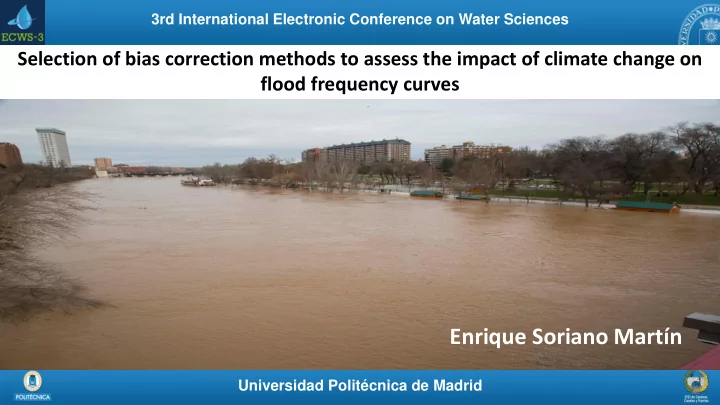
3rd International Electronic Conference on Water Sciences Selection of bias correction methods to assess the impact of climate change on flood frequency curves Enrique Soriano Martn Universidad Politcnica de Madrid 3rd International


slide-1
SLIDE 1

Universidad Politécnica de Madrid 3rd International Electronic Conference on Water Sciences

Selection of bias correction methods to assess the impact of climate change on flood frequency curves

Enrique Soriano Martín

slide-2
SLIDE 2

Universidad Politécnica de Madrid 3rd International Electronic Conference on Water Sciences

STUDY AREA AND DATA METHODOLOGY RESULTS CONCLUSIONS INTRODUCTION

  • In Spain, there are two sources of climate projections under climate change supplied by AEMET (‘Agencia

Española de Meteorología’, in Spanish) and CORDEX.

  • Garijo et al. (2018) found that AEMET projections do not characterise adequately extreme events.

Consequently, in this study climate projections supplied by EURO-CORDEX are used.

  • Temperature and precipitation time series are the input data of the HBV model, calibrated with the

methodology proposed by Garijo and Mediero (2018).

  • Bias correction will be applied to both temperature and precipitation time series.
slide-3
SLIDE 3

Universidad Politécnica de Madrid 3rd International Electronic Conference on Water Sciences

METHODOLOGY RESULTS CONCLUSIONS INTRODUCTION STUDY AREA AND DATA

Acronym GCM RCM ICH-CCL ICHEC-EC-EARTH CCLM4-8-17 MPI-CCL MPI-ESM-LR CCLM4-8-17 MOH-RAC MOHC-HadGEM2-ES RACMO22E CNR-CCL CNRM-CM5 CCLM4-8-17 ICH-RAC ICHEC-EC-EARTH RACMO22E MOH-CCL MOHC-HadGEM2-ES CCLM4-8-17 IPS-WRF IPSL-CM5A-MR WRF331F IPS-RCA IPSL-CM5A-MR RCA4 MOH-RCA MOHC-HadGEM2-ES RCA4 ICH-RCA ICHEC-EC-EARTH RCA4 CNR-RCA CNRM-CM5 RCA4 MPI-RCA MPI-ESM-LR RCA4

  • The four catchments selected are located in the Douro river basin, in the northwestern part of Spain.
  • Flow data collected by the Centre for Hydrographic studies of CEDEX.
  • Time series of daily observations of rainfall and temperature were supplied by the AEMET.
  • Climate change projections provided by 12 regional climate models of the EURO-CORDEX programme have

been used.

slide-4
SLIDE 4

Universidad Politécnica de Madrid 3rd International Electronic Conference on Water Sciences

STUDY AREA AND DATA RESULTS CONCLUSIONS INTRODUCTION METHODOLOGY

  • The flood response in the four catchments has been modelled with the HBV rainfall-runoff model (Seibert

and Vis, 2012).

  • Precipitation time series have been corrected by using the quantile mapping, lineal and second-degree

polynomial techniques.

  • Temperature time series were corrected by using the mean error in each month.
  • Annual maximum flood and precipitation quantiles have been estimated by using the Generalized Extreme

Value (GEV) distribution with the L-moment method.

  • The best bias correction method has been identified, correcting the time series in the future period under

climate change provided by EURO-CORDEX.

  • Delta changes in flood quantiles have been calculated in three time periods: 2011-2041, 2041-2071, 2071-

2100

slide-5
SLIDE 5

Universidad Politécnica de Madrid 3rd International Electronic Conference on Water Sciences

STUDY AREA AND DATA METHODOLOGY CONCLUSIONS INTRODUCTION RESULTS

Bias Correction

  • Temperature and precipitations time series supplied by climate models in the control period presents a

significant difference compared to observed time series in the same period.

Temperature

  • Monthly mean temperatures supplied by climate models are significant lower than observations.
  • The difference between monthly temperatures supplied by each climate model and observations has been

added to the temperature time series in each month to correct the bias.

slide-6
SLIDE 6

Universidad Politécnica de Madrid 3rd International Electronic Conference on Water Sciences

STUDY AREA AND DATA METHODOLOGY CONCLUSIONS INTRODUCTION RESULTS

Precipitation

  • In the Barrios de Luna catchment, climate models supply larger extreme precipitation than observations.

However, in the other three catchments, climate models supply lower precipitations.

  • Results obtained after correcting bias by the lineal and polynomial techniques show smaller errors than in

the case of raw precipitation data.

  • The best bias correction technique is polynomial correction.
slide-7
SLIDE 7

Universidad Politécnica de Madrid 3rd International Electronic Conference on Water Sciences

STUDY AREA AND DATA METHODOLOGY CONCLUSIONS INTRODUCTION RESULTS

Precipitation

slide-8
SLIDE 8

Universidad Politécnica de Madrid 3rd International Electronic Conference on Water Sciences

STUDY AREA AND DATA METHODOLOGY CONCLUSIONS INTRODUCTION RESULTS

Flood frequency curves in the control period

  • The best bias corrections technique will be identified in terms of smaller errors with the flood frequency

curve estimated with observations.

  • The higher return periods have been considered due to its importance in dam design.
  • In general, the smaller are obtained with the polynomial bias correction technique.
slide-9
SLIDE 9

Universidad Politécnica de Madrid 3rd International Electronic Conference on Water Sciences

STUDY AREA AND DATA METHODOLOGY CONCLUSIONS INTRODUCTION RESULTS

Flood frequency curves in the control period

slide-10
SLIDE 10

Universidad Politécnica de Madrid 3rd International Electronic Conference on Water Sciences

STUDY AREA AND DATA METHODOLOGY CONCLUSIONS INTRODUCTION RESULTS

Flood frequency curves in the control period

slide-11
SLIDE 11

Universidad Politécnica de Madrid 3rd International Electronic Conference on Water Sciences

STUDY AREA AND DATA METHODOLOGY CONCLUSIONS INTRODUCTION RESULTS

Flood frequency curves in the future period

  • Finally, precipitation and temperature projections in the future (2011-2100) were corrected with the best

bias correction techniques identified in the previous step.

  • Simulations with the HBV model shows that in general flood frequency curves decrease in the future,

though an increase can be seen in some cases.

slide-12
SLIDE 12

Universidad Politécnica de Madrid 3rd International Electronic Conference on Water Sciences

STUDY AREA AND DATA METHODOLOGY CONCLUSIONS INTRODUCTION RESULTS

Flood frequency curves in the future period

slide-13
SLIDE 13

Universidad Politécnica de Madrid 3rd International Electronic Conference on Water Sciences

STUDY AREA AND DATA METHODOLOGY INTRODUCTION RESULTS CONCLUSIONS

  • Temperature time series supplied by climate models in the control period are significantly lower than
  • bserved data.
  • The bias correction of precipitation time series is more important than the temperature correction, affecting

flow results.

  • The best bias corrections techniques are precipitation polynomial correction and temperature monthly

mean correction simultaneously.

  • Simulations with the HBV model in the future period under climate change show a general reduction in

flood quantiles, smoothing increases in precipitation quantiles. In the control period, when precipitation quantiles in the climate models are larger than observations, flood quantiles are similar to observations.

  • In general, the period 2071-2100 presents the smallest reductions and in some cases the larger increases.
slide-14
SLIDE 14

Universidad Politécnica de Madrid 3rd International Electronic Conference on Water Sciences

Contact

GI de Hidroinformática y Gestión del Agua ETSI Caminos, Canales y Puertos Enrique Soriano e.soriano@upm.es

THANK YOU FOR YOUR ATTENTION