Enhancing OPC differentiation in the context of MS The right - - PowerPoint PPT Presentation

enhancing opc differentiation in the context of ms the
SMART_READER_LITE
LIVE PREVIEW

Enhancing OPC differentiation in the context of MS The right - - PowerPoint PPT Presentation

Enhancing OPC differentiation in the context of MS The right approach? Charles ffrench-Constant MRC Centre for Regenerative Medicine University of Edinburgh Disclosures Advisory work for Bluerock, Roche. Previous collaborations with


slide-1
SLIDE 1

MRC Centre for Regenerative Medicine University of Edinburgh
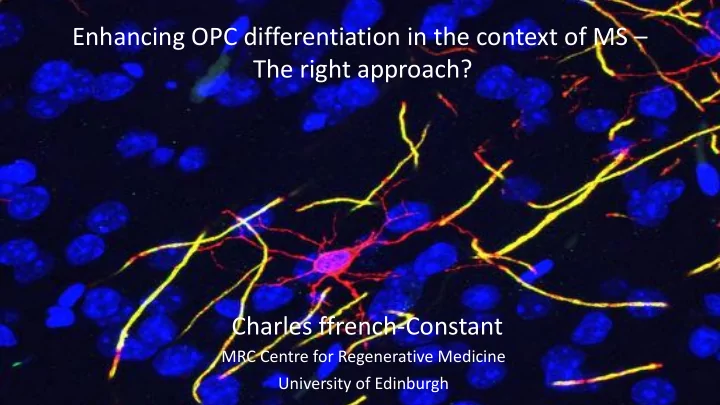
Charles ffrench-Constant Enhancing OPC differentiation in the context of MS – The right approach?

slide-2
SLIDE 2

Disclosures

  • Advisory work for Bluerock, Roche.
  • Previous collaborations with Biogen
slide-3
SLIDE 3

The logic of remyelination

  • Why is remyelination desirable?
  • How does remyelination occur normally?
  • Where in this process might drugs enhance remyelination?
  • What should be our targets ?
  • Will it work?
slide-4
SLIDE 4

Myelin both enables rapid saltatory conduction and maintains axonal energy homeostasis

Nave/Rothstein labs

slide-5
SLIDE 5

Remyelination as a neuroprotective strategy

slide-6
SLIDE 6

Remyelination – cause or effect?

Axons remyelination

slide-7
SLIDE 7

Transplantation to rescue remyelination preserves axons

Cuprizone X-irradiation Cuprizone X-irradiation OPC transplantation

Irvine and Blakemore Brain 2008

slide-8
SLIDE 8

Oligodendrocyte ablation results in axon damage

PLP CreERT2 DT-A

Pohl et al. J Neurosci 2011

slide-9
SLIDE 9

Accelerating remyelination increases axon preservation

Musc Ach receptor cKO In oligodendrocytes – accelerates remyelination previously myelinated axons newly (re)myelinated axons

Mei et al eLife 2016

slide-10
SLIDE 10

The logic of remyelination

  • Why is remyelination desirable?
  • How does remyelination occur normally?
  • Where in this process might drugs enhance remyelination?
  • What should be our targets ?
  • Will it work?
slide-11
SLIDE 11

Oligodendrocyte development

Oligodendrocyte precursors- a type of stem cell Abundant – 5% of neural cells

slide-12
SLIDE 12

Adult oligodendrocyte precursor cells

Nature 1986

slide-13
SLIDE 13

Adult OPC activation, recruitment and differentiation drives remyelination

slide-14
SLIDE 14

OPCs but not existing oligodendrocytes form new myelin

Crawford, Tripathi ….. Richardson and Franklin; Am J Path 2016

slide-15
SLIDE 15

Pre-existing oligodendrocytes expressing activated ERK contribute to remyelination

Jeffries et al. J Neurosci 2016

slide-16
SLIDE 16

The logic of remyelination

  • Why is remyelination desirable?
  • How does remyelination occur normally?
  • Where in this process might drugs enhance remyelination?
  • What should be our targets ?
  • Will it work?
slide-17
SLIDE 17

Neuropathological analysis of remyelination failure

✗ ✗70%

30%

slide-18
SLIDE 18

Variability of OPC numbers in MS lesions

Boyd et al. Acta Neuropath 2013

slide-19
SLIDE 19

Premyelinating oligodendrocytes in MS lesions

Chang et al NEJM 2002

slide-20
SLIDE 20

Cell biology-based drug screens for remyelination therapies

slide-21
SLIDE 21

The logic of remyelination

  • Why is remyelination desirable?
  • How does remyelination occur normally?
  • Where in this process might drugs enhance remyelination?
  • What should be our targets ?
  • Will it work?
slide-22
SLIDE 22

Using nanofibers to define regulators of myelination

Polylactic acid – 2µM diam Marie Bechler

slide-23
SLIDE 23

Internode-like sheaths made by

  • ligodendrocytes myelinating PLA fibers
slide-24
SLIDE 24

Sheath lengths on fibres are comparable to those in vivo

Murtie et al 2007

slide-25
SLIDE 25

Oligodendrocytes detect fiber diameter

regulation of internode length by fibre thickness

slide-26
SLIDE 26

Spinal cord oligodendrocytes form longer internodes on PLA fibres

Are all oligodendrocytes the same?

slide-27
SLIDE 27

Inhibition may explain failure of remyelination

As PSA-NCAM goes down, myelination starts PSA on unmyelinated axons Lubetzki and colleagues (Paris)

slide-28
SLIDE 28

The logic of remyelination

  • Why is remyelination desirable?
  • How does remyelination occur normally?
  • Where in this process might drugs enhance remyelination?
  • What should be our targets ?
  • Will it work?
slide-29
SLIDE 29

Adaptive myelination – experience- dependent myelin plasticity

Does adaptive myelination contribute to learning?

slide-30
SLIDE 30

Intrinsic and adaptive myelination

Bechler at al Curr Biol 2015, Dev Neurobiol 2017

slide-31
SLIDE 31

Remyelination generates thin sheaths

axon diameter myelin thickness remyelination myelination

x y g ratio = x/y

A. B. C. `M1 M2 R2 R1

slide-32
SLIDE 32

Hypothesis – the intrinsic pathway drives remyelination Will remyelin adapt?

slide-33
SLIDE 33

Marie Bechler Andrew Jarjour Matt Swire Rose Owens Monica Kim Susan van Erp Ally Rooney Max Ahmed Steffan Mayerl Gerry Ma Canadian MS Society UK MS Society Wellcome Trust

David Lyons (Edinburgh)