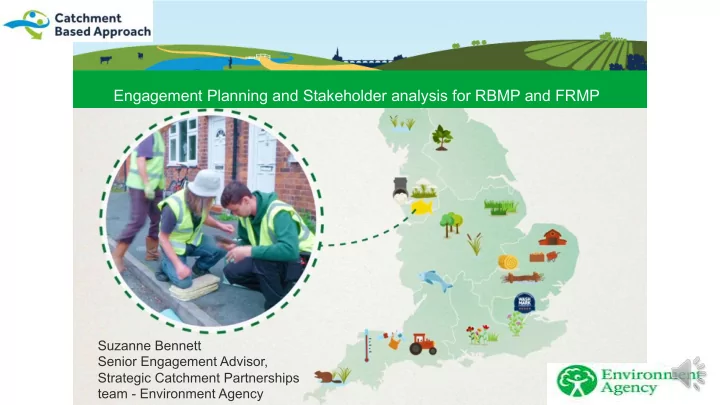
SLIDE 1 Suzanne Bennett Senior Engagement Advisor, Strategic Catchment Partnerships team - Environment Agency
Engagement Planning and Stakeholder analysis for RBMP and FRMP
SLIDE 2
Welcome
Catchment Co-ordinators, CaBA Catchment Hosts, Flood Risk Management Plan and River Basin Management Plan, Single Points of Contact (SPoCs)
SLIDE 3
Why are we here?
A whirlwind tour of River Basin Planning
SLIDE 4 October 2020 Draft RBMP and FRMP consultation October 2019 Challenges and Choices consultation December 2021 Updated River Basin Management Plan and Flood Risk Management Plan published December 2018 Working Together consultation closed
6 months 6 months
3 public consultations to inform the update to the plans
Updating the river basin management plans
SLIDE 5 CaBA National Success measures and you
As part of the success measures agreed with the CaBA National Support Group, catchment partnerships are required to:
- Fully participate in third cycle river basin planning engagement and, as
appropriate, strategic planning activities
- Undertake stakeholder analysis and take steps to include ‘missing’
stakeholders where the analysis indicates gaps
- As part of the widening remit of catchment partnership working, we expect
catchment partnerships to be able to demonstrate they have supported engagement for river basin management planning
- Made a catchment plan available online
- Developed light touch catchment level engagement plans as part of their
hosting role.
SLIDE 6 Why engage?
To explain
- 1. Why water is such a vital resource
- 2. The current and future challenges that
threaten the water environment
- 3. How we can work together to manage our
waters, including flood risk areas
There are changes we all need to make to help tackle these challenges
SLIDE 7 Engagement Objectives (RBMP and FRMP)
- 1. Secure the commitment, ownership, shared understanding and trust needed to
enable a joined up engagement approach to our place based planning.
- 2. Create and build a shared ambition for joint engagement to maximise the
- utcomes that flood and river basin planning will deliver.
- 3. Ensure our internal stakeholders feel empowered to deliver the enhanced joint
- utcomes that can be achieved by having a clear ambition for flood and river
basin planning.
- 4. Engage flood and river basin planning stakeholders (and secure consultation
responses) so their opinions, views and expertise inform and shape our place based planning.
SLIDE 8
Individuals, organisations, partnerships or groups of any kind who are (or could become) involved in, or affected by our policies, activities or decisions. It is a practical set of steps, to identify and improve our understanding of stakeholders.
What is a stakeholder analysis? What or who are stakeholders?
SLIDE 9 Likely stakeholders at Area and Catchment level:
Flood Forum
Flood Groups
- LLFAs
- IDB
- Highways Agency
- Catchment Partnerships
- Local Authorities
- National Trust
- Wildlife Trusts
- Natural England
- Water Companies
- Coastal Groups
- Canal and River Trust
- The Rivers Trust
- RFCC
- NFU
- ADA
Key Joint External Stakeholders FRMP RBMP
SLIDE 10 Where to begin - Catchment Partnerships
- Work with your team (including your
Catchment Co-ordinator) to develop your list of stakeholders. You might find it useful to categorise your
- stakeholders. You could do this
according to:
- Sector
- Function
- Geography
- Socio-economic
- Affect of the work on them
- At this stage the purpose is to be as
inclusive as possible.
SLIDE 11
The four-box grid
SLIDE 12 Why engage – how to develop your engagement
SLIDE 13 Working with business
13
SLIDE 14
Run through a sample engagement plan
Engagement plan includes: engagement objectives, stakeholders, activities, engagement log, and evaluation.
SLIDE 15
Have we included everyone?
SLIDE 16 Evaluation: What does success look like: representative, proportionate, clear reasons why you are engaging
- Engage stakeholders so their
- pinions, views and expertise
inform and shape our place based planning
- Secure commitment,
- wnership, shared
understanding and trust to do place based planning
- Build a shared ambition for joint
engagement to maximise environmental outcomes.
stakeholders to build on their views
- Collaborative meetings with key
contacts have taken place
- We have supported our partners in
engaging with the public regarding
- ur key messages.
- We have explained our objective to
key stakeholders and they have had the opportunity to collaborate with us on delivering cycle 3 plans.
- All key stakeholders have had the
- pportunity to build a shared
ambition
SLIDE 17 Evidence: the engagement log
EA contact (the Catchment Partnership contact who has engaged) Type of engagement (email/phone) meeting, workshop) Date of engagement Name of
Group Contact Name
group Sector Project phase Any additional information
SLIDE 18 Soar catchment story map
River Soar Catchment Partnership https://trentriverstrust.maps.arcgis.com/apps/MapSeries/index.html?appid=a71a4fd476a54500ba52d1ca4bc25fed 18
SLIDE 19 More help here:
- CaBA self-assessment tool: https://catchmentbasedapproach.org/wp-content/uploads/2019/04/self-evaluation-tool-
v2.pdf
- Stakeholder tools: https://catchmentbasedapproach.org/learn?s=engagement
- National and Area Stakeholder engagement plans and log:
http://teamshare1.ea.gov/directorates/EandB/RBMP21/Challenges%20and%20Choices/Forms/AllItems.aspx?RootFol der=%2Fdirectorates%2FEandB%2FRBMP21%2FChallenges%20and%20Choices%2FEngagement%20Log&Folder CTID=0x01200017735961062630478967AC60D470D989&View={627283A1-F095-42C1-97A5-41C78D131BE0}
- Working with business: http://www.cameopartnership.org/our-groups-2/board-members/
- CaBA business pages: https://catchmentbasedapproach.org/learn/tools-and-resources-for-businesses/
- Story maps: River Soar CP :
https://trentriverstrust.maps.arcgis.com/apps/MapSeries/index.html?appid=a71a4fd476a54500ba52d1ca4bc25fed
https://groundwork.maps.arcgis.com/apps/MapSeries/index.html?appid=a875b7b92bcb4ca28e24552edccb7d4f
- Engagement Toolkit (to come)
- Contact: suzanne.bennett@environment-agency.gov.uk
SLIDE 20
Any questions?