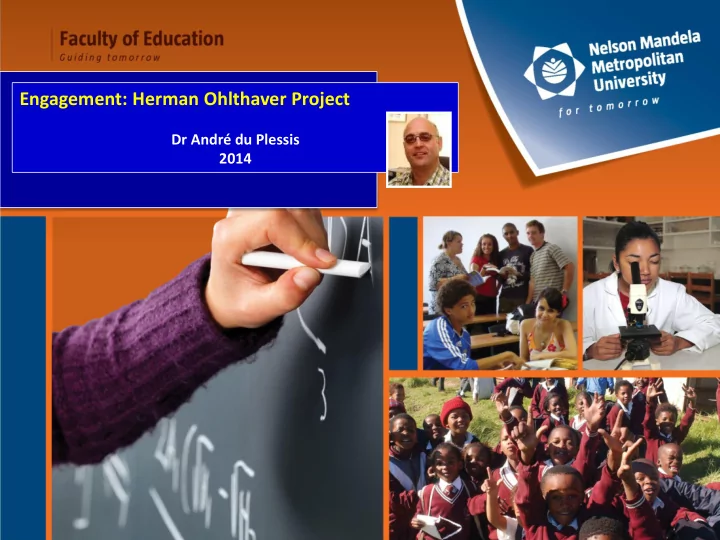
SLIDE 1
Engagement: Herman Ohlthaver Project
Dr André du Plessis 2014
SLIDE 2 What led to the establishment/initiation
(Background Information)
Principals approaching us: Great need for ICT training Sponsors approaching us
SLIDE 3
Duration
Since 2008
SLIDE 4
Engagement categories
Project focus on ALL engagement categories
Community Interaction, Service and Outreach, Teaching and Learning, Research
SLIDE 5
Our Sites
SLIDE 6
Beneficiaries (Target Groups)
Teachers and learners of schools in
La Trobe Primary, Rietberg Primary, Zanoxolo Primary and Sandisulwazi High School in Paterson Zanoxolo Primary is the only urban school located in Motherwell, Port Elizabeth. Emafini & Emfundweni with technical support
SLIDE 7
What have we been doing?
Trained teachers from 8 schools in basic: Word PowerPoint Email Internet search skills Cyber hunting teaching strategy Mathematics software Reading Skills Cartoon Story Maker Paint Skype Science Patterson Cami Maths (Paterson – SAB) Fixing computers Anti-virus Networking Wireless Internet connectivity Workshops on support, etc.
SLIDE 8
WIRELESS INTERNET PROVISION
SLIDE 9 Partners [Stakeholders]
Internally at NMMU
Planners
- Preston Geswindt (Coordinator)
- Dr André du Plessis
Coordinator at Paterson
Technical support
- Eldrige van der Westhuizen
- Stephen Viljoen
- Grant Abbot
- Creswell du Preez
- Connie van Zyl
Overall Support
NMMU Trust
Externally
Herman Ohlthaver Trust SAB
SLIDE 10
Yearly Report
Click here for FULL REPORT
SLIDE 11
Integration of Engagement into the Teaching and Learning, Research and Service functions of NMMU
Apply ICT aspects in Media Module & Maths Method Modules Enable students with ICT skills at school level (not mere computer literacy) Research Papers Local organised conference in 2012 at NMMU Presentations: Locally, Nationally & Internationally – even as Key Notes Speaker
SLIDE 12
Adding value to Teaching and Learning, Research and Service activities
Applying the previous has lead to receiving:
Emerging Teacher of the Year: Faculty of Education (2010) NMMU Teacher of the Year (2011) Teacher of the Year: Faculty of Education (2011) NMMU Faculty of Education: Emerging Researcher of the Year (2012) [Field of Research: ICT in Education] NMMU Emerging Engagement Award for ICT: Best Emerging Engagement Project for ICT in Education in Schools (2012) [Field of Engagement: ICT in Education] HELM LEAD (Higher Education Leadership Management) HESA (Higher Education South Africa) Scholarship (2013) NMMU Distinguished Teacher Award: Prestigious award Awarded for Five Years (2014)
SLIDE 13 Adding value to Teaching and Learning, Research and Service activities Research published in ISI an IBSS indexed journals
Du Plessis, A., & Webb, P. (2012). Teachers’ perceptions about their own and their schools’ readiness for computer implementation: A South African case
- study. Turkish Online Journal of Educational Technology, 11(3), 312-325
Du Plessis, A., & Webb, P. (2012). A teacher proposed heuristic for ICT professional teacher development and implementation in the South African
- context. Turkish Online Journal of Educational Technology, 11(4), 46-55.
Du Plessis, A., & Webb, P. (2012). Digital immigrant teacher perceptions of an extended Cyberhunt strategy. Australasian Journal of Educational Technology, 28(2), 341-363. Du Plessis, A., & Webb, P. (2011). An extended Cyberhunts strategy: Learner centred learning-by-design. Australasian Journal of Educational Technology, 27(7), 1190-1207. DHET accredited journals Du Plessis, A. & Webb, P. (2011). An extended 'learning by design' framework based on learner perceptions. African Journal of Research in Mathematics, Science and Technology Education, 15(2), 16-29. Du Plessis, A. & Webb, P. (2008). Generative use of computers: Promoting critical outcomes of the South African curriculum. Education as Change, 12(1), 15-27.
SLIDE 14 Adding value to Teaching and Learning, Research and Service activities
DHET accredited journals
Du Plessis, A. & Webb, P. (2011). An extended 'learning by design' framework based on learner perceptions. African Journal of Research in Mathematics, Science and Technology Education, 15(2), 16-29. Du Plessis, A. & Webb, P. (2008). Generative use of computers: Promoting critical outcomes of the South African curriculum. Education as Change, 12(1), 15-27.
Articles in refereed journals
Du Plessis, A. & Subramanien, B. (2014). Voices of despair: Challenges of multi-grade teachers in a rural district in South
- Africa. Educational Research for Social Change, 3(1), 20-36.
Du Plessis, A. (2013). Wikis and Power Points as cognitive development tools in Scientific Literacy: A Proposed Heuristic. Problems in Education in the 21st Century. 57, 25-47.
SLIDE 15 Adding value to Teaching and Learning, Research and Service activities
Keynote conference proceedings
Du Plessis, A. (2014). An ICT learning-to-design heuristic to promote science learning: using PowerPoint in an “unintended”
- mode. Keynote presented at the IXth IOSTE SYMPOSIUM FOR
CENTRAL AND EASTERN EUROPE Science and Technology Education for the XXIst Century at the University of Hradec Králové in the Czech Republic, 15 to 17 September 2014. Du Plessis, A. (2013). Wikis and PowerPoints as cognitive development tools in Scientific Literacy. Keynote presented at the International Scientific Conference, “Information & communication technology in natural science education – 2013”, 23-27 October 2013, Siauliai, Lithuania. Du Plessis, A. (2013). A heuristic for ICT implementation in schools and FET colleges. Presentation at 4th Annual ICT in Higher Education, Johannesburg, 18-19 March 2013.
SLIDE 16 Adding value to Teaching and Learning, Research and Service activities
Presenting papers or presentations at discipline-based conferences: Published in proceedings
Du Plessis, A. & Webb, P. (2012). A proposed ICT implementation heuristic for schools in disadvantaged contexts: An African perspective from South Africa. Science & Technology Education for Development, Citizenship and Social Justice, IOSTE 15 Symposium, La Medina - Yasmine Hammamet, Tunisia, October 28 to 03 November 3, 2012. Du Plessis, A. & Webb, P. (2012). A heuristic for higher level student cognitive thinking and questioning through collaborative student designed wiki-based Cyberhunts Seventh International Conference on Science, Mathematics and Technology Education, Muscat, Oman, November 4 to 7, 2012. Du Plessis, A. & Webb, P. (2010). The CRAR3FS2 framework for developing teachers’ ICT skills for Science Education through
- Cyberhunts. Socio-cultural and Human Values in Science and
Technology Education, IOSTE 14 Symposium, Bled, Slovenia. 361-371.
SLIDE 17 Adding value to Teaching and Learning, Research and Service activities Attending and presenting papers or presentations at discipline-based conferences: Not in proceedings
Du Plessis, A. (2013). A heuristic for ICT implementation in schools and FET
- colleges. Presentation at 4th Annual ICT in Higher Education, Johannesburg,
18-19 March 2013. Du Plessis, A. (2012). Can we continue with ICT devices the way we are currently?- The road ahead & A New Internet Teaching Strategy. Presentation at Inspiring Teachers Conference, Nelson Mandela Metropolitan University, Port Elizabeth, South Africa, 03 August 2012. Du Plessis, A. (2011). Internet learning through learners as designers of Extended Cyberhunts: A South African Developed Strategy. Presentation at the Africa Higher-Ed ICT Conference, Johannesburg, 30-31 March 2011. Du Plessis, A. (2010). Action Research might hold the key to improving teachers’ mathematics practices. Presentation at AMESA 2010 Mathematics Conference in Port Elizabeth. Du Plessis, A. (2009). The CRAR3FS2 framework for developing teachers’ ICT skills for e-Education. Presentation and paper at Walter Sisulu University E- Learning Conference on 3-4 November 2009.
SLIDE 18 Trans-disciplinary exchanges and co-operation within NMMU
Cooperate with ICT services
- Eldrige van der Westhuizen
- Stephen Viljoen
- Grant Abbot
- Creswell du Preez
- Connie van Zyl
SLIDE 19 So what have we tried so long?
Enabling and motivating the early majority at school To focus more on particular groups of learners in schools
Training and developing them during school & after school: WHY?
- These learners have to become our co-drivers and
facilitators to …
Teach other learners
- Lead to ‘pressure’ teachers to use ICT
Teach their teachers
SLIDE 20
Benefits of Engagement
Personal Learning – Those who organize, plan and implement it Communities enabled Learners feel important Teachers become ICT enabled Changes in using ICT at classroom & school level NMMU brand is spread – an institution that cares Faculty of Education is promoted Possible MEd & PhD students
SLIDE 21
Un-learning of our traditional ways of doing!!! We stick to the ‘old way’ of doing OR the traditional way!!
Desks in straight lines …
Which often results in …
Losing students
What are some of the problems that we face at school level?
SLIDE 22
The problems our teachers experience (And ENGAGEMENT in general)
First order barriers
Limited, but evolving vision, focus and goals Infrastructure is lacking & computers are getting ‘old’ Department of Education does not provide support Ongoing support is vital Existing participation and sharing of experiences during the implementation process has to be improved Computer skills of colleagues have to be improved, more training is required Time issues have to be addressed Rewards, incentives and training prospects
Second order barriers
Some teachers are still lacking computer skills Confidence related to learning computer skills
SLIDE 23 What should be done?
23
“The secret to learning new things is to be willing to unlearn – even if your behaviors previously brought success” [Marcia Conner]
“And this is very hard and uncomfortable for many” Address the Greatest Barrier: OURSELVES!! Our THOUGHTS & DOINGS
SLIDE 24 Greatest lessons learnt about Engagement in Higher Education
Address First & Second Order Barriers It is NOT easy Takes a GREAT amount of TIME Perseverance Not everyone has the same passion, view, etc.
- n the value of engagement
Do not expect that your engagement will be the ‘silver bullet’ or ‘cure’ Don’t give up
SLIDE 25
Suggestions: How to assist / enable project/ engagement activities
Invest TIME-TIME-TIME and MORE time Use SKYPE Use Screen recording activities that can be viewed in own time Think differently about the “How To” do it
SLIDE 26
Project: Hyperlink
Busy to design NEW website
SLIDE 27
END
Thank you: Any Questions?