End of Year Celebration!! Thursday, May 2, 12:00 2 Jon Kleinberg - - PowerPoint PPT Presentation

end of year celebration
SMART_READER_LITE
LIVE PREVIEW

End of Year Celebration!! Thursday, May 2, 12:00 2 Jon Kleinberg - - PowerPoint PPT Presentation

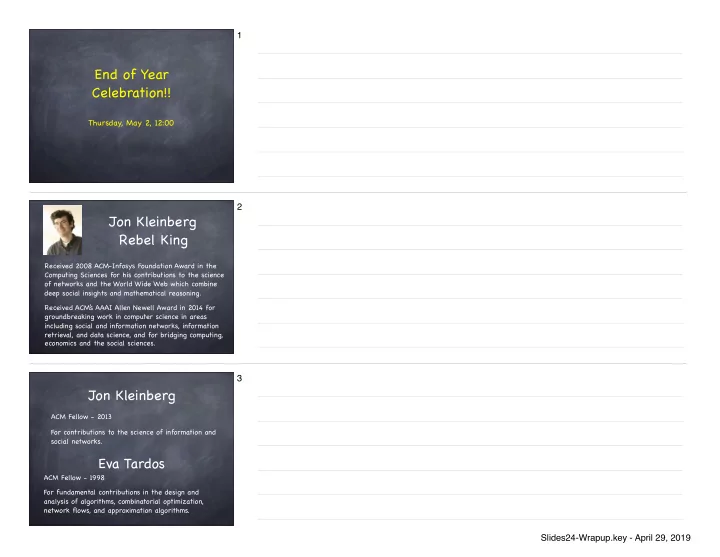
1 End of Year Celebration!! Thursday, May 2, 12:00 2 Jon Kleinberg Rebel King Received 2008 ACM-Infosys Foundation Award in the Computing Sciences for his contributions to the science of networks and the World Wide Web which combine deep


slide-1
SLIDE 1

End of Year Celebration!!

Thursday, May 2, 12:00

1

Jon Kleinberg Rebel King

Received 2008 ACM-Infosys Foundation Award in the Computing Sciences for his contributions to the science

  • f networks and the World Wide Web which combine

deep social insights and mathematical reasoning. Received ACM’ s AAAI Allen Newell Award in 2014 for groundbreaking work in computer science in areas including social and information networks, information retrieval, and data science, and for bridging computing, economics and the social sciences.

2

Jon Kleinberg

ACM Fellow - 2013 For contributions to the science of information and social networks.

Eva Tardos

ACM Fellow - 1998 For fundamental contributions in the design and analysis of algorithms, combinatorial optimization, network flows, and approximation algorithms.

3 Slides24-Wrapup.key - April 29, 2019

slide-2
SLIDE 2

Applications of what we have learned

Graph theory: Used to study large networks found in physical, biological and social sciences O() Do you suppose Google cares? Greedy algorithms: Approximation for problems with no known efficient solutions Divide and conquer: Computational geometry Fast Fourier Transform - used to convert analog information to digital Dynamic programming: Computational biology Internet routing

4

Algorithms Timeline

1962 - Stable Matching Problem defined early 1970s - O() concept formalized 1964 - Priority queues invented 1736 - Euler develops graph theory 1959 - Dijkstra shortest path 1957 - Prim’ s algorithm 1956 - Kruskal’ s algorithm 1945 - mergesort early 1970s - closest pair of points 1957 - beginning of dynamic programming 1961 - Segmented least squares early 1970s - string comparison 1962 - Ford-Fulkerson algorithm early 1970s - NP-completeness defined

5 Algorithms Researchers who have won Turing Award

1972 - Edsger Dijkstra 1974 - Donald Knuth - analysis of algorithms 1976 - Michael Rabin - helped define P and NP 1978 - Robert Floyd - priority queues 1982 - Stephen Cook - NP-completeness 1985 - Richard Karp - network flow, NP-completeness 1986 - John Hopcroft, Robert Tarjan - analysis of algorithms 1993 - Richard Stearns, Juris Hartmanis - foundations of computational complexity theory 1995 - Manuel Blum - computational complexity theory 2000 - Andrew Yao - complexity theory 2012 - Silvio Micali and Shafi Goldwasser - cryptography, complexity theory

6 Slides24-Wrapup.key - April 29, 2019

slide-3
SLIDE 3

Algorithms Research

Approximation algorithms Complexity theory Cryptography Computational biology Computational geometry Scientific computing Machine learning Parallel computation Networks

7

Topics we have not explored

Problems not in NP: planning, games like chess Approximation algorithms Parallel algorithms

8

What is the point of taking this course?

9 Slides24-Wrapup.key - April 29, 2019

slide-4
SLIDE 4

O(), Ω(), Θ() Graph algorithms: BFS, DFS, Bipartite graphs, Topological sort Greedy algorithms: Key is finding an order to sort by Proof techniques: staying ahead, exchange Classic algorithms: MST, Dijkstra’ s Divide and conquer: Key is recursion Using recurrence relations to do O() analysis Dynamic programming: Key is memoization Network flow: Ford-Fulkerson algorithm Key is reducing a problem to be a network flow problem P ?=? NP: limits of what is practically computable

Topics Covered

10 11-1

Please do course evaluations online!

11-2 Slides24-Wrapup.key - April 29, 2019