
SLIDE 1
1
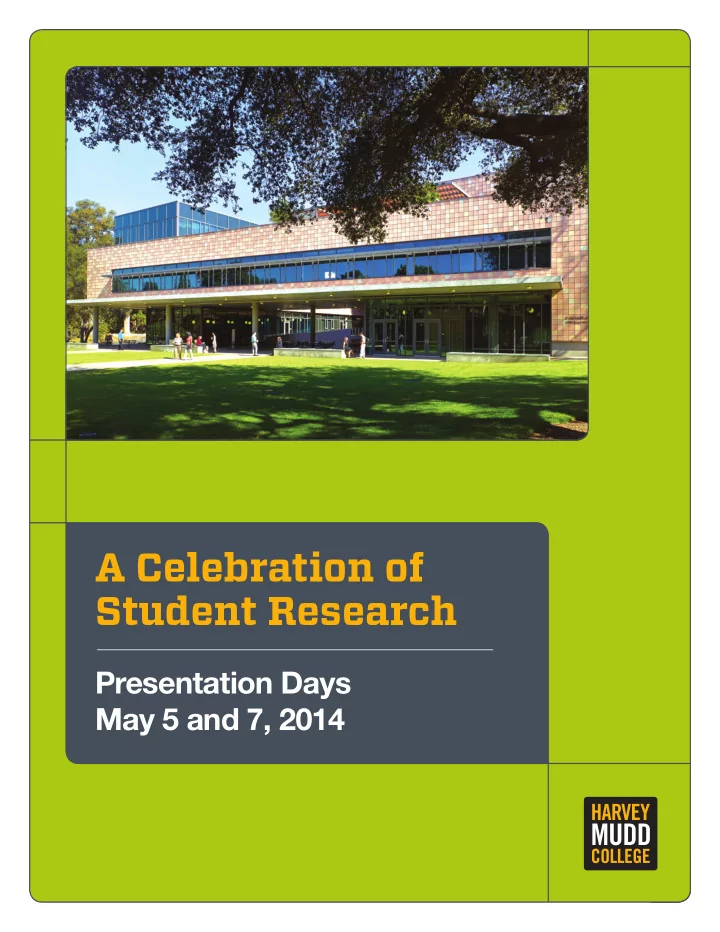
A Celebration of Student Research Presentation Days May 5 and 7, - - PDF document
A Celebration of Student Research Presentation Days May 5 and 7, 2014 1 A Celebration of Student Research Student research is an integral part of the Harvey Mudd College experience, and during Presentation Days each spring, the entire
1
A Celebration of Student Research
Student research is an integral part of the Harvey Mudd College experience, and during Presentation Days each spring, the entire College community is invited to celebrate students’ original proj- ects in design or research. Our students grapple with real-world problems through individual and group research projects across all disciplines. Our professors use research as a powerful teaching tool that promotes learning well beyond the classroom and the laboratory. For many Harvey Mudd students, these intense research opportunities spark a lifelong love for a previously unconsidered fjeld, help them lead diverse teams from many varied disciplines and provide them with the fmexibility to change careers over time. Each year, more than 200 students participate in Presentation Days, and every department at the College is well represented. From groundbreaking individual research done by graduating seniors to engaging and eye-opening design projects done by fjrst-year students, the emphasis throughout Presentation Days is
You’ll fjnd the presentations listed by room and then by time. The 2014 Presentation Days Committee members are Elizabeth Glater, Kash Gokli, Lelia Hawkins, Colleen Lewis, Rachel Mayeri, Michael Orrison, Nicholas Pippenger and Patricia Sparks. Special thanks go to Stephanie Graham, Eric Ditwiler and the Offjce of the Dean of Faculty.
Felicia Marie Agrelius, 28 Ryder Aguilera, 17 Elizabeth L. Allen, 5 Alexander Alves, 17 Clara Amorosi, 11 Fangzhao A. An, 7 Spenser Anderson, 9 Sarah Anderson, 25 Chris Apple, 22 Allison F. Arnold- Roksandich, 6 Ferrel Atkins, 21 Sila Ayoz, 22 Akhil Bagaria, 9 Jacob Tracy Bandes-Storch, 28 Sun Hwi Bang, 29 Tito Barina, 17 Allison Barry, 9 Lakshmi Batachari, 27 Lawrence Beall, 22 Marta Bean, 24 Emily Beeese, 27 Brett Berger, 29 Eric Benjamins, 29 Victor Bhattacharyya, 16 Hayden Blauzvern, 29 Emma Bodell, 22 Evan Bodell, 26 Zane Bodenbender, 25 Caitlyn Bonilla, 21 Kimi Bourland, 25 Amy Brown, 26 Zoe Brown, 24 Berkay Bulut, 22 Cassie Burgess, 26 Eric Caldwell, 17 Andrew Capron, 26 Mike Chaffee, 26 Cherilyn Chan, 27 Julie Chang, 17 Chanel Chang, 22 Jedrik Chao, 26 Alana Chapko, 25 Owen Chapman, 26 Ben Chasnov, 9 Benjamin Junhua Chasnov, 28 Tracy Chasnov, 28 Sorathan Chaturapruek, 6 Gillian Chen, 28 Josephine Chen, 17 Brian Cheney, 22 Scott Chow, 25 Marley Cohen, 28 Tyler C. Cohen, 28 Michael Culhane, 16 Robert Cyprus, 26 Samuel DeRose, 9 Danie Diamond, 24 Mario Diaz, 26 Sam Dietrich, 25 Phillip Diffmey, 21 Jaron P. Kent-Dobias, 14 Alistair Dobke, 22 Neftali Dominguez, 16 Andrew Donelick, 24 Priya L. Donti, 16 Caleb Eades, 21 Mary Elise Elam, 28 Rami Elminyawi, 9 Samantha Englert, 28 Noelle Fa-Kaji, 16 Conor Fanlo, 25 Matias Farfan, 9 Brian C. Fielder, 5 Austin Fikes, 17 Emily M. Fischer, 6 Emma Frederick, 22, 28 Alejandro Jose Frias, 28 Aaron Friend, 26 Lisa Gai, 20, 28 Eva Gao, 19 Abhishek Goenka, 28 Madeline Rose Goldkamp, 28 Christian Gomez, 24 Eddie Gonzales, 17 Nick Gott, 25 Thendral Govindaraj, 17 Christian Guerrero, 21 Deval Gupta, 25 Samuel C. Gutekunst, 6 Fabiha Hannan, 17 Kaitlin Hansen, 17 Lillian E. Haynes, 11 Lisa Hazelton, 10 Jacob Higle-Ralbovsky, 17 Christopher Hirlinger, 24 Joanna Ho, 26 Cherie Ho, 27 Jane Elizabeth Hoffswell, 28 Yeahmoon Hong, 24 Molly Horgan, 28 Karen Hou, 24 Mitch Horning, 28 Tyler Hoyle, 28 Siyi Hu, 27 Xin Huang, 17 Leonardo Huerta, 27 Leah Rose Hughes, 28 Cecily Beatrice Hunt, 28 Aric Hunter, 29 Sidra Hussain, 11 Jessica Iwamoto, 17 Lydia G. Jahl, 4 Jerome Jahn, 27 Chandler Philip Jennings, 28 Andrew Jevsevar, 29 Meghan C. Jimenez, 28 Cory Johnson, 17 Maya Johnson, 22 Paul Jolly, 17 Ryan Jones, 21 Kathryn Jones, 26 Jesse Joseph, 27 Marisa Kager, 25 Lucy Kaye, 25 Lauren Kecskes, 24 Eliana Keinan, 27 Jaron Kent-Dobias, 14 David Khatami, 21 Sooyeol (Suzy) Kim, 17 Solhee Kim, 26 Kaitlin Kimberling, 17 Sebastian Krupa, 17 Shreyas Kumar, 14 Nicole Kyle, 17 Sherman Lam, 17 Joshua Ryan Lam, 27 Kirklann Lau, 17 Alexa Le, 26 Alex B. Lee, 10 Julia S. Lee, 5 Daniel Lee, 9 Kelly Lee, 29 Minji Lee, 28 Pichaya Lertvilai, 9 Calvin Leung, 27 Sabrina Li, 26 Angelo Liao, 22 Jeremy Lim, 25 David Lingenbrink, 6 Jeannette Liu, 17 Maggie Liu, 17, 22 Robyn Low, 18 Morgan Luckey, 23 Frank Lui, 22 Jonathan Lum, 25 Jack Yunung Ma, 28 Kazuho Maeda, 27 Noah Marcus, 25 Rose Martin, 17 Jerry Martinez, 26 Christian Taylor Mason, 28 Lucas G. Mastalli-Kelly, 8 Camille Matonis, 26 Dan McCabe, 26 James McConnaughey, 22 Kelly McConnell, 25 Matthew McDermott, 7 Jozefa McKiernan, 9 Peter Megson, 14, 28 Bryan Mehall, 17 Kunal Menda, 17 Nithya Menon, 9 Zach Miller, 25 Nathan Miller, 25 Tatsu Monkman, 21 Bryan Roman Monroy, 28 Thomas Morgan-Witts, 9 Katherine Muller, 23 Samantha Elizabeth Munoz, 28 Audrey Musselman-Brown, 11 Azubuike Isaiah Ndefo-Dahl, 28 Angela Ng, 17 Amy Ngai, 17 Daniel Nguyen, 26 Huy Nguyen, 17 Monique Nguyen, 24 Nga Nguyen, 25 Phuong Nguyen, 26 Triet Nguyen, 9 Sarah Nichols, 9 Caroline Nielsen, 17 Lauren Nishizaki, 22 Angad Ohri, 28 Rachel O’Neill, 27 Cierra Owens, 22 Alex Ozdemir, 25 Sarah Paek, 9 Natasha A. Parikh, 12, 27, 28 Miranda Chantelle Parker, 24, 28 Sophie Parks, 19, 24 Sheena K.K. Patel, 8, 21 Anastasia Patterson, 4 Raunak Pednekar, 27 Elyse Pennington, 27 Scout Pepper, 25 Joana Perdomo, 17 Jonathan Perez, 17 Paul Picciano, 26 Richard Piersall, 9 Weerapat Pittayakanchit, 28 Brennan C. Plassmeyer, 12, 20, 29 Alex Putman, 16 Alexander Merrifjeld Putman, 28 Xiaoyin Qu, 29 Maggie Rabasca, 17 Ralitsa Racheva, 21 Juan Ramirez, 26 Alex Rich, 17 India Richter, 24 Paige Rinnert, 27 Kelly Robertson, 9 Charlotte Robinson, 26 Aaron Rosen, 17 Tim Rotolo, 29 Alberto J. Ruiz, 7 Lydia Scharff, 27 Stephen Schein, 17 Adam Schiller, 17 Arielle Schlesinger, 16 Emily Schooley, 27 Michelle Schultz, 28 Brittani A. Serna, 28 Alexa Serrato, 12 Sejal Shah, 4, 22 Victor Shang, 29 Jennifer Sharma, 15, 21 Apoorva Sharma, 9 Ivan Shaw, 22, 26 Katherine Rose Shepherd, 28 Tongjia Shi, 12 Lauren Shull, 20 Joe Sinopoli, 26 Paul Slaats, 25 Tyler Smallwood, 25 Nicholas Smith, 28 In Sung Song, 9 Ian Song, 27 David C. Spierings van der Wolk, 8 Aarthi Sridhar, 28 Sid Srinivasan, 29 Christian Stevens, 18 Holly Strickland, 21 Aaron Stringer-Usdan, 26 Frances Yenan Su, 22, 28 Nicole Subler, 17 Ankit Sud, 29 Carling Sugarman, 13 Jessica Szejer, 9 Ben Teng, 17 Avi Thaker, 17 Brianna Leilani Thielen, 28 Rebecca Ann Thomas, 28 Margaret Thompson, 22 Miranda Thompson, 21 Jacqueline Tran, 24 Zoe Tucker, 25 Andrew P. Turner, 13 Jack Tyndall, 29 Jeremy B. Usatine, 13 Joshua Austin Vasquez, 28 Mitul Verma, 29 Michelle L. Vick, 15 Ana Villa, 9 Kangni Wang, 25 Olivia Warren, 23 Alex Washburn, 24 Maxwell Waugaman, 9 Alanna L. Weisberg, 8 Tyler West, 28 Matt Wilber, 29 Lauren N. Winkler, 10 Garrett T. Wong, 20 Wai Sing Wong, 27 Kira Wyld, 26 Daniel Xie, 9 Ashuka Xue, 17 Andrew J. Yandow, 15 Tiancheng Yang, 9 Chanud Yasanayke, 26 Beverly O. Yeh, 19 Bruce YH Yan, 28 Lucy Yu, 26 Christopher J. Zazueta, 18, 24 Christina Zeeb, 9 Jordan D. Zesch, 15 Sherry Zhang, 24 Shiyu Zhang, 27 Laura Xin Zhang, 28 Mo Zhao, 9 Carmel Zhao, 25 Anna Zimmerman, 25 Hannah Zosman, 26 Willie Zuniga, 25
Index of Presenters
2 Recital Hall Shanahan 1430 Shanahan B460 Shanahan 2421 Shanahan 2425
10:30 a.m.
Shah Arnold-Roksandich An DeRose, Nichols, Song, Xie Bagaria, Chasnov, Sharma, Piersall
10:45 a.m.
Jahl Chaturapruek Ruiz
11:00 a.m.
Patterson Fischer Weisberg Anderson, Elminyawi, Farfan, Villa Barry, Morgan-Witts, Robertson, Szejer, Zeeb
11:15 a.m.
Allen Gutekunst Spierings van der Wolk
11:30 a.m.
Fielder Lingenbrink Mastalli-Kelly McKiernan, Menon, Paek, Waugaman Lee, Lertvilai, Nguyen, Yang, Zhao
11:45 a.m.
McDermott Patel
Noon–1:30 p.m.
LUNCH
1:30 p.m.
Hazelton Serrato Vick Kim, Mehall, Nielsen, Rabasca Caldwell, Fikes, Iwamoto, Liu, Schiller
1:45 p.m.
Bo Lee Shi Sharma
2:00 p.m.
Winkler Sugarman Yandow Ng, Ngai, Perez, Rosen Krupa, Sebastian, Lam, Lau, Rich
2:15 p.m.
Musselman-Brown Usatine Zesch
2:30–3 p.m.
REFRESHMENTS AT THOMAS-GARRETT PLAZA
3 p.m.
Haynes Turner Donti Alves, Barina, Govindaraj, Hannan Aguilera, Gonzales, Johnson, Martin
3:15 p.m.
Amorosi Kent-Dobias
3:30 p.m.
Hussain Kumar Putman Liu, Kimberling, Hansen, Nguyen Chang, Higle-Ralbovsky, Jolly, Menda
3:45 p.m.
Plassmeyer Megson
4 p.m.
Parikh ICM/MCM Culhane Thaker, Subler, Xue, Teng, Perdomo Chen, Huang, Kyle, Schein
4:15 p.m. 4:30 p.m.
Bhattacharyya, Dominguez, Fa-Kaji, Schlesinger
4:45 p.m.
Monday, May 5
Biology Chemistry Computer Science Engineering Mathematics Physics Humanities, Social Sciences, and the Arts
10–10:30 a.m.
REFRESHMENTS AT THOMAS-GARRETT PLAZA
Recital Hall Shanahan B442 Shanahan 1430 Shanahan 2450 Shanahan 2454 Parsons 1287
8:30 a.m.
Stevens HSA10 Astronomy 62
8:45 a.m.
Low
9 a.m.
Zazueta
9:15 a.m.
Gao Fredrick, Johnson
9:30 a.m.
Parks Thompson, Bodell
9:45 a.m.
Lui, McConnaughey, Dobke
10–10:30 a.m.
REFRESHMENTS AT THOMAS-GARRETT PLAZA
10:30 a.m.
Yeh HSA10 Astronomy 62 Apple, Liu
10:45 a.m.
Wong Chang, Su
11 a.m.
Shull Nishizaki, Shah
11:15 a.m.
Plassmeyer Ayoz, Bulut
11:30 a.m.
Gai Owens, Cheney
11:45 a.m.
Shaw, Beall, Liao
Noon–1:30 p.m.
REFRESHMENTS AT THOMAS-GARRETT PLAZA
1:30 p.m.
Muller Bourland, Miller, Ozdemir, Wang Ramirez, Shaw, Stringer-Usdan, Wyld
1:45 p.m.
Warren Tucker, Slaats, Bodenbender, Dietrich Yu, McCabe, Le, Jones
2 p.m.
Tweedy Chapko, Kaye, Miller, Zimmerman Bodell, Diaz, Friend
2:15 p.m.
Luckey Kager, Nguyen, Smallwood Brown, Martinez, Chaffee
2:30–3 p.m.
BREAK
3 p.m.
Donelick HIV/AIDS Anderson, Fanlo, McConnell, Zhao Leung, Rinnert, Zhang
3:15 p.m.
Marcus, Chow, Pepper, Lum Batachari, Hu, Jahn, Song
3:30 p.m
Gott, Gupta, Lim, Zuniga Maeda, Huerta, Wong, Pednekar
3:45 p.m.
Burgess, Cyprus, Nguyen, Picciano Ho, Lam, Parikh, Schooley
4 p.m.
Kim, Matonis, Sinopoli, Zosman Joseph, O’Neill, Scharff
4:15 p.m.
Robinson, Nguyen, Yasanayke, Chao Beese, Chan, Keinan, Pennington
4:30 p.m.
Capron, Chapman, Ho, Li
4:45 p.m. 5 p.m. 5:15 p.m. 6–8 p.m.
Art Show in Art Gallery
8–10 p.m.
Jazz Concert in Recital Hall Music of Bud Powell
Wednesday, May 7
3
4
Monday, May 5 | Morning
10 a.m. Refreshments at Thomas-Garrett Plaza
Drinkward Recital Hall Chemistry
10:30 a.m. Sejal V. Shah: A Homologous Series of Porphyrin Dyes for Dye-Sensitized Solar Cells Advisor: Hal Van Ryswyk, professor of chemistry and Chair, Department of Chemistry Dye-sensitized solar cells (DSSCs) are a promising alternative to silicon solar cells. DSSCs, made of an inexpensive semiconductor, a dye and an electrolyte, are cheaper to manu- facture, but they need to be more effjcient to effectively compete with silicon solar cells. A series of fmuorinated zinc porphyrins were synthesized for use as potential dyes. The effjciency and surface chemistry of these dyes were investigated. 10:45 a.m. Lydia G. Jahl: Chemical Composition and Light Absorption Properties of Claremont Ambient Air and Po Valley Fog Water Advisor: Lelia Hawkins, Barbara Stokes Dewey Assistant Professor of Chemistry The chemical composition and solar radiation absorption properties of aerosols and fog water are important because of the effects these properties can have on the climate. Atmospheric samples contain compounds that absorb light, and this radiative forcing may be signifjcant. Absorption spectra of Claremont ambient air and Po Valley fog water were taken in a Liquid Waveguide Capillary Cell with a UV-Visible spectrophotometer. Ion chromatography and a Total Organic Carbon analyzer were used to fjnd concentrations
Beer’s law with regard to the organic carbon content. Data analysis reveals diurnal trends in air pollution and possible sources of light-absorbing compounds. 11 a.m. Anastasia L. Patterson: Zinc Oxide Nanorod and Nanotube Photoanodes for Dye-Sensitized Solar Cells Advisor: Hal Van Ryswyk, professor of chemistry and chair, Department of Chemistry Dye-sensitized solar cells (DSSCs) have the potential for being a low-cost, scalable com- mercial energy resource, and offer an alternative to single-crystal silicon photovoltaics. This project focused on the production and characterization of the photoanode component
cess and tested to investigate the feasibility of inexpensive, solution-processed nanostruc- tures and their performance.
5 11:15 a.m. Elizabeth L. Allen: Dehalogenation of Groundwater Pollutants by Cobaloximes Advisor: Katherine Van Heuvelen, assistant professor of chemistry This project explored the dechlorination of carcinogenics found in groundwater through-
alkenes in certain anaerobic bacteria. In hopes of elucidating its mechanism, we have synthesized a series of cobalt-containing molecules called cobaloximes that model B12. Exposure of these models to a reducing agent and a proton donor is known to release less-chlorinated organic products, a phenomenon that Van Heuvelen summer researchers confjrmed in 2013. I aimed to study the roles of the different reagents involved and explore how adjustments in their reactivity and stoichiometry alter product formation. Most of my work focused on the development of a reaction procedure that results in systematically detectable products. 11:30 a.m. Brian C. Fielder: Synthesis of Novel Chitosan-Antioxidant Conjugates Advisors: Shenda Baker, professor of chemistry; Andrew P . Duncan, Synedgen Inc. Chitosan is an abundant polysaccharide derived from shrimp shells. It is soluble in water at low pH and has a variety of interesting biological properties. The chitosan derivative poly(acetyl, arginyl)glucosamine (PAAG) is a conjugate of the amino acid arginine and
as a therapeutic. Deferoxamine is a bacterial iron chelator and antioxidant. We are synthe- sizing the novel chitosan-deferoxamine and PAAG-deferoxamine conjugates as a means of selectively delivering the antioxidant to cell surfaces. We hope to use these conjugates to treat or prevent free radical damage to cells. 11:45 a.m. Julia S. Lee: Synthesis and Characterization of a Chitosan Derivative Advisor: Shenda Baker, professor of chemistry; Andrew P . Duncan, Synedgen, Inc. Chitosan, a copolymer of glucosamine and N-acetylglucosamine, has been shown to have antimicrobial activity at low pH. However, chitosan is insoluble at physiological pH, reduc- ing its utility as an antimicrobial agent. A water-soluble chitosan derivative was developed previously by functionalizing chitosan with the positively charged amino acid arginine, and that conjugate was observed to have antibacterial properties similar to chitosan. In order to explore the effects of positive charge on chitosan conjugates’ solubility and activity, we have synthesized an ornithine-chitosan conjugate and investigated its antimicrobial activi-
terizing the conjugate’s bioactivity. Noon– 1:30 p.m. Lunch
6
Shanahan 1430 | Morning Mathematics
10:30 a.m. Allison F . Arnold-Roksandich: L-Functions and Arithmetic Functions Advisor: Christopher Towse, associate professor of mathematics, Scripps College L-functions are an interesting area of number theory because of their ability to encode
arithmetic functions can be related to the Riemann Zeta-function through L-functions. This talk will discuss the encoding of arithmetic functions and their relation to the Riemann Zeta-function. 10:45 a.m. Sorathan Chaturapruek: A Mathematical Framework for Unmanned Aerial Vehicle Obstacle Avoidance Advisors: Weiqing Gu, professor of mathematics; Zachary Dodds, Leonhard-Johnson-Rae Professor of Computer Science The obstacle avoidance navigation problem for Unmanned Aerial Vehicles (UAVs) is a very challenging problem. It lies at the intersection of many fjelds such as probability, differential geometry, optimal control and robotics. We build a mathematical framework to solve this problem for quadrotors using both a theoretical approach through a Hamiltonian system and a machine-learning approach that learns from human sub-experts’ multiple demon- strations in obstacle avoidance. Prior research on the machine-learning approach uses an algorithm that does not incorporate geometry. We have developed tools to solve and test the obstacle avoidance problem through mathematics. 11 a.m. Emily M. Fischer: Infinitely Many Rotationally Symmetric Solutions to the Semilinear Laplace-Beltrami Equation on the Unit Sphere Advisor: Alfonso Castro, professor of mathematics We show that on the unit sphere, the semilinear Laplace-Beltrami Equation has infjnitely many solutions that are rotationally symmetric about some axis. This equation corre- sponds to a singular ordinary differential equation, which we solve using energy analysis and phase plane analysis. We obtain a Pohozaev-type identity to prove that the energy is continuously increasing with the initial condition and then use phase plane analysis to prove the existence of infjnitely many solutions. 11:15 a.m. Samuel C. Gutekunst: Characterizing Forced Communication in Networks Advisor: Susan Martonosi, associate professor of mathematics Research into the load maximization problem has been proposed as a novel way to disrupt communication networks. Inherent to this method is the concept of load, representing the amount of communication forced through a vertex in such networks. We will begin by de- fjning and motivating load as a property of graphs. We will then summarize combinatorial, spectral and structural approaches we have pursued, emphasizing research that begins to combinatorially characterize load as a graph property. 11:30 a.m. David Lingenbrink: New Subgroups of the Finite Affine Group Advisor: Michael Orrison, Avery Professor of Mathematics The fjnite affjne group is a matrix group whose entries come from a fjnite fjeld. A natural subgroup consists of those matrices whose entries all come from a subfjeld instead. I will introduce intermediate subgroups with entries from both the fjeld and a subfjeld. I will also examine the representations of these intermediate subgroups as well as the resulting branching diagram for the subgroup chain.
7 11:45 a.m. Matthew McDermott: Fast Algorithms for Analyzing Partially Ranked Data Advisors: Michael Orrison, Avery Professor of Mathematics Imagine your local creamery administers a survey asking their patrons to choose their fjve favorite ice cream fmavors. Any data collected would be an example of partially ranked data, as the set of all possible fmavors is only ranked into groups of the chosen fmavors and the not-chosen fmavors. If your creamery asks you to help analyze this data, what ap- proaches could you take? One approach is to use the natural symmetries of the underlying data space to break down any data set into smaller parts that can be more easily under-
create and study effjcient algorithms that yield such decompositions. Noon– 1:30 p.m. Lunch
Shanahan B460 | Morning Physics
10:30 a.m. Fangzhao A. An: Experimental Realization of Slowly Rotating Light Advisor: Theresa Lynn, associate professor of physics A light beam and its constituent photons can carry spin angular momentum (from a rotating electric fjeld vector) or orbital angular momentum (from a rotating fjeld amplitude pattern). Angular momentum of visible light can be crucial in determining light-matter inter- actions, but the rotations occur at hundreds of terahertz and are observed only indirectly. In contrast, slowly rotating light can be generated by superposing modes of light with slightly detuned frequencies; some of these superpositions have been predicted to carry angular momentum with sign opposing their direction of slow rotation. I show experimental realization of slowly rotating spin superpositions, present continuing theoretical questions and outline future experiments with orbital angular momentum superpositions. 10:45 a.m. Alberto J. Ruiz: Simultaneous Collection of Resonance Raman and Fluorescent Signatures Using a 405 nm Excitation Source Advisors: Gregory Lyzenga ’75, professor of physics; Michael Storrie-Lombardi P13, visiting professor, University of Florida Astrobiology Raman scattering (RS) is the result of inelastic collisions between photons and the elec- tronic shell of a molecule. The shift in photon energy is information rich, but RS occurs less frequently than Rayleigh scattering and fmuorescence. Exciting a molecule within its maximum absorption band can increase RS by three orders of magnitude if the Raman signal can be separated from co-existent fmuorescence. The resulting technique, Reso- nance Raman Spectroscopy (RRS), can chemically characterize organic targets without sample preparation. High-resolution RRS has been achieved for fmuorescing targets using Shifted Excitation Raman Spectroscopy (SERDS) for lasers operating at 783, 671, and 488
405 nm laser diodes.
8 11 a.m. Alanna L. Weisberg: Physical Attributes and Assembly of PEG-linked Immuno-labeled Gold Nanoparticles for OCM Image Contrast in Tissue Engineering and Developmen- tal Biology Advisors: Richard Haskell, Burton G. Bettingen Professor of Physics; Elizabeth Orwin ’95, professor of engineering In developing an artifjcial human cornea replacement, we are immuno-labeling human corneal fjbroblasts with gold nanoparticles to visualize the cells and their phenotypes. We see excessive nonspecifjc binding when labeling cells with PEG-linked immuno-labeled gold nanoparticles (IgG-AuNPs). We have investigated the physical properties of IgG- AuNPs assembled with three different protocols in an attempt to understand and eliminate this nonspecifjc binding. Two of these protocols bind the antibody with a PEG-linker. We monitor the hydrodynamic radius and surface plasmon resonance (SPR) at each stage of
PEG-linker is bound to gold fjrst and then bound to the antibody second rather than vice versa. 11:15 a.m. David C. Spierings van der Wolk: Manipulating the Orbital Angular Momentum of Entangled Photons from Spontaneous Parametric Down-Conversion Advisor: Theresa Lynn, associate professor of physics Quantum entanglement is an important resource in numerous quantum communication protocols, and the orbital angular momentum (OAM) of light offers a means of encoding more information per photon than established schemes based solely on two-state vari- ables, such as polarization. However, precise measurement and manipulation of OAM-en- tangled photon pairs remains a challenge. Using a combination of phase holograms and single-mode optical fjbers, our research group measures correlations between the OAM of photon pairs produced by spontaneous parametric down-conversion (SPDC). I present ef- forts to improve OAM entanglement measurements by addressing the complicated spatial mode structure inherent to the use of SPDC as a source for entangled photons. 11:30 a.m. Lucas G. Mastalli-Kelly: Maximizing Optical Path Length in a Thin Multilayer Solar Cell Advisor: Peter Saeta, professor of physics and chair, Department of Physics We model the absorption enhancement in thin multilayer solar cells caused by scattering from embedded dipole scatterers. By re-examining the coupling between the dipole and fjeld orientations used in prior work, we fjnd new limits on the enhancement possible in a variety of thin-fjlm solar cell geometries using realistic dipole properties. 11:45 a.m. Sheena K.K. Patel: Anomalous Hall Measurements of Co/Tb Multilayers That Exhibit All-optical Switching Advisor: James Eckert, professor of physics All-optical switching has been observed in rare earth-transition metal (RE-TM) alloys. The RE and TM sublattices couple to each other antiferromagnetically and have a character- istic magnetic compensation temperature where the net magnetization is zero. Measure- ments of the Anomalous Hall effect were used to track the magnetic reversal of Co/Tb multilayers with structure [Ta(4 nm)/[Co(t)/Tb(t)]xN/Ta(4 nm)] with constant Co:Tb ratio and total thickness of 25 nm. Divergence of the coercive fjeld near the magnetic compensation temperature was observed for these samples at temperatures that decreased from 390 K for the sample with the thinnest layers to 247 K for the sample with thickest layers, indicat- ing that the polarized moment in the Tb layer is reduced as the layer thickness increases. Noon– 1:30 p.m. Lunch
9
Shanahan 2421 and 2425 | Morning Engineering
E80 Experimental Engineering Advisors: Chris Clark, associate professor of engineering; Jon Roberts ’93, adjunct professor of engineering; Erik Spjut, professor of engineering and Union Oil Company Engineering Design Fellow; Qimin Yang, associate professor of engineering Sophomores in the Experimental Engineering course engage in hands-on laboratory work to fmy instrumented model rockets as a team and then analyze and report on their data—all with the goal of learning fundamental principles applicable to multiple engineering disci-
from their fmights compared with their expectations. Room 2421 10:30–11 a.m. Samuel DeRose, Sarah Nichols, In Sung Song, Daniel Xie 11–11:30 a.m. Spenser Anderson, Ramy Elminyawi, Matias Farfan, Ana Villa 11:30–Noon Jožefa McKiernan, Nithya Menon, Sarah Paek, Maxwell Waugaman Room 2425 10:30–11 a.m. Akhil Bagaria, Ben Chasnov, Apoorva Sharma, Richard Piersall 11–11:30 a.m. Allison Barry, Thomas Morgan-Witts, Kelly Robertson, Jessica Szejer, Christina Zeeb 11:30–Noon Daniel Lee, Pichaya Lertvilai, Triet Nguyen, Tiancheng Yang, Mo Zhao
10
Monday, May 5 | Afternoon
Drinkward Recital Hall Biology
1:30 p.m. Lisa Hazelton: Modeling the Growth of the Barnacle Balanus glandula Advisors: Sarah Gilman, W.M. Keck Science Department; Catherine McFadden, Vivian and D. Kenneth Baker Professor in the Life Sciences and chair, Department of Biology Increases in average air and water temperatures due to global climate change will espe- cially affect intertidal organisms such as the barnacle Balanus glandula, which inhabits both aquatic and terrestrial environments. Dynamic energy budget (DEB) models have been used to successfully model the growth of other marine invertebrates. A DEB model predicts an organism’s energy use and intake from its body size, food supply and tempera-
tal conditions. This model can then be extended to predict growth in response to global climate change for B. glandula living in an intertidal environment. 1:45 p.m. Alex B. Lee: Circumnutation in Wild Cucumbers Advisors: Stephen Adolph, Stuart Mudd Professor of Biology; Anna Ahn, associate profes- sor of biology; Sharon Gerbode, assistant professor of physics Since the time of Darwin, biologists have been interested in plants that climb surrounding structures to gain access to the sun. Echinocystis lobata, a wild cucumber, uses tendrils to
common in growing plants. While past studies simply track the tip of the plant in 2-D space during circumnutation, we hope to understand the mechanisms of circumnutation by creating quantitative 3-D reconstructions of the entire tendril. Our mechanical model, which approximates the tendril as a rod bent by gravity, is made to mimic circumnutation by altering the rod’s intrinsic curvature. This model is compared to the reconstructions to understand the nature of the motor that drives circumnutation. 2 p.m. Lauren N. Winkler: Stationary Phase Degradation of ß-Galactosidase in Escherichia coli Advisor: Daniel Stoebel, assistant professor of biology The ß-galactosidase assay has long been regarded as an easy and reliable method for assessing the output of lacZ transcriptional fusions in Escherichia coli genetic studies. As the rate of lacZ transcriptional initiation increases or decreases, intracellular levels of ß-ga- lactosidase should follow suit. ß-galactosidase activity should therefore serve as a faithful proxy for lacZ expression. In order for this relationship to hold, however, ß-galactosidase degradation must occur more rapidly than any fmuctuations in the rate of lacZ transcrip- tional initiation. My data indicate that stationary phase ß-galactosidase persists in excess
levels of transcriptional initiation during stationary phase.
11 2:15 p.m. Audrey Musselman-Brown: Cophylogenetic Reconciliation of Mutualistic Species Advisors: Ran Libeskind-Hadas, R. Michael Shanahan Professor of Computer Science and chair, Computer Science Department; Catherine McFadden, Vivian and D. Kenneth Baker Professor in the Life Sciences and chair, Department of Biology Phylogenetic tree reconciliation is an important problem in biology because it allows bi-
currently exist for fjnding reconciliations between groups of parasite species and their
assumptions made by host-parasite algorithms may not be valid for trees of mutualists. I have developed an algorithm specifjcally designed for use with mutualistic species that produces simpler, more biologically plausible reconciliations than the available algorithm for host-parasite species. 2:30– 3 p.m. Break 3 p.m. Lillian E. Haynes: Exploring the Neuronal and Genetic Basis of Food Choice in Caenorhabditis elegans for Bacteria Found in its Natural Habitat Advisor: Elizabeth Glater, assistant professor of biology Understanding food choice behavior is key to understanding human obesity and eating-re- lated disorders. We used the nematode Caenorhabditis elegans to understand the neuronal and genetic basis of food choice. To determine the neurons involved in choosing among bacteria from the natural habitat of C. elegans, we used mutant worm strains defective in specifjc neurons and rescue strains (mutant strains with normal function restored in one neuron). To visualize how sensory neurons drive food-choice decisions, the activity of the sensory neuron AWC was measured in in freely moving worms using fmuorescent indicator GCaMP3.0. Finally genetically different strains of C. elegans were screened for differences in food preference to understand how natural genetic differences affect food choice. 3:15 p.m. Clara Amorosi: The Metabolic Niche of RpoS in Escherichia coli Advisor: Daniel Stoebel, assistant professor of biology Bacteria are remarkably adept at responding to different stressors. In particular, sigma factors, which allow bacteria to regulate gene expression, are highly relevant to bacterial stress protection. RpoS is an alternative sigma factor in Escherichia coli that controls the general stress response by regulating up to 10 percent of the genome. It has been pro- posed that RpoS is involved in a tradeoff between bacterial self-preservation and nutri- tional competency. To further test this, I developed a procedure to measure the impact of RpoS levels in a strain of E. coli on the metabolism of a number of energy sources. This investigation provides a more complete picture of the role of RpoS in bacterial regulation
3:30 p.m. Sidra Hussain: Modeling the Evolution of Genetic Trade-offs Advisor: Stephen Adolph, Stuart Mudd Professor of Biology An evolutionary trade-off refers to a situation in which an allele or trait increases fjtness in one way and decreases it in another. Computational population simulations were used to model quantitative traits and explore genetic trade-offs. Simulations of the trajectory
strengths of selection could give rise to or affect the equilibrium of trade-offs. For example, simultaneous selection on two traits controlled by a single trade-off locus led to a negative correlation between the traits under certain conditions.
12 3:45 p.m. Brennan C. Plassmeyer: Bio 198 Independent Study in Experimental Ecology Advisor: Catherine McFadden, Vivian and D. Kenneth Baker Professor in the Life Sciences and chair, Department of Biology In my independent study Experimental Ecology laboratory course, I designed and carried
species diversity, habitat associations and effects of abiotic and biotic factors on growth rates of organisms. I will present the results of one of the experiments that I completed during this semester, focusing on its experimental design, implementation and analysis. 4 p.m. Natasha A. Parikh: Visual Selective Attention to Pleasant Foods: A Neurological Study Advisors: Elizabeth Glater, assistant professor of biology; Catherine L. Reed, professor of psychology, Claremont McKenna College Food is advertised everywhere, but Americans struggle with obesity and eating disorders. The mixed media creates a confmict: Should we pay attention to food or avoid it for health’s sake? Using high-density electroencephalography, I investigated the neural substrates of selective visual attention to food cues and whether these neural markers were modulat- ed by people’s eating behaviors and body satisfaction. Hungry participants performed a dot-probe attention task that cues a food and a non food. After eating one food, they were tested again to determine if their attention to specifjc food cues changed as a result of
Shanahan 1430 | Afternoon Mathematics
1:30 p.m. Alexa Serrato: Reed’s Conjecture and Cycle-Power Graphs Advisor: Nicholas Pippenger, professor of mathematics Reed’s conjecture is a proposed upper bound for the chromatic number of a graph. Reed’s conjecture has already been proven for several families of graphs. I show how one of those families of graphs can be extended to include additional graphs and also show that Reed’s conjecture holds for a family of graphs known as cycle-power graphs, and also for their complements. 1:45 p.m. Tongjia Shi: Random Permutations Advisor: Nicholas Pippenger, professor of mathematics Random permutations are among the most natural mathematical structures, but we still don’t know everything about them. Here, we will focus on the ordered cycle lengths of a random permutation and ask questions like, “What’s the expected length of the short- est cycle in a very large random permutation?” Historical research has given partial and complicated results, which are unsatisfactory considering the simplicity of the problem. We will complete the missing results and provide a unifjed description for the ordered cycle lengths of these random permutations.
13 2 p.m. Carling Sugarman: Using Topology to Explore Mathematics Education Reform Advisor: Jon Jacobsen, associate professor of mathematics Mathematics education is a constant topic of conversation in the United States. Many attempts have been made historically to reform teaching methods and improve student
more applicable and enjoyable. Many have additionally tackled the widespread problem
shift focus from speed and accuracy. In my project, I explored past reform goals and some added goals concerning students’ perceptions of mathematics. To do so, I created and tested a pilot workshop in topology, a creative and intuitive fjeld, for use in fourth- through sixth-grade classrooms. Preliminary results suggest some success in altering student views on mathematics. 2:15 p.m. Jeremy B. Usatine: Arithmetical Graphs and the Frobenius Number Advisors: Dagan Karp, assistant professor of mathematics; Melody Chan, National Science Foundation postdoctoral fellow and lecturer, Harvard University If R is a list of positive integers with greatest common divisor equal to 1, calculating the Frobenius number of R is in general NP-hard. Dino Lorenzini defjnes the arithmetical graph, which naturally arises in arithmetic geometry. He also defjnes a notion of arith- metical graph genus, the g-number, that in specifjc cases coincides with the Frobenius number of R. Using a formulation of chip-fjring on the vertices of an arithmetical graph, I will discuss this connection and how in specifjc cases, this connection can be leveraged to quickly fjnd upper bounds for the Frobenius number of R. 2:30– 3 p.m. Break
Shanahan 1430 | Afternoon Physics
3 p.m. Andrew P . Turner: Distinguishability of Qudit Hyperentangled States by Linear Evolution and Local Measurement Advisor: Theresa Lynn, associate professor of physics Entanglement is a property of quantum systems that is central to many applications such as quantum teleportation, quantum secret sharing and quantum cryptography. All of these applications require measurement of entangled particles in the “Bell-state basis.” The goal
particles simultaneously entangled in multiple variables, where each variable takes an arbi- trary number d of distinct values. Such measurements are diffjcult in general, and so mea- surements that use only linear evolution and local measurement (LELM) are of particular
using LELM devices, setting limitations on various quantum information protocols.
14
Shanahan 1430 | Afternoon Mathematics
3:15 p.m. Jaron P . Kent-Dobias: Planar Dipole Driven Pattern Formation Advisor: Andrew Bernoff, Kenneth A. and Diana G. Jonsson Professor of Mathematics and chair, Department of Mathematics Many two-dimensional fmuid-like systems are mediated by a dipole-like interaction. We show that the microscopic details of any such system are irrelevant in the macroscopic limit and contribute only a constant offset to the system’s energy. A numeric model is developed, and all stable domain morphologies are characterized. By applying a random energy background in the numerics, we recover a smörgåsbord of diverse morphologies that were previously unstable and that show strong similarities to physical systems. Finally, we develop a method for recovering information about the microscopic parameters of any system from only simple aspects of their shape. 3:30 p.m. Shreyas Kumar: Simulations of Surfactant Driven Thin-Film Flow Advisors: Rachel Levy, associate professor of mathematics; Darryl Yong ’96, associate professor of mathematics Surfactant-driven thin fjlm fmow has been a rich area of study with important industrial and biological applications. The accepted model, created by Gaver and Grotberg in the 1990s, is a coupled system of nonlinear partial differential equations for the height of the thin fmuid fjlm and the concentration of surfactant, which lowers the surface tension of the fmuid. Comparisons of simulations of the model to the experimental results suggest signifjcant time scale differences. This talk explores the impact of the equation of state (relating surface tension to surfactant concentration) on the results of the simulations and considers ways to reconcile the model with experiment. 3:45 p.m. Peter Megson: Experiments with Surfactants on Thin Fluid Films Advisors: Rachel Levy, associate professor of mathematics; Jon Jacobsen, associate professor of mathematics Surfactants on thin fmuid fjlms appear in many biological and industrial contexts, notably in the human lung. Spatial concentration gradients in surfactant give rise to surface forces which lead to perturbations in the fmuid height profjle and cause the surfactant to move on the fmuid surface. Since the 1990s, models have existed which predict the fmuid height pro- fjle and surfactant concentration in such problems, although experiments which measure both simultaneously are a relatively recent development. We present an experimental setup which can be used to study both height profjle and surfactant concentration simultaneous- ly in order to facilitate comparison with the models. This talk will also present preliminary results with this apparatus on Newtonian and non-Newtonian fmuid layers. 4 p.m. Mathematical and Interdisciplinary Contests in Modeling Advisor: Susan Martonosi, associate professor of mathematics This year’s Mathematical and Interdisciplinary Contests in Modeling (MCM/ICM) took place Thursday, Feb. 6–Monday, Feb. 10. During this competition that typically attracts a few thousand teams from around the world, four teams from Harvey Mudd worked around the clock to solve one of three modeling problems: the keep-right-except-to-pass driving rule; modeling what makes an athletic coaching legend; and using networks to measure infmuence and impact. The problems are generally open ended and will not have a unique
written style. In this session, participating students will present their problem and pro- posed solution.
15
Shanahan B460 | Afternoon Physics
1:30 p.m. Michelle L. Vick: Determining Binary Orbital Periods via Timing Analysis of Microlensing Events Advisor: Ann Esin, associate professor of physics Many stars in the galactic disk are gravitationally bound in binary systems. Better un- derstanding of star formation requires accurate statistics of these systems. However, acquiring information about dim and distant binaries is diffjcult. Gravitational microlens- ing (magnifjcation) of background stars by such systems can prove useful by providing information about the systems’ orbital properties. Lensing events show distinctive patterns
rotating these patterns appear periodically. With careful timing analysis, the orbital period
effectiveness of this timing analysis technique in extracting orbital periods. 1:45 p.m. Jennifer Sharma: Magneto-transport Properties of CoIr Thin Films Advisors: James Eckert, professor of physics; Patricia Sparks, professor of physics Several applications of magnetic materials require that the preferential easy axis of the magnetic moment lies perpendicular to the plane of the material, a result known as per- pendicular magnetic anisotropy (PMA). We investigated multilayers of cobalt and iridium, which have previously exhibited strong PMA and can produce both antiferromagnetic and ferromagnetic coupling between the magnetic layers. Five samples with varying Ir and Co thickness were sputtered, then measured to determine their magneto-transport properties, characterized in three ways: measuring the magnetization of the sample with respect to applied fjeld, and measuring the changes in the extraordinary Hall effect (EHE) and orienta- tion-dependent anisotropic magnetoresistance (AMR) with respect to temperature. 2 p.m. Andrew J. Yandow: Characterizing the Laser Ejection of Polystyrene Nanosphere Targets from a Silicon Surface Advisor: Tom Donnelly, professor of physics Simulations predict that when a high-intensity laser pulse interacts with a wave- length-scale particle energy is transferred to electrons by a process known as multi-pass stochastic heating. To study this mechanism, we developed a technique to place poly- styrene nanosphere targets in the focal volume of a high-intensity laser pulse. We deposit targets on a silicon substrate and then remove them using an ablating laser pulse just prior to the arrival of a high-intensity pulse. We observed the targets leaving the substrate in real time by measuring the light they scatter from a continuous-wave laser beam running parallel to the substrate surface, yielding a timing profjle and a partial velocity distribution. Our technique will be used this summer at the University of Texas’ GHOST laser. 2:15 p.m. Jordan D. Zesch: Optimization of Time-of-Flight Mass Spectrometers Using Simion Advisors: Peter Saeta, professor of physics and chair, Department of Physics; Greg Miller, Space Science, Southwest Research Institute Multibounce time-of-fmight (MBTOF) mass spectrometers have high resolution and small mass, making them suitable for space exploration. Southwest Research Institute’s goal for this project is to develop an effjcient approach to optimize the design of a MBTOF to minimize the high voltage required to achieve the greatest possible mass resolution, which should be suffjcient to distinguish isotopologues of very similar mass, such as DH16O and
ing from Mathematica to search for a global optimum for given instrument length.
16
Shanahan B460 | Afternoon Computer Science
3 p.m. Priya L. Donti: A Holistic Approach to Productivity and Wellness Advisors: James Boerkoel, visiting assistant professor of computer science; Qutayba Abdullatif, associate dean, student health and wellness We’ve all been in that situation where what we want to do supersedes what we should do, and in the opposite situation where we end up completing obligatory tasks rather than pursuing our own interests. This project aims to help students achieve fmow and work-life balance by means of a smart phone app that acts as a friendly, motivating, personalized study buddy. This past semester, we collected data on Harvey Mudd student productivity and wellness through both an in-depth email survey and an experiential study conducted using PACO. We then used this data to begin developing the artifjcial intelligence models that will be the basis of our app. By the end of summer, we hope to have an Android app prototype ready for user tests in fall 2014. 3:30 p.m. Alex Putman: Transformational Grammar for Jazz Idioms Advisor: Robert Keller, professor of computer science Shelton Berg’s Goal Note Method asserts that effective jazz improvisations can be built from common idioms in the context of basic chord progressions. I will present a transfor- mational grammar that defjnes these and other jazz idioms and that controls their place- ment within melodies generated by a grammar within Impro-Visor. Applying such transfor- mations dynamically provides for automatic creation of melodies that support a particular improvisational style. 4 p.m. Michael Culhane: Co-Evolution of Programs and Their Proofs Advisor: Robert Keller, professor of computer science Evolutionary algorithms can develop creative solutions to problems, but those solutions could often be more reliable with proofs of their correctness. Similarly, formal methods such as Hoare Logic provide a toolset for proving programs but often require creative input to construct those proofs. We investigate blending evolutionary algorithms and formal methods in order to generate provably correct software. We co-evolve programs along with their proofs, using formal methods to guide program evolution and using evolutionary methods to assist in proof construction. 4:30 p.m. Arielle Schlesinger, Noelle Fa-Kaji, Neftali Dominguez, Victor Bhattacharyya: Perceptions of What Counts as a Programming Language Advisor: Colleen Lewis, assistant professor of computer science An educational programming language may be more accessible, less frustrating and more rewarding for young students. However, if a student thinks that the educational language does not constitute actual computer programming, it is hard to build interest in the subject and confjdence in their programming skills. We interviewed sixth-grade students about their perception of various programming environments to understand students’ tacit assumptions about computer programming. Within a summer enrichment program, we attempted to build students’ confjdence in their programming ability by showing how the educational programming language they used related to Java, C++ and Python, but there were no statistically signifjcant differences between students who did and did not receive the intervention.
17
Shanahan 2421 and 2425 | Afternoon Engineering
E80 Experimental Engineering Advisors: Chris Clark, associate professor of engineering; Jon Roberts ’93, adjunct professor of engineering; Erik Spjut, professor of engineering and Union Oil Company Engineering Design Fellow; Qimin Yang, associate professor of engineering Sophomores in the Experimental Engineering course engage in hands-on laboratory work to fmy instrumented model rockets as a team and then analyze and report on their data—all with the goal of learning fundamental principles applicable to multiple engineering disci-
data from their fmights compared with their expectations. Room 2421 1:30 p.m. Sooyeol (Suzy) Kim, Bryan Mehall, Caroline Nielsen, Maggie Rabasca 2 p.m. Angela Ng, Amy Ngai, Jonathan Perez, Aaron Rosen 2:30–3 p.m. Break 3 p.m. Alexander Alves, Tito Barina, Thendral Govindaraj, Fabiha Hannan 3:30 p.m. Jeanette Liu, Kaitlin Kimberling, Kaitlin Hansen, Huy Nguyen 4 p.m. Avi Thaker, Nicole Subler, Ashuka Xue, Ben Teng, Joana Perdomo Room 2425 1:30 p.m. Eric Caldwell, Austin Fikes, Jessica Iwamoto, Maggie Liu, Adam Schiller 2 p.m. Sebastian Krupa, Sherman Lam, Kirklann Lau, Alex Rich 2:30–3 p.m. Break 3 p.m. Ryder Aguilera, Eddie Gonzales, Cory Johnson, Rose Martin 3:30 p.m. Julie Chang, Jacob Higle-Ralbovsky, Paul Jolly, Kunal Menda 4 p.m. Josephine Chen, Xin Huang, Nicole Kyle, Stephen Schein
18
Wednesday, May 7 | Morning
Drinkward Recital Hall Chemistry and Biology
8:30 a.m. Christian Stevens: Using RNA-based Gene Therapies to Inhibit HIV-1: A Tunable tRNA-nucleolar Localizing Trans-activation Response Element (TAR) Decoy-U5 Short Hairpin RNA (shRNA) Triple Chimera Advisor: Karl Haushalter, associate professor of chemistry and biology A TAR decoy is a short RNA oligomer that inhibits HIV-1 transcription by binding to the trans-activator of transcription (Tat) protein, thereby competitively inhibiting the TAR-Tat interaction required for effjcient HIV-1 transcription. The U5 shRNA is a small piece of RNA that specifjcally targets HIV-1 transcripts and prevents them from being translated through RNA interference. In this work, the TAR decoy and the U5 shRNA are used in a variety
control of the HIV-1 long terminal repeat (LTR) promoter, we show that expression of the variable tRNA chimeras result in differential inhibition of HIV-1. Chimeras with multiple ther- apies show the greatest inhibition and all chimeras have tunable inhibition. 8:45 a.m. Robyn Low: Effect of Electromagnetic Stimulation on Rabbit Corneal Fibroblasts Gene Expression Advisor: Elizabeth Orwin ’95, professor of engineering A viable tissue-engineered (TE) cornea offers a promising alternative to using human donor tissues in treating corneal diseases. Corneal fjbroblasts cultured in the lab undergo a wound-healing response that alters protein expression and results in a cloudy cornea. In order to reverse the wound-healing response, we are investigating the effect of electro- magnetic stimulation on protein expression in rabbit corneal fjbroblasts. Cells are exposed to varying wavelengths and intensities of light and then analyzed for changes in protein levels that are characteristic of the wound-healing phenotype. Corneal cells alter their pro- tein expression in response to different wavelengths and intensities of light. 9 a.m. Christopher J. Zazueta: Gene Control Using tRNA-shRNA Chimeras: Knockdown by shRNA and Degradation of tRNA Advisor: Karl Haushalter, associate professor of chemistry and biology Gene therapy using RNA interference (RNAi) mediated by short hairpin RNAs (shRNAs) targeted against HIV-1 is a promising alternative to antiretroviral therapy. Fusing shRNA to carrier tRNA to produce a tRNA-shRNA chimera can provide a tunable level of shRNA delivery that is dependent on the action of the enzyme tRNaseZ to separate the shRNA and tRNA components of the chimera. We have introduced changes in the sequence
next-generation of tRNA-shRNA chimeras. Our targeted mutations are designed to result in an isomerization that triggers rapid tRNA decay after release of the shRNA by tRNaseZ. The knockdown effjciency of the resulting constructs can be assayed by a dual-luciferase assay.
19 9:15 a.m. Eva Gao: Inhibiting HIV-1 with Chimeric tRNA-miRNA Mimics Advisors: Karl Haushalter, associate professor of chemistry and biology Gene therapy utilizing RNA interference (RNAi) has the potential to repress HIV-1 repli- cation in patients living with HIV. This study investigates the effectiveness of microRNA (miRNA) mimics fused to tRNA in inhibiting the synthesis of proteins important to HIV-1’s
tRNA(Ser) fused to miRNA mimics directed against either Gag-Pol or CCR5, respectively, were designed and constructed. Using a dual-luciferase assay in cultured cells, the effec- tiveness of these tRNA-miRNA mimic constructs will be compared with the effectiveness
9:30 a.m. Sophie Parks: Effect of Electromagnetic Stimulation on Cell Viability of Rabbit Corneal Fibroblasts Advisor: Elizabeth Orwin ’95, professor of engineering Production of a tissue-engineered cornea would alleviate the global shortage of donor cor- neas, allowing millions of visually impaired people to receive treatment. The most import- ant quality of a viable cornea is transparency, which is infmuenced by protein expression. Corneal fjbroblasts undergo a wound-healing response that results in protein expression corresponding to a cloudy cornea. Electromagnetic stimulation shows promise in reversing this response to get the desired protein expression. However, electromagnetic radiation can also reduce cell survival. This project looks at the effect of varying wavelengths and in- tensities of light on viability of corneal fjbroblasts with the goal of developing ideal growing conditions to maximize viability and minimize the wound-healing response. 10– 10:30 a.m. Break
Drinkward Recital Hall | Morning Biology
10:30 a.m. Beverly O. Yeh: Food Choice Preference and its Correlation With Immune Response in Caenorhabditis elegans Advisor: Elizabeth Glater, assistant professor of biology The nematode worm C. elegans consumes bacteria that grow on rotting fruit. Some of these bacteria are pathogenic and cause an immune response in C. elegans. Using bac- teria found in C. elegans natural environment, we worked to determine if C. elegans prefer
preferences between different species of bacteria as well as different strains of the same species of bacteria. C. elegans detects volatile odors that bacteria release with chemo- sensory neurons. The neuronal basis of food choice preference was determined by using mutant strains where specifjc neuron functions are destroyed. Preliminary data have shown that the AWC chemosensory neuron is a key component in food choice preference
20 10:45 a.m. Garrett T. Wong: The Effect of RpoS Levels on the RpoS Regulon in Escherichia coli Advisor: Daniel Stoebel, assistant professor of biology In E. coli, RpoS is a transcriptional regulator for a large number of genes (its “regulon”). We know that the amount of RpoS present varies widely across environmental conditions. However, assays of the RpoS regulon have treated the RpoS signal as binary: It’s either there, or it’s not. Instead, I examined transcription across a range of RpoS levels to begin to build functional relationships between RpoS levels and transcription in its regulon. I showed that the transcriptional response to increasing RpoS is monotonic, but often
greater sensitivity of this assay reveals many more genes affected by RpoS than previously identifjed. 11 a.m. Lauren Shull: The Effect of DNA Supercoiling on Expression of osmY in Escherichia coli During Late Stationary Phase Advisor: Daniel Stoebel, assistant professor of biology DNA supercoiling can act as a regulator for gene transcription and has been implicated as a signal of environmental stressors. The E. coli sigma factor RpoS is responsible for transcribing the general stress response genes under stressful conditions including cold shock, high osmolarity, acidity, and entry into stationary phase. The gene osmY, induced during hyperosmotic stress, is both RpoS dependent and induced by DNA relaxation during exponential growth. However, little is understood about RpoS-driven transcription
appropriate control genes and using a combination of quantitative PCR and supercoiling assays have helped elucidate the role of supercoiling in this previously unstudied condition. 11:15 a.m. Brennan C. Plassmeyer: A Mathematical Model of Optimal Perch Height for Arboreal Lizards Advisor: Stephen Adolph, Stuart Mudd Professor of Biology Arboreal lizards utilize a “sit and wait” foraging pattern: perching in trees until prey items appear on the ground. I created a quantitative model to determine the optimal perch height for such foragers—the perch height that maximizes net energy gain. As the lizard perches higher, it can see more ground area, but is unable to see smaller prey items and expends more energy climbing and running. The model yielded two general results: (1) The optimal perch height for lizards ranging from 5 to 20g is between 1 and 2m and (2) Larger lizards should perch higher if they have better visual acuity. Both of these model results are com- monly observed in arboreal lizard species. 11:30 a.m. Lisa Gai: Convergent Evolution in Vocal Learning Birds Advisors: Daniel Stoebel, assistant professor of biology; Erich Jarvis, associate professor
Humans are not unique in their capacity for vocal learning, the ability to acquire new vocal- izations through imitation. Four mammalian groups and three avian groups also share this trait, with the avian groups in particular used as model organisms. Vocal learning ability is thought to have evolved independently in each group, that is through convergent evolu-
at the gene sequence level. By identifying convergent genes, we may better understand the genetic basis of this trait. Here we present preliminary work on a pipeline to identify such genes in vocal learning birds.
21
Shanahan 2454 | Morning Physics
8:30– Noon Astronomy 62 Introduction to Astrophysics Advisor: Gregory Lyzenga ’75, professor of physics Students in Introduction to Astrophysics present reviews and research on various topics in modern astrophysical research. Abstract of talks can be accessed at https://dl.dropbox- usercontent.com/u/3991845/A62_abstracts.pdf and will be available in hard copy at the talks. Scheduled presenters: Ferrel Atkins (PO), Caitlyn Bonilla, Phillip Diffmey, Caleb Eades, Christian Guerrero, Ryan Jones, David Khatami (PO), Tatsu Monkman (PO), Sheena Patel (by video), Ralitsa Racheva (PO), Jennifer Sharma, Holly Strickland, Miranda Thompson
Shanahan 1430 | Morning Humanities, Social Sciences, and the Arts
8:30 a.m.– Noon HSA10 Critical Inquiry, Representative Student Presentations Faculty: Bill Alves, Isabel Balseiro, Hal Barron, Ambereen Dadabhoy, Marianne de Laet, Erika Dyson, Gary Evans, Kenneth Fandell, Vivien Hamilton, Rachel Mayeri, Paul Steinberg, Lisa Sullivan, Chang Tan Critical Inquiry is a topical seminar in the humanities, social sciences and the arts required
half of the semester, all students give formal research presentations. The participants in each of the 13 sections then choose one of those presentations to represent their section during Presentation Days. The presentations in this session cover a wide range of topics, from the economics of oil and energy to religious experiences.
22
Parsons 1287 | Morning Engineering
Special Topics in Engineering Advisor: Gordon Krauss, Fletcher Jones Professor of Engineering 9:15 a.m. Emma Fredrick and Maya Johnson: Walkers Walkers help users maintain balance while moving. However, many models do not have safe, convenient methods for holding items users may wish to carry with them. The team designed, prototyped and tested a universal walker accessory dock that users can attach to their walkers and then easily add, remove or rearrange walker accessories, such as trays or cup holders, to the accessory dock. 9:30 a.m. Emma Bodell and Margaret Thompson: Drowsy Driving Device The new product development process for a device to prevent drowsy driving accidents will be presented. The device is designed to sense when a driver is falling asleep and subsequently alert them. The device originated with a need area, a business case was researched and outlined, customer needs were investigated through surveys and focus groups, and prototypes were developed from a list of specifjcations and tested using a model of drowsy driving events. 9:45 a.m. Alistair Dobke, Frank Lui, James McConnaughey: E190S New Product Development Advisor: Gordon Krauss, Fletcher Jones Professor of Engineering Washing glassware is a time-consuming, repetitive task that hinders scientists and re-
involved the development of three laboratory glassware cleaner prototypes. Ultrasonic agi- tation was selected as the cleaning method in the fjnal prototype, and the fjnal prototype is a modular, programmable intake/outtake pump system and glassware racks that can turn any commercially available ultrasonic cleaner into a cyclical laboratory glassware washer. 10:30 a.m. E190N Transformation of a Manufacturing Company Advisor: Kash Gokli, professor of manufacturing practice The Manufacturing Planning and Execution course teaches tools and techniques in shop fmoor, quality and supply chain management. By using these tools and techniques students will transform an unprofjtable manufacturing company in to a successful, profjtable com-
10:30 a.m. Chris Apple, Maggie Liu 10:45 a.m. Chanel Chang, Frances Su 11 a.m. Lauren Nishizaki, Sejal Shah 11:15 a.m. Sila Ayoz, Berkay Bulut 11:30 a.m. Cierra Owens, Brian Cheney 11:45 a.m. Ivan Shaw, Lawrence Beall, Angelo Liao
23
Wednesday, May 7 | Afternoon
Drinkward Recital Hall Chemistry
1:30 p.m. Katherine Muller: Mass Spectrometry and Absorptivity of Atmospheric Nitro-aromatics Advisor: Lelia Hawkins, Barbara Stokes Dewey Assistant Professor of Chemistry The contribution of fog to the radiative forcing of the atmosphere is not well-quantifjed. Fog water, which refmects light and cools that atmosphere, also may contain suspended light-absorbing brown carbon. Recent research has shown that less than a dozen nitro-ar-
absorptivity, particularly at the longer wavelengths observed in fog water from urban areas. Mass spectrometry and UV-visible analysis of fog water samples show that measurable quantities of these nitro-aromatics are present and have a measurable impact on the ab- sorptivity of atmospheric samples. 1:45 p.m. Olivia Warren*: Evaluation of the Extraction of Chemical Species from Desalination Brine Advisor: Mary Cardenas, LaFetra Associate Professor of Environmental Engineering Dave Larky is a career engineer and scientist with a number of patents in color television, radar tracking and heat transmission. He is currently interested in the extraction of chem- ical species from the brine of desalination plants. Given current attention to desalination, this chemistry capstone project (also a Clinic project) aims to identify the various chemical species that are obtainable from brine and to minimize the cost of extracting those spe-
economic analysis. *Members of the Clinic team also include Anthony Chung (spring team leader), Angela Medina, Abe Cass and Patrick Loftus. 2:15 p.m. Morgan Luckey: Characterization of Thorium-bearing Minerals in Highly Radioactive Rare-Earth-rich Rocks at Mountain Pass, California Advisor: Jade Star Lackey, associate professor of geology, Pomona College The occurrence of thorium in lanthanide-rich rocks at Mountain Pass, California was stud- ied to determine the origin of actinide enrichment and the effects of decay on surround- ing minerals. Mountain Pass is mined for Ga,Y, Zr, Nb, In, Ta, Re and all of the naturally
generated by decay of thorium rather than uranium. Elemental analysis was done by XRF , WDS-EMP and EDS-BSE; mineral analysis was done by XRD, SEM and petrographic microscopy; and a Geiger-Muller counter and gamma spectrometer were used to estimate relative decay rates. Thorium occurs as thorium silicates with uranium phosphate cores in micron scale grains along paths of hydrothermally altered carbonatite.
24
Drinkward Recital Hall | Afternoon Physics
3 p.m. Andrew Donelick, Christopher Hirlinger, Yeahmoon Hong: Shanahan Grant Project– Experimental Hybrid Propulsion System Advisor: Greg Lyzenga ’75, professor of physics A hybrid rocket motor is a rocket propulsion system that burns a solid fuel and a liquid
research project that aims to design, develop, build and test a throttleable hybrid rocket
can be programmed to follow variable thrust curves. This year, we focused on designing and constructing the motor and its test bed. Team members worked on understanding the theory of rocket motor design, constructed and tested a small demonstration motor, designed and constructed a reusable combustion chamber, nozzle, oxidizer plumbing system, static test stand and data collection system.
Shanahan B442 | Afternoon Chemistry and Biology
3–5:30 p.m. HIV-AIDS: Science, Society and Service Advisor: Karl Haushalter, associate professor of chemistry and biology Students from Bio187, Chem187 and STS187 will make their fjnal summary presentations
community-based organization on a semester-long project related to HIV-AIDS. 3:00–3:15 p.m. Introduction and overview 3:15–3:45 p.m. Crossroads Team: Miranda Parker, Sophie Parks, Zoe Brown (PZ) 3:45-4:15 Bienestar Team: India Richter (PZ), Christian Gomez (POM), Danie Diamond (SCR), Monique Nguyen (CMC) 4:15-4:30 p.m. Break 4:30-5 p.m. Youth Above the Infmuence Team: Molly Horgan (POM), Lauren Kecskes (CMC), Alex Washburn (SCR) 5-5:30 p.m. Promotoras Team: Christopher Zazueta, Jacqueline Tran (POM), Karen Hou (POM), Marta Bean (SCR), Sherry Zhang
25
Shanahan 2450 | Afternoon Engineering
1:30– 2:15 p.m. E4: Introduction to Design and Manufacturing (break 2:30-3 p.m.) Device to Measure Nose Shape During Surgery Client: Dr. Brian Wong, Beckman Laser Institute, Irvine, Calif. I am looking for a device that is autoclavable and can measure changes in nose shape during surgery. There is an existing solution (a projectometer, see image) but it is diffjcult to use, not very accurate, and prone to movement. This device gives you two measurement points on the nasal tip—one north-south and one front-back. Ideally, I would like to know the shape of the nose in a more robust way—for example, how far the nose sticks out and how far it rotates and changes along its profjle, all measured during a surgical procedure. We need to achieve sub-millimeter accuracy with the device. 1:30 p.m. Team 1: Kimi Bourland, Zach Miller, Alex Ozdemir, Kangni Wang 1:45 p.m. Team 3: Zoe Tucker, Paul Slaats, Zane Bodenbender, Sam Dietrich 2 p.m. Team 2A: Alana Chapko, Lucy Kaye, Nathan Miller, Anna Zimmerman 2:15 p.m. Team 2B: Marisa Kager, Nga Nguyen, Tyler Smallwood Design of Improved Shoulder Sling for Patients After Rotator Cuff Surgery Client: Dr. Jeff Fairley, Western University of Medicine and the Body Center After rotator cuff surgery, the shoulder must be immobilized for an extended period of time. During that time, the arm is supported and held away from the patients body by a sling. This sling is supported substantially by the muscles of the patient’s neck, causing discom- fort and fatigue. The client would like an inexpensive and safe means to redistribute the load off the neck of the patient, while not incurring any new risk to the patient. 3 p.m. Team 2: Sarah Anderson, Conor Fanlo, Kelly McConnell, Carmel Zhao 3:15 p.m. Team 3: Noah Marcus, Scott Chow, Scout Pepper, Jonathan Lum 3:30 p.m. Team 1: Nick Gott, Deval Gupta, Jeremy Lim, Willie Zuniga
26 Design of Improved Post Harvest Food Preservation Technology for Developing Countries Client: Tom Little and Patrick Little, Harvey Mudd College Moderators: Liz Orwin ’95, Kash Gokli Food spoilage after harvest is an important problem in developing countries. Cooling and then sustaining the lowered temperatures has the potential to dramatically improve shelf life of produce, thus increasing access to markets in the developing world. There are, however, signifjcant challenges, including limited capital resources, scarce energy, lack of technological awareness and other problems typically associated with severe poverty. The clients would like to explore techniques and approaches that could be developed into a system for target country Cambodia. 3:45 p.m. Team 1A: Cassie Burgess, Robert Cyprus, Phuong Nguyen, Paul Picciano 4 p.m. Team 2: Solhee Kim, Camille Matonis, Joe Sinopoli, Hannah Zosman 4:15 p.m. Team 3: Charlotte Robinson, Daniel Nguyen, Chanud Yasanayke, Jedrik Chao 4:30 p.m. Team 1B: Andrew Capron, Owen Chapman, Joanna Ho, Sabrina Li
Shanahan 2454 | Afternoon Engineering
1:30– 4:30 p.m. E4 Introduction to Design and Manufacturing Laptop Checkout System Client: Joseph Vaughan, CIO/vice-president for computing, Harvey Mudd College Computing and Information Services (CIS) would like to have a cabinet that can hold laptops and can charge them. It would allow students/faculty/staff to check out laptops using their ID card and would record information about who checked what out, when, to a spreadsheet or database (preferably either a Google spreadsheet or our asset data- base). The solution could be expanded for other devices such as cables and projectors. 1:30 p.m. Team 1: Juan Ramirez, Ivan Shaw, Aaron Stringer-Usdan, Kira Wyld 1:45 p.m. Team 3A: Lucy Yu, Dan McCabe, Alexa Le, Kathryn Jones 2 p.m. Team 2: Evan Bodell, Mario Diaz, Aaron Friend 2:15 p.m. Team 3B: Amy Brown, Jerry Martinez, Mike Chaffee 2:30-3 p.m. Break
27 Miniature XYZ Translation Stage for Smartphone Camera Client: Joon You, Praxis BioSciences, Irvine, Calif. Praxis BioSciences is working on a miniature spectrometer technology that will be compati- ble with a smartphone. Current method relies on CCD arrays about a size of 1cm x 1cm. We would like to extend this technology to be compatible with a smartphone camera sensor (which is tiny [2um x 2um]). The challenge lies in positioning the spectrometer in precise location with tight precision on the order of micrometers. The key technical requirements are size (relative to the phone) cost (under $50) and material selection (not too heavy) as the portability and affordability are the key advantage of this technology over the conventional spectrometers. 3 p.m. Stage 1: Calvin Leung, Paige Rinnert, Shiyu Zhang 3:15 p.m. Stage 2: Lakshmi Batachari, Siyi Hu, Jerome Jahn, Ian Song 3:30 p.m. Stage 3: Kazuho Maeda, Leonardo Huerta, Wai Sing Wong, Raunak Pednekar A Safer Baby Bath Seat Client: Kids in Danger, Chicago, Ill. Baby bath seats are devices designed to aid a parent in washing a baby that cannot fully support itself, typically between 4–10 months. Unfortunately, injury and death are a result of the failure modes of these devices. This is mainly due to parents leaving the baby unattend- ed after being lulled into a false sense of security concerning the safety of the bath device. Since 1983, there have been more than 130 known deaths associated with bath seats. Law- suits and ethical obligations associated with these deaths have forced all but one manufac- turer to cease production of baby bath seats. These obvious safety concerns have left KID (a non-profjt organization that assesses the safety of baby products on the market) with no safe baby bath seats to recommend to parents. Our mission was to develop a safe solution to effectively wash a baby without allowing the caregiver to leave the baby. 3:45 p.m. Team 1: Cherie Ho, Joshua Ryan Lam, Natasha Parikh, Emily Schooley 4 p.m. Team 3: Jesse Joseph, Rachel O’Neill, Lydia Scharff 4:15 p.m. Team 2: Emily Beese, Cherilyn Chan, Eliana Keinan, Elyse Pennington
28
Wednesday, May 7 | Evening
Caryll Mudd and Norman F. Sprague, Jr. Gallery Humanities, Social Sciences, and the Arts
6–8 p.m. Art 033: Photography Art and 179C: Undisciplined Art Advisor: Ken Fandell, associate professor of art and Michael G. and C. Jane Wilson Professor in Arts and the Humanities Artworks produced in Harvey Mudd art classes. Artists Jacob Tracy Bandes-Storch, Benjamin Junhua Chasnov, Alejandro Jose Frias, Lisa Gai, Abhishek Goenka, Jane Elizabeth Hoffswell, Cecily Beatrice Hunt, Minji Lee, Jack Yunung Ma, Christian Taylor Mason, Bryan Roman Monroy, Natasha Aseem Parikh, Miranda Chantelle Parker, Frances Yenan Su, Rebecca Ann Thomas, Felicia Marie Agrelius, Tyler C. Cohen, Madeline Rose Goldkamp, Leah Rose Hughes, Chandler Phillip Jennings, Meghan
Alexander Merrifjeld Putman, Brittani A. Serna, Katherine Rose Shepherd, Brianna Leilani Thielen, Joshua Austin Vasquez, Bruce YH Yan MS182 Introduction to Video Art Selections from videos produced in Video Art class will show in this looping video projec-
represent time, space or light to (2) subjective portrayals of thoughts, feelings or dreams to (3) refmections on the ubiquitous uses of video today. Video Artists Gillian Chen, Marley Cohen, Mary Elise Elam, Samantha Englert, Emma Frederick, Alejandro Frias, Mitch Horning, Tyler Hoyle, Samantha Munoz, Angad Ohri, Weerapat Pittayakanchit, Michelle Schultz, Nicholas Smith, Aarthi Sridhar, Tyler West, “Laura” Xin Zhang
29
Drinkward Recital Hall | Evening
8–10 p.m. Jazz Concert, Music of Bud Powell Advisor: Robert Keller, professor of computer science Students will perform, in a mixture of trios and small combos, music of celebrated jazz composer and pianist Earl (Bud) Powell (1924–1966). Bud Powell was one of the legendary musicians who led the development of the bebop genre. His legacy includes hundreds of recordings as both leader and sideman, in which can be heard a then-innovative style of left-hand comping while the right-hand played lines similar to those of bebop horn players such as Charlie Parker. Players Sun Hwi Bang, drums Eric Benjamins (PZ), alto sax Brett Berger, piano Hayden Blauzvern, alto sax Aric Hunter, guitar Andrew Jevsevar (PZ), electric bass Robert Keller, instructor, piano, trumpet Kelly Lee, piano, vocal Brennan Plassmeyer, drums Xiaoyin Qu (POM), piano Tim Rotolo (CMC), piano Victor Shang, piano Sid Srinivasan, drums Ankit Sud (CMC), drums Jack Tyndall (PZ), tenor sax Mitul Verma, Indian fmutes Matt Wilber, piano Tunes Bouncing with Bud Buster Rides Again Celia Elogie Hallucinations I’ll Keep Loving You Oblivion Parisian Thoroughfare So Sorry Please Un Poco Loco
Harvey Mudd College 301 Platt Boulevard | Claremont, CA 91711 hmc.edu
C ASE
PITZER SCRIPPS
P P P P P P P P P P
for Teaching and Learning Parsons Engineering Building F.W. Olin Science Center Kingston Hall Platt Blvd. Hoch-Shanahan Dining Commons Joseph B. Platt Campus Center North Hall South Hall/ Marks Residence Hall Ronald and Maxine Linde Activities Center Frederick and Susan Sontag Residence Hall Case Residence Hall Ronald and Maxine Linde Residence Hall J.L. Atwood Residence Hall Garrett House East Hall/ Mildred E. Mudd Hall West Hall Norman F. Sprague Center Galileo Hall W.M. Keck Laboratories Jacobs Science Center Foothill Blvd. Dartmouth South Columbia Ave.
Beckman Hall
Dartmouth North 2 1 1 2
Caryll Mudd and Norman F. Sprague, Jr. Gallery Parsons 1287
HMC community parking only. Public parking available on Platt Blvd. and Foothill Blvd.
Drinkward Recital Hall